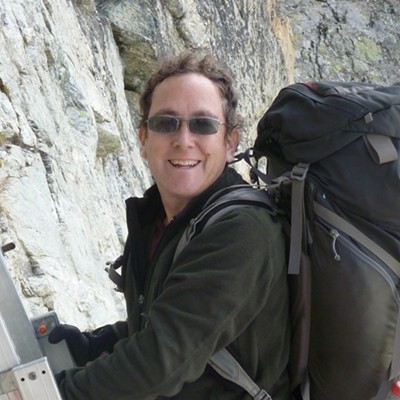

At 43, with an ex-wife and two kids, he told the government in his bankruptcy filing that he had $20 in his pocket and $15 in the bank. He was hundreds of thousands of dollars in debt.
Maynard, a Valley native and former Marine, had seen some success in the late 1990s as the founder of Internet America, an early Internet service provider. He had owned a nice home in Ahwatukee with expensive cars in the driveway. He had bragged he would retire at age 35. Those days were gone.
Still, Maynard was optimistic. He'd been through this before. He's the type who jumps back up after a fall — one of those edgy entrepreneurs who always seem to be on the verge of great success or great failure.
His first personal bankruptcy was in 1990, and he had filed again in 1994 for one of his failed companies.
But even as his finances sunk to new depths, his next big business venture was taking off. Drawing on his experience in credit repair and with the Internet, Maynard dreamed up a service that would protect people against the dreaded crime of identity theft.
Lifelock, as his new company would come to be called, began offering services to the public the same month in 2005 that Maynard filed still another bankruptcy.
LifeLock's primary service is nothing you can't do yourself. If you think someone has stolen your identity, you can call one of the three major credit bureaus, TransUnion, Experian or Equifax, and place an electronic red flag, called a fraud alert, on your account.
Here's how it works: The credit bureaus make money by selling information about you that helps lenders determine whether you're going to cheat them out of money if they give you a loan. Now, imagine a scraggly meth head trying to open a line of credit in your name at Circuit City to buy an HDTV because he stole your boss' laptop, which had all your personal data in it. When Circuit City calls one of the credit bureaus to check you out, there's a fraud alert on your account. Circuit City is supposed to use the contact information on the credit bureau's account to notify the account holder of the impending purchase. If everything goes according to plan, the meth head goes home empty-handed.
The catch: Every 90 days the credit bureau erases fraud alerts on the account. That's because fraud alerts are a headache to lenders like Circuit City — commerce would move like molasses if every account was red-flagged.
Customers pay LifeLock $10 a month to call a credit bureau every three months and put a fraud alert on an account. By law, if one bureau is notified, it must alert the other two. LifeLock also offers insurance. If a customer becomes a victim despite the service, LifeLock says it will pay losses (if the claim holds up to scrutiny) of up to $1 million. The company says that has happened only three times, and the costs were far less than the million-dollar limit.
LifeLock was an immediate hit. The news media scrambled to meet Maynard and his business partner, Todd Davis, pimping them like crime-fighting superheroes.
Maynard claimed he got the idea for LifeLock after spending a week in jail in 2003. The pair have told his story ever since as a frightening example of what can happen to victims of identity theft. The details vary slightly in articles and television news reports, but the story goes something like this:
A few years ago, Maynard answered a knock on his door in Phoenix one morning to find five deputies holding a warrant for his arrest. They accused him of failing to pay back a $16,000 casino loan to the Mirage in Las Vegas and, despite his protests, hauled him off to the Maricopa County Jail. Maynard had not even been in Vegas when the casino made its loan. One of the guys who stole Maynard's identity and the casino's money is now doing time for murder. Maynard was released after seven days, but he spent more than $20,000 and countless hours on the telephone trying to clear his name. While sitting in his jail cell, he came up with the plan for LifeLock so other people could avoid being victimized by identity thieves.
It's a story that stokes the public's worst fears of identity theft, a crime that induces a state of near-paranoia in many of us. Though not a crime of violence, victims are left feeling violated, even when financial losses are small. Nationwide, the problem is immense, costing at least $50 billion a year and forcing consumers, businesses, and governments to become more savvy in trying to prevent it.
Horror stories like Maynard's are staples in almost any discussion about identity theft. Clearly, such stories may influence people to take counter-measures — signing up with LifeLock, for instance. No wonder that Maynard and Davis, LifeLock's chief operating officer, seem to relish repeating how Maynard became a victim.
Maynard's life was soon looking up again — big time.
Today, he's one of the heads of a multimillion-dollar company based in Tempe that employs dozens of people. The company claims to have more than 150,000 customers, which is a lot of people paying $10 a month. Last month, a trio of investors, including the local Biltmore Ventures group, gave LifeLock an additional $6 million in seed funding. LifeLock advertises heavily on the Internet and radio; its ads can be heard on the Howard Stern, Paul Harvey and Rush Limbaugh shows.
Against a backdrop of unrelenting hype over identity theft, credulous news reporters gulped Maynard's story down like cold beer. But a simple Google search reveals Maynard's credibility in the business community was long ago shot.
His credit-repair company was shut down by authorities in the early 1990s for false advertising and deceptive practices. Forced closure means that a federal court order has banned Maynard from working in the credit-repair industry — forever.
That he continues to work in the industry, despite the court order, should surprise no one who knows his history. It also shouldn't surprise anybody that Maynard's story about how he became a victim is only partially true.
Maynard did, in fact, spend a week in jail in 2003 because of an unpaid $16,000 casino marker drawn from the Mirage.
It was Maynard's marker. The casino took a copy of his Arizona driver's license when he took out the loan.
There was no identity theft.
But an even more serious reflection on Maynard in his new role as Mr. Identity Theft can be found alongside the paper trail of lawsuits against him in Maricopa County Superior Court.
American Express sued Maynard's father in 2005 for $154,000 in unpaid bills. But Dr. Robert J. Maynard Sr., a prominent local eye doctor, denied he ordered the card.
Records show that someone with Maynard Sr.'s personal information ordered the card. But that someone didn't have the bills sent to Maynard Sr.'s home. Instead, the bills went to a company called Netshield, at a Phoenix address used by one of Maynard Jr.'s former firms.
Though Maynard Sr. says he never asked for the card, he settled with the company. Coincidentally, Maynard Jr. has $170,000 in debt to American Express listed on his 2005 bankruptcy paperwork — and his father is named as a co-debtor.
If Maynard Jr. ordered the card using his dad's data, without his dad's knowledge, that would make him — you got it — an identity thief.
Of course, his father could have lied to American Express. Perhaps, Dr. Maynard ordered the card for his son.
But that's not what Dr. Maynard tells New Times.
The elder Maynard says he's still in litigation on the matter and cannot fully comment. But asked whether Maynard Jr. used his dad's identity to obtain the card, Dr. Maynard, who says he hasn't spoken to his son in more than two years, replies, "I can't disagree with that."
Security at LifeLock, which shares suites in an office building at Rural and Guadalupe roads, rivals that of the FBI building in downtown Phoenix.
Visitors are asked to leave their driver's licenses at the front desk during their stay. Employees press an electronic fingerprint reader to gain access beyond the reception desk into a hallway with lockers. The personal effects of workers must be put into the lockers before they pass into the main offices, and workers mustn't take anything in or out of those offices.
Mike Prusinski, the company's bald and beefy spokesman, explains that LifeLock is proud to be the smallest company in the world with ISO 27001 certification, the highest security rating possible for a business involved in data exchange.
Such high-level security must be a reassurance for customers, who must release to LifeLock exactly the kind of personal data that would make them prone to identity theft. To deal with the credit bureaus on behalf of customers, LifeLock must become a legal representative of these customers.
Trust, then, is one of LifeLock's key selling points.
Past the lockers is a secure room with glass walls next to a larger, open office space. Inside the room, which requires a magnetic card swipe to enter, about 10 employees sit in front of computers talking into headsets. They're taking inbound calls from people signing up with LifeLock, people who are giving out Social Security numbers and driver's license numbers and bank-card numbers, so that the company can debit $10 a month from their checking accounts or credit cards. On the wall hangs a large, flat-panel computer screen with a map of the United States that shows where the calls are coming from.
LifeLock's business and administrative folks work in the less-secure part of the suite. Smaller enclosed offices for the company's executives line the wall at one end.
Prusinski had set up a meeting for New Times with Robert Maynard and LifeLock CEO Todd Davis. But a few days before the interview, Prusinski had called to say Maynard was too busy to make it. Maynard was going on a business trip, meeting with shock jock Howard Stern to discuss radio advertising options. And after that he was, well, "really busy." Told that New Times had questions about Maynard's 2003 arrest, Prusinski says Maynard has been "touchy" lately about discussing the details.
When a reporter and photographer arrive at LifeLock midmorning on the appointed date, Maynard's long office, with a fiery abstract painting at one end, looks as if it was vacated only minutes earlier. A laptop, next to his desktop computer, is open; half-empty cups of coffee and water sit next to paperwork.
Davis, about 40 with blondish, short hair, invites the reporter and photographer into his office, which is adjacent to Maynard's but is smaller.
As he explains LifeLock's services, it becomes clear that if trust is one of the company's key concepts, another is fear.
Davis is a wealth of scary statistics: Americans are 25 times more likely to be victims of identity theft than vehicle theft. Data breeches at U.S. companies spurred 150 million warning letters to Americans since 2005.
And then there's Maynard's story.
"They don't know how his identification was stolen," Davis says. "But it was stolen, and he went to, uh, the thief went to Las Vegas and opened lines of credit."
The cops put Maynard in handcuffs in front of his family and took him to jail in Phoenix. Authorities in Clark County, Nevada, tried to have him extradited. Davis integrates selling points into the tale.
"If he'd had the fraud alerts in place, it would have stopped the transaction before it happened, so he wouldn't have had to go to jail," Davis says.
Davis acknowledges that casinos keep a copy of the ID of any person who takes out a loan as large as $16,000. But he says Maynard would have had to spend weeks in jail before authorities allowed him to prove he was innocent with a simple comparison of photos.
Davis again switches to sales mode: "We would have gone to the casino and said, 'Let's see the tape. That's clearly not our client.' Our client would not have stayed in jail. He would have been exonerated quickly."
As it was, Maynard figured the best thing to do was just pay the casino its money, Davis says.
"That was the quickest way to get out from under the problem, 'cause he's in jail," Davis says. "He had to make a financial decision: 'Do I dig my heels in on moral grounds, or do I make this go away?'"
It's as if Davis is describing the actions of a man to whom money means nothing.
Yet in 2003, Maynard already was up to his eyeballs in debt. Questioned pointedly on this issue, Davis appears nervous. His foot starts bouncing under his desk. He insists that he believes Maynard's yarn is perfectly accurate.
Asked why Maynard would have to forfeit the $16,000 if he could prove he didn't take out the loan, Davis says Maynard eventually did get his money back.
But that contradicts part of the story Davis has told many times — that the experience "cost" Maynard $20,000, a figure he says included the $16,000.
Davis flip-flops later in the conversation, saying he was "under the impression" that Maynard never recovered the money.
Before the interview, New Times had made a call to Bernie Zadrowski, chief deputy district attorney in Clark County, Nevada, and supervisor of the office's bad check division.
Maynard's case was actually very simple, Zadrowski says.
A casino marker is the same thing as a personal check under Nevada law. It's a way gamblers avoid the risk of carrying around big wads of cash. A high-roller submits a form for the marker with his or her checking account number and obtains a stack of chips. The casino then has the right to deposit the marker at any time but usually waits a few months. That way, Zadrowski says, if the gambler's losses are high, the casino gives the gambler time to pay the money back. And everyone is happy.
If the check bounces, the casino makes a number of collection attempts, and if that doesn't work, the case is referred to authorities.
Records show that on January 15, 2003, Zadrowski's office contacted the Arizona Department of Public Safety and put a warrant out for Maynard's arrest. Six months later, on June 20, officers from DPS and Phoenix police went to a Phoenix apartment, picked Maynard up and took him to a Maricopa County Jail unit.
It was Maynard's second time behind bars. DPS records show he was stopped for speeding on Arizona Highway 68 near Bullhead City in 1991 and taken to jail in Mohave County because of an unpaid speeding ticket.
Faced with untold numbers of gamblers who fail to pay their markers, the Clark County D.A.'s office long ago created a diversion program that gives deadbeats a second chance to pay up rather than face criminal charges. Once Maynard finally coughed up the 16 grand, Nevada dropped its criminal case against him.
Because Las Vegas is one of the identity-theft capitals of the world — right up there with the Phoenix metro area — Clark County provides a "forgery packet" to anyone claiming to be a victim. A claim like Maynard's would have been investigated thoroughly, Zadrowski maintains.
"Not once did anybody ever suggest, in this particular case, that this was a case of stolen identity," he says.
Maynard never filed a police report for identity theft, or it would be part of the D.A.'s office file, Zadrowski says.
"The only call we received while he was in jail was from his girlfriend. She wanted to know how to get him out of jail," he says.
Zadrowski pulled the Arizona driver's license submitted to the casino by the person who took out the loan and e-mailed a copy to New Times.
Although the resolution quality is poor, the man in the picture looks like Maynard. Zadrowski says the man pictured is Maynard.
Maynard's girlfriend at the time, Valley resident Betsey Griffin, is listed on Maynard's 2005 bankruptcy report as being owed $10,000. Reached by phone, she says she had nothing to do with getting Maynard out of jail and did not pay the $16,000 for him.
"Because he owed me money, I wasn't going to give him any money to get him out of jail," she says. "So it didn't come from me." (Maynard later paid back the $10,000 with interest, she says.)
Confronted with Zadrowski's side of the story, Todd Davis registers no obvious surprise.
"Is that what you think you have?" he says. "Okay, I hear what you're telling me."
Davis then goes into defense mode, saying that although the story is, indeed, the inspiration for the company, "we don't use that story. That's nowhere on our Web site. That's not part of our messaging. We don't use it in any of our, quote, advertising."
He says that he, Maynard and Prusinski — who's also on record telling the tale — simply respond to reporters' questions about how the company got started.
As of May, LifeLock still had at least one link on its Web site that introduces Maynard's victim story — a WCPO-TV news broadcast from Cincinnati. (The station took the video down, but still has a transcript on one of its sites.)
Call it advertising or public relations, Maynard's tale certainly has made the rounds. Another TV station in Baltimore reported it as fact. Internet sites like www.eweek.com and www.scambusters.com also fell for it.
Newspapers in the Valley were no different.
In a 2005 Business Journal of Phoenix article by Adam Kress, Maynard spiced up his story by adding that police officers assumed he was a murderer they had been seeking. An East Valley Tribune business article by Edward Gately says Maynard claimed to have been victimized in 1998, as does an Arizona Business Gazette article by Maggie Galehouse. A quick call to either the Maricopa County Sheriff's Office or Clark County D.A.'s office would have turned up evidence of the actual arrest date.
The amount Maynard lost dropped from $20,000 to $3,000 in an Arizona Republic article last summer by Luci Scott. That discrepancy could have been caught by looking up previously published articles.
Other stories, which don't include the jail yarn, appeared in various editions of the Republic in August and December 2006, and in May 2007.
Newspapers all over the country have written about LifeLock, and the company has a decent Web presence. Punching the name in Google returns 202,000 results, partly because the company pays bloggers who help sell its services.
Maynard himself writes craftily about his jail stint in articles posted on www.military.com, including one headlined "I was a Jailbird or 'Sitting Duck.'"
Say what you will about LifeLock, all this is evidence that its execs are masterful at getting publicity.
Robert J. Maynard Jr. is one of the smartest people his father has ever known.
Dr. Maynard, one of six members of the state's board of optometry, says his son possesses an extraordinary ability to predict the growth of future markets and to convince people that they should give him money.
Maynard Jr. was born in Phoenix in 1962 and went to Arizona State University for a time after graduating from Brophy College Preparatory. He joined the U.S. Marine Corps and was honorably discharged.
His father says Maynard Jr. eventually graduated from Northern Arizona University, burning with desire for the good life.
"It started when he was in college," Dr. Maynard says. "He didn't want the $20 pair of shoes. He wanted the $300 pair of shoes."
Three years after his first Chapter 7 bankruptcy in 1990, Maynard's dream of getting rich was coming true. His credit-repair company, the National Credit Foundation, was raking in millions. But a few months after it started, state and federal authorities crashed the party.
New laws had been passed to deal with unscrupulous credit-repair firms that, at the time, seemed to be cropping up everywhere. Retired Tucson attorney John Wall, who handled the National Credit Foundation case on behalf of then-state Attorney General Grant Woods, says Maynard's firm was one of several the state targeted.
Court records show the state sued the firm, accusing Maynard and his three partners of fraud and misrepresentation. For one thing, the company falsely claimed it was a "foundation," a label that implied nonprofit status. It stated in advertising it could "help anyone legally obtain good credit," but it couldn't really do that. And it claimed, falsely, that it was operating legally.
State law required companies like Maynard's to pay the state a bond amount of $5,000 to $25,000, to notify customers of their right to cancel services, and to provide customers with written contracts and informational statements. National Credit Foundation failed to do those things, the state said.
At the time, Maynard denied any wrongdoing, saying his business had no customer complaints and was, indeed, legal. He accused Woods of trumping up the charges and trying to destroy all "credit restorative service" firms like his.
A judge soon forced the company to stop doing business and turn over customer records to investigators.
Wall says he remembers running into Maynard around that time in the checkout line at a Costco store. Maynard was friendly, despite the ongoing litigation, and introduced his wife and baby. But the veteran prosecutor views Maynard's niceness with cynicism.
"Oftentimes, people are selling even when under investigation," he says.
The FTC launched a parallel lawsuit, going after Maynard and his partners for producing and airing a misleading infomercial about the firm's services. That wasn't the worst of it.
Federal court records state that Maynard and the other defendants obtained their customers' banking information and, "in numerous instances . . . withdrew funds from consumers' checking accounts without authorization."
Gilbert resident Vincent Calabrese, listed as one of the firm's creditors because of owed back pay, says he worked for National Credit Foundation for about a year and was there at the end. He says he'll never forget how the "phone was just going nuts" in the last few weeks with customers reporting unauthorized debits on their bank accounts, usually for about $300 a whack.
"I don't know what happened. People were getting hit; their accounts were getting hit," he says. "I thought the information got out on these people on these accounts, and somebody used it."
He didn't suspect the company itself, he says.
"I was on three-way conversations with the bank and the people," Calabrese says. "These people were crying, practically, on the phone."
He also recalls that, sometime in the company's last few days of existence, a news reporter from a television network came in to interview Maynard for a story about the problems.
In a 1998 magazine article, Maynard blamed the National Credit Foundation debacle on the company that produced the infomercial, saying it tried to take over his business. As revenge, Maynard "killed his business" so the other company could not usurp it. The article states Maynard "strapped on a pistol and told his 300 employees to get out. Then he closed the office, declared Chapter 7 and sold everything."
The story could not be verified, because Maynard has refused to be interviewed by New Times.
Again, Maynard denied wrongdoing. But the federal government was so ticked off, it issued a permanent injunction that bans Maynard from "advertising, promoting, offering for sale, selling, performing, or distributing any product or service relating to credit improvement services."
Yet such a service is offered by LifeLock, where founder Maynard works as the chief marketing officer. (He was formerly the chief operating officer).
LifeLock helps customers who fall victim to identity theft repair damaged credit histories. So, the question is: Does Maynard's position at LifeLock violate the court order?
When his partner, Davis, is asked about this, he says the company outsources its credit-repair service. Besides, he says, the company has a written opinion from its attorney that Maynard is legally allowed to work for LifeLock.
After National Credit Foundation's fall, Maynard moved to Dallas and started Internet America. By early 1996, that firm was backed by investors and had 25,000 customers, according to an article that year in the Fort Worth Star-Telegram.
The newspaper article describes Maynard as a financial whiz kid who adheres to the utmost standards of professionalism.
"That's how we go out and get a $250,000 line of credit somewhere," Maynard was quoted as saying.
Two years later, a Dallas Business Journal article reported that Maynard resigned from Internet America after finally settling with the FTC in the credit-repair case.
Maynard came back to Phoenix in 1999 and invested hundreds of thousands of dollars in a new company he founded, Dotsafe, which offered Internet-filtering services for schools.
Around the same time, someone ordered an American Express card in Maynard Sr.'s name and had the bills sent to a company called Netshield at 8181 South 48th Street, Suite 120, in Phoenix. That was Dotsafe's address.
Court and bankruptcy records suggest that Maynard Jr. obtained the card without his father's consent.
Dr. Maynard, while not giving up all the details because of the open case with American Express, says the "premise" that his son fraudulently ordered the card is accurate.
He adds that he has advice for any new parent: Don't name your kid after yourself.
Even as Dotsafe imploded, Maynard Jr. borrowed heavily and "his living style never went down," his father says.
At one point, Maynard Jr. owed more than $1 million in unpaid taxes to the Internal Revenue Service. Court records reveal lawsuits from a slew of creditors related to Dotsafe. His 2005 personal Chapter 7 bankruptcy lists debts to friends, business partners, credit card companies, the Phoenix Library — even $24,000 to his children's private school, Summit School of Ahwatukee.
Yet, these days, Maynard is back in black — or close, anyway.
LifeLock's expanding and even became a finalist for this year's national Stevie Awards for best new company and best new product or service. Davis is a finalist for best executive.
Dr. Maynard, who acknowledges that his relationship with his son isn't "normal," says he is pessimistic about his son's future — regardless of his current success.
"I don't think Robert will ever not have the ups and downs," Maynard Sr. says. "Mostly, veracity is a problem."
One thing Maynard Sr. finds "mind-boggling" is why his son has repeated the bogus victim story so often because it was bound to be exposed, and LifeLock might have been just fine without it.
"Nobody has any idea [why he did that]," Maynard Sr. says, adding that a real identity-theft victim could have been found to promote the company. "I think Robert has told the story enough that he thinks it's true."
Journalists and other members of the public probably shouldn't be judged too harshly for believing Maynard's tale. There is no doubt that identity theft has left some victims ravaged, and legitimate horror stories are presented often by credible sources.
Andrea Esquer of the Arizona Attorney General's Office recalls going to a meeting recently with Phoenix College staff who had been victimized by a dumpster-diving mail thief.
"There were at least four or five victims in the audience who are still trying to clear their name from the mess this guy made," Esquer says. "They were devastated. They were very angry."
On the other hand, identity theft shouldn't be cause for hysteria. Yes, the crime can be horrendous, and we all need to be aware of it. But for most victims, it's really not that bad.
Much of the hype stems from confusion over government definitions of identity theft. For instance, two-thirds of the $50 billion in losses nationally comes from credit card misuse: Someone steals your credit card or credit card number and makes charges without your knowledge.
That crime used to be called fraud — now it's in the identity-theft category. Like shoplifting, the crime is bad for business and bad for the economy. But it's a breeze for consumers: The law forbids credit card companies from making clients pay more than $50 in false charges. Even that $50 often gets waived, typically, in the interest of good customer service.
More insidious forms of identity theft, like opening new credit accounts in a consumer's name — the type of theft LifeLock's periodic fraud alerts purport to prevent — are less common.
Statistics show that many victims don't act particularly concerned.
The Federal Trade Commission's 2006 data shows that of about 250,000 identity theft complaints to the FTC, more than half of victims never contacted a credit bureau to place a fraud alert. About 62 percent never contacted police.
A survey of 5,000 American homes in October by Javelin Research and Strategy showed new-account fraud seems to be declining: One percent of respondents to the survey reported being victims, down from 1.5 percent in 2005. Identity theft cost victims less money and took less time to resolve last year, too.
Overall, 3.7 percent of Americans were victimized in 2006, down from 4.7 percent in 2003, the survey concluded.
That still would mean millions of victims.
But Fred Cate, an Indiana University professor and authority on banking security issues, says a lot of these survey numbers are "crap."
"So, we call these people at home, have these murky definitions, then we multiply that out," Cate tells New Times. "I don't mean to sound too skeptical, but we know Visa has testified before Congress, and more than half the calls they get about false charges, they weren't false charges."
Cate, who has testified before Congress, says that although identity theft isn't such a big problem in the greater scheme of things, he doesn't want to "diminish the horror" victims may feel. He believes innocent people have gone to jail because of the crime — he says he's talked with some of them. But it's not exactly a widespread phenomenon.
Fearing the worst motivates people to buy identity-theft insurance and credit-monitoring services, which have become big business. Plenty of companies offer services similar to LifeLock's, including the three credit bureaus.
"The unique and troubling aspect of identity theft is that it's not like other crimes, where the crime happens and it's over," says Ron Griffin, public education manager for Experian, one of the credit bureaus. "The nature of ID theft is that it recurs."
Credit bureaus are usually the "messenger that somebody is at it again," Griffin says.
Once an identity thief screws up your credit, the process can be "cumbersome" to unwind, Griffin admits. Victims must present valid police or state identity theft reports, and provide identifying information, he says.
Arizonans are extra vulnerable. The FTC says the state was No. 1 for the crime last year, though Valley residents are less likely to become victims, on a per capita basis, than people in smaller towns like Flagstaff and Prescott.
Responding to worried constituents, Republican and Democratic lawmakers in Arizona worked on a bill this year that would allow people to freeze their credit reports, making it close to impossible for thieves to open new accounts.
State Representative Bob Robson, a Republican from Chandler, says the bill failed partly because the fee of $45 to freeze the reports at all three credit bureaus was too high. Customers could unfreeze the reports in as little as 15 minutes to take advantage of a good credit offer, but they'd have to pay for a refreeze. The bill will be back next year with a better price tag, he predicts.
According to an article in the Washington Post last month, 33 states already have similar credit-freezing programs. Robson points out, though, that only about 50,000 people nationwide have taken advantage of that option.
"I heard it might be for people who don't use credit a lot," Robson says.
Amanda Aguirre, a Democratic state Senator from Yuma who helped sponsor Arizona's credit freeze bill, has her own tale of woe, though nothing so dramatic as Robert Maynard's. The Regional Center for Border Health Inc., a walk-in health clinic in San Luis, was struck last year by an identity thief.
"Somebody used the routing number of the nonprofit agency, went on the Internet and paid all kinds of bills," says Aguirre, the agency's president and CEO.
It's not a good example for her bill — a credit freeze wouldn't have prevented the crime. And like most identity-theft victims, the agency paid no out-of-pocket expenses. The bank reimbursed the agency the $6,000 that was stolen, and her staff spent about five hours doing paperwork and making phone calls to fix the damage.
LifeLock CEO Todd Davis says no one ever questioned Maynard's victim tale until New Times called.
Any public revelation that Maynard's story wasn't true would be a "massive downside" for LifeLock, he says, and he wouldn't have repeated the story if he knew it was false.
"If I thought there was something, why would I go jeopardize everything else we're doing when I have very effective messaging that works without [Maynard's jail story]," he says. "It would give me grave concern if there was an issue with that story."
Despite that, Davis refuses to call Maynard at the time of the interview to ask him about the situation. He says he'll "look into it" and the company will issue an official response.
That was on May 10. New Times is still waiting.
On May 21, Maynard told a Today show producer his victim story. And on May 17, Davis repeated the story to members of the Enterprise Network business association during a speech about the company at the Lakeview Inn at Camelback Golf Club in Phoenix.
The Clark County D.A.'s representative, Zadrowski, says nobody from LifeLock has called him about Maynard.
So much for Davis' "grave concern." Clearly, the company considers the bogus victim story too precious to throw out.
Zadrowski grew indignant when he was e-mailed newspaper articles in which Maynard tells the tall tale. If it were based in Nevada, LifeLock would be subjecting itself to potential criminal liability for obtaining money or services under false pretenses, he says. But a prosecution would depend on the unique facts of the case.
Ken Abbe, a staff attorney for the FTC, says speaking to the media is usually covered by the First Amendment to the U.S. Constitution, but a case for false advertising could potentially be made.
"The question is: Is that the story that makes consumers act on their decision?" Abbe says, making it clear he cannot comment on whether LifeLock is breaking the law.
It cannot be predicted what will happen to LifeLock if customers lose trust in it.
The company offers a legitimate service, and no LifeLock subscribers have complained of being misled, Davis says.
"We're squeaky clean," he brags.
Then again, until now, LifeLock customers haven't had a reason to doubt the word of Davis and Maynard.
Calls to venture capitalists Kleiner Perkins Caufield & Byers, Bessemer Venture Partners and Biltmore Ventures — the groups that, in April, kicked $6 million in funding to LifeLock — were not returned.
In another sign of the company's growth, LifeLock was set to transform its office at Rural and Guadalupe into the main call center and move its headquarters to two floors at the Hayden Ferry Lakeview building next to Town Lake in Tempe.
When New Times finally reached Maynard on his cell phone in mid-May, he hung up. New Times called him again and asked him point blank whether he had stolen his father's identity to take out the American Express card. He didn't deny it but said, "You better be real careful."
He was also asked to explain the facts behind the jail story. Before hanging up again, he blurted, "You're going to say what you're going to say. You're going to assassinate my character."
Nobody could do that better than Robert J. Maynard Jr. already has.