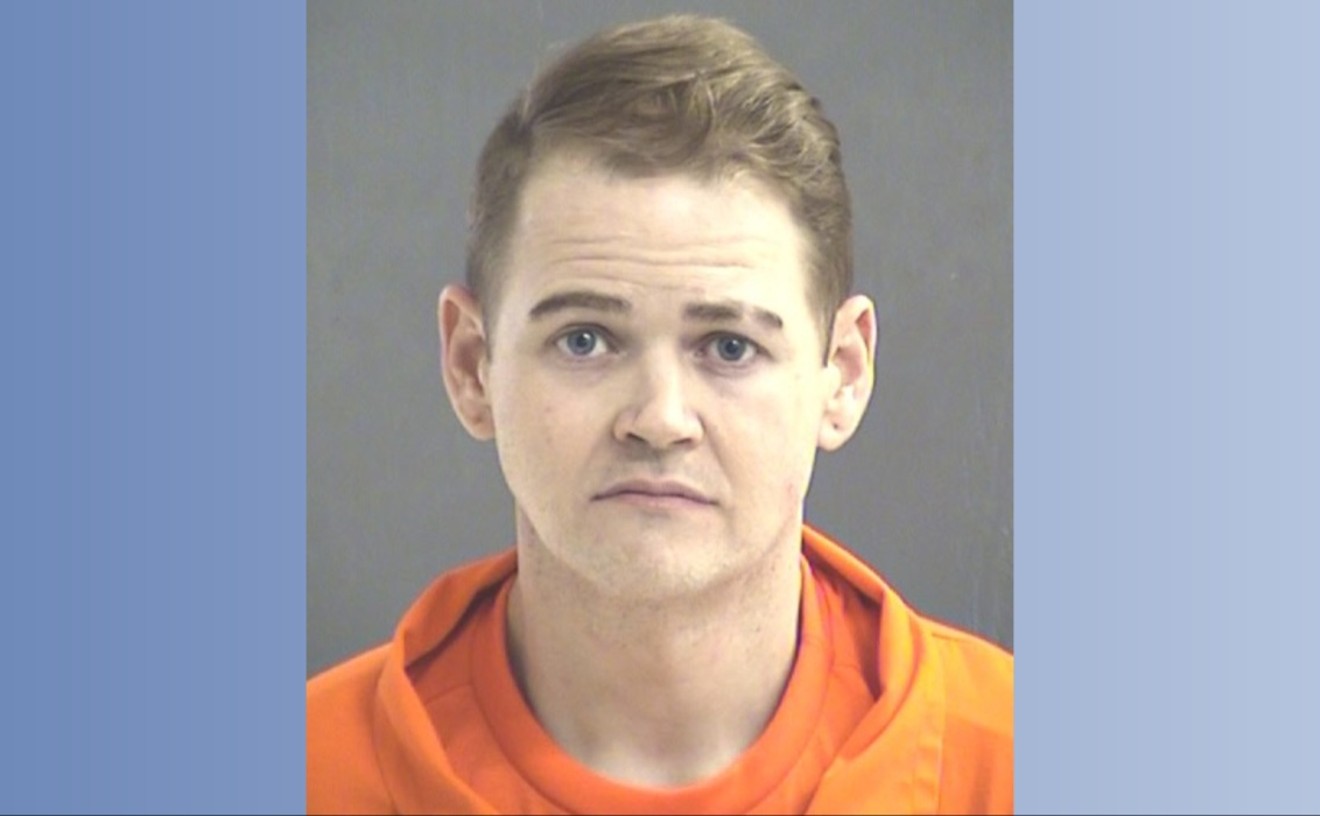

Former Phoenix Suns nutritionist and vitamin-supplement entrepreneur Grant was accused of committing the ultimate crime: the first-degree murder of his wife, Faylene, at their Gilbert home as three of their young children were in another part of the house.
The case had sex, drugs, and, if not rock 'n' roll, then the Mormon Tabernacle Choir. All the case's main players were born into the Church of Jesus Christ of Latter-day Saints, and the church's tenets about marital fidelity, suicide, and spiritual revelation were central to the bizarre events that landed the 43-year-old in criminal court.
Faylene died hours after slipping underwater in a bathtub adjacent to the couple's master bedroom. The 35-year-old had ingested a large, but not fatal, dose of the sleep aide Ambien.
The hardwood pews inside Maricopa County Superior Court Judge Meg Mahoney's 13th-floor courtroom in downtown Phoenix had been at a premium for more than three months, filled with family members of the defendant and his late wife, the media, and the curious.
But the sole spectators on this late-February morning when Grant's legal fate would be sealed were a New Times writer and a producer from ABC's 20/20 — one of three national TV networks on the scene. (New Times published two stories and numerous blog items on the Grant case before the trial started, available at www.phoenixnewtimes.com.)
The 13-person jury, which included one alternate, had the day off.
The prosecution and defense were there to haggle over legal instructions that Judge Mahoney would be giving to jurors before they began deliberations about a week later.
Defense lawyers often ask judges to allow jurors in first-degree murder cases to consider less-serious murder counts, specifically second-degree murder, manslaughter, or negligent homicide. But Doug Grant's veteran lawyer, Mel McDonald, didn't want this jury to weigh anything other than the sitting charge of first-degree murder.
Before trial testimony began last November, McDonald and Deputy County Attorney Juan Martinez agreed it would be an all-or-nothing affair: The jury would find Doug Grant guilty of premeditated first-degree murder or he would walk out of court a free man.
Martinez sought through the trial to nudge jurors toward an inescapable conclusion that this was a premeditated murder, though the official theory as to why Doug Grant had done it evolved over time.
Police first followed the money, primarily a $300,000 insurance policy on Fay's life that Grant later collected.
But that did not resonate with the prosecutor as much as his "other woman" theory. Martinez was claiming Grant murdered Faylene to allow for his immediate reunification with sexy, young Hilary, whom he married just three weeks later.
Mel McDonald remained confident there was no way 12 jurors could agree that Faylene was even a murder victim, much less that his client had committed the crime beyond a reasonable doubt.
But McDonald knew that Grant's potential exposure to a guilty verdict was likely to be far greater if the word "reckless" — a key component of Arizona's manslaughter statute — slipped into the legal mix. Premeditation, which is at the heart of first-degree murder, is not an element of manslaughter.
McDonald feared jurors would consider reckless his client's decision to call a physician's assistant instead of 911 after he'd found his all-but-dead wife in the tub, especially if they wanted to convict him of something.
And no question, Grant had been morally reckless in another arena that definitely didn't help his cause.
His sexual scores with women had ruined marriages to his first wife and Faylene. His seven-year marriage to Fay, which produced two sons, ended acrimoniously in 2000. Then in July 27, 2001, the couple suddenly and surprisingly remarried in Las Vegas, exactly two months before Fay mysteriously died.
New Times wrote in its first story on the Grant case, "If the sex-fiend theory sounds flimsy, think again: Defendants, guilty or innocent, can be convicted simply because jurors don't like them."
That's what Mel McDonald was most concerned about, that the jurors would punish his client by convicting him of a lesser charge because of his historically bad character, even if they couldn't unanimously find him guilty of premeditated murder.
Since the start of the trial, Juan Martinez had tried to do everything but tattoo the words "cold-blooded killer" on Doug Grant's balding head. It seemed inconceivable that the tough-talking prosecutor would seek anything less than the maximum.
But Martinez had much better evidence that Grant was a first-degree cad than a first-degree murderer.
Martinez had been performing legal sleights of hand for months to divert jurors from focusing on weaknesses in his case, which included a slipshod investigation by Gilbert police, lack of physical evidence against the defendant, and the fact that Faylene Grant long had predicted her own premature death in diary entries and so-called "farewell" letters to friends and family.
Faylene claimed God had "spoken" to her of her impending demise, though she never did reveal to anyone how she believed it would happen. Her obsession about going to the Celestial Kingdom (the Mormon version of Heaven) sooner rather than later revealed itself both when she and Doug were divorced and not talking and after they remarried.
Faylene never wrote in her journals and apparently never told anyone about fearing that Doug would hurt her physically.
No one who sat through the Doug Grant trial could predict its outcome.
Even whether it was a murder case was up for grabs.
In early 2002, then-assistant County Medical Examiner Arch Mosley ruled Faylene Grant's manner of death "undetermined," instead of a homicide, suicide, or accident.
"I have no evidence to support this being a homicide," Dr. Mosley testified to the visible chagrin of prosecutor Martinez.
Though the case against Doug Grant seemed anything but ironclad, he was on trial because a series of factors — many of them his own doing — had landed him there.
Two catastrophic events within 72 hours of each other — Faylene's potentially fatal fall off a cliff in Utah during the couple's second honeymoon, followed by her Ambien overdose and drowning — had occurred with her husband nearby. According to the couple's accounts afterward, Fay miraculously survived the 60-plus-foot fall at Timpanogos Cave National Monument only because a large tree slowed and cushioned her on the way down. Remarkably, she suffered only minor injuries.
Doug married his ex-girlfriend, Hilary Dewitt, within a month of Faylene's death, which infuriated and raised deep suspicions inside the dead woman's family, and propelled some of them into an investigative mode.
Most damning against Doug Grant was his seeming failure to call 911 after finding his wife submerged in their bathtub shortly after dawn on September 27, 2001. (Grant later told police and others that he had called 911, but computer records and other evidence, though inconclusive in some regards, failed to corroborate his account.) Instead, he twice phoned Chad White, a physician's assistant who had gone to the Grants' home the previous evening to examine Faylene's injuries.
White prescribed the sleeping pills and other drugs before he left the residence. Grant immediately filled the scrips at a pharmacy and then returned home for the evening. White dialed 911 the following morning after hearing from Grant, an acquaintance.
He told the emergency operator, "I told [Grant] to call 911, and he said, 'I'm afraid to. I'm afraid to.' I don't know why he said that."
Juan Martinez knew that, while perhaps suggestive of Grant's consciousness of guilt (morally or criminally), the lack of a 911 call might not be enough to prove first-degree murder. So now, in the waning moments of trial, he asked Judge Mahoney to add the less-serious homicide charges to the jury instructions.
Beyond "reckless," a prosecutor trying to win a manslaughter conviction must prove that a defendant "was aware of and showed a conscious disregard of a substantial and unjustifiable risk of death. The risk must be such that disregarding it is a gross deviation from the standard of conduct that a reasonable person would observe in the situation."
The phrase "reasonable person" can spell trouble for the defense: Most jurors see themselves as reasonable, and a defendant — especially one who couldn't prove he called 911 to get help for his desperately injured wife — easily could seem grossly unreasonable.
Another section of the manslaughter law says a defendant is guilty if he helps someone commit suicide.
Juan Martinez told Judge Mahoney that he still considered Grant guilty of premeditated murder but feared appellate reversal if he didn't ask for the lesser charges and the jury returned a first-degree conviction. Yet his unexpected handwringing seemed more an admission that proving premeditation to 12 jurors would be too much for him to achieve, given the circumstances.
The prosecutor now speculated that Faylene indeed may have been seriously depressed before she died (which is what Mel McDonald had been suggesting for the whole trial), and that her husband could have "recklessly" abetted her death.
"He's . . . indifferent to that depression, indifferent to her wants of committing suicide," Martinez said. "He didn't care about her, bottom line."
Not caring may not rise to the level of causing someone's death, recklessly or intentionally, but no matter to the prosecutor. His task was to sell the jury that the defendant was a manipulative Lothario with a heart of stone and a teenager's need for instant gratification.
Mel McDonald tried to convince the judge that his client was guilty of either first-degree murder or nothing.
"Every facet of this case reeks of first-degree murder," he told Mahoney, sounding in this role reversal like a prosecutor. "It's either all or nothing. To put her in the tub, [given that] she's so disabled, is not an accident. It's as premeditated as you can possibly go . . . To confuse this jury and try to come in with some spin, there's no evidence to support it."
The defense attorney and his client looked hangdog after the hearing.
Within a few days, Judge Mahoney issued her ruling on the all-important jury instructions: For legal reasons, she wouldn't allow the jurors to consider the "assisted suicide" part of the manslaughter statute. But she said she would allow them to deliberate first- and second-degree murder, as well as manslaughter.
"I feel like I'm trapped," Doug Grant told New Times soon after he got word. "I'm really scared they're going to convict me of manslaughter, even though I never would have hurt Faylene."
Grant said he wanted the jury "to hear from me and maybe see I'm not this bad person that they probably think I am. I know what happened with Fay and what I did and didn't do. But I won't get to tell my story in there. It's Juan's courtroom, and the judge is going to let him run it."
Doug Grant was right to be scared about the manslaughter instruction.
After nearly three grueling weeks of deliberation, his jury returned its verdict on March 24.
Grant looked wan and shrunken in a glen plaid suit as he walked into court with his wife of seven-plus years, Hilary. Several members of his family were in attendance as a show of support. An equal number of Faylene Eaves Grant's family awaited anxiously on the other side of the courtroom.
Grant had been out on bond since shortly after his July 2005 arrest outside his vitamin-supplement operation in tiny Pima, about 3 1/2 hours east of Phoenix. If the jurors were to convict him, sheriff's deputies would probably take him into custody.
The Grants had spent the weekend at their home, hunkered down with their kids: Doug's 18-year-old son Bowen, from his first marriage, their sons Braven and Marley (Faylene's birth children), and his and Hilary's 5-year-old daughter, Nevaeh (heaven spelled backwards).
First, Judge Mahoney's clerk announced that jurors had been unable to reach a verdict on either first- or second-degree murder.
Next was the manslaughter count, the elephant in the room and the product of Juan Martinez's clever last-minute legal strategy
"Guilty," the clerk said.
Heeding Judge Mahoney's admonition, no one so much as gasped in the courtroom.
Looking lost, Grant turned briefly back to Hilary, who was holding onto her brother Hunter for dear life.
The jury hadn't returned a guilty verdict of first- or second-degree murder, but Martinez's little smile trumpeted that he had won.
Though Doug Grant is eligible for probation, Judge Mahoney's ordering him immediately incarcerated means prison definitely will follow. (Mahoney set sentencing for May 1.) Because of a subsequent decision by the jury, Grant could receive up to 12 1/2 years in prison, of which he must serve more than 10. The midrange sentence for manslaughter is five years.
Just like that, it was over.
Doug Grant's older brother, Vaughn, an LDS bishop and an insurance agent, hung back and tried to avoid the media crush on the plaza outside the central court building. The elder Grant, who had sat through most of the trial and testified for the defense, could only manage this:
"Tell me, where was the evidence? Where was the evidence?"
A criminal trial is not often a place the truth is found.
Witnesses, including defendants, don't get to tell their stories as if they're chatting in a coffee shop or a pub. Rules governing "hearsay" and "leading" questions usually crimp each side, and jurors don't get to hear much of what really happened.
In the Grant case, innuendo and rank speculation by both sides were rampant. The judge's rulings on the admission of testimony and evidence (which far more often favored the prosecution) surely had impact on the outcome.
By the end of the trial, more questions than answers had emerged.
For sure, no gun was smoking in this twisted case.
The bottom line in State of Arizona vs. Douglas Dewey Grant, according to juror Matt Percifield: "We pretty much felt he was a scuzzbag."
Most of the jurors, six of whom voted at one point to render a first-degree murder verdict, couldn't stand the guy.
Percifield, who says he never did believe the prosecution's premeditation theory, definitely was one of them.
But did Grant actually kill his wife?
"I think he contributed to it," says Percifield, a Chandler resident who is chief of security at a DUI facility. "Just a gut feeling. Nothing was proven."
Nothing proven?
The consensus of the jurors, Percifield said, was that Faylene may have come up with the idea of her impending premature death but that the defendant had "played on it. He didn't stop it . . . We believed he participated in this fantasy that Faylene had."
Juror Pam Somerville goes one step further, saying she still believes that Grant intentionally killed his wife so he could get back with his girlfriend Hilary.
"It's wrong to say that we convicted him because of his bad character, because we didn't," Somerville insists to New Times. "We convicted him because he was guilty of a crime, and we worked really hard to get to that conclusion. I think he just didn't want Faylene around anymore."
However, Somerville and several jurors interviewed by New Times say the panel ultimately rejected Juan Martinez's theory that Faylene never made it into the bathtub that morning, and that Grant had dunked her into the water and held her down. Then, according to the prosecutor, Grant had placed his comatose wife on their bed and waited minutes before calling the physician's assistant instead of 911.
The jurors agreed afterward that they would have been hung if the judge hadn't given them the manslaughter option. They also unanimously concluded that the devout Faylene hadn't committed suicide, despite the existence of her "farewell" letters and other writings that predicted her demise.
That, despite the testimony of pathologist Arch Mosley, who testified that he probably would have ruled the woman's death a suicide had Gilbert police provided him with Fay's "farewell" letters — which detectives intentionally withheld from him.
"The notes in the hand of the dead person are critical," Mosley testified. "The tone of the letters is similar to a lot of other suicide notes I've read — putting one's affairs in order. She's just so prolific with it. That's the most unusual thing."
Faylene actually was mostly upbeat in her writings about her husband and about life in general, with the notable exception of a journal entry dated three weeks before she died. In that September 5, 2001, notation — which Juan Martinez read to the jury whenever he could — Faylene wondered whether her once-adulterous husband was being straight with her, after he had confessed to sending Hilary money as an alleged goodwill gesture.
Gilbert police lead investigator Sy Ray, a central and controversial player in the case, testified that he had withheld Fay's telltale letters from Dr. Mosley because "it is very common for us to actually not give too much information on an ongoing case to the Medical Examiner's Office, because we have had problems with the information being released [and jeopardizing the investigation]."
This came as news to Mosley (who is now working as a coroner in Coconino County) and other pathologists at the county agency, who tell New Times they don't know what Sy Ray was talking about.
Ray knew as well as anyone that Faylene increasingly alluded to the inevitability of her early death. About three weeks before she died, she wrote that she had confided her fatalistic thoughts to one of her sisters and to a brother-in-law.
"This is it," Faylene wrote to a friend, Fatima Marinakis, about a week before the end. "My last letter, since I don't think they have mail delivery where I am going."
But with a straight face, Sy Ray told Mel McDonald from the witness stand, "I've never become aware at any time about Faylene contemplating her death."
Faylene also told at least two close friends that she was going to die sometime soon, and she said it before she and Doug were even contemplating reuniting. In one odd chat with a longtime girlfriend in early 2001, Faylene explained that she was planning to break off a budding relationship because she couldn't stand the thought of making the fellow a "young widower."
One day before she nearly fell to her death in Utah, Faylene scribbled another strange letter, this one to both Doug and Hilary. Doug later claimed he'd found the letter back in Arizona soon after Fay died.
"I know I will be here with my body until it is buried," she wrote on September 23, 2001. "I have held a secret hope and desire for several weeks that I would be able to see you both married, that I could be there! For some reason, this desire for you to be married immediately and to see you sitting together as husband and wife at my funeral has been so strong . . . I pray that your home will be protected from the adversary [Satan] and filled with the Holy Ghost! I know it will be!"
Hilary Grant testified that Faylene confided in a phone call (supposedly out of Doug's earshot) that she was going to die in Utah. Though, again, Fay never said how it would happen. Within a day or so, Faylene slipped, jumped, or was pushed off the precipice at Timpanogos.
"All we know about that is that she fell somewhere in Utah," juror Matt Percifield says, "and it was kind of a miracle that she didn't die. But Doug wasn't charged with that, so we let it go after a while."
Faylene also apparently had become certain that Hilary was meant to be her successor as "earthly" mother to her children. Faylene noted in her journals that she had, after her divorce from Doug, seen how her children bonded with Hilary.
"I know you have great blessings," Faylene wrote in another letter, this one solely to Hilary. "I want you to be the mother of my children. Remind them that they are precious to their mother who has been called to serve her mission elsewhere . . . There is no place for jealousy; I feel a oneness with you. No matter what, know above all else how much I love and admire you and wish for your happiness."
The relationship between the two women during Faylene's last weeks was profound, no matter how prosecutor Juan Martinez tried to spin it during the trial. To Martinez, Hilary was little more than the classic "other woman," a nasty little gold digger whose sole goal was to win Doug back at whatever cost.
Unquestionably, the situation was weird.
Though the women never met in person after the July 2001 remarriage, Faylene would become Hilary's spiritual mentor and confidante.
The Faylene/Hilary relationship spun this case into the stratosphere. They had known each other through family connections since Hilary, 15 years younger than Faylene, was a child.
After the Grants remarried, Doug and Faylene (separately and together) had maintained close telephone contact with the broken-hearted Hilary, who had moved out of the Valley to her parents' home in northern Arizona after the breakup.
Juan Martinez didn't want the jury to accept the Faylene/Hilary relationship as a positive bond between a "spiritual giant" (as both sides dubbed Faylene) and a confused and lovelorn young woman.
Instead, Martinez alternately portrayed Hilary as someone who "skirt[ed] the truth" if it suited her needs and actually conspired with Doug to somehow murder Faylene.
The latter allegation lacked any evidence.
"Mr. Martinez's march to conviction has to be accomplished over the bodies of just about everybody in the case," Mel McDonald told the jury during his closing argument. "Every person in the case [who] has testified [for Doug] in one way or another is trashed."
That comment was as much on point as anything McDonald said during the trial. But more than any other witness, Hilary Grant felt the brunt of Martinez's take-no-prisoners courtroom style.
Faylene Grant, by the way, did get her wish.
Hilary has legally adopted Faylene's two sons, whom she has been raising since late 2001. Faylene's two older children from a previous marriage, Austin and Jenna, are estranged from the Grants.
But certainly Faylene could not have reckoned that her chosen successor, Hilary (now 27), would, in effect, become a single mother after their husband's murder conviction and incarceration.
Sy Ray was one of Mel McDonald's main targets in the years before the Grant trial finally got under way.
Trial observers speculated about whether Juan Martinez would risk exposing the Gilbert cop's investigative shortcomings firsthand by putting him on the stand. But Ray almost had to testify after the dismal courtroom performance of original Grant case lead investigator James Palmer (now a school resource officer in Gilbert)
Palmer barely could recall from the stand anything about 2001, much less something substantive about the Grant case.
Unlike Palmer, Ray proved to be slick and confident, even smug at times. He held up well, despite McDonald's lengthy and intense efforts to show jurors that Ray's investigation of Doug Grant had been, at best, inadequate and, at worst, malevolent.
Many of the jurors considered Ray a non-entity as a witness. One of the female jurors told New Times that she thought he was "cute."
But the jury's forewoman said she was repulsed by his dubious investigative techniques, including lying to numerous witnesses, sometimes in an apparent effort to get them to turn on Grant.
Still, Doug Grant's chances for an acquittal dimmed when jurors didn't buy the defense theory that a less-than-pristine investigation translated into a kind of conspiracy to "get" Grant.
Sy Ray chose not to interview several potentially key witnesses in this case, including members of Doug Grant's immediate family, some of whom were among the last to communicate with Faylene. Detectives usually are eager to speak with family members and to "lock them in" to their stories. But not Ray, who told the jury that the Grant clan's "bias" would have rendered their statements as untrustworthy.
It was during Ray's days-long testimony that the simmering bad feelings between defense attorney McDonald and Judge Mahoney hit new lows. Relations between the two had been fractured for some time.
Everyone around the courthouse expected that opposing litigants McDonald and Martinez would be at each other's throats during the high-profile Grant case, and they were. But it was the palpable dislike of McDonald by Judge Mahoney that became an even hotter behind-the-scenes topic.
It had become obvious even before the Grant trial started that McDonald had gotten under Mahoney's skin, and it got much worse as things inched along. Maybe it was because McDonald tends to whine when things don't go his way, which they often didn't in this case.
Someone would be hard-pressed to find another trial in which there were more legal objections, most of them lodged by Juan Martinez. One reason is that Mel McDonald tends to ask leading questions of witnesses, some of which other judges might let slide and some a first-year law student would not dare try.
Mahoney's distaste for McDonald was visible at times, especially during her obvious chiding of him during whispered bench conferences. McDonald addressed the situation during a meeting in Mahoney's chambers after she threatened to hold him in contempt if he continued to try to elicit alleged "hearsay" testimony.
"I have sensed for days that you are angry with me," he told the judge (according to a transcript). "It just concerns me because the jury senses this anger, and I think it's happened more than today. I just don't want them to construe this as your belief that my client is guilty or something."
Replied Mahoney, "You don't have any idea what the jury is viewing or seeing. This is all your view of what's going on out there."
Like a schoolboy presenting a shiny apple, Martinez, of course, sided with the judge:
"Even when you have been stern up at the bench, your level of voice is not raised. When these issues arise and you're trying to instruct Mr. McDonald, it seems that the pattern is that he says, 'I can't hear you,' and then you smile at him . . . Your demeanor hasn't changed."
After the trial ended, more than a few jurors expressed respect for Judge Mahoney but few had complimentary things to say about Mel McDonald.
"I think we got as frustrated with Mr. McDonald, as the judge did with the way he asked questions sometimes," one juror told New Times. "I found myself [trying to figure] out how I would have asked the questions if I were him, how to avoid the hearsay and the leading. It was all frustrating."
Doug Grant kept telling his family, supporters, and attorneys that he wanted to take the witness stand in his own defense. He became especially persistent about it after Judge Mahoney's momentous ruling on the manslaughter instruction.
But time was running out for the defense. The judge had promised jurors weeks earlier that trial testimony would be done by March 5, and, by God, she was sticking to it.
Late in the afternoon of March 4, Mel McDonald met at his law office at Central and Thomas with Doug Grant and several others, including his law associate Jay Adleman and Grant's wife, Hilary. McDonald had less than three hours of courtroom time left for his defense, and he needed to make a final decision about Grant's possible testimony.
Defense attorneys usually are loath to have their clients take the stand because, guilty or not, they don't often help their cause. McDonald fit squarely into that category.
Doug Grant, a salesman during his entire adulthood, believed he might save the day by talking directly to the jury.
McDonald allowed New Times to listen in on the discussion via speakerphone.
Also in the discussion by phone was Thomas Streed, a retired homicide cop from San Diego who had just finished testifying as an expert witness for Grant. Streed, who has a doctorate in human behavior, chimed in after a time.
"My main concern is Doug being boxed into a lengthy series of objections by Juan," he said, "and, in the end, he doesn't get to tell his story. Then Juan gets yet another opportunity to get in Doug's face as this philandering adulterer. But a plus is that the jury would get to see remorse about the whole situation, and the horror that Doug had to endure when Faylene died. Jurors naturally like to hear how someone sounds. But this judge doesn't like you, Doug. She's going to let Juan tear into you non-stop, no doubt."
Grant said nothing, but his wife spoke up.
"I absolutely hear what you guys are saying," Hilary said, speaking of McDonald and Streed, "but I am wondering, did we get enough of our story for the jury to make the right decision. But then I think every second about the things I wanted to say on the stand and could not. I just don't know."
Streed added, "I feel Doug's heart on this, that he really wants to testify. But Juan is masterful at what he does, and I've seen every slimy trick that a prosecutor can pull in a courtroom, and he got away with it."
Doug Grant spoke just once during the 40-minute conference: "Can I have a few minutes to speak with Hilary alone?"
He never did take the witness stand in his own defense before the jury convicted him of manslaughter.
During his closing argument, Juan Martinez provided jurors with his own theory — a whole new theory, in fact — of what actually happened in the Grants' bathroom back in September 2001.
Martinez lectured jurors that Doug Grant had told Faylene in her final days, "'God dialed me direct. I got a vision. I've got this vision that you are going to die!'"
Martinez continued, "And we know from her journals that she believed it. She's now under a death sentence. She doesn't know when that death sentence is going to be carried out, but she's under a death sentence."
Martinez's riff, delivered in a grating high-pitched rat-a-tat, did have grains of truth in it. But his "God dialed me direct" and "death sentence" phrases were hyperbole designed solely to sway jurors that Doug Grant was an evil man.
The prosecutor wanted jurors to believe that Grant tried to kill Faylene in Utah. Then, undaunted, he resolved to do her in at their home as his 11-year-old stepdaughter, Jenna, and the two boys slept in their bedrooms down the hall.
Genine Fulcher, a registered nurse from the hospital in Utah where Faylene was treated after the fall, testified that she examined postmortem photos showing two nasty abrasions under Faylene's right breast. Though Fulcher didn't have independent recollection of Faylene's injuries, she claimed that one of the bruises looked "fresher" than the other.
But under cross-examination, the nurse told Mel McDonald that the first time she'd seen color photos of the abrasions was that day in court. She explained that Juan Martinez e-mailed her black-and-white snapshots of the injuries months earlier and followed up with a phone call.
"I thought one showed more evidence of healing than the other," Fulcher told McDonald. "To me, that means there is a time difference."
Armed with this so-called "new" evidence, Martinez told jurors that the unconscious Faylene had sustained the second abrasion as Doug Grant lifted her up from the bathroom floor, draped her body over the edge of the tub, and held her head under the bathwater.
Martinez hadn't asked the Utah emergency room doctor who treated Faylene to compare and date the abrasions, nor had he asked the case pathologist, Dr. Mosley, to give his opinion.
"I'll bet I know why Juan didn't ask me," Mosley tells New Times. "I wouldn't have said what he wanted me to say."
Martinez's take on why Doug Grant chose this particular hands-on mode of murder, rather than just lifting the woman into the tub:
"He's got his hand over her mouth because there's somebody [allegedly stepdaughter Jenna] at the door trying to get in . . . You don't want anybody to come in and watch what you're doing."
The jurors didn't buy Martinez's fanciful flight. "Most of us thought it was ridiculous," one panelist told New Times.
But this was fine with the victorious prosecutor, because, when it was all over, a jury of Doug Grant's peers had returned its guilty verdict.