
Keith Brofsky/Getty Images

Audio By Carbonatix
Independent Journalism in Phoenix Needs You
We need to raise $15,000 by August 9 to support the reporting our community depends on. Reader support keeps us independent and is playing a larger role in funding local journalism and shaping what comes next. If you believe independent local journalism matters, make a contribution today.
Good news, everyone! Fewer children are dying in Arizona!
Small, infuriating caveat, though: More children are dying from infectious diseases that vaccines might have prevented.
That’s the revelation from this year’s Child Fatality Report, which is issued each year by the Arizona Department of Health Services. In 2024, 791 children died in Arizona, a rate of 47.2 per 100,000 kids. Both numbers are dips from 2023, when Arizona saw 853 juvenile deaths for a rate of 51.1 per 100,000. It marks the third straight year that the childhood fatality rate has dropped.
Prominent causes of death include motor vehicle crashes, firearms and suffocation. But in a country whose largest health agencies are now overseen by an anti-vaccine crusader, another cause of death catches the eye. Last year, 109 children died from infectious diseases, a jump from 93 the year before.
And more than a third of those deaths — 36%, specifically — were considered preventable by vaccines or other means. By comparison, 28% of infectious disease deaths were considered preventable in 2023.
The report does not specify which infectious diseases caused otherwise preventable deaths, and the Department of Health Services did not respond to a message seeking that information. But Ashley Chambers, the executive director of Arizona Families for Vaccines, called the spike “upsetting.”
“People who are being misled by anti-vaccine activists don’t really realize that what they are doing causes serious harm,” Chambers said.
Though it’s not clear which diseases proved fatal, the report outlines why vaccine-conferred herd immunity is so important. Of the 109 children who died from infectious disease in 2024, 65% were under the age of one. Relatedly, 39% had “prematurity” as the top cause of death, meaning they were born extremely small and early — and, crucially, more susceptible to infectious diseases.
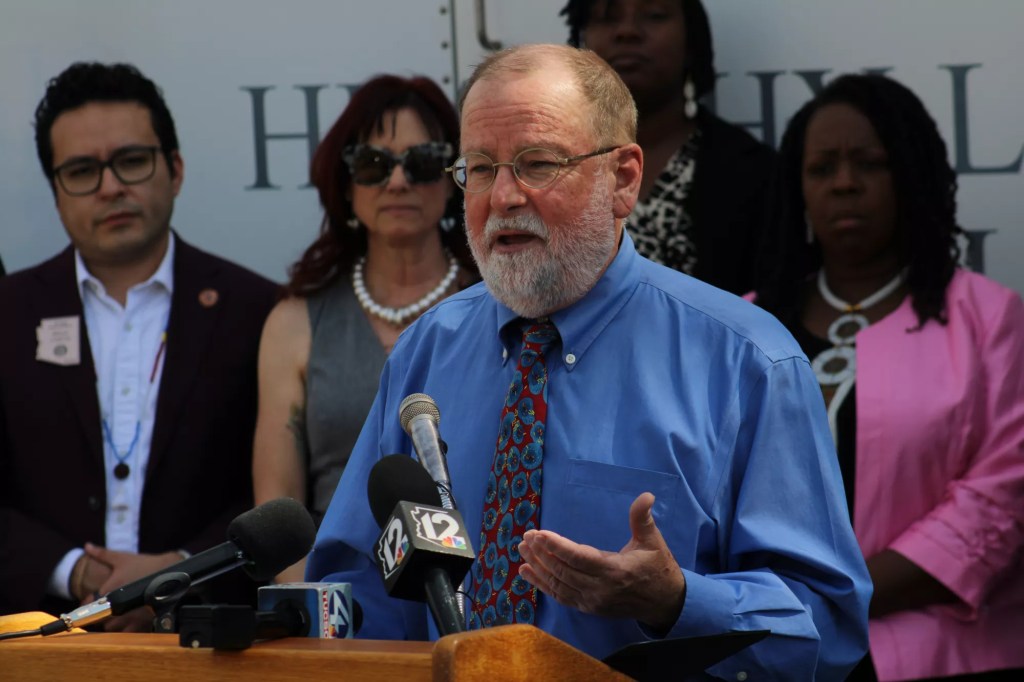
“They don’t have a cough reflex,” said Will Humble, a former DHS director and now the executive director of the nonprofit Arizona Public Health Association. “Everything about those little, tiny babies is just so precarious.”
The report recommended that parents make sure their infants aren’t “exposed to vaccine-preventable diseases by unvaccinated individuals or anyone who has a potentially contagious illness,” such as the flu, measles, chickenpox, whooping cough, COVID-19 or RSV. Another 15% of infectious disease-related child deaths were from viral infections, such as the flu and COVID-19, while 12% of the deaths were from bacterial infections. Pneumonia, which is often caught after a different disease lowers a person’s immune system, and was the cause of death of nearly 10% of children.
Morgan Fischer
Small children are often too young to receive many vaccines, making it all the more important that older children and adults who are around them are vaccinated and unlikely to pass those illnesses on.
“What we used to find with little tiny babies who got pertussis, it was often older siblings who were unvaccinated or undervaccinated, and/or babysitters who came in with a cough,” Humble said. “And then you got a little tiny baby with pertussis. That’s really dangerous.”
As would be expected from a rise in infectious disease deaths, vaccination rates in Arizona have been dropping. This school year, nearly 20% of private school kindergarteners obtained a personal belief exemption from having at least one of the state’s required vaccines, according to DHS data. Nearly 7% of public school students were similarly exempt. That’s a steady increase from the previous year, when the rates of personal belief exemptions were four points and one point lower, respectively.
Arizona is reckoning with that now. Vaccination rates for measles have also fallen below what is required to keep a community protected from an outbreak. Roughly 87% of kindergartners in Arizona are fully vaccinated with the measles, mumps and rubella vaccine, which requires a 95% vaccination rate to achieve herd immunity. At the moment, Mohave County is home to the second-largest measles outbreak in the country.
Only four hospitalizations and zero deaths have been reported from that outbreak since it began in August, but Chambers is still “extremely concerned that every year we’re going to have more kiddos getting infected with vaccine-preventable diseases and more kids dying from it.” Notably, any deaths that do result from that outbreak wouldn’t show up in the Child Fatality Report numbers until next year’s report is released.
There’s reason to think things could get worse. For one, the 2024 fatality report covers a period when relatively sane, science-minded people were running national health agencies. Now, they’re overseen by vaccine-denier Robert F. Kennedy Jr., who has made it his life’s work to sow vaccine distrust and has systematically worked to undermine public health infrastructure in his first year as Secretary of Health and Human Services. Under Kennedy’s reign, certain vaccinations have already become harder to obtain.
The solution to this problem is, on its face, obvious — get the vaccines that prevent vaccine-preventable diseases.
To that end, Arizona Child Fatality State Team chair Mary Ellen Rimsza recommended in the report that “health departments and healthcare providers promote vaccine and vaccine confidence through ongoing, proactive messaging and increase the availability of vaccines in healthcare settings.” But changing an anti-vaxxer’s mind is easier said than done — at least before their child is in the throes of a disease that vaccines have already eradicated.
“The community has a responsibility for protecting people who are the most vulnerable. That’s the core principle of public health,” Humble said. “But there are many, many people who see vaccines only in terms of protection for me.”