
Rebecca Noble/Getty Images

Audio By Carbonatix
While the MAGA crowd calls the District of Columbia “The Swamp,” the arid plains and rolling hills of Southeastern Arizona, sadly, are starting to resemble a cesspool. If you are looking to understand the culture of cronyism emanating from this Trump administration — and, in particular, its obsession with the border, immigration and the militarization of law enforcement — you only need to kick over a rock in the high desert of Cochise County.
Located in the southeast corner of the state, the square-shaped county comprises 6,200 square miles, high desert grasslands, the Sky Island mountain ranges and only about 125,000 people. It draws its share of sunscreen-caked tourists, who flock to visit Tombstone and the mining-town-turned-hippie-enclave-turned-gentrified-yuppie-bubble of Bisbee.
But that somewhat sleepy reality has been changing in recent years. In 2022, the county made national news when two of the county’s three supervisors — one of whom had also been present at the U.S. Capitol during the Jan. 6 insurrection — refused to certify the results of that year’s elections, resulting in the indictments of both. Consecutive elections directors resigned, citing the toxic state of disinformation in Cochise County.
Seemingly at the center of much of the county’s insanity and rising MAGA notoriety — or at least very near to it — is the border. The wild west call of the border has drawn a certain kind of person to the county, which has had its share of border vigilantism. The siren of the border warrior seems to have only grown, and many have followed, including some with very deep pockets and political connections.
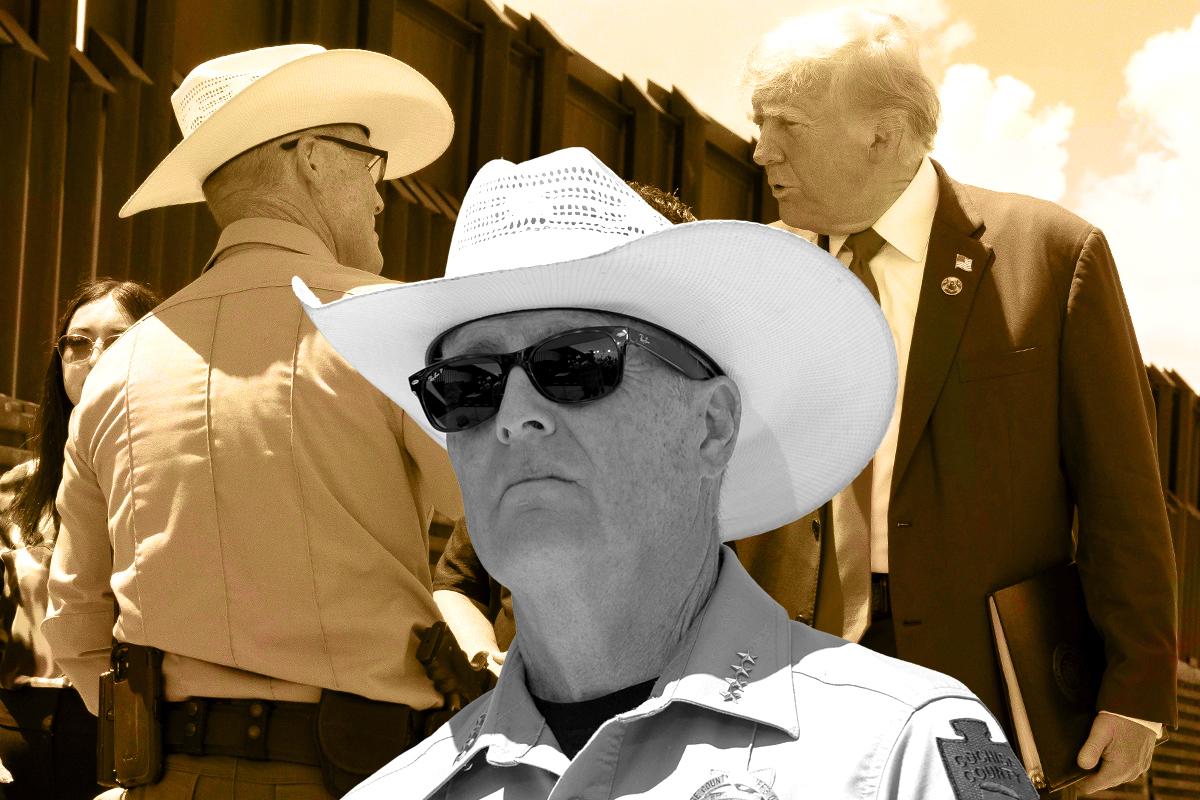
The border is big business in Cochise County. For 84 straight-as-an-arrow miles, many of them covered by a massive steel bollard border wall, the county butts up against Mexico. Stark and imposing, the wall makes a great backdrop for photo opportunities. And there is no creature who loves photo ops more than politicians. Every election season, Republicans and Democrats alike make a pilgrimage to the county’s section of border wall, where — flanked by the same handful of right-wing ranchers — they intone gravely about the importance of border security. In 2024, Kamala Harris campaigned in proximity to the razor-wire-festooned wall separating Cochise County border town Douglas from Agua Prieta, Sonora. Donald Trump stood at a podium and gesticulated, set against the backdrop of the big beautiful wall he ordered built (or replaced, given that most of the county’s border wall has existed since the days of George W. Bush) in his first term.
Seated at the nexus of that political attention has been Cochise County Sheriff Mark Dannels. Known today for his rising influence in both Arizona and national law enforcement circles — and, unfortunately, less known for his ties to far-right extremists and the often dubious nature of his border security claims — Dannels owes his position to the border and a bottle of peppermint schnapps. He won election as sheriff in 2012 after his predecessor, Larry Dever, died in a drunk driving misadventure. Dannels’ jurisdiction contains fewer people than live in the Phoenix exurb of Goodyear, yet the county’s strip of border allows the 61-year-old to wield outsized influence.
Dannels is a former president of the Arizona Sheriffs’ Association and the current president of the Western States Sheriffs’ Association. He’s a key player in Operation Desert Guardian, created in early 2025 by Democratic Gov. Katie Hobbs, and also serves on Trump’s Homeland Security Advisory Council.
Now, in the midst of the second Trump administration — with ballooning immigration enforcement budgets and an ongoing effort to militarize the border — Dannels is both reaping the rewards and helping to dish them out. Documents obtained by Cochise Regional News and Phoenix New Times show how Dannels and his agency are greasing the wheels of border security business, raking in federal money and potentially helping to line the pockets of some of Trump’s pals.
Public records show that the Cochise County Sheriff’s Office recently received a million-dollar federal grant from the Department of Homeland Security, largely and ostensibly to serve federal immigration warrants in the county jail. However, at least a quarter of that grant appears to be earmarked, at least in part, for Dannels’ travel to conferences — many of which may be held at casinos and resorts. The grant award specifically notes that Dannels, through many groups that put on such events, spreads the gospel of “standing united and border security.”
Further, as CRN and New Times will explore next week, Dannels has seemingly used his public office to advertise for drone company and private defense contractor Draganfly. The campaign has not only benefited the profit-driven corporation in its quest to land contracts under Trump’s reign — including from the U.S. Army and the Department of Defense — but has also likely personally enriched one of the corporation’s newest board members and others receiving equity compensation. Among this defense contractor’s board members is a Trump ally who served in a Project 2025 leadership position and seems to have provided guidance to a shadowy Project 2025 group of Trump acolytes who, ahead of the 2024 election, wrote blueprints for Trump’s mass deportation agenda. CRN and New Times first reported the existence of those plans in May.
Also involved in that effort: Cochise County Sheriff Mark Dannels.
Dannels is a small cog in a much larger MAGA machine, but his activities in Cochise County illustrate how influence and money work in the Trump administration. It’s a world in which loyalty to the administration is seemingly subsidized with federal tax dollars, and in which public officeholders work to boost private corporations with ties to the machinery that, in turn, boosts Trump.

Kevin Dietsch/Getty Images
Hopping in bed with ICE
Last year, Congress handed a whopping $75 billion to Immigration and Customs Enforcement. As a result, ICE and its parent agency, the Department of Homeland Security, are flush with money to shower on Trump’s most loyal servants.
Cochise County has lined up at that trough.
In August, the Cochise County Sheriff’s Office quietly executed a memorandum of agreement to participate in ICE’s 287(g) program, which allows local law enforcement agencies to enforce some aspects of federal immigration law. The program has been controversial virtually since its creation in 1996. It was under the auspices of 287(g) that infamous Maricopa County Sheriff Joe Arpaio terrorized and racially profiled Hispanic residents across the Phoenix area — many of whom became hesitant to call police when they needed help. Critics argue that, given these realities, 287(g) makes communities of color less safe. But the Trump administration seems to relish inflicting insecurity on such communities and has pushed to rapidly and broadly expand 287(g).
There are three “models” of the 287(g) program. The task force model allows state and local cops to act as immigration agents during routine duties, and the jail enforcement model deputizes local cops to “identify and process” undocumented immigrants arrested for crimes. In August, the Cochise County Sheriff’s Office signed up for the warrant service officer model, which “allows ICE to train, certify and authorize state and local law enforcement officers to serve and execute administrative warrants on aliens in their agency’s jail,” according to ICE materials.
That model is the least aggressive in the 287(g) program. CCSO has only two warrant service officers and has tried to downplay the extent of its cooperation with ICE.
According to CCSO spokesperson Carol Capas, the two officers dedicated to the program “can only serve warrants and can only do it in the jail,” and they “have no authority outside the jail.” Further, CCSO’s agreement with ICE states that individuals served these federal warrants may only be transferred to ICE custody following completion of local “criminal charges that caused the alien to be taken into custody.” Capas stressed that CCSO, per the agreement, could only hold people on behalf of ICE for up to 48 hours.
In scant public discussion of the agreement, CCSO has tried to downplay its involvement with ICE. “We don’t want to get a bunch of furries and blow-up animals runnin’ around with signs in front of our jail,” a CCSO commander told the county board of supervisors in October, in an apparent reference to whimsical anti-ICE protests in Oregon.
Whatever the case, though, the agreement marks a substantial reversal for Dannels.
Though Dannels is a border hawk and rising MAGA star, he has long avoided programs like 287(g). He opposed Arizona’s Proposition 314, which made it a state-level criminal offense — policed by state and local agencies — to be in the country without documentation. “We don’t have the infrastructure, we don’t have more personnel,” he said after voters approved the measure in November 2024.
As recently as February, he was on record as not wanting to join the 287(g) program. County board of supervisors meeting minutes from that month show that supervisors asked Dannels if his agency would join 287(g). Dannels flatly stated he would not. He stated that joining the program would shift focus from local law enforcement efforts (odd, given that Dannels has built a career by playing up his proximity to the border). And, at any rate, said Dannels, CCSO already coordinates with Border Patrol to transport undocumented immigrants.
Dannels also told county supervisors that participating in 287(g) could result in “immediate jail shutdowns due to compliance issues.” Indeed, Dannels spent much of the past two years trying to sell Cochise County voters on a new county-wide sales tax to replace the county’s aging jail, which he said was needed due to disrepair, overcrowding and overall concerns for staff and prisoners alike. Further, he has long complained of the cost of housing undocumented persons in his county’s jail.
Nevertheless, on Aug. 7, Dannels signed a 287(g) agreement with ICE that addressed absolutely none of the sheriff’s historic concerns. According to the agreement, the partnership would not alleviate any jail population issues and does not provide any funding to address jail safety, repair or issues of compliance with federal detention standards. In fact, the agreement was so clear about CCSO handling the full financial burden of participating in the program that it said ICE would not even pony up a dime for “printer toner.”
But then, a little less than two months later, CCSO was awarded a federal grant. And with it, a big chunk of money seemingly set aside for Dannels’ MAGA proselytizing.

Rebecca Noble/Getty Images
Special money for a special sheriff
Three weeks after Dannels signed the agreement with ICE, it officially went into effect. Four days after that, the Department of Homeland Security announced that money would soon be available for state and local agencies partnering with ICE — though, apparently, only for agencies engaged in the task force model.
Nonetheless, about a month after the agency’s partnership with ICE began, Christmas came early for the Cochise County Sheriff’s Office — and, seemingly, for Dannels in particular.
In a letter dated Sept. 30, the Federal Emergency Management Agency — like ICE, an agency under DHS — awarded CCSO a $1 million grant through DHS’s Targeted Violence and Terrorism Prevention Grant Program. The majority of the awarded money was dedicated to CCSO’s involvement in the 287(g) program. Capas did not respond to a question about whether Dannels knew funding would be heading his way when he signed the agreement with ICE two months earlier.
Significant expansion of 287(g) has been a key element of the administration’s war on immigrants. As of Dec. 12, the second Trump administration has increased the number of 287(g) participants from 135 before he reentered the White House to a whopping 1,255 in 40 states. CCSO and three other Arizona agencies are among that group, but CCSO appears to be the only one of them to receive any money for it.
ICE records show that sheriff’s offices in Navajo County and Yuma County both signed warrant service officer agreements with ICE before CCSO did the same, while the Pinal County Attorney’s Office signed up for the task force model.
Neither the Yuma County Sheriff’s Office nor the Pinal County Attorney’s Office responded to questions asking whether they are receiving any federal funding relating to their 287(g) involvement. However, in order for either agency to accept such a grant, their respective county boards of supervisors would have to approve it first. A review of available supervisory meeting records for both counties shows no trace of any such awards.
The Navajo County Sheriff’s Office definitely didn’t get any ICE money — even though they are far more involved in the program than CCSO. Spokesperson Tori Gorman told CRN and New Times that the agency is working to bring a total of five warrant service officers online for its county jail — three more than are in CCSO’s jail — but that Navajo County will receive no federal funding as a result.
CRN and New Times also asked both DHS and ICE whether they are typically reimbursing costs associated with non-task force 287(g) models, but neither responded.
So it appears Dannels’ agency exists in a league of its own.
According to the grant letter, $825,000 of the million-dollar award is to be used over three years — from September 2025 to September 2028 — to fund the salaries and “employee related expenses” of two detention officers who will “process and handle illegal immigrants held at the Cochise County Jail.” Another $42,539 was set aside for the purchase of a portable X-ray imaging system used in explosive ordnance disposal operations.
Beyond that, the math is a bit fuzzy.
According to the grant letter, a total of $315,000 was awarded for “personnel” while another $234,966 was awarded for “fringe benefits,” which is generally understood to relate to employee benefits ranging from health coverage to retirement plans. There’s an additional $157,495 for “indirect charges” and $250,000 for “travel” — all of which is somewhat striking, given CCSO’s assertion that their two warrant service officers don’t do much.
It’s that travel budget that literally has Dannels’ name on it. As is stated in the award letter’s description of this specific amount:
“$250,000.00 for travel, training, conferences and expenses associated with issues and challenges as an International Border community. Sheriff Mark J. Dannels has a strong commitment to the Southern Border and challenges faced being a border community. Through collaboration and leadership with the American Sheriff’s Alliance which includes the National Sheriff’s Association (NSA), Southwestern Border Sheriff’s Coalition, Texas Sheriff’s Coalition (SWBS & TXSC), Major Counties Sheriff’s Association (MCSA), and Western States Sheriff’s Association (WSSA), Sheriff Dannels is spotlighting the importance standing united and border security.” (Typos original.)

Gila River Resorts & Casinos
Resorts and casinos
So why the travel budget? Dannels, who has a history of association with far-right extremists and of making dubious border security claims, has used his office’s proximity to the border to leverage a burgeoning political career — particularly in the era of Trump. Dannels touts his relationship with Trump border czar Tom Homan. During the 2024 election cycle, Dannels appeared at Trump- and Homan-related political events.
Perhaps most notably: Throughout 2024, Dannels took part in the Project 2025 Border Security Workgroup, which crafted policy proposals and plans intended to implement Trump’s promised mass immigrant deportations and other national security objectives. The “main operational effort” of the subgroup was the creation of plans for the implementation of a new nationwide “multi-jurisdictional” fusion center-style law enforcement structure that would unite state, local and federal law enforcement under the direct command of Donald Trump.
A major component of implementing these plans, according to documents, was to be a drastic expansion of 287(g) participation.
The group also worked to craft “strategic communications” strategies for the advancement of their objectives, including advocacy through participating and/or sympathetic sheriffs, according to documents.
Dannels is not only an acolyte of the Trump/Project 2025 vision, but is in a position to serve as a prime evangelist. The rural Arizona sheriff is the chair of Arizona’s law enforcement certification board and is a member of Trump’s Homeland Security Advisory Council. He has also long held leadership positions with a host of influential law enforcement groups — including sheriffs’ associations dedicated to Arizona, the Southwest, the Western U.S. and the country at large.
Many of these associations hold conferences each year, at which members hobnob with fellow sheriffs, policymakers and private sector vendors. (The latter often underwrite the conferences and are rewarded with market access.) CCSO’s “terrorism prevention” grant provides a quarter of a million dollars for “travel,” seemingly to include expenses related to such conferences, which are often held at resorts, casinos and luxury hotels.
For example, in September, the Southwestern Border Sheriffs Coalition held its “Annual Fall Cooperative Meeting” at the Gila River Resort and Casino in Chandler. The National Sheriffs’ Association winter conference is to be held Jan. 31 through Feb. 4, at the luxury JW Marriott in Washington, D.C., right down Pennsylvania Avenue from the White House. The Western States Sheriffs’ Association — which Dannels leads as president — will host its next conference a month later at “the beautiful, modern Peppermill Resort and Casino” in Reno, according to a statement signed by Dannels himself.
This event is explicitly marketed as a “trade show” and the group solicits sponsorships from private vendors to underwrite the event. According to WSSA materials, an official “conference sponsorship” (which gets a vendor two booths in the “exhibit hall” as well as corporate logo placement on WSSA materials, and speaking opportunities for company reps at the conference) runs $20,000.
“This is the annual gathering of Sheriffs and their command staff from across 18 western states. Our trade show provides the perfect opportunity for you to showcase your law enforcement-related company,” Dannels wrote. “If you would like to obtain maximum exposure to the Sheriffs in the Western United States – this is your chance!”
You get the idea. Attendance at these conferences is important work that surely warrants up to a quarter of a million dollars in federal taxpayer revenue.
CRN and New Times repeatedly asked Capas, the CCSO spokesperson, if the $250,000 in grant money is indeed earmarked — in full or in part — for Dannels’ travel to such conferences. She did not respond. DHS did not respond to similar questions.
The subject of the travel money barely came up when the three-member county board of supervisors approved the grant on Oct. 21, with a CCSO representative offering only that the money would be for “travel, training, conferences, and expenses associated with, ah, promoting, ah, er, talking about the border and the border issues that we face on a daily basis.” CRN and New Times asked all three Cochise County supervisors — Kathleen Gomez, Tom Crosby and Frank Antenori — whether any portion of this $250,000 in “travel” funds was to be spent on Dannels’ travel to conferences, as the grant letter seems to indicate. None responded.
Given the strong appearance of cronyism — or, at the very least, frivolous use of taxpayer money — we provided those privy to the details of CCSO’s grant with ample, and repeated, opportunity to explain the purpose of these funds. And yet, no explanation has been given.
Read an expanded version of this story on CRN. This article is a continuation of the Big Takeover investigative series CRN and New Times began last year. You can subscribe to CRN here. This story is also a part of the Arizona Watchdog Project, a yearlong reporting effort led by New Times and supported by the Trace Foundation, in partnership with Deep South Today.