
Morgan Fischer

Audio By Carbonatix
Independent Journalism in Phoenix Needs You
We need to raise $15,000 by August 9 to support the reporting our community depends on. Reader support keeps us independent and is playing a larger role in funding local journalism and shaping what comes next. If you believe independent local journalism matters, make a contribution today.
For months, Republicans on the Maricopa County Board of Supervisors have made a stink about the supposed costs of complying with a more-than-decade-old racial profiling lawsuit against the county sheriff’s office. Taxpayers were paying out the wazoo — more than $300 million, they estimated — for reforms that are more or less complete.
But the federal judge presiding over that case isn’t buying it. Last year, Judge G. Murray Snow released the results of an audit showing that the Maricopa County Sheriff’s Office had improperly attributed more than $150 million in unrelated spending to compliance efforts. The sheriff’s office and the board of supervisors have disputed that finding and continued to campaign for the end of independent oversight of the agency.
If they thought that would gain any traction with Snow, they seem to be mistaken.
In a Friday hearing at the Sandra Day O’Connor U.S. Courthouse, Snow told the county to either show its work about its supposedly ballooning costs or to, essentially, shut up about it.
“Quit making what may be misstatements in the press,” Snow said. “Maybe the sheriff hasn’t, but members of the county board have, or at least it certainly appears as much.”
The sheriff’s office has been subject to independent monitoring since 2012, when Snow found that the office, then led by Sheriff Joe Arpaio, had been racially profiling the Valley’s Latino population through traffic stops and immigration sweeps. Over the last decade and a half, the agency has been required to hire additional staff, reduce its internal investigation backlog, eliminate racial profiling in traffic stops and meet quarterly with the plaintiff class — the Latino community — to address complaints and concerns.
The office must be in full compliance with the court order for three years before Snow will end it. And while the office has made significant progress, it still hasn’t reached full compliance. Despite that, the county wants to eliminate the federal oversight entirely. Supervisors like Thomas Galvin and Debbie Lesko have cited an ongoing $350 million price tag — which Snow called “questionable” — as justification.
Galvin and Lesko showed up — along with other Republicans — at the sheriff’s office’s court-mandated monthly meetings to demand the end of the court order. Cost concerns “overrode” the meeting, which spiraled out of control, Snow said. As a result, Snow took control, moving meetings to the federal courthouse and presiding over them himself. He also released a 93-page report from the monitor that found the sheriff’s office improperly attributed more than $163 million to compliance orders — 72% of what the agency had spent on compliance.
The Republican campaign to unshackle the sheriff’s office has continued anyway. In mid-December, the county filed a Rule 60 motion to end the case, which the sheriff’s office joined, prompting Friday’s hearing.
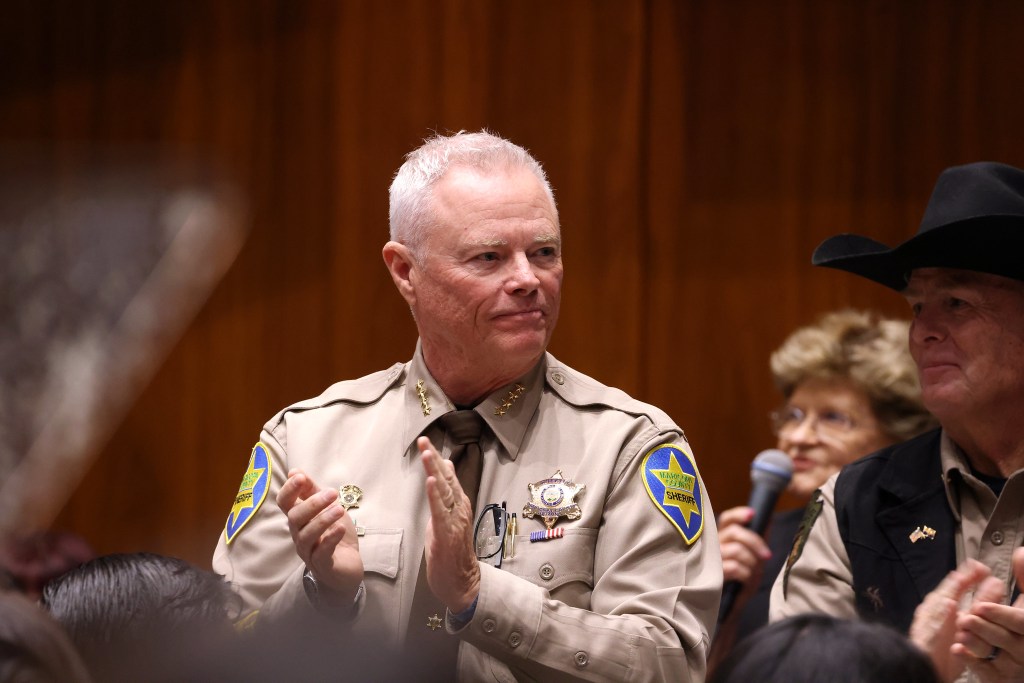
Gage Skidmore/Flickr/CC BY-SA 2.0
Sword and shield
At the hearing, Snow said the board of supervisors — and specifically Galvin — have continued to spout “inaccurate statements” online and in the media about compliance costs. Snow cited statements on the Maricopa County Board of Supervisors’ website, including Galvin claiming in a video that the county “has spent hundreds of millions of dollars on this case.” Snow also cited a Nov. 21 press release in which the county board celebrated that, as Snow put it, “we stand by our budgeting practices and the 209 positions we created as a direct result of the Melendres orders.”
“The county cannot use my order as both a sword and a shield,” Snow said.
Previously, Snow offered the court the “opportunity to verify their costs,” but the county declined to do so. But now that the county has continued to complain about the costs — which are “not accurate information,” Snow said — he may now require them to “justify their costs.”
“If the county is going to continue to make public statements about the cost of the Melendres order, I can, if I choose, require them to back up those costs,” Snow said Friday. “They are trying, with some success in some quarters, to discredit this court’s order based on the costs that they are incurring.”
While Snow admitted that he cannot stop or prevent the county board of supervisors from making inaccurate statements, he does have the “right to require them to justify that information.” Snow also suggested that Galvin, who’s been a leader on the board for pushing for the end of the court order, “might be careful in terms of his ethical obligations” as an attorney, but “he can say whatever he wants, and so can any other member of the Board of Supervisors.”
Galvin declined to comment to Phoenix New Times, and the other members of the county board of supervisors did not respond to questions. In a statement, county spokesperson Jason Berry said that “Maricopa County has been clear that it stands by its accounting practices, which are audited annually.” He also said that the county is pleased that the U.S. Department of Justice is supporting its Rule 60 motion to end the case and “that Judge Snow set a clear path forward.”
Sheriff Jerry Sheridan didn’t answer questions from New Times on Friday’s hearing, but he wrote in a statement that ”we remain steadfast in our responsibility to serve all residents of Maricopa County with fairness, respect, and integrity, and we will continue to implement policies and practices that reflect those values.”
Snow hasn’t made a ruling since Friday’s hearing, but he’s given the defendant three weeks to discuss which party — either the county or the sheriff’s office — should argue the Rule 60 motion in an upcoming but as-yet unscheduled hearing.