
Stephen Lemons

Audio By Carbonatix
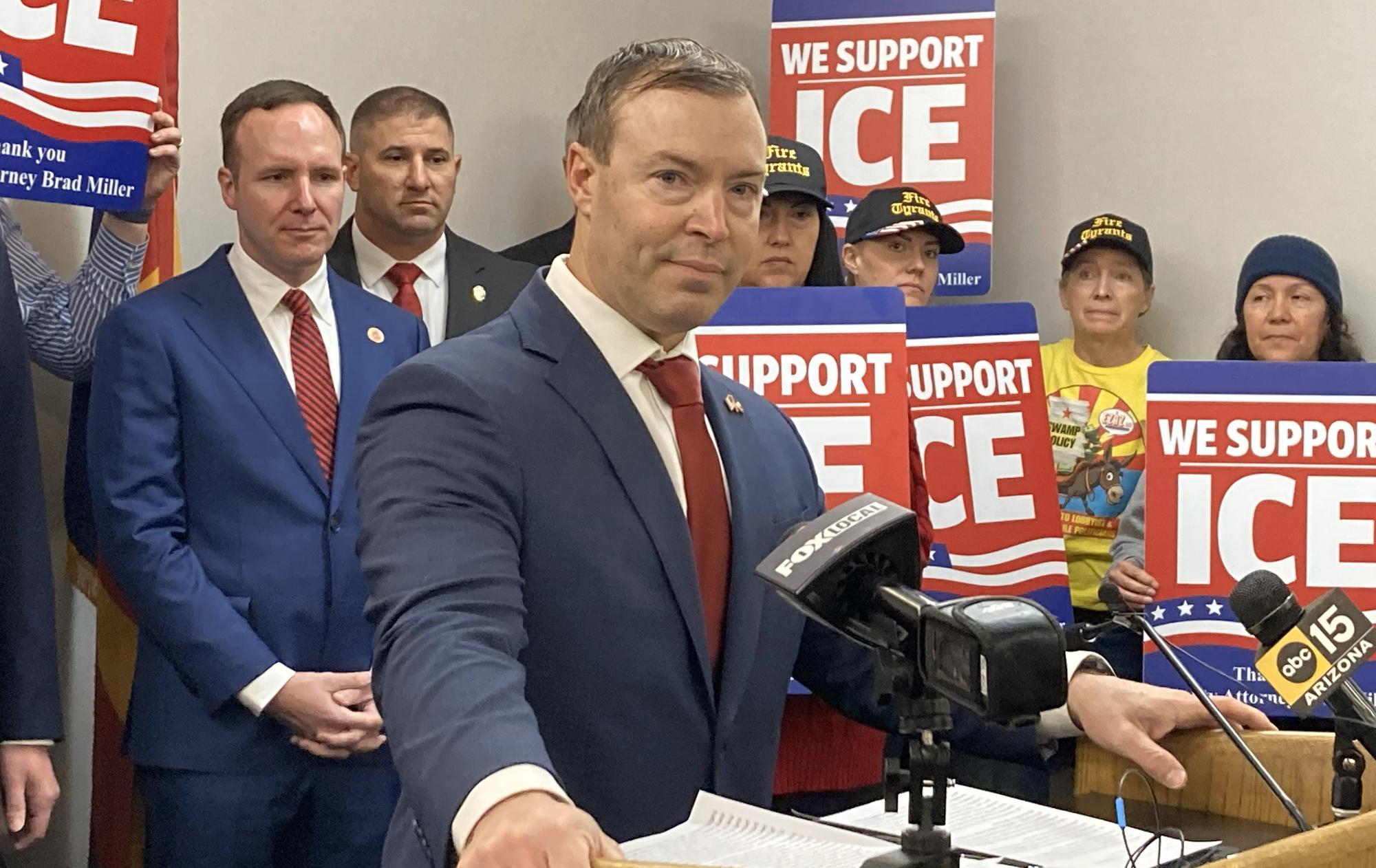
Pinal County Attorney Brad Miller has denied that he uses the encrypted messaging app Signal to shield work communications from public records scrutiny, as alleged in a notice of claim letter sent to his office last month.
Yet, according to records recently reviewed by Phoenix New Times, the MAGA-aligned prosecutor and key members of his staff utilized Signal — which allows users to set messages to be automatically deleted after certain periods of time — in an apparent effort to skirt Arizona public records law.
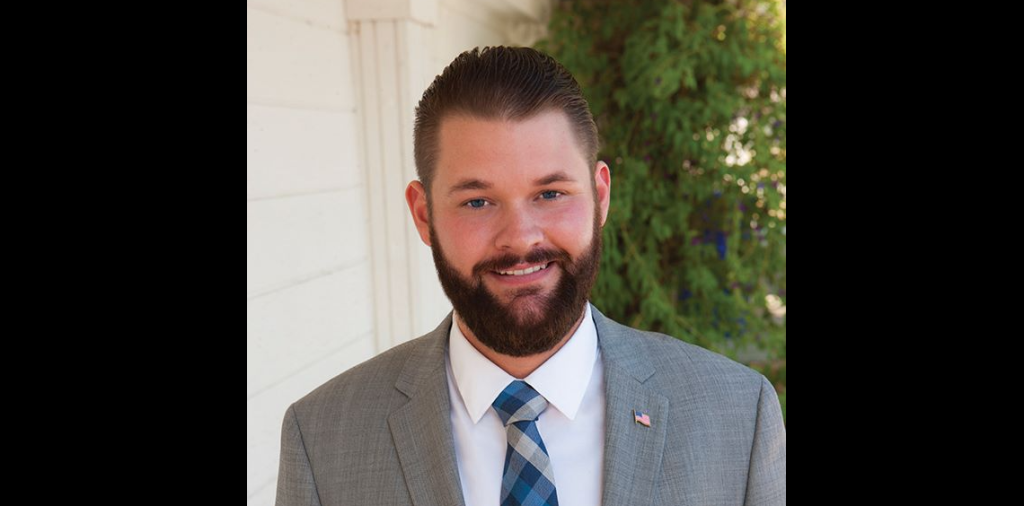
The allegation first came to light when New Times reported earlier this month on a December notice of claim letter from a former member of Miller’s executive staff. The letter detailed a pattern of sexual discrimination and retaliation against several female staffers. It also noted that shortly after Miller assumed office in January 2025, Miller chief of staff Jeremiah Brosowske directed staffers to use Signal for the purpose of “keeping government messages offline” and “avoiding public records request laws.” The letter claimed one staffer was terminated, in part, because they raised concerns about using Signal.
Since first reporting on the claim letter, New Times has reviewed scores of messages apparently sent and received by Miller and members of his staff, including Brosowske and others. The messages, which were made available by a former employee of Miller’s, appear in four Signal accounts: one under Miller’s name and phone number, another administered by Brosowske under the title “CA Miller Media,” a third titled “Working Group Chat” and a fourth named “Social Media Approval.”
The Signal account under Miller’s name used the seal of the Pinal County Attorney’s Office as its logo. Messages on this account began in March 2025 and extended through much of the year. In them, Miller discussed press conferences, legislative issues and general office administration. In other words: Government business subject to open records law.
At one point, in commenting on a matter involving Arizona Attorney General Kris Mayes, Miller wrote, “Tell the AG to go away!” Mayes, a Democrat, had previously smacked down Miller, a Republican, over his grandstanding “offer” to “investigate” Democratic state Sen. Analise Ortiz for sharing an Instagram post that warned of activity by Immigration and Customs Enforcement in Phoenix. Mayes publicly reminded Miller that Ortiz’s post was protected by the First Amendment and that Miller’s authority as a prosecutor was limited to Pinal County.
Miller’s Signal account used a phone number associated with Miller and was answered by a voicemail message that sounded like Miller. Miller did not respond to a voicemail left for him at this number. Miller’s account was not set to make his messages disappear, allowing New Times’ source to have access to them. However, the account administered by Brosowske — which uses a phone number associated with Miller’s chief of staff — had messages set to disappear after one hour.
New Times recently confronted Miller about using Signal after a Jan. 12 press conference at the Arizona Capitol, where Miller promoted a bill to make it a class 5 felony to obstruct a lawful arrest by a law enforcement officer, ICE officers included. Following the presser, New Times asked Miller if he or his staff had ever used encrypted apps like Signal to communicate with each other. Miller said no and that he doesn’t even have the app on his phone.
When a New Times reporter asked to see his phone to confirm, Miller asked if he could look at the reporter’s phone. New Times immediately agreed to such an exchange, but Miller reneged on the mutual look-see.
New Times also filed a records request with Pinal County seeking any communications to and from Miller made on the Signal app, only to receive a response last week stating that Miller avowed that “he does not have any records from the Signal app to provide.” A public records request concerning Signal app messages to and from Brosowske received the same reply.
Problem is, some of these records do exist. Whether or not they were preserved as required by Arizona law is another question.
Leon Neal/Getty Images
Signal fire
During his press event on Jan. 12, Miller asserted that “we believe in the rule of law.”
But Miller’s interpretation of the “rule of law” is suspect. For example, the Pinal County Board of Supervisors recently spanked Miller publicly by waiving executive privilege and allowing the board’s outside counsel to testify that Miller’s much-ballyhood 287(g) agreement with ICE last year was “void” and “unauthorized by law” because it was not approved by the board — unlike the Pinal County Sheriff’s Office’s agreement with ICE, approved by the board nearly two decades ago.
Similarly, the Signal messages viewed by New Times show that Miller and his office have a problem with following Arizona public records law.
The law itself is unambiguous. The Arizona Revised Statutes state that “all officers and public bodies shall maintain all records” related to their official activities or “any of their activities that are supported by monies from this state or any political subdivision of this state.” Any officer who “knowingly and without lawful authority” destroys public records or “permits any other person” to do so may be guilty of a class 4 felony, punishable by up to 3.75 years in prison. Notably, that’s a harsher penalty than the one Miller is proposing for obstructing ICE agents.
Public bodies are required to make public records available “promptly” upon request, though there are some exceptions for privacy, confidentiality and other reasons. If records are redacted or not made available for cause, the office must explain the reasons when asked. According to both the Arizona Attorney General’s Office and the Arizona Ombudsman Citizens’ Aide — a state agency tasked with fielding complaints about public records — there is no exception in state law for communications on encrypted apps.
“No matter what type of written communication is used, if a public official is communicating with anyone as part of his or her job, it is a public record that is presumed available for disclosure,” Arizona Attorney General spokesperson Richie Taylor told New Times via email. Nor would it matter if the communication in question was made with a private cell phone. “Personal devices are not exempt either if the communication is related to the official’s job,” Taylor wrote.
Nick Bacon, a staff attorney with the state Ombudsman’s office, generally agreed with Taylor’s assessment.
“To my knowledge, Arizona’s public records statutes and the case law interpreting them do not exempt encrypted communications from the requirements placed on public records,” Bacon told New Times in an email. “Similarly, Arizona courts and public records law have not exempted communications made on private devices.”
According to Bacon, the key issue is whether the communication at hand was a public record. A court could take into consideration encryption and the ownership of the device, but these factors would not be “determinative,” he said. “If an agency gave as its reason for a denial that a communication is encrypted or exists only on personal devices,” Bacon wrote, “that alone would not exempt a public record from disclosure.”
An agency could argue that the communications were “purely personal and therefore not public records at all,” Bacon said. But the messages New Times reviewed were clearly not of a personal nature. And, according to Pinal County’s public records department, as well as both Miller and Brosowske, the Signal chats do not exist at all.
Jeremiah Brosowske for City Council Facebook Page
‘Oh, yes, we are’
It’s hardly surprising that the use of Signal would become an issue for Miller, whose prior claim to fame was going to bat for two of Arizona’s fake electors and aiding ever-wacky ex-state Sen. Justine Wadsack in her crusade over a 2024 speeding ticket.
Multiple sources told New Times that Miller was advised by both attorneys and non-attorneys on his staff that Brosowske’s genius idea of having folks communicate via Signal was a bad one. One source described an in-person meeting with Miller during which Brosowske mocked people who were questioning “if we were going to use Signal.”
“Oh, yes, we are,” Miller replied, according to the source.
Brosowske may not have been the best source of counsel. As New Times reported, he has a checkered past that involves reportedly being kicked off the city council of Hesperia, California, and leaving a well-paying gig as an assistant manager for San Bernardino County’s West Valley Water District in what one news outlet called part of a “housecleaning move” for the district.
At his Jan. 12 press conference, Miller was silent when asked if he knew about Brosowske’s history in California. When asked if Miller knew about his past before hiring him, Brosowske said, “I’m not answering any personal questions.”
Regardless, Miller’s use of Signal raised a red flag for Chandler attorney and local pundit Tom Ryan. Lawyers have a duty to preserve evidence, he said, and public servants have a “heightened responsibility” to the public and their oaths of office “to preserve records of communications that could be considered public.”
It’s not that using Signal or other encrypted apps violates the law, he said, but that officials have an obligation to retain communications made on such apps if they regard public matters. “The day-to-day operations of a public official, you have a duty to preserve those things,” Ryan said, “and if you’re using Signal, you have a duty to preserve them before they go away.”
Ryan added a word of advice to all public officials.
“If you’re communicating on something that is a public matter,” he said, “perhaps using Signal is not the right way to go.”
This story is part of the Arizona Watchdog Project, a yearlong reporting effort led by New Times and supported by the Trace Foundation, in partnership with Deep South Today.