

Illustration by LOOKOUT

Audio By Carbonatix
This story was first published by LOOKOUT, an investigative nonprofit news organization covering Arizona’s LGBTQ+ communities.
April Gendill never thought she would be the kind of person to pick up a gun. In past years, she said, she was more likely to argue that firearms should be melted down altogether.
That changed when Donald Trump returned to the White House.
Within his first month back in office, Trump and his administration enacted a wave of executive orders and policy changes targeting LGBTQ+ people, particularly transgender Americans. The actions included banning trans people from military service and sports, stripping LGBTQ+ history and references from federal websites, dismantling diversity initiatives across the federal government, rescinding Biden-era protections against gender-based discrimination, forcing passport gender markers to match those listed on birth certificates, removing references to transgender people from the Stonewall National Monument website, and labeling gender-affirming care as “child abuse” on the Department of Health and Human Services website.
The list goes on.
Since then, the administration and aligned conservative groups have mounted what advocates describe as an all-out assault on LGBTQ+ existence. GLAAD documented 213 attacks against LGBTQ+ people in 2025 tied to Trump administration actions, one of the largest coordinated information and policy campaigns against the community in recent memory.
For Gendill, the shift translated into fear.
As a trans woman who describes herself as “visibly” trans — an in-group term meaning strangers can tell she has transitioned — she said the past year has brought more stares, more double-takes and a growing sense of unease in public. Going outside became something to brace for.
That anxiety eased only after she began taking self-defense seriously. She said she had always carried around a butterfly knife, but started going to a gun range and learning how to safely handle a firearm. And that’s when everything changed.
Gendill is not alone.
Across Arizona and the country, queer and trans people are enrolling in self-defense classes at a noticeable clip, from firearms training and gun clubs to jiu-jitsu, boxing and martial arts. The motivations are familiar: heightened fear, political instability, rising hate crimes and a sense that help may not come when it is needed.
LOOKOUT spoke with 10 people who have taken up self-defense in different ways. Nearly all said they were preparing for worst-case scenarios. But many described an unexpected benefit: self-defense helped them feel more comfortable in their bodies, particularly those navigating transition or rebuilding a sense of physical autonomy.
And while the outcome is consistent — you probably do not want to corner any of them in a dark alley — there is something distinct about queer people trained in self-defense: the emergence of community protectors.
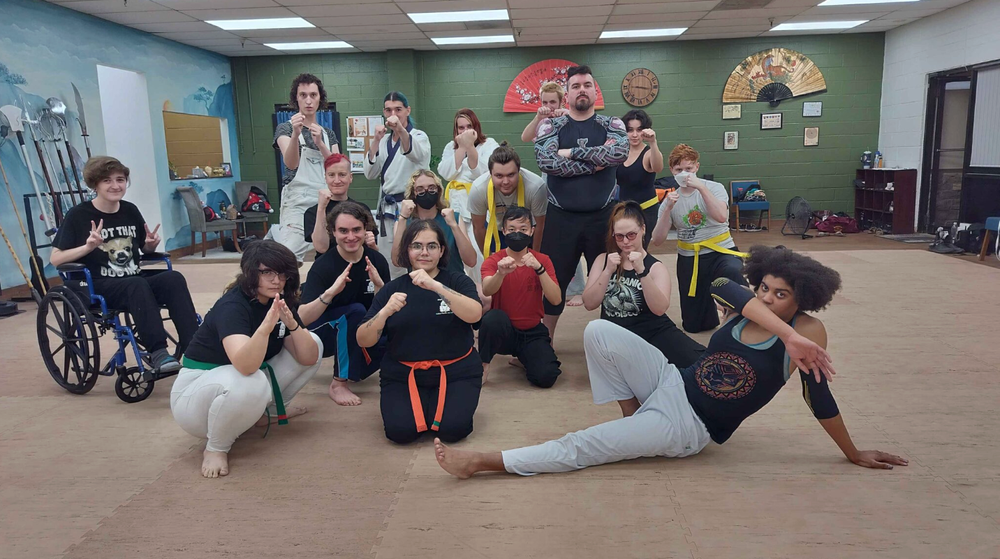
Rainbow-Warriors.org
A body I can work with
Every Sunday night, Rae Sombras, 24, an assistant coach with Rainbow Warriors, a Phoenix-based queer martial arts group, helps lead Tang Soo Do classes inside a space intentionally built for LGBTQ+ people.
Though people join for self-defense, its effects go beyond learning how to bring someone down in a pinch.
“A lot of us come in with complicated relationships to our bodies,” Sombras said. Training, he added, helps people reconnect with themselves at every stage of transition or embodiment. “You stop seeing your body as a problem to fix. It becomes a tool you’re learning to understand.”
Rainbow Warriors was founded in 2022 by Silver Drinan, 36, who began training informally with friends outdoors. The goal was simple: movement, breath and safety.
“Most fitness spaces are built around shame,” Drinan said. “Or proving something. I wanted a place where people could build strength without being punished for existing in their bodies.”
That approach keeps people coming back.
Cosette Claybaugh, 30, joined the group about six months ago after moving to Arizona and feeling isolated. She had trained in jiu-jitsu before but said those gyms felt transactional.
“I would pay, show up and leave,” she said. “There wasn’t space to talk about mental health or physical limitations.”
At Rainbow Warriors, instructors encourage listening to the body, modifying movements and speaking openly about neurodivergence, injury and burnout.
“For the first time, my body wasn’t something I had to fight,” Claybaugh said. “It was something I could work with.”
Members described the training as unexpectedly meditative. Repetition and controlled movement, they said, quieted their anxieties and sharpened their focus.
“It’s not about aggression,” Claybaugh said. “It’s about control — of my movements, my reactions, my confidence.”
The benefits extend beyond the mat. Members report improved mental health and accountability rooted in care rather than pressure. When someone misses class, others check in, not to guilt them, but to make sure they are OK.
“That kind of care,” Claybaugh said, “is what makes it sustainable.”
PinkPistols.org
‘I’m living again’
For many queer and trans people who ended up choosing to enroll in self-defense classes, the fear did not arrive all at once. It crept in — first as doomscrolling, then canceled plans, then days when leaving the apartment felt optional and later, risky.
Cayce Kenney, 45, a nonbinary member of the Tucson chapter of Pink Pistols, said that by late 2024, most of their life had moved online. Community existed, but largely through screens.
“I was scared,” Kenney said. “I didn’t know if it was going to be safe to be me, or for my friends to be themselves.”
Kenney found Tucson Pink Pistols, an LGBTQ+-focused firearms education group, while scrolling Reddit at 3 a.m., unable to sleep. The post was from Gendill, who founded the Tucson chapter in early 2025 after struggling to find firearms spaces that did not feel hostile or far-right.
“It was queer. It was led by a trans woman,” Kenney said. “That mattered. It felt like the safest place to learn how to protect myself and be less afraid.”
Before that moment, Kenney had never seriously considered owning a gun. They had shot recreationally with friends but viewed firearms as a hobby, not a tool for survival. That changed with Trump’s return to office and the acceleration of anti-trans rhetoric and policy.
“You can talk your way out of a lot of situations,” Kenney said. “But you can’t talk your way out of genocide.”
The fear translated into hesitation around everyday errands, unfamiliar places and being visibly queer in public, and it later turned into isolation inside Kenney’s apartment.
What changed was not just training, but re-entering the world alongside others who shared that fear.
The first shift came before Kenney ever touched a firearm. It started in Pink Pistols’ Discord server, with conversation, shared anxiety, shared humor and people checking in on each other.
“The fear didn’t disappear,” Kenney said. “But it softened.”
The second shift came at the range.
The first time Kenney fired their own pistol, something clicked.
“It was like a moment of calm,” they said. “I thought, OK. I can defend myself.”
Gendill said she sees that transformation often. She founded the group after being harassed in public during Trump’s first term, an experience that shattered her belief that visibility alone could keep her safe.
“I went from being, you know, take all guns and melt them down to now I run this gun club” she said.
At first, owning a firearm did not feel empowering. It felt heavy and uncomfortable. Training changed that relationship.
“The more I practiced, the more confident I felt,” Gendill said, adding that she feels more present now with her firearms training.
That presence matters.
Gendill said many members initially join Tucson Pink Pistols afraid to leave their homes. Over time, she has watched people stand taller, move through public spaces with less hesitation and rebuild routines that fear had quietly erased.
She said it’s not only about using the weapon, specifically, but rather the goal is to not feel helpless.
Both Kenney and Gendill emphasized that Pink Pistols is not a militia or a paramilitary group. The organization is nonpartisan and focused on firearms safety, education and harm reduction. Members repeatedly said they hope never to use their weapons outside of target practice.
But right now, they argue, learning self-defense is not theoretical.
“I don’t carry everywhere,” Kenney said. But knowing that they can, it changes how they move through the world.
What ultimately pulled Kenney out of isolation was not just the gun, but the combination of training and community: range days, group chats, shared meals and people who would show up if something went wrong.
Now, Kenney said, “I’m living again.”
Not counting on hope
The modern LGBTQ+ rights movement is often described as joyful and nonviolent — Pride parades, rainbow flags, celebration as resistance. But its origin story is messier. Stonewall was a riot. Bricks flew. Heels landed. People fought back.
That tension between nonviolence and self-defense is not unique to queer liberation.
In his book “This Nonviolent Stuff’ll Get You Killed: How Guns Made the Civil Rights Movement Possible,” author and activist Charles E. Cobb Jr. argues that while nonviolence was central to civil rights gains, it existed alongside an underappreciated tradition of armed self-defense, particularly in communities where the state refused protection. And where it has been mentioned in modern media, it was often misreported.
That context matters as queer people today face scrutiny for learning how to defend themselves.
John O’Hagan, a black belt instructor who runs a free Sunday night jiu-jitsu class for LGBTQ+ and other marginalized people at Gracie Arizona, started the program shortly after the 2024 election. When he offered a similar class years earlier, only a handful of people showed up before it fizzled out. This time, nearly 50 packed the mat.
“I’m a boring, straight, cis white guy,” O’Hagan said. “I have every privilege available to me. And I’m surrounded by people who don’t.”
O’Hagan, who has trained in jiu-jitsu for about 16 years and also runs a real estate brokerage out of Phoenix, said the decision came down to responsibility.
“I kept asking myself, what can I actually do?” he said. “Helping people with real estate doesn’t help folks who are terrified. But this does.”
The class, co-taught with fellow black belt Jeff Hazel, is intentionally designed for people who would never feel safe walking into a traditional fight gym. The goal is explicit: self-defense as a right.
“A lot of us are taught that if you fight back, you’re just as bad as your attacker,” O’Hagan said. “That’s not true. If someone puts their hands on you, you have the right to make that stop.”
That message cuts against both narratives of queer passivity and the moral panic surrounding armed LGBTQ+ people. In recent months, far-right media has exaggerated isolated incidents into claims that mainstream media has picked up, calling it an organized “trantifa” movement. That fear has filtered into government rhetoric; a Department of Justice memo recently labeled “gender ideology” as radical and linked it to domestic extremism.
“That’s the thing,” said Sombras, the assistant coach for Rainbow Warriors. “If a trans person hits someone back, it gets twisted.”
While O’Hagan respects people who choose pacifism, he rejects the idea that enduring violence is safer.
“Hope is a terrible strategy,” he said. “If someone has already decided to hurt you, letting it happen isn’t de-escalation. It’s gambling.”
Self-defense, he said, is not about winning fights or proving toughness. It is about awareness, boundary-setting and knowing what to do if avoidance fails.
“If you can talk your way out of a situation, that’s a win,” he said. “But if someone grabs you, you should have an answer.”
Defending oneself carries legal and social risk, particularly for trans people. O’Hagan does not minimize that.
“I’d rather deal with the aftermath than attend a funeral,” he said. “We don’t need permission to defend ourselves.”
Over time, he has watched students change. People who arrived anxious and withdrawn now help lead warmups, welcome newcomers, and take up space with confidence.
“That doesn’t come from nowhere,” O’Hagan said. “That comes from training, community and knowing, deep down, that you’re not helpless.”
He calls it resistance without slogans: not looking for fights, but not shrinking either.
“It’s not arrogance,” O’Hagan said. “It’s knowing that when things go bad, you’re not just counting on hope.”