
Morgan Fischer

Audio By Carbonatix
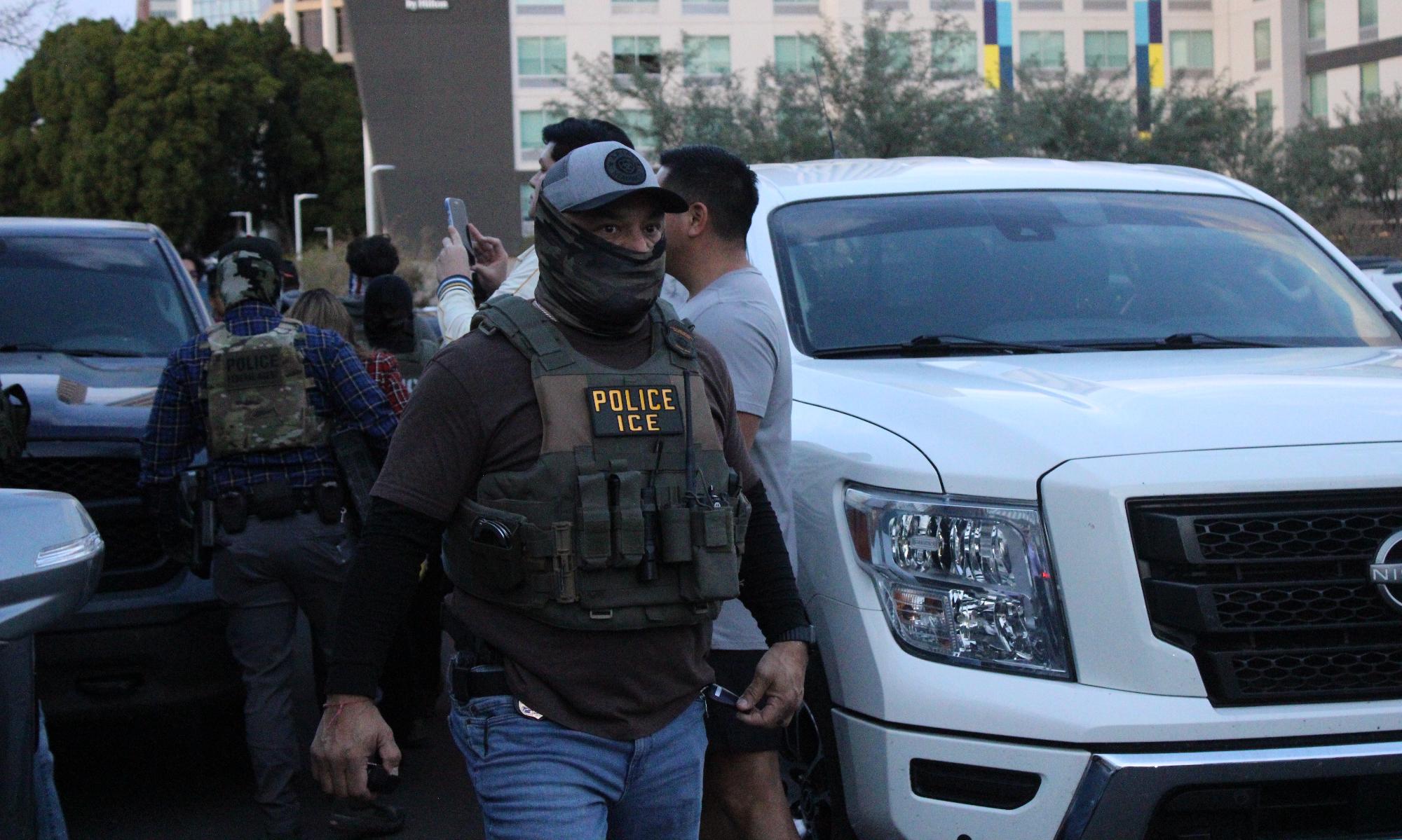
For the past year under President Donald Trump, Immigration and Customs Enforcement has been wreaking havoc on American communities.
ICE agents have been documented arresting citizens and others who are in the country lawfully. Agents have gone after otherwise law-abiding people rather than the much-ballyhooed worst-of-the-worst the Trump administration says it’s targeting. More recently, ICE generated outrage by arresting children and killing two U.S. citizens who were legally observing ICE activities in Minneapolis.
Now a new proposed Arizona law asks: What if these guys were at every polling place in the state?
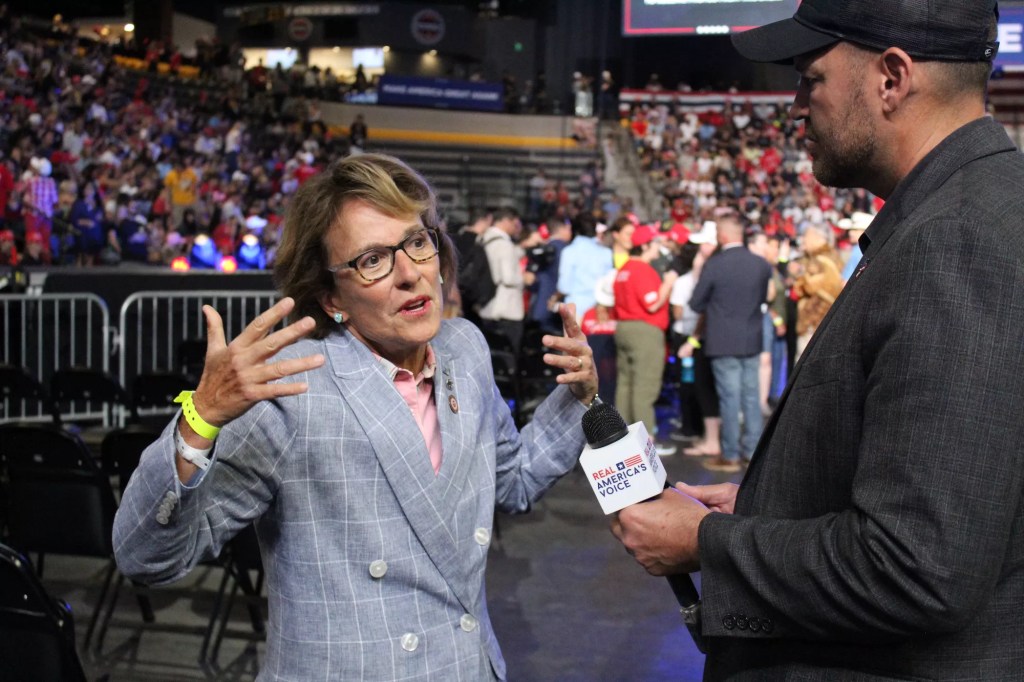
That’s the gist of a bill being pushed by Republican state Sen. Wendy Rogers, a notorious far-right lawmaker who was once censured by her own party for speaking at a white nationalist conference. Rogers has crafted a strike-everything amendment — that’s when a bill’s text is scrapped and replaced by something new — to a bill previously sponsored by fellow far-right state Sen. Jake Hoffman. Rogers’ version of Senate Bill 1570 would force county elections officials to strike agreements with federal immigration authorities to place immigration agents at every voting location, including early voting sites and ballot dropboxes.
The text of the bill requires that county boards of supervisors and county recorders, which share election duties in much of the state, “enter into a written agreement with a federal immigration law enforcement agency to provide for a federal immigration law enforcement presence at each location within this state where ballots are cast or deposited.” ICE agents may “observe election activities and perform lawful duties within the scope of their federal authority,” but cannot “interfere with the casting or depositing of ballots except as otherwise authorized by law.” They also could not “question, detain or arrest a voter solely for the purpose of determining voter eligibility.”
The bill applies only to the 2026 general election.
In a press release about the amendment, Hoffman and Rogers cast the measure as “intended to prevent violations of voter eligibility laws, establish consistent election security standards across all counties, and address ongoing public concerns about election administration following years of disputes and uncertainty.”
Hoffman said in the release that having ICE agents at voting sites would help to reduce “confusion, inconsistency, and a lack of visible accountability (that) have fueled doubts about how elections are administered” — a supposition rich in irony given that Hoffman, as an indicted fake elector who attempted to subvert the will of voters in 2020, is responsible for much of that confusion and inconsistency.
Rogers added in the release that “elections should never be surrounded by uncertainty or last-minute disputes that put voters and election workers in difficult positions,” though nothing in her amendment lays out how ICE agents would solve last-minute disputes or interact with election workers.
Hoffman was unavailable for comment when reached by Phoenix New Times, while Rogers did not immediately respond to an interview request.
Several voting rights advocates and Democrats think the amendment’s subtext is pretty clear: This law would allow the federal government to intimidate Arizona voters.
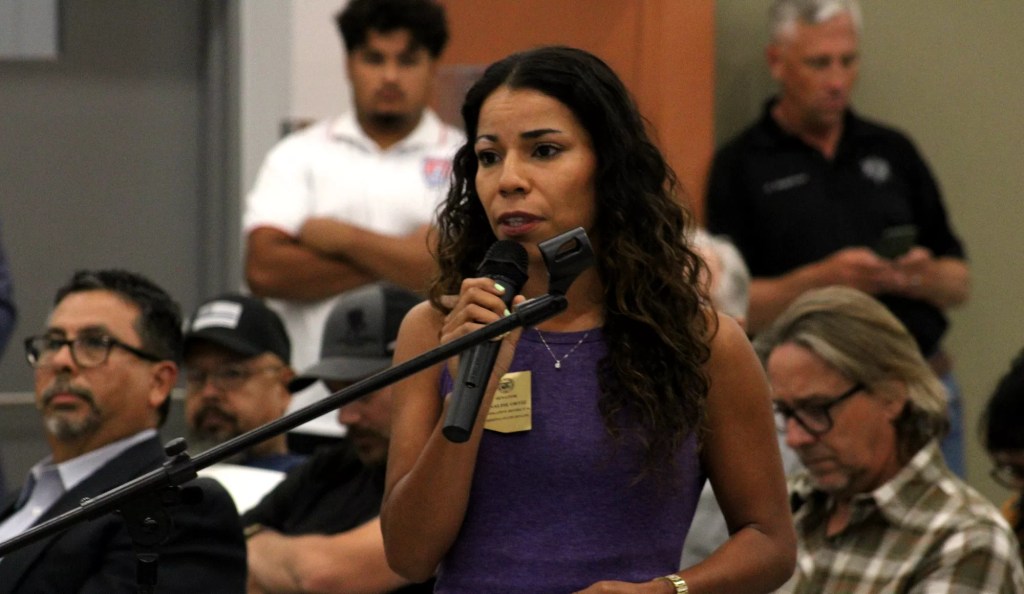
“It’s deeply disturbing,” said Democratic state Sen. Analise Ortiz. “It’s racist and it’s intended to intimidate people from turning out to vote.”
TJ L’Heureux
‘Clearly voter suppression’
ICE hasn’t had a great track record of arresting only those people it’s supposed to arrest. Reports have counted at least 170 U.S. citizens detained by ICE in the past year. Agents have stopped people seemingly for little other reason than the color of their skin or their accent, a pattern of racial profiling that Supreme Court Justice Brett Kavanaugh ostensibly green-lit in an opinion last year. Such stops are now called “Kavanaugh stops.” One Navajo man, Peter Yazzie, was wrongly detained in such a way in Arizona.
The increased presence of ICE agents has deterred even those with legal authority to be in the country from going to work or other public places for fear of being detained. Ortiz and others say it’s only logical to conclude that ICE agents at polling places would make Black and brown voters less likely to vote for fear of being caught in the agency’s haphazard dragnet.
“I wanted to give a copy of ‘1984’ to some of the legislators just to remind them: This isn’t a science fiction novel; this is what science fiction novels warned us about,” said Antonio Ramirez, the political and policy director of the advocacy group Rural Arizona Action. “SB 1570 is clearly voter suppression.”
It also may be illegal on its face. Both Democratic state Sen. Lauren Kuby and the Arizona chapter of the American Civil Liberties Union pointed to several federal statutes that they said SB 1570 would violate. Kuby referenced laws that prohibit the placement of troops at the polls and the intimidation of voters. Katelynn Contreras, a policy strategist with the ACLU, noted a law against “conspir(ing) to prevent by force, intimidation, or threat, any citizen who is lawfully entitled to vote.” Kuby also noted that ICE’s acting director recently told Congress that ICE agents have no business being at polling places.
Kuby and Contreras also referenced state laws against voter intimidation, including the state’s rule that prevents anyone but election workers, voters and legal observers from being within 75 feet of a voting location. Rogers’ amendment makes no mention of whether ICE agents would be kept outside that boundary.
“How does having ICE presence at every single polling location work with that?” Contreras said. “Are they going to be in the polling locations, observing the activities happening? Are they going to be outside of the 75-foot line? Are they going to be in marked vehicles and in uniform? Are they going to be in unmarked vehicles and in clothes? There’s a lot of practicality questions with the language.”
And though the bill as currently written bars immigration agents from stopping people just to ask about voter eligibility, the bill does expressly allow them to “perform lawful duties within the scope of their federal authority.” That authority, of course, includes stopping and detaining people suspected of being in the country without authorization. ICE agents have been documented basing such suspicions on flimsy evidence.
Ortiz thinks ICE inevitably would arrest someone legally trying to vote.
“There is no doubt that if this were to become law, Trump’s ICE thugs would be intimidating people and detaining United States citizens who are in line to vote,” she said. “That is not a question of if that would happen if this were passed. It’s a question of when it would happen.”
Morgan Fischer
‘Tyranny in the United States’
A spokesperson for Democratic Arizona Secretary of State Adrian Fontes blasted the bill in a statement to New Times, calling it “nothing more than an attempt to create chaos and intimidate voters from exercising their constitutional right to vote.” However, it’s unclear how the local Maricopa County authorities — who would be most affected by the bill — feel about it.
The Maricopa County Board of Supervisors, which is currently locked in a Republican-on-Republican election administration battle with MAGA-aligned county recorder Justin Heap, declined to comment through a spokesperson. Heap’s office did not respond to questions about his position on the measure.
But the previous recorder, Republican Stephen Richer, questioned the need for such a bill, noting that Arizona has some of the strictest voter ID laws in the country. Arizona voters must provide proof of citizenship when registering to vote in state and local elections and must show ID when voting in person. He also expressed his “great admiration and respect for the Maricopa County Sheriff’s Office,” which is charged with policing polling places in the county.
“I think they are equipped to provide any sort of law enforcement needed,” Richer said in a text message.
Ortiz drew a parallel between Rogers’ bill and the voter intimidation tactics used by law enforcement in the Jim Crow South. Richer pushed back on that characterization. He pointed out that Arizona voters who might hesitate to visit an ICE-policed polling location or dropbox could mail in their ballot, as most Arizonans do. However, he said the suggestion that the bill would intimidate Hispanic voters was a “reasonable hypothesis.”
“Federal uniformed presence at voting locations has been something viewed with great skepticism the past 40 years given its history,” Richer wrote. “The Voting Rights Act was usually enforced by suits (Department of Justice) rather than boots in the 1960s and 70s.”
Rogers’ bill was due to be considered in committee on Wednesday. Even if it were to clear both chambers of the legislature, it’ll die with a stroke of Democratic Gov. Katie Hobbs’ veto pen. But while it’s tempting to write the bill off as another display of “performative authoritarianism,” as Ramirez put it, Kuby worries about the corrosive effect such bills might have on voter confidence.
She pointed to a voting measure that is likely to go before voters this fall, bypassing Hobbs’ desk, that would limit early voting under the guise of election integrity. The measure would solve a non-problem — the perceived speed of finalizing the state’s election results — and would add unnecessary measures to prevent the mythical threat of noncitizens voting.
“In my time in the legislature and in my time as a citizen, the Republican-led legislature has been trying to whittle away at voting rights and voting access,” Kuby said. “They’ve acted to really increase disenfranchisement. We see bill after bill after bill.”
That Hobbs backstops most such proposals is “very calming for many of us,” Kuby said. But Hobbs is up for reelection this year and there’s a real chance that GOP Reps. Andy Biggs or David Schweikert could be sitting at her desk in 2027. “I believe Andy Biggs would be more than happy to sign a bill like this,” Ramirez said.
That would remove the last major obstacle to the Republican Party’s ongoing mission to, essentially, make voting harder in ways that directly benefit the GOP.
“They want this masked, violent paramilitary force to be the ones standing guard between Arizonans and their right to make their voice heard,” Ortiz said. “It’s really scary stuff. It’s the stuff of authoritarian nightmares. It’s what tyranny in the United States looks like.”