

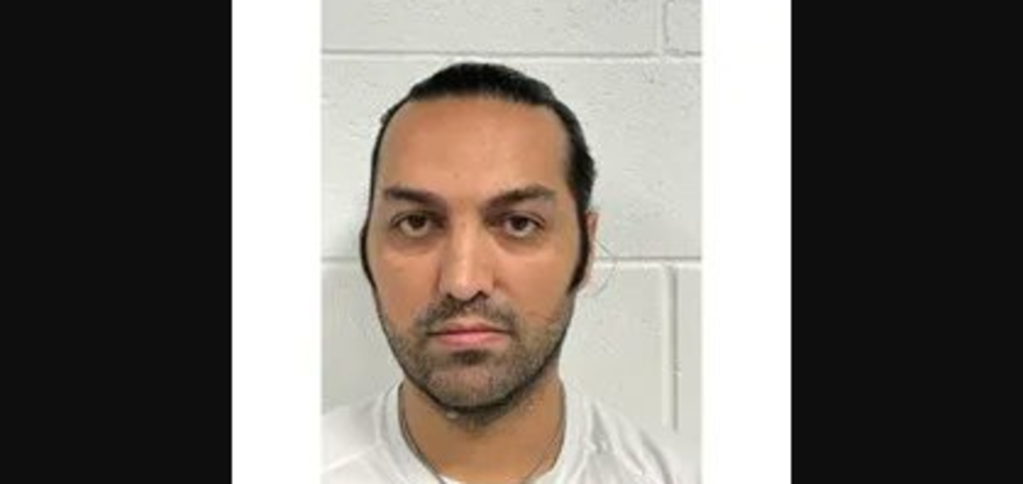
Courtesy photo

Audio By Carbonatix
Editor’s note: This story has been updated with a statement from Management & Training Corporation, which owns and operates the ICE facility where Mehrzad Asadi Eidivand is being held.
***
If Mehrzad Asadi Eidivand is sent back to his home country of Iran, his attorney says, he will be executed. Immigration and Customs Enforcement appears deadset on sending the 41-year-old undocumented Tempe resident there anyway.
Eidivand has been in federal custody since June, when he and his wife were arrested by Homeland Security Investigations agents at their East Valley home. HSI, which is a division of ICE, showed up at the couple’s home without a warrant. Eidivand’s wife, a naturalized U.S. citizen named Linet Vartanniavartanians, called Tempe police. In 911 call audio, she could be heard threatening to shoot the HSI agents if they entered her property.
That led to their eventual arrest — Vartannianvartanians for threatening a federal agent and Eidivand for possession of a firearm as an undocumented immigrant. Eidivand’s immigration attorney, Rebecca Cheaves, believed the pair was targeted by HSI in retaliation for Eidivand’s brother going on a hunger strike while in immigration detention in Florence. At the time, Cheaves was representing the brother, who has since been granted asylum and is in the process of obtaining a green card.
In late November, Eidivand and Vartanniavartanians took plea deals and were released with time served and two years’ probation. Vartanniavartanians is now free, but Cheaves said Eividand was immediately detained by ICE. For the last three months, he’s been held at the Imperial Regional Detention Facility in Calexico, California, a border town economically linked to the much larger nearby Mexican city of Mexicali.
Since Eidivand’s detention by ICE, agents have repeatedly signaled that they want to deport him to Iran by asking him to sign a deportation order without the presence of his attorney, Cheaves said. But back in Iran, she said, Eidivand faces an execution order because of his views against the country’s Islamist regime.
ICE acknowledged but did not respond to a request for comment.
According to Cheaves, the Iranian government issued the order against him in 2010 and delivered it to his family’s home in the country. She said she was not authorized to share a copy of that order with Phoenix New Times.
As early as 2003, according to a relative who spoke to New Times on the condition of anonymity, Eidivand began speaking out against the Iranian government, which led the regime to call for his arrest. Similar to a warrant, the order requires Eidivand to present himself for execution, or else the government will be looking to locate and kill him for the rest of his life. These types of orders never expire.
“He would be killed if he were returned to Iran,” Cheaves said. “ICE doesn’t care. They actually told him in custody that they didn’t care if he died.”
Eidivand fled Iran and traveled through several countries — including Turkey, Spain, Guatemala and Mexico — before arriving in the U.S. in 2012. In 2013, an immigration judge ordered him to voluntarily depart the country. Eidivand unsuccessfully appealed that ruling and has remained in the country. Cheaves has filed a motion for a stay of his removal proceedings and a motion to reopen his case with the Board of Immigration Appeals, arguing he didn’t have a fair shot to present his asylum case.
Cheaves said she has struggled to get any type of response from ICE about the status of her client’s case. She claimed that Eidivand’s prior immigration attorney failed to present his asylum case, including failing to show the judge his execution order. If the judge had seen that order, Cheaves said, “no immigration judge would have removed him to Iran.”
Since Eidivand left Iran, the Iranian government has only grown harsher toward dissenters. In late December, protests erupted nationwide amid an economic collapse that saw rapid food price inflation and extreme unemployment. Protesters called for the overthrow of the Islamic Republic, which resulted in a harsh, violent government crackdown. The government instituted internet blackouts and the regime killed more than 7,000 people, with hundreds of thousands more injured or arrested.
President Donald Trump has warned Iran that the U.S. may take military action in response to the crackdown on peaceful protesters, and the U.S. has instituted additional tariffs against the country. Despite that, the Trump administration deported 14 Iranians, some of whom would face similar danger to Eidivand, back to the country in late January.
Cheaves worries her client could be next.
“I’m doing everything I can to try to stop the deportation,” she said. “He’s very afraid that they’re going to come to him at any moment and just put him on a plane.”
Immigration and Customs Enforcement
‘I’d rather die myself’
The fear that he could be scooped up and deported in the middle of the night has taken a significant toll on Eidivand’s mental and physical health, Cheaves said. So have the detention center’s squalid conditions, which Cheaves called “abusive” and inhumane.
In the last four months, two Imperial Regional Detention Center detainees, Luis Beltrán Yanez‑Cruz and Huabing Xie, have died from heart attacks.
During his transfer to Imperial Regional Detention Center, Eidivand’s family lost contact with him for three days as he was moved from Colorado to Los Angeles, back to Florence and then back to California. He wore the same clothes throughout the transfer and was denied blankets despite fighting a sickness that would turn out to be a severe case of COVID-19, Cheaves said.
Soon after arriving in Calexico, Eidivand’s relative said Eidivand fell down multiple times, began throwing up blood and landed in the hospital. He’s back in detention now and has been there for three months, but conditions haven’t been any better.
His health has continued to plummet, Cheaves said. An unknown lump formed on his chest. The relative said he’s been denied access to a doctor — staffers have claimed to him that the facility has only nurses — and to medication for his chronic back pain. He’s been unable to get more than two or three hours of sleep a night.
Due to his dietary restrictions, Eidivand cannot digest anything that has lactose or carbohydrates, his relative said. The detention center hasn’t accommodated this, limiting Eidivand to consuming only water, coffee, peanut butter and occasionally chicken for three months.
Eidivand’s mental health has also deteriorated. He calls his family less often and has made concerning remarks during these calls, said the relative. When they do speak, his family begs him to keep going and tries to distract him with “stupid stuff to make him laugh.”
“He’s like, ‘Unfortunately, I’m still alive,’” his relative recalled him saying in a recent phone call. “He keeps saying that over and over, even the last time, he told me, ‘You know what? I’m just done with this. And if they’re going to kill me, I’d rather die myself.’”
The Imperial facility is run by Utah-based private prison company Management & Training Corporation. In a statement provided to New Times, company spokesperson Emily Lawhead “strongly dispute(d) the allegation that Imperial Regional Detention Facility fails to provide appropriate medical care, medication, or adequate nutrition.” She added that the facility adheres to ICE detention standards and is subject to regular oversight, though she said she could not comment on a specific individual’s medical treatment.
“Residents are provided three meals daily that are reviewed and approved by a registered dietitian,” Lawhead wrote. “The facility accommodates medically necessary and religious dietary requests in accordance with established procedures.”
Cheaves has been exploring other options to get Eidivand out of detention, including having him deported to another country that wouldn’t kill him as soon as he set foot on its soil. Mexican officials have said Eidivand can seek asylum there, but he needs to be there in person, Cheaves said. He’s currently locked up less than four miles from the U.S.-Mexico border.
“That’s where Mehrzad wants to go, Mexico,” Cheaves said. “He’s like, ‘I don’t even care if they don’t let me stay here, just send me to Mexico. I can live there with my wife.’ He doesn’t want to stay here. He wants to go to Mexico, where he feels like he can get better treatment.”
Prior to his detention, Eidivand was a big Trump-fan that “loved the United States to death,” the relative said. “He actually believed what Trump said, that ‘I’m a patriot. I’m going to make this country a better place. I’m going to make it great again.’” But this experience has broken the MAGA spell.
Now, Eidivand is begging the U.S. government to let him leave — and let him live.