
Phoenix New Times photo remix/Getty Images

Audio By Carbonatix
No wonder it went viral.
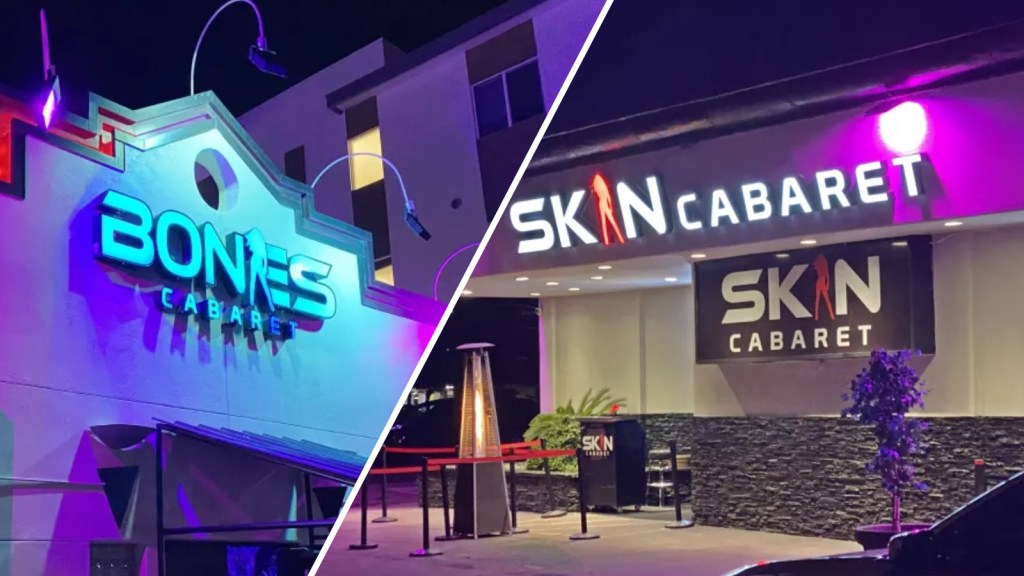
In March 2024, Fox 10 broke a salacious story that seemed, perhaps literally, ripped from pop culture. A lawsuit filed by patrons of three Valley strip clubs — Dream Palace in Tempe and Skin Cabaret and Bones Cabaret in Scottsdale, all situated along Scottsdale Road — claimed that dancers were drugging scores of customers and racking up six-figure charges on their credit cards.
Speaking anonymously, with their faces obscured or darkened, two alleged victims told the news station that they believed they had fallen prey to the same scheme portrayed in the 2019 film “Hustlers,” which starred Jennifer Lopez as one of several New York City strippers who, well, drugged wealthy clients and ran up their credit cards to the max.
Neither man could prove he’d been drugged, but each claimed that he was escorted to semi-private VIP rooms, where they experienced extreme impairment. One man described “symptoms not related to alcohol, something else that made me acquiesce and go along to what they seemed to be pushing.” A month later, Fox 10 followed up with an interview with one of the club’s former dancers, whose identity also was concealed. She’d seen men drugged, she said, their champagne spiked with “roofies.”
At the time, there were 20 men telling similar stories in the lawsuit filed by Phoenix attorney Rod Galarza. The complaint, which is still winding its way through Maricopa County Superior Court, now boasts more than 40 plaintiffs, with the total amount of allegedly bogus charges exceeding $2.3 million. The Fox 10 story generated a host of second-wave news stories about allegedly shady doings at the clubs.
And then…nothing.
In 2024, the Scottsdale Police Department told Fox 10 that the accusations were part of an “ongoing investigation” into the clubs. And yet no charges were ever filed in the case, and no charges appear likely to ever be filed. Scottsdale police presented the case to the Maricopa County Attorney’s Office and the Arizona Attorney General’s Office for prosecution, only to have both decline the case because, in the words of spokespersons for both agencies, “there was no reasonable likelihood of conviction.” A spokesperson for the Attorney General’s Office added that the investigation’s claims “lacked sufficient evidence.”
Though Galarza’s lawsuit persists, records show that if drugging was really going on at the clubs, Scottsdale police didn’t try very hard to sniff it out. Scottsdale investigators didn’t speak to any dancers working at the clubs, didn’t search the club for drugs and didn’t send in undercover cops. Former club employees who did talk to police reported no direct knowledge of any drugging scheme.
It raises the question: If all of this illicit, shanghai-style drugging and thievery was going on, why didn’t Scottsdale police bust the joints and close them down?
That question is addressed in a new lawsuit filed last month on behalf of Todd Borowsky, who owns the Skin and Bones clubs. (Borowsky is the brother of Scottsdale Mayor Lisa Borowsky, though she was not yet in office when Scottsdale police first touted its investigation.) Filed March 20 in federal court, the suit names the city of Scottsdale, the police department and several individual cops as defendants, accusing them of perpetrating a vindictive sham investigation against the clubs.
A spokesperson for the Scottsdale Police Department declined to comment.
Borowsky’s suit claims — and records obtained by Phoenix New Times show — that Scottsdale police never found evidence of wrongdoing, much less that anyone was actually slipped a Mickey. And according to the Scottsdale cops’ own reports, Borowsky’s clubs went to great lengths to document their clients’ pricey forays into VIP rooms, requiring signed contracts, a fingerprint and even a photo of the customer holding up the paperwork for each transaction. New Times has obtained several of these photos.
The reams of documents and exhibits backing up the suit make clear that if there was any truth to the allegations of criminal drugging and credit card mugging, the Scottsdale Police Department’s shoddy investigation screwed the proverbial pooch, overlooking exculpatory evidence and repeatedly avoiding no-brainer investigative techniques. And though the cops couldn’t prove that any dancers were misusing clients’ credit cards, that didn’t stop a Scottsdale investigator from figuratively reaching into the clubs’ purses and messing with their bank accounts.
Borowsky’s complaint insists his clubs were targeted for a takedown and have lost business as a result of a cop conspiracy to run him out of Scottsdale, and his complaint offers plenty of corroboration for this assertion. Whether or not Scottsdale police were attempting to retaliate against Borowsky for past conflicts remains unresolved.
But the record shows that Scottsdale police definitely had a hard-on for his adult businesses and apparently sought to drive him to ruin.
Benjamin Leatherman
Skin and Bones
It’s not hard to see why the drugging scheme claims were believable. After all, the amounts that strip club clientele spent at the three establishments are staggering.
One man supposedly charged a total of $179,200. Another charged $177,100. A third racked up $65,000 in charges. And so on. Many of those listed in the complaint filed by Galarza used American Express, which processed the charges.
Each plaintiff claims to have been “unwittingly drugged” and “kidnapped” by being separated from their friends and led into VIP rooms. Once they were incapacitated, their wallets and ID were allegedly taken from them and their signatures and thumbprints either faked or forced onto contracts. Then they supposedly were propped up for photos to document their purchases, despite being heavily drugged.
The latest version of Galarza’s complaint lists American Express, Borowsky’s two clubs and his affiliated LLCs as defendants. It alleges that the clubs engaged in “a pattern of illegal behavior,” and that AmEx effectively looked the other way as the clubs rang up the charges on its cards to insane amounts. American Express did not respond to a request for comment, but Galarza told New Times that he is currently in “31 arbitration proceedings against American Express,” which he can’t discuss in detail because the process is confidential.
“The only thing I can tell you is that my clients are happy,” he said.
Galarza pointed to the similarity in the tales being told by his clients and the fact that they didn’t know each other as evidence that they were victims of a racketeering conspiracy.
Many of the men conceded to Scottsdale investigators that they had been drinking prior to arriving at one of the clubs. Some claim their fingerprints and signatures were forged, though the Attorney General’s Office told New Times that it found no evidence of forgeries. Others contend that they were forced to sign and give fingerprints.
Interestingly, according to Galarza’s complaint, a few of the plaintiffs admit to charging exorbitant amounts — just not nearly as exorbitant as they were ultimately billed.
A Bones patron states that he was “rendered incapacitated by something given to him by club representatives” and charged a total of $177,100, but admitted to authorizing an astonishing $17,884 of the total. The guy who was charged $179,200 spent more than six hours at the same establishment, though he acknowledged that drinks and a private dance cost him $8,400, which he authorized.
Other than the eye-popping credit card receipts, though, there’s a notable lack of hard evidence that anything criminal was amiss. None of the men can prove they were drugged or — more importantly — that they were drugged at the strip clubs.
All of which sounds like morning-after shame to Dennis Wilenchik, the attorney representing Borowsky in both lawsuits. He believes patrons of the club get caught up in the moment, and, as indie rocker Beck once sang, go crazy with the Cheez Whiz. “Nobody’s putting a gun to their head,” Wilenchik said of the supposedly drugged patrons. “They get back home, they sober up, and they realize, ‘What the fuck did I just do?’”
Despite the sometimes six-figure bills, Wilenchik finds the “I wuz drugged” excuse a little too convenient.
“I can find no evidence anybody was drugged, OK?” said Wilenchik, who has also represented Borowsky’s sister, the Scottsdale mayor, in other matters. “And if they were, it certainly wasn’t with management’s knowledge.”
Scottsdale police didn’t find much evidence, either.
Jim Louvau
Coming up empty
Indeed, the best backup for Wilenchik’s advocacy is the record of a piss-poor investigation done by the Scottsdale cops into the claims of mass drugging being done in their backyard.
Borowsky’s lawsuit claims the Scottsdale investigation was retaliation for a series of events in which ex-Scottsdale police officers at the Arizona Department of Liquor Licenses and Control investigated Skin Cabaret during the COVID-19 pandemic over governmental social-distancing directives. The club was suspended in 2020 for allegedly violating COVID protocols. Shortly after, the investigator in the case was accused of inappropriately touching a dancer at Skin Cabaret. The same investigator had been in trouble previously for allegedly inserting his finger into the vagina of a stripper at the Hi Liter Gentleman’s Club in Phoenix.
The fallout from the scandal triggered internal investigations and the resignation of two senior liquor control officials. According to Borowsky’s complaint and supporting documents, a Scottsdale police commander was also reprimanded for his back-channel discussions with liquor authority officials about the dancer’s complaint. As a result, the Borowsky lawsuit maintains that Scottsdale Police Department muck-a-mucks “harbored retaliatory animus” toward Borowsky and his clubs.
“A lot of this is my conjecture,” said Wilenchik. “But as I see it, Scottsdale was going after people like Todd Borowsky, who they blamed for basically being part of a group that got rid of their buddies at the liquor department.”
That may be true, but police agencies in general have never needed an excuse to harass adult businesses, which are catnip for cops. And Borowsky was already on the Scottsdale Police Department’s radar. In 2006, he and other strip club owners helped overturn Scottsdale’s onerous anti-lap dance regulations. Over the years, Scottsdale police have raided and charged Borowsky’s clubs several times.
The probe into the alleged druggings began in 2021 when Dennis Metz, a detective with Scottsdale police’s financial crimes unit, was assigned to look into complaints of extreme over-billing and possible druggings at Borowsky’s cabarets. Initially, most of the complaints had been quickly closed by police.
In a revealing transcript of a July 2025 arbitration proceeding, which New Times obtained from Wilenchik, Metz was questioned by Galarza and attorneys for the credit card companies involved. Metz said that prior to his investigation, police treated the complaints as “a civil issue” and labeled them as such. But Metz began reopening complaints against the clubs from years prior, relabeling them as suspected violations of state laws against “fraudulent schemes and artifices.” He informed his fellow cops that any calls involving the three clubs should be written up and the reports sent to him.
From 2019 to 2024, he said, he identified 96 suspect complaints, 29 of which involved American Express. Many of the complainants were not interested in filing charges. According to Borowsky’s lawsuit, few had claimed to have been drugged when they first disputed their charges, only doing so after Metz reopened their complaints. New Times has not been able to verify this assertion.
Still, Metz testified in his arbitration deposition that no charges were ever brought, and that he could not establish a criminal conspiracy and had no evidence of anyone being drugged or anything else illegal.
When questioned by the attorneys and the arbitration judge, Metz said he had never requested a toxicology report during his years-long investigation. It didn’t matter anyway, he said, because even if the toxicology report turned up positive, there would be no way to know if a customer had been doped at one of the clubs.
The investigation involved other officers — as many as eight, according to Borowsky’s complaint — but Scottsdale police never assigned any undercover operatives to snoop around the clubs. Why not? Metz said the idea was discussed by his unit and by the Arizona Attorney General’s Office, which joined the probe at one point, but they decided against it because there were “a lot of risks.”
“If there is any truth to clients or customers being drugged, if I send a UC (undercover) in there, that UC is potentially going to get drugged,” he said.
That seems a particularly lame excuse, given that undercover cops get into lots of sketchy situations involving drugs, gun buys, organized crime and more — risky activities that, if undertaken by police, have the benefit of proving a criminal allegation. Metz also claimed that strippers could spot an undercover cop a mile away, which suggests that exotic dancers are somehow more wary of potential narcs, and better at sniffing them out, than drug dealers.
Metz claimed there was “never a task force” formed for the investigation, and that — surprisingly — he never listened to any of the initial recordings of calls from suspected victims or read their associated transcripts. Nor did he recall any of the complainants saying that their signature had been forged. Metz and the Attorney General’s Office did subpoena records from the clubs and various financial institutions, but they turned up bupkis.
One would think more than 40 people saying they were drugged and ripped off might be enough to request a search warrant to look for whatever was being used to allegedly zonk out club-goers. But there’s nothing in the transcript or in any of the police reports obtained by New Times that proves this happened.

fsHH (Pixabay), CC0, via Wikimedia Commons
Do the hustle
Metz testified that his investigation foundered because “no one wanted to talk to me. I couldn’t get dancers or managers to talk to me.”
In fact, Metz did talk to at least two former employees, as well as the clubs’ bookkeeper and a manager. None of them offered any indication that druggings were afoot. Quite the contrary.
As is recounted both in Metz’s testimony and in an August 2025 summary of his investigation, Metz and another detective met with the bookkeeper for Skin and Bones and with other employees. The bookkeeper believed all the charges were legit, and the employees explained the process they have for documenting large credit card charges: a signed contract, a fingerprint and a photo for each charge in a VIP room, all done in case the cardholder challenges the bill.
“The prices for a VIP room are $400 to $600 for 15 minutes, $800 to $1,200 for 30 minutes and $1,500 to $2,500 for an hour,” Metz’s report states. “Tips are extra. When the time ends for the customer, they can choose to add further time. If they do, they need to take another photograph, sign a contract and thumbprint it. Drinks are included in the price of a VIP room.”
A manager gave Metz and the other officer a tour of Bones Cabaret, where they saw the VIP rooms. The cops were told that the dancers needed a permit from the city of Scottsdale before the women were allowed to dance. The detectives later received copies of the contracts signed by customers.
In his police report, Metz stated that he asked the bookkeeper about one hostess who was tasked with taking photos and acquiring documentation. He was told the woman was an ex-employee who left on bad terms — in other words, a potential witness. Metz and an agent with the Attorney General’s Office, Heidi Chance, eventually interviewed this former employee via Zoom. But despite being involved in a labor dispute with the clubs, the employee threw water on the idea that anyone would be drugged and manipulated.
She admitted that it might be possible for a dancer to drug a customer. But she had never seen such activity, and if she had, she would have informed a manager, who would have been pissed. She also noted that “after the movie ‘Hustlers’ came out, more customers claimed they were drugged,” but she “could not understand why the customers would say they were drugged” because customers “would need to physically speak with their banks to get their charges approved.”
She had never heard of dancers using customers’ phones to approve charges with the credit card companies, or of dancers holding the phones up to the customers’ faces to gain access to the phones, as alleged in Galarza’s complaint. She never saw anyone put “roofies” or other drugs into the champagne that came with the VIP rooms, and explained that the bottles were unopened until brought to the rooms. She never saw a customer being posed by hostesses for photographs or saw fingerprints and signatures being faked.
In his arbitration testimony, Metz described interviewing another former Skin and Bones dancer who had been arrested on an unrelated warrant. The dancer told him she had never seen customers being drugged, nor had she participated in doing so. But she did report that “other dancers used to giggle in the locker room about drugging the customers” with Visine, which, according to various sources, contains an ingredient that could be used to facilitate sexual assault. However, in the parlance of attorneys, that’s referred to as “hearsay.”
In his investigative report, Metz observed that “all of the reporting parties report being in some state of intoxication before arriving at the cabarets” or in the cabarets themselves. Indeed, Metz had “re-contacted the reporting parties” to interview them about an alleged conspiracy to drug patrons at the clubs. Borowsky’s complaint suggests that it was hearing about the alleged scheme from Metz weeks, months or even years after the fact that gave complainants the bright idea to say they were drugged.
When asked about the massive charges incurred by some customers, Metz testified in his deposition that “I still can’t prove whether or not they’re legitimate.”
Courtesy of Dennis Wilenchik
Eyes wide shut
Despite the lack of proof — or, indeed, evidence to the contrary — Metz and Scottsdale police still took steps to screw with the clubs’ business.
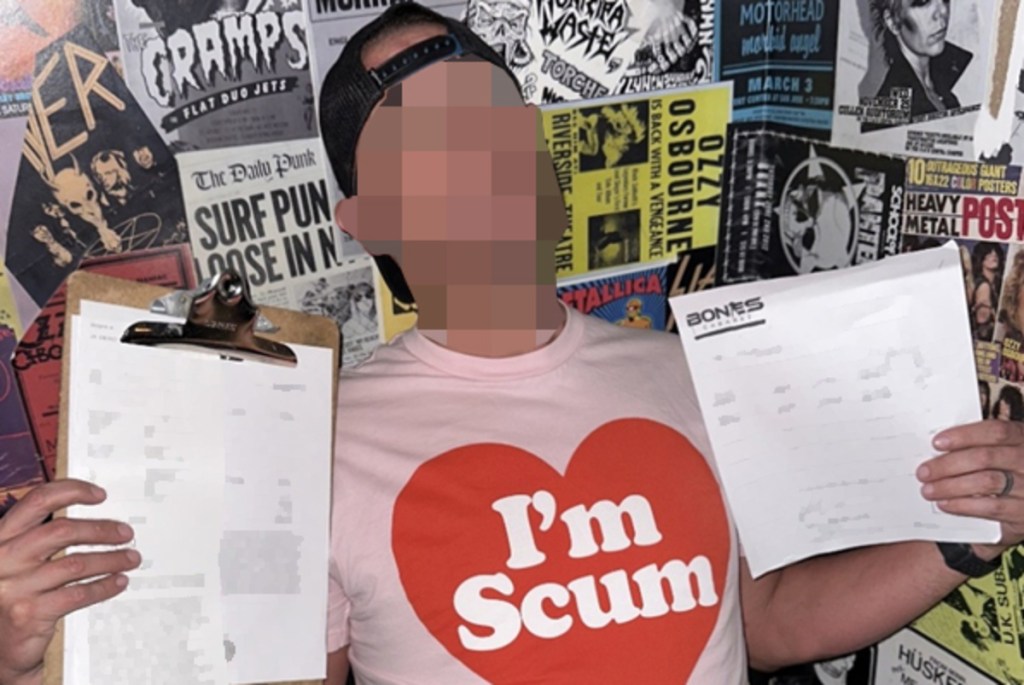
Some contradictory evidence exists in the form of photos of supposedly drugged patrons with their bills. Several such photos were given to New Times by Wilenchik, though New Times has not seen all of the photos in the case. Nor is New Times identifying the men depicted in them.
Several snapshots show Bones Cabaret patrons holding up signed contracts with shit-eating grins on their faces. One alleged victim is shown sitting up in a chair by himself, eyes wide open and a huge smile on his face as he holds his contracts with the club aloft. He’s wearing a t-shirt with a heart that reads “I’m scum.”
When asked, Galarza said he was unfamiliar with the “I’m scum” photo, but he said context was important. More than one photograph may have been taken of the individual during his sojourn in the VIP room; the question is: Which was first? But Galarza agreed that someone can black out and forget events from drinking too much alcohol, a common-enough occurrence to be the basis for “The Hangover” movie series.
The photos present a persuasive case that at least some of the massive charges were made with the full knowledge of the customers, which is the entire reason the photos were taken. They’re part of why many of the aggrieved patrons have so far been unsuccessful in overturning the charges with their credit card companies. So, unable to make the case against Borowsky’s clubs in a criminal filing, Scottsdale leaned on one credit card company to drive Borowsky underground.
Metz reached out to a contact who was a fraud investigator at American Express, informing her that the clubs were under criminal investigation and laying out the suspected conspiracy afoot. Metz testified in the arbitration hearing that he never advised the AmEx investigator on what to do.
Yet, in one April 2022 email to his superiors included as an exhibit to the Borowsky lawsuit, Metz wrote a to-do list that included “Contact American Express and ask about the possibility if they can revoke their products from use in Skin and Bones.” According to Wilenchik, AmEx complied, canceling out a huge source of revenue for Borowsky’s cabarets.
Metz also exchanged several emails with Galarza between 2022 and 2024, with Galarza sending at least one of his clients to file a police report on the suspect credit card charges. Galarza told New Times that this was for a credit card company, which needed a report for their investigation of the charges.
In one email to Metz, Galarza asked if he had a record of ever contacting the credit card companies involved. In another, Metz requested documents from Galarza regarding one of the counselor’s clients and the client’s dispute with AmEx. Galarza sent them to Metz later that day, saying, “Here’s what I have.” Metz also sent Galarza’s info to investigators with the Attorney General’s Office, telling them that he had “received a call” from Galarza, who “has multiple subjects that may be able to assist in the case.”
Galarza initially confirmed to New Times that he’d had communications with Metz, but when pressed on details in the emails, he said he had no comment.
When Fox 10 broadcast its stories on the allegations, the mood at the Scottsdale Police Department was practically celebratory. Emails show Metz and other officers passed around links to the pieces, with Metz forwarding a link to the Attorney General’s Office. They never turned the investigation into actual convictions, or even an indictment. But they’d managed to damage a private business, albeit a socially disfavored one.
“They were out to get Todd,” Wilenchik said, adding that the clubs have lost a lot of revenue as a result of the saga. “Metz set out along with a couple of others on a path to destroy them, and they did.”
What becomes of Borowsky’s lawsuit remains to be seen. The competing lawsuit from cabaret clients is still ongoing, even if the police investigation stalled out — due to a lack of evidence, incompetence or some other reason. “Everybody’s looking to pick everyone else’s pocket,” Wilenchik said of the suit against the clubs, and now “we’re going to try to pick Scottsdale’s pocket.”
“If nothing else,” he added, “we’ll get the story out in the end.”
This story is part of the Arizona Watchdog Project, a yearlong reporting effort led by New Times and supported by the Trace Foundation, in partnership with Deep South Today.