
Dante Dallago

Audio By Carbonatix
Advertising Can't Do It Alone
The challenges facing local news organizations are very real. That's why reader support matters more than ever. If you believe independent journalism matters, make a contribution today and help us reach our summer fundraising goal of $15,000 by August 9.
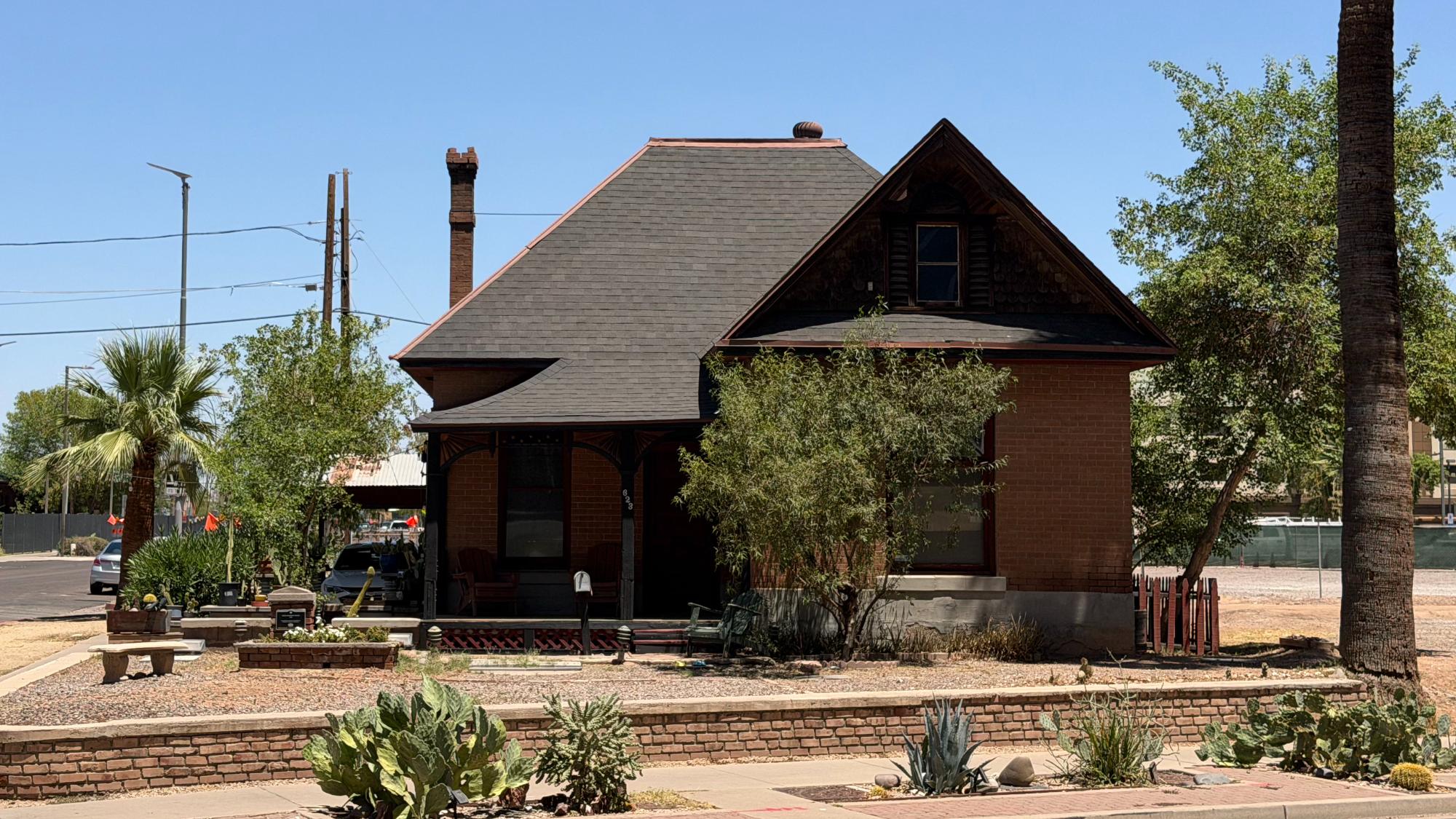
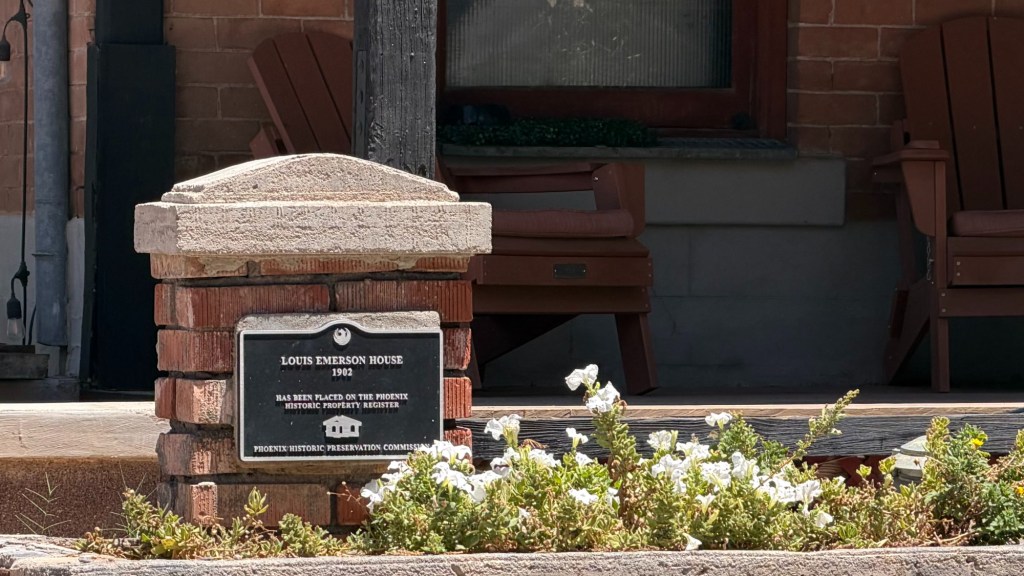
Among the newly developed high-rises, cycle studios and breweries in the Evans-Churchill neighborhood of downtown Phoenix sits a quaint Queen Anne-style house. The Louis Emerson House, built by its namesake in 1902, is one of the few single-family homes still standing in this neighborhood, known for Roosevelt Row.
But the Victorian-era house, a registered Phoenix historic property, may soon be demolished to make way for a massive new Arizona State University building.
On April 9, ASU broke ground on what it’s calling the “ASU Health headquarters” at 620 N. Fifth Street. The building will house the John Shufeldt School of Medicine and Medical Engineering, ASU’s new medical school that was announced last year.
According to ASU, the new ASU Health headquarters will be a five-story, 170,000-square-foot, state-of-the-art medical building dedicated to research, teaching and the future of Arizona’s health. With a $200 million construction price tag, the headquarters is scheduled to open in the ASU’s 2028 fall semester. It will be located on the lot situated between North Fourth Street and North Fifth Street, and East Pierce Street and East Fillmore Street.
Among those at the groundbreaking ceremony were ASU’s President Michael Crow, Phoenix Mayor Kate Gallego and Gov. Katie Hobbs. So Barry Schwartz, whose home happens to be in the way. Schwartz, who is the current tenant of the Louis Emerson House, said he approached Crow and asked him what would happen to it. Not knowing who Schwartz was, Crow replied, “We’re going to demolish or remove it.”
ASU has secured all the parcels on the plot except for the Louis Emerson House, and now it’s made moves to do just that. On May 22, the Arizona Board of Regents, which governs the school, filed a condemnation action lawsuit in Maricopa County Superior Court. Using eminent domain, ABOR requests “immediate possession” of the Louis Emerson House and the land it sits on.
The Arizona Board of Regents has not responded to a request for comment. In a statement sent to Phoenix New Times, ASU spokesperson Jerry Gonzalez said the university “made several offers to the owner to purchase the parcel, including options allowing for the house to be moved. The university’s final offer was based on an appraisal prepared by an experienced, state-certified appraiser, a copy of which was provided to the property owner. The offers were not accepted.”
Robert Young, the 89-year-old owner of the Louis Emerson House, doesn’t dispute any of that. But he does question the logic in razing such a piece of history.
“Why would anyone want to tear this down? It’s like a statue,” Young said.
Young lived in the house in the mid-1970s and even got married on its steps in the ‘80s. To make way for a realignment of Fourth Street in the 1990s, he already had to move the house a few dozen feet, doing so just 10 days before it was set to be demolished.
The house “has real craftsmanship, unlike the rusting building over there,” said Young, pointing to rust on a high-rise apartment building across the street that finished construction in 2021.
Young said he has already spent thousands on legal fees trying to save the house. He has set up a petition that has gathered 600 signatures and is also working with Preserve Phoenix, a nonprofit dedicated to preserving and protecting historical buildings, neighborhoods and districts. The nonprofit recently posted a video about the house.
Young said ASU’s first offer for the property was only $190,000. He ignored it. ASU then bumped its offer to $999,000, but Young refused because ASU wouldn’t pay for relocating the house, which Young said would cost between $2 million and $3 million.
Young has since been given a precondemnation appraisal by ASU valuing the 833-square-foot house and its 4,642-square-foot lot at $850,000. A precondemnation appraisal is required before filing for eminent domain. Under Arizona law, owners of properties seized under eminent domain must be given “just compensation” determined by a jury of peers; however, a judge decides the legality of eminent domain, and construction can begin before compensation is determined.
Dante Dallago
‘Mafia without a face’
The Louis Emerson House was once one of many houses in the sprawling neighborhood of Evans-Churchill, but redevelopment from the 1960s to the 2000s eliminated virtually all the homes. Preserve Phoenix treasurer Roger Brevoot said the Evans-Churchill neighborhood was one of the earliest and most prominent neighborhoods where “the movers and shakers” of Phoenix lived.
“This is one of a handful of maybe three or four houses from the pre-statehood era that remained to reflect the first edition subdivision in downtown Phoenix,” Brevoot said. “We have precious few turn-of-the-century houses in the city of Phoenix surviving.”
According to Phoenix zoning rules, properties on the Phoenix Historical Property Register are protected by a special review process that provides a demolition stay of at least one year before the historical property can be demolished. However, because the Louis Emerson House is being seized by eminent domain, it is legally unclear whether the demolition stay is enforceable against the Arizona Board of Regents, a state agency that is not subject to all of Phoenix’s local land-use regulations. Phoenix spokesperson Saneeya Mir told New Times that “local municipal zoning laws generally do not apply to state or federal agencies.”
Preserve Phoenix president Erin Lindsey said the nonprofit met with two ASU officials in January to discuss options for the construction project, including keeping the Louis Emerson House on the lot. There have been no further meetings.
“I hope ASU owns up to what I think are its obligations to respect historic properties. They do not have a good track record of historic preservation,” Lindsey said. She recalls several significant buildings ASU has demolished, including the Gold Dome Bank in Tempe, which was torn down in 2007.
“It seems like demolishing a property or just moving it out of the way is like this easy solution that they think of first. Rather than exploring, thinking outside of the box, and working with preservationists and architects who are experienced in historical preservation, to come up with creative solutions,” said Lindsey. “I think our city becomes boring and lifeless without interesting architecture that defines the sense of place.”
Schwartz, the tenant of the Louis Emerson house who has lived there for eight years, wants to make the historic house into a community space. (He declined to share what he pays in rent.) A visual artist, he has created a sort of museum inside the house, displaying photos and other archival material of historical Phoenix. He even built a coffee bar in the house that he opened to the public during recent First Fridays.
Schwartz said ASU has been hard to reach and opaque with its plans for the house. He was only recently served the condemnation action lawsuit early Friday morning. Standing outside the Louis Emerson House, looking at the dirt lot where the soon-to-be ASU Health headquarters will be, Schwartz felt frustrated.
“They’re like the mafia without a face,” he said.