
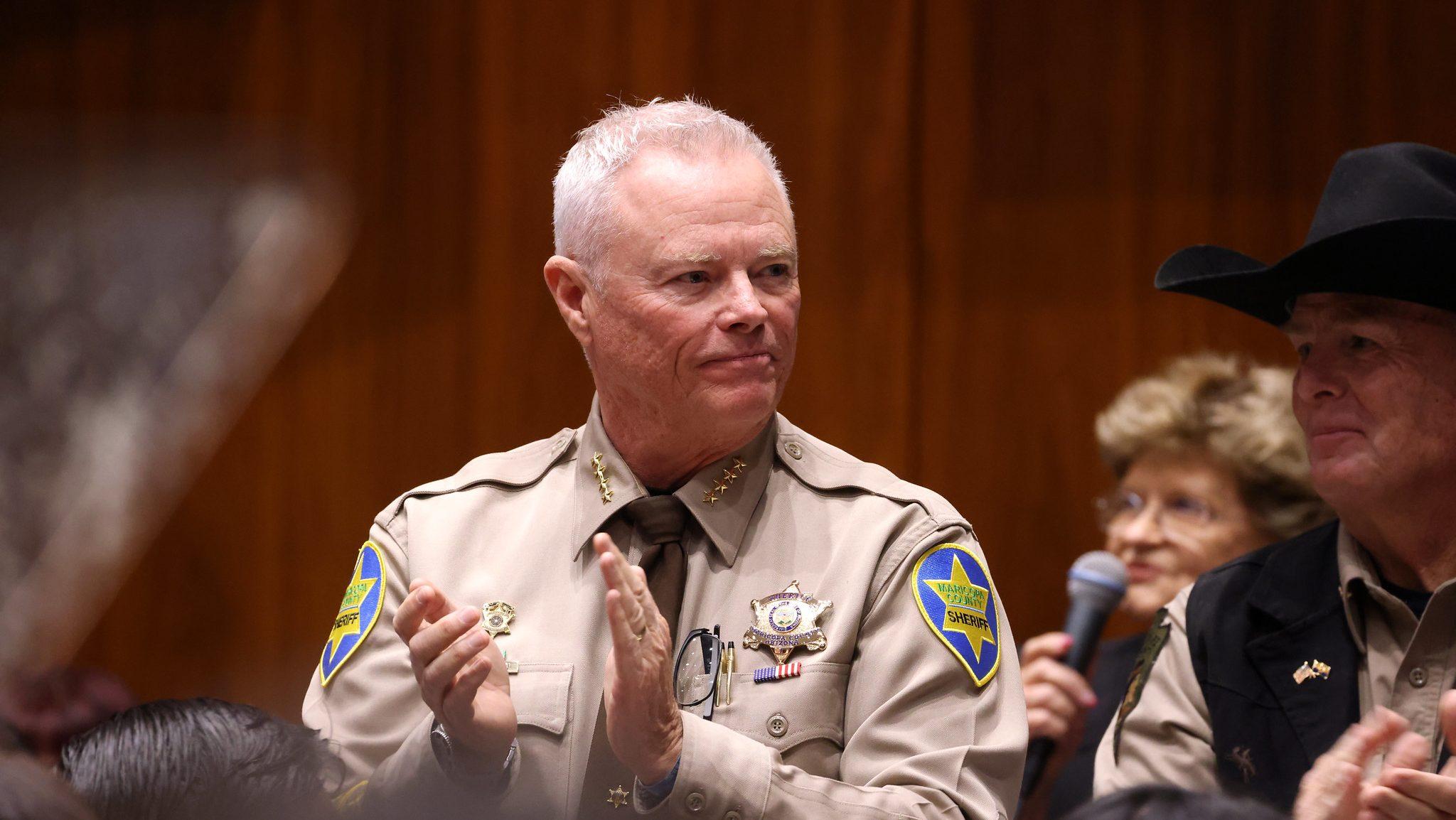
Gage Skidmore/Flickr/CC BY-SA 2.0

Audio By Carbonatix
If the Maricopa County Sheriff’s Office wants to get out from under the thumb of a federal monitor, it will have to work it out with the lawyers who successfully sued the department for racial profiling more than a decade ago.
On Friday, the federal judge who mandated independent oversight of the law enforcement agency signaled that he was not likely to reverse himself and end that oversight just because the sheriff’s office and Maricopa County leaders find it cumbersome. But the judge, G. Murray Snow, did say he’d be open to lifting some of his mandated reforms if the sheriff’s office can reach an agreement about it with the plaintiffs in the case, though he did not order the parties to negotiate on that front.
Republican county leaders have decried what they say has been a $350 million cost in complying with Snow’s orders, which include ending the practice of racial profiling and clearing a massive backlog of internal investigations complaints. County leaders and Sheriff Jerry Sheridan, a former Arpaio acolyte who took office in January 2025, have also claimed the agency is essentially in full compliance with those orders.
That’s not true, however. The sheriff’s office has not yet cleared its backlog of complaints, and the latest report from the federal monitor appointed by Snow raised significant concerns about Sheridan exerting undue influence over Professional Standards Bureau operations. Additionally, a 2025 audit by the monitor’s team found that the county had misattributed roughly 72% of that $350 million to compliance costs.
The county has also added to its costs by attempting to litigate its way out of monitoring. Since hiring an outside law firm for that purpose in February 2025, the county has spent nearly $200,000 on legal fees in what appears to be a Hail Mary effort to get out from under Snow’s orders.
The case, a class-action racial profiling suit that was brought on behalf of Latino drivers in the Valley, has gone on for nearly two decades now. In December, Maricopa County filed a motion to end the court-ordered monitorship of the Maricopa County Sheriff’s Office. The county argued that the agency had achieved sufficient compliance with Snow’s orders that it was no longer in violation of the Constitution, and that ongoing compliance was a financial burden.
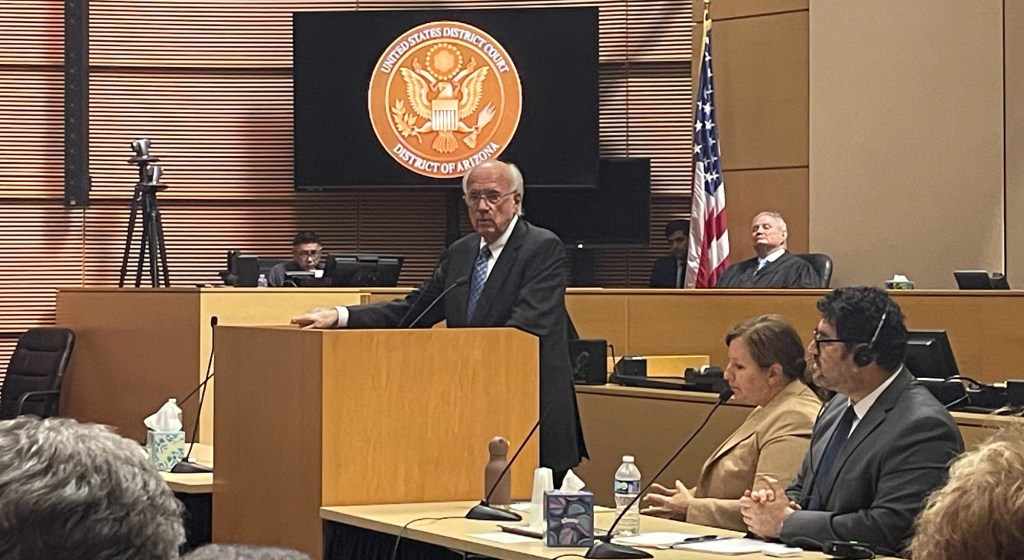
In a contentious hour-and-a-half-long hearing on Friday at the Sandra Day O’Connor U.S. Courthouse, all three sides — the federal government, the county and the plaintiffs, the latter of whom are represented by the ACLU — presented their arguments. Snow seemed inclined to deny the motion but did not issue a ruling.
In back-and-forths with the different attorneys, Snow made it clear that he didn’t think the county had met the burden of proof that it had made what he called “durable remedies” and completion of the orders’ requirements. And he didn’t trust that some of the changes were long-lasting, in no small part because of Snow’s own history with Sheridan.
“I’m not going to beat Sheriff Sheridan over the head about what he did in the past, but I’m also not going to forget it,” Snow said.
In the early years of the case, Sheridan, who was Arpaio’s top deputy, was found in contempt of court for, among other things, slow-walking internal investigations into deputies so they couldn’t be disciplined and manipulating the process to come out in their favor. More recently, the latest monitor’s report — the 46th quarterly report, published earlier this month — found that the department had backslid on compliance, including in its internal affairs process.
The monitor found that upon taking office, Sheridan and his command staff looked into reopening closed discipline cases that had gone through internal investigation by the Professional Standards Bureau, including for a deputy who had been found guilty of driving drunk. The monitor also found that Sheridan and his top brass then retaliated against the captain in PSB, who had resisted reopening cases because doing so was not in compliance with state law or the monitorship.
Snow said that finding disturbed him “because it has happened before in multiple ways in this very lawsuit, and the finding was that the current sheriff was the one who did it.”
Morgan Fischer
We can’t we be friends
Dominic Draye of the law firm Greenberg Traurig, which is representing the county, argued that everyone was making “a mountain out of a molehill” about the monitor’s findings. Draye said he found the findings in the monitor’s report to be suspicious, as it is the first and only report published since the county filed its motion to terminate. He also claimed the findings were irrelevant to the case.
“There’s been nothing to indicate an issue with respect to the treatment of the plaintiff class,” said Draye about the internal affairs process.
Despite his general skepticism of the sheriff’s office, Snow seemed open to lifting some of the restrictions and finding an “alternative remedy.” When he wrote his orders in the case, he had no idea that the case would still be active more than a decade later. But the big question is what to drop from the requirements imposed on the sheriff’s office. He questioned if he could send the parties off to figure it out, and if they would be able to find common ground.
“You’ve found that with the return of Sheriff Sheridan, you can’t work much out,” Snow said to one of the plaintiff’s attorneys, Stanley Young. “Does it make any sense for me to say, ‘Work it out, people?’”
Young said he thought they could. However, Young then argued against lifting the restrictions, saying that he didn’t think the agency had made long-lasting changes. Many changes the sheriff’s office has made happened because they were forced to. “Compliance by itself,” he said, “is not enough.”
Young gave the example of saturation patrols, a tactic previously used by the sheriff’s office in which it would flood neighborhoods known to have a lot of undocumented immigrants and round people up. Saturation patrols are not banned by the orders, he said, but the sheriff’s office has “chosen not to do them, I suspect because they don’t want to comply with the various court orders in that regard,” Young said. If the sheriff’s office started doing the patrols again, he said, it might fall out of compliance.
Young also pointed to the ongoing disparities in traffic stops. There’s been no documented ongoing racial profiling, he said, but the disparities persist, Specifically, the monitor found that stops of Hispanic drivers were more likely to end with an arrest than those of white drivers. The sheriff’s office should investigate why and figure out what is happening on the ground, Young said. Instead, the agency merely claims that Hispanic motorists are more likely to drive without a license. It’s also slow to report the data to the court.
“That’s just another sign that they are not taking their obligations seriously when it comes to addressing the issue of disparities,” Young said.
At the end of the hearing, Snow returned to the issue of the internal affairs process. He asked Draye, the attorney for the county, what remedy the sheriff could implement to guarantee that he couldn’t manipulate discipline or retaliate against those complying with the court. But Draye denied there had been any manipulation or retaliation against the PSB captain, saying neither was proven. And he defended the sheriff against Young’s accusations that the sheriff’s office is doing the bare minimum to comply.
“It’s frankly offensive! And it’s absurd,” he said.
Snow ended the hearing undecided.
“I don’t promise quick, but I do promise diligent efforts to make a ruling on this order,” he said before walking out of the courtroom.