
Geena Matsumoto for Phoenix New Times

Audio By Carbonatix
Reader support matters more than ever
We're in the final stretch of our summer campaign. Our goal is to raise $15,000 by August 9 to support the journalism our community relies on. Reader support is helping shape the future of local news.
At 7:30 a.m. on any given day, Jed Riding has already been at work on his Phoenix urban farm, Millennial Food Gardens, for hours.
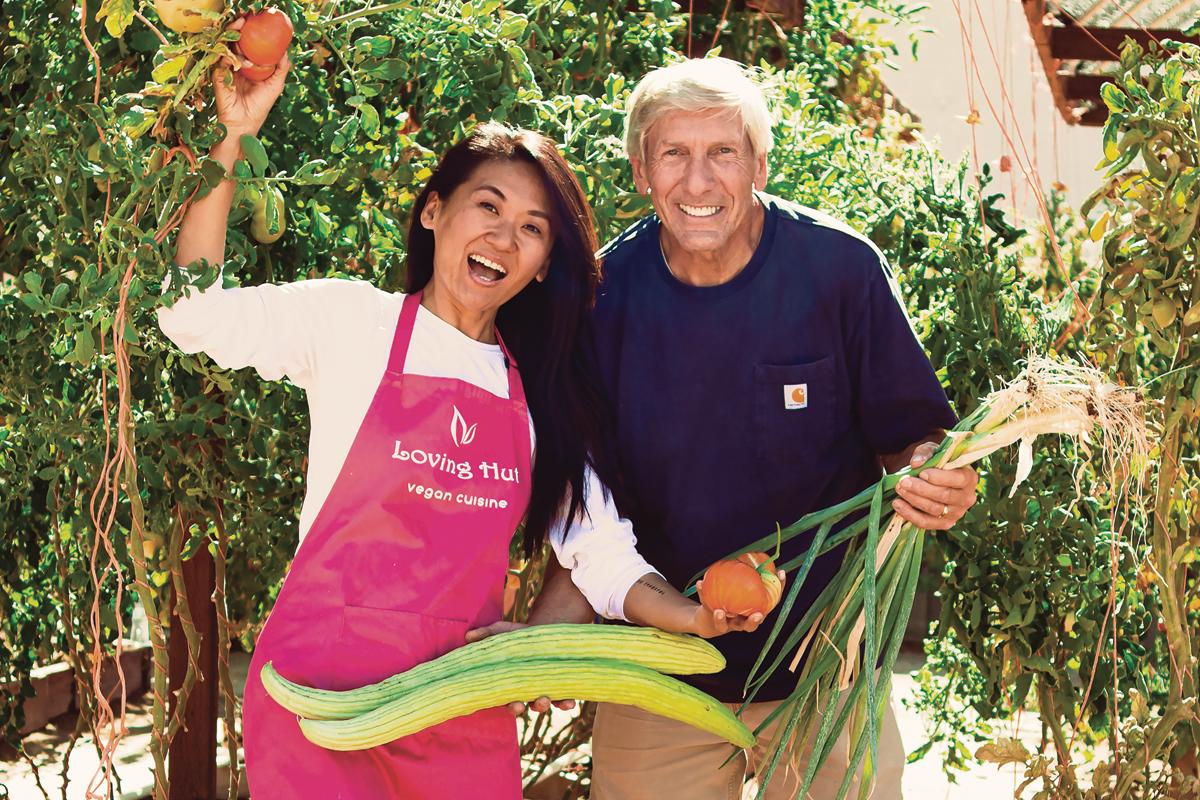
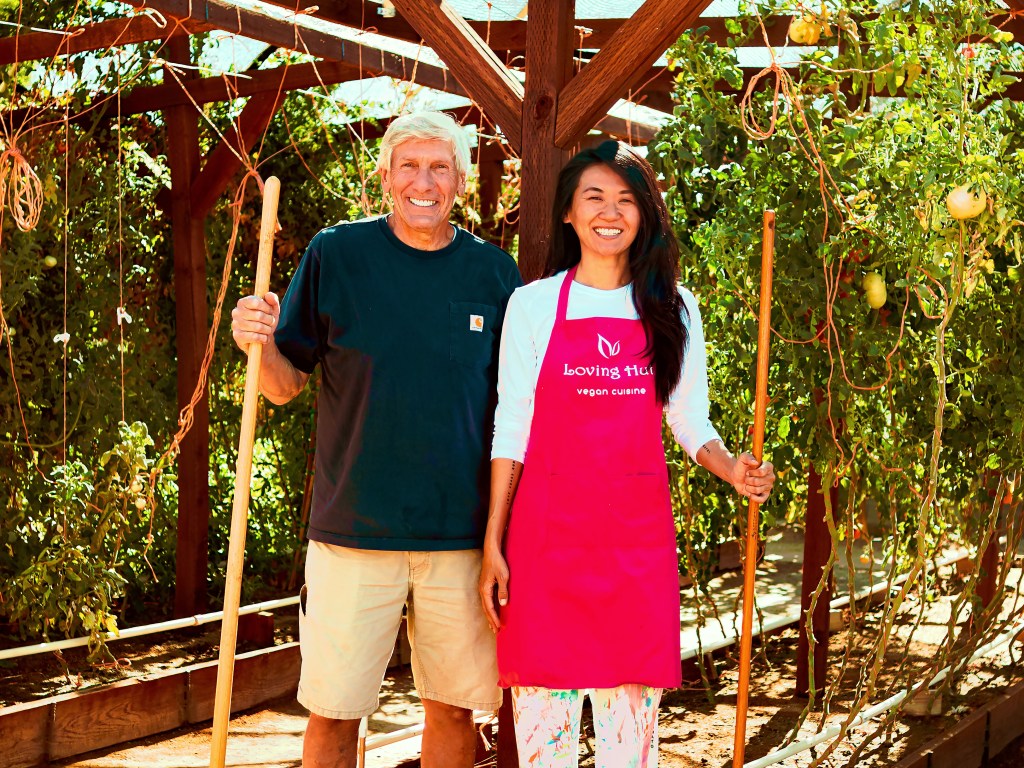
As I pull up to the low gate in front of the garden, I am warmly greeted by Linh La. She and her mother, Ngan Tran, own Valley locations of the restaurant chain Loving Hut.
La, a petite woman who wears two different-colored sneakers and a sport coat and exudes genuine warmth, is a frequent visitor at the garden. She met Riding two years ago while he dined at one of her restaurants. Since then, the two have formed a symbiotic relationship based on their love of building community, helping others and promoting sustainable practices.
La and her mother are both longtime vegans and opened their first Loving Hut in Glendale on Union Hills Drive and 35th Avenue 17 years ago. Subsequently, they opened other locations, most recently in Peoria.
“Our mission is good for you, good for the planet, good for the animals,” La explains.
Since opening, La has stuck to this ethos by eliminating food waste and giving meals to those in need.
“On a given day, we’ll give out five to 30 meals between the three restaurants,” La says. In Arizona, one in seven people are food insecure, according to the nationwide network of food banks, Feeding America. So this kind of help is essential.
With shared interests of helping others and being good stewards of the environment, La and Riding’s introduction was serendipitous.
Geena Matsumoto for Phoenix New Times
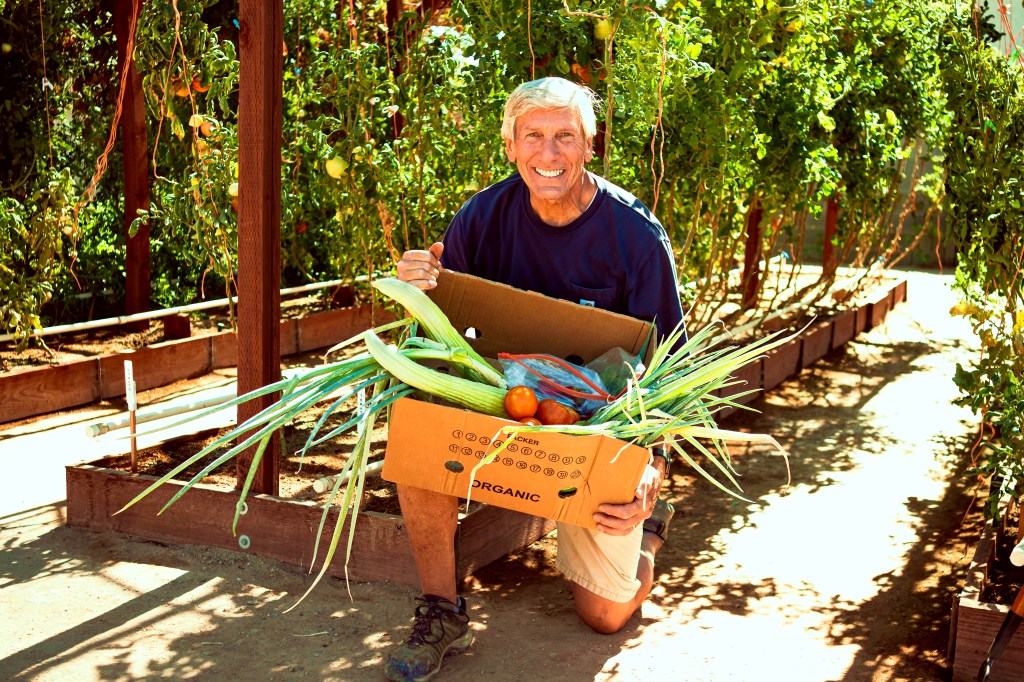
As we walk into the farm, Riding rushes to turn down the soft rock music playing loud enough to reach every corner of the three-quarter-acre property.
“It’s for the plants,” the septuagenarian says with a smile.
Riding grew up in Phoenix. His father kept a home garden, and after Riding got married, he continued the tradition by planting his own.
In 2020, Riding retired from his career in education and found himself with more time on his hands. Looking to do something meaningful, he soon put his gardening experience to use.
Riding’s brother-in-law, Ben Schaub, owned an unused lot just west of Interstate 17. For several years, it sat vacant, save for the occasional unsheltered person and lots of rocks.
Then, Schaub came across a way of gardening developed in the 1960s called the Mittleider Method. Schaub attended a conference on the method, developed by Dr. Jacob R. Mittleider, which focuses on using elements of organic gardening and a precise mix of nutrients to feed plants, generating high yields in small spaces.
Schaub created his own backyard garden using this method, and to Riding’s astonishment, it was full of thriving plants in the middle of July. Wanting to expand on the success of the home garden, the duo got to work.
As with many of the other thousands of vacant lots in Phoenix, the space had become a venue for drug use. It took clearing eight tons of rock and many used needles to make the land suitable for gardening. Riding encountered other challenges as well.
“Some of the frustrating things getting started are, you don’t know what you don’t know,” Riding says. For instance, APS would not provide electricity to the property unless it housed a structure.
So, Riding enlisted the help of friends and family to install solar panels on the roof of the preexisting shipping container, which provide just enough electricity to run the timers for the watering system, and a mini fridge to keep drinking water cool.
Riding also had to have the water line capacity to the property increased to efficiently water the plants.
In August 2024, they finished clearing out the lot and created Millennial Food Gardens. Soon, the small urban farm began to flourish.
“Right now, we’re donating 150-plus pounds a week to nonprofit organizations,” Riding says.
These include the local fire department, Valley View Community Food Bank and religious institutions in the area. La estimates, to date, the non-profit urban farm has donated an impressive 14,000 pounds of food.
Provided by Linh La
Tending the garden
Schaub’s dream is for every community in Arizona to have a similar garden. However, not every neighborhood has a Jed Riding.
“It’s a lot of work,” Riding says. “I came in and this thing was just a mess. It was lopsided. The container was over in the corner, buried in two feet of dirt. There was no back wall.”
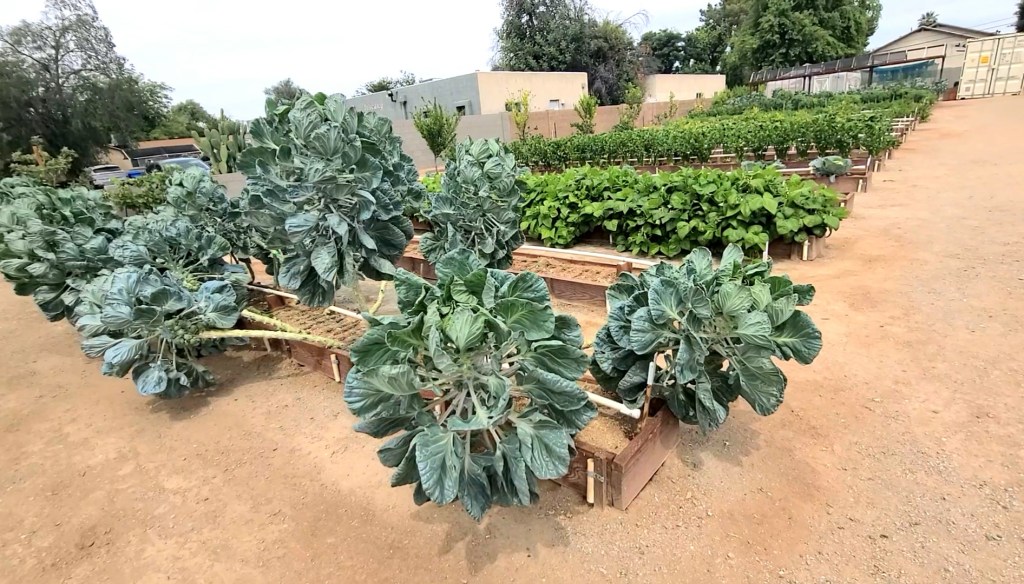
He leveled the ground, moved the container, built walls around the property, hauled away 16,000 pounds of rocks and installed garden beds.
To water the hundreds of plants, Riding engineered an eco-friendly, high-pressure irrigation system that quickly brings water directly to plant roots, reducing waste.
“There are seven different zones. And each zone gets watered for one minute every day,” Riding explains.
He also gives the plants a weekly dose of minerals, including magnesium and copper.
“What’s really genius about this place is that it’s so modular. It’s very easy to go from one bed to another, turn off the water on one bed,” La adds. “I want to learn more about gardens. Jed’s been teaching me so much. We (all) need to think about sustainability.”
Riding shares this sentiment, and runs the garden as a model for what people can do at their own homes.
“It doesn’t matter how big or how small your backyard is. We literally can help you create what we’ve done on a smaller scale. You can have a row that has lots of different vegetables in it,” Riding says.
He offers free advice to anyone who visits the farm, and has donated sawdust to people trying to start their own gardens.
Provided by Linh La
We approach a bed overflowing with green leaves. Riding bends down, plucks a stem out of the earth and several small white potatoes freely emerge. Digging down slightly with his sturdy hands, he pulls out four more small potatoes.
“We don’t use any kind of pesticides. Everything’s really clean,” Riding explains. He knows exactly what goes into the soil, including a blend of filtered sawdust, sand and minerals.
To control pests, Riding turns to all-natural methods and takes care to remove affected plant leaves before pests spread.
“The first year, we had aphids. It’s one thing to have aphids on your tomato plant, but it’s another thing to have a 30-foot row of aphids,” Riding says. He was able to get rid of the tiny insects known as “plant lice” by painstakingly spraying the underside of all the leaves with soapy water.
Riding also had an issue with a plant fungus that looks like dust. He researched the issue and found that diluted hydrogen peroxide would kill the fungus, and fortunately, it did.
The searing Arizona sun also poses a challenge; however, Riding says that the plants suffer the most damage from birds. He has tried numerous methods to deter them, including buying a sound box and getting a fake cat to guard the vegetation.
Fortunately, water consumption for the plants is relatively conservative.
“I spend as much at my home as I do on this huge lot,” Riding explains. Because of the sawdust in the soil mixture, water retention is fairly high. So, the water needed for the plants is relatively minimal.
“The biggest challenge is finding another Jed,” Riding says with a laugh. “I enjoy it, but summers are tough. By noon, it’s 100 degrees out here.”
Despite the dangers of working in the heat, Riding doesn’t plan on stopping any time soon. Working the garden has provided him with not only a hobby but a purposeful way of spending his retirement.
The garden includes 24 fruit trees, including peaches, pears and figs, 24 grape vines and a multitude of melons, squash, berries, root vegetables, greens, peppers, herbs and other produce.
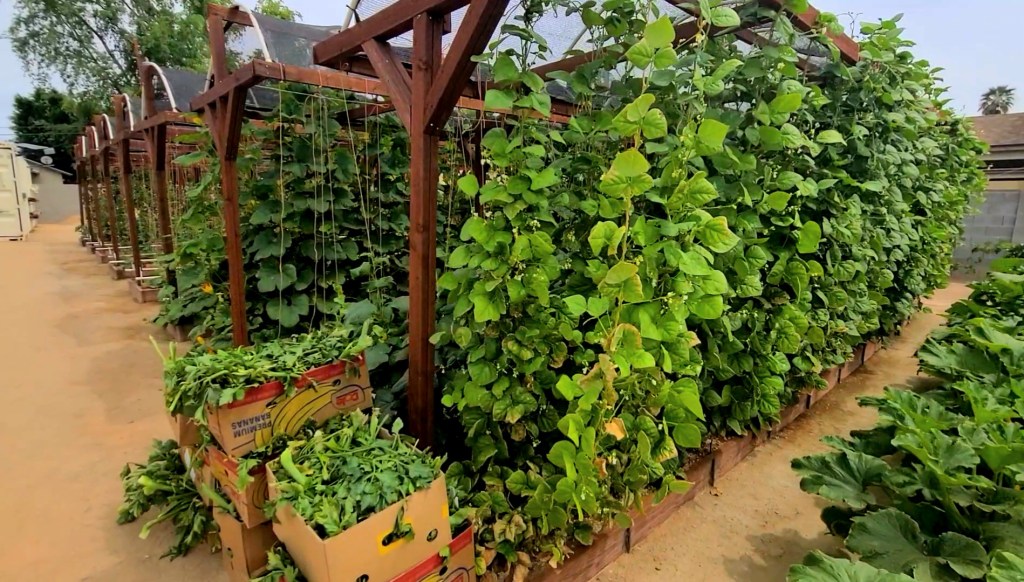
Toward the back of the garden, Riding built a greenhouse. The tidy structure offers a sheltered space for young seedlings. Walking over to another raised bed, he gently wraps new tendrils from viny melons and squash around vertical growing lines.
Geena Matsumoto for Phoenix New Times
Building community
For Riding, the garden is a passion project that fosters connections with its neighbors. Nearby residents, some of whom live only a few doors down, often meet for the first time at the farm.
“They’ll come and help, and I’ll give them food. We’ve got a great relationship; they’re just good people,” Riding says.
Riding hosts open house events at the farm. Recently, a nearby mosque held a meeting there. After the event, he gave the attendees buckets of produce.
“It brings the people together,” Riding says.
Due to the volume of work required to maintain the farm, Riding enlists volunteers through JustServe.org. Some have special needs, others have court-mandated community service. Riding loves teaching them all about gardening.
A couple of regular volunteers with special needs are some of Riding’s favorite people to work with.
“They’re showing up every week, and it’s really fun to work with them. They love it, they can get their hands dirty. Sometimes I have to go clean up after them, but who cares,” Riding says.
It’s clear the garden is treasured by others in the community. Riding describes how on occasion, he has left the lock open on the garden fence, and someone will come by and lock it after him.
“Something about working with your hands, being in the sun, donating to people in need, everything about this place is so magical to me,” La says.
Provided by Linh La
A partnership for the pigs
In late 2024, Riding was having lunch at Loving Hut in Glendale when he noticed videos playing in the dining area about Better Piggies, an organization that provides refuge to pigs and other farm animals that have been abandoned, surrendered or neglected. The footage piqued his interest, especially since he found himself buried in an excess of garden trimmings.
“Ever since I started, it’s been driving me crazy because I’m throwing away as much greens as I am donating,” Riding explains. He wished he knew someone with a goat or a pig who could make use of the extra.
Two weeks after speaking with La about the north Valley pig rescue, she came to Millennial Food Gardens for a tour and “completely fell in love at first sight,” she says.
La has volunteered at Better Piggies for four years. She became the connection point.
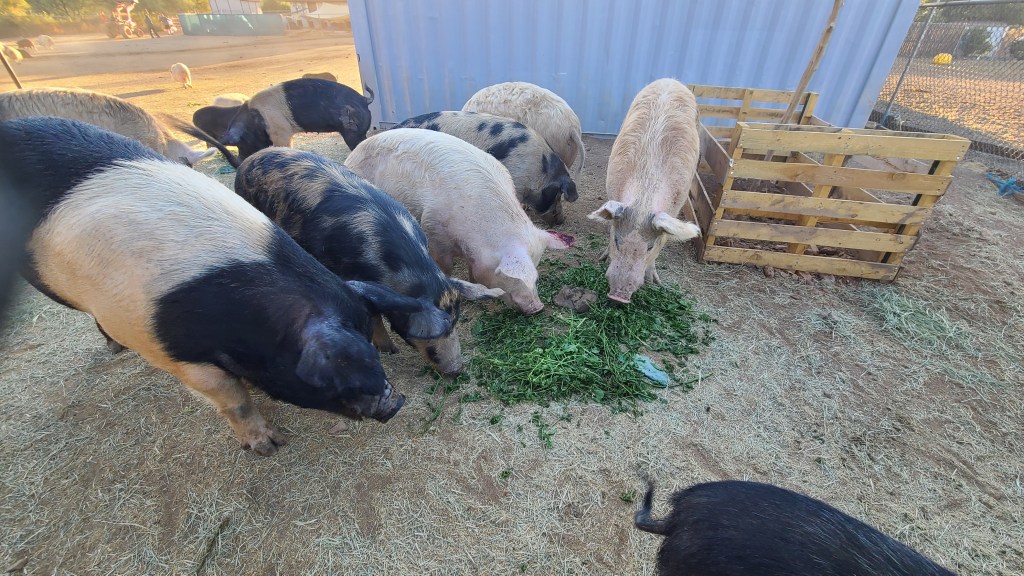
“I always bring our vegetable scraps from all three or four restaurants over there,” La says. “With Jed’s help, we’ve gone from 200 pounds of food per week for Better Piggies to now 1,100 to 1,200 pounds per week for the rescue.”
The two have an efficient system in place for getting the greens to Better Piggies. On Thursdays, Riding harvests and packages the greens. La then picks them up and refrigerates them at Loving Hut, until the food is brought to Better Piggies the next day.
“There’s 215 pigs and two cows,” La says as she pulls up a video of the donated greens being laid out on the ground via a tractor. Soon after, a crowd of pigs and a cow named Jerry rush over.
“All the pigs are just super, super excited,” La says as they eagerly run to the pile of fresh greens and bruised produce and start chowing down.
In addition to providing nourishment to hundreds of rescue animals, the impact of La and Ridings’ work is huge. Collectively, they help feed dozens of people in need each week, provide spaces that build a sense of community and advocate for environmental sustainability. Their partnership provides a sum greater than its parts.
For the former educator, it’s more than Riding ever imagined for his retirement project.
“Can you imagine turning a vacant lot into this?” Riding says. “I think the amount of food that we produce is mind-blowing, and it doesn’t take a lot to make this happen.”
For La, combining the mission of her restaurant with her fondness of Millennial Food Gardens was the perfect fit.
“We connect with people through eating food, and Jed connects with people through growing food. So it just makes sense for me to fall in love with this place.”
Millennial Food Gardens
2508 W. Vista Ave.