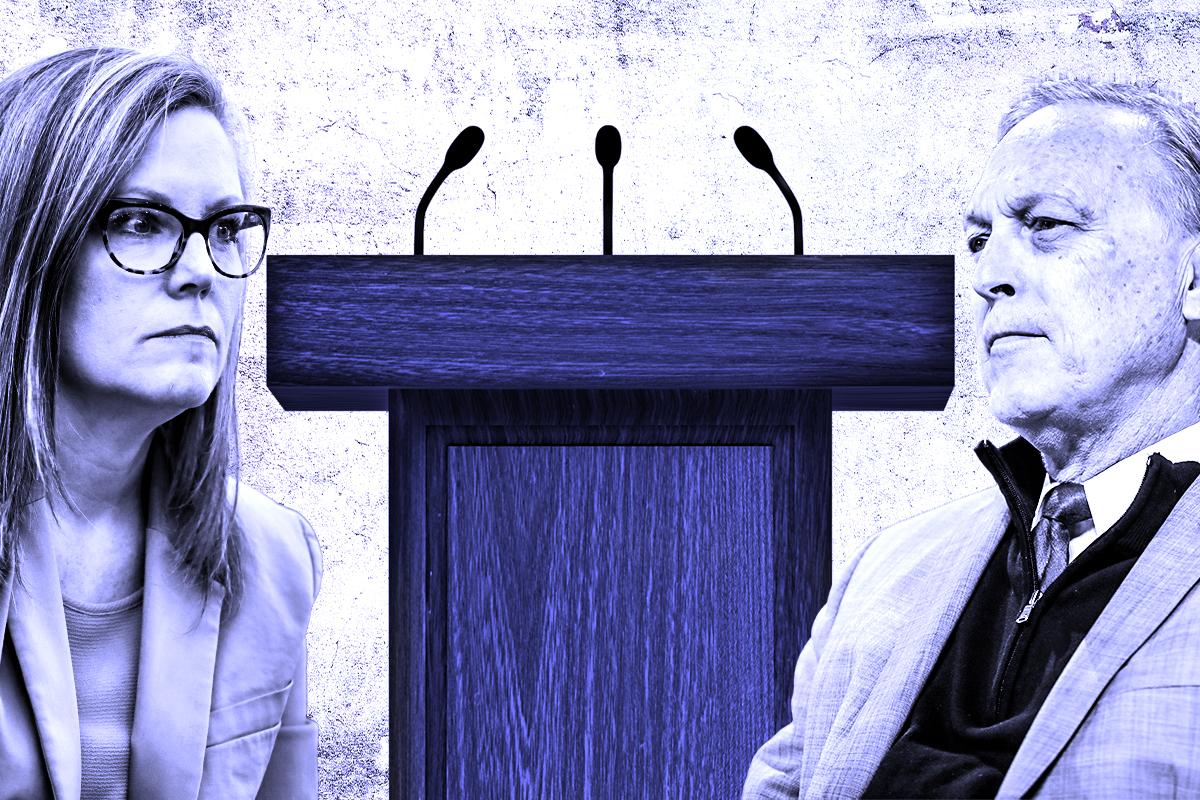
(Photo Illustration by Eric-John Torres / Photos by Gage Skidmore/Flickr/CC BY-SA 2.0 Images)

Audio By Carbonatix
Advertising Can't Do It Alone
The challenges facing local news organizations are very real. That's why reader support matters more than ever. If you believe independent journalism matters, make a contribution today and help us reach our summer fundraising goal of $15,000 by August 9.
Standing behind a podium in her office, her salt-and-pepper hair up in a high-messy bun, Gov. Katie Hobbs had to have anticipated the question.
Arizona’s primary elections were just 11 days away and the general election — in which the Democrat would be seeking reelection — was three months beyond that. Her opponent hadn’t even been determined, yet already her political foes were pounding a steady drumbeat that she was, well, chicken.
Hobbs infamously hadn’t participated in a single debate during her first campaign in 2022, and Republicans were already sharpening their knives over her perceived unwillingness to spar with her opponents this time around. GOP Rep. Andy Biggs, her likely challenger who ultimately cruised to a primary victory, had been slamming Hobbs for being unwilling to debate him. Turning Point Action executive Tyler Bowyer, whose far-right organization is backing Biggs, had taken to calling her “No Debate Kate.” Clips of Hobbs’ speaking engagements — with the governor talking in her typical halting, less-than-comfortable style — had been offered as proof for why she’d surely avoid debating once more.
Three days before this mid-July press conference, Hobbs had already been asked whether she’d debate Biggs or whoever won the GOP primary. It was too early for that question, she demurred, and she’d answer it after primary results rolled in. At the press conference, Phoenix New Times tried to squeeze a debate question in through the side door. Do you think debates still have value in the world of today’s politics? Again, Hobbs dodged, verbally gesturing at the election calendar.
There’d be “plenty of time to talk about debates in the general election,” she said, explaining that she was there today to talk about signing a bill to protect first responders. There was apparently a time and place for such questions, it seemed, and that was after the primary — though, notably, the debate question had been asked during a portion of the press conference set aside for off-topic queries.
The morning after the primary, New Times tried again. The night before, Biggs had sewn up the GOP nomination within minutes of the first results being reported, and the Hobbs campaign had already released an ad attacking him. After a campaign stop at a Gilbert group home, New Times broached the subject again: Governor, will you debate Andy Biggs?
Post-primary or not, the runway was still closed for debate questions.
“There is going to be plenty of time to talk about debates in the coming days,” Hobbs said, against ducking the subject and redirecting to her “Arizona First” campaign tour. When pressed for when that time would be, Hobbs noted that “we have 104 days left to talk about that.” Perhaps on one of them, she actually will.
If history is any guide, Hobbs may duck the debate question all the way through the election — and potentially all the way to a reelection win.
When she first ran for governor in 2022, a similar will-she-won’t-she question dogged Hobbs before she quite publicly declined to debate Kari Lake, her bombastic MAGA opponent. Hobbs’ team argued that voters wouldn’t be served by allowing Lake — a polished former TV reporter turned Trump sycophant — to yell and spout conspiracy theories without an adequate mechanism to keep her in check. The two women were given separate sit-down interviews instead, and Hobbs’ debate-shyness ultimately didn’t cost her. She bested Lake by 17,000 ballots and a slim 50.33% of the vote.
Hobbs didn’t debate her primary opponent that year either. In fact, she hasn’t actually debated anyone since she ran for secretary of state in 2018, when she took on Republican Steve Gaynor in a televised Arizona PBS forum.
That might rightfully make Hobbs the queen of avoiding debates just as much as she’s the empress of gubernatorial vetoes. But in Arizona, the “to debate or not debate” question far predates Hobbs’ political ambitions.
Every four years at least, it seems, one candidate for high office in the Grand Canyon State accuses another of wussing out on their democratic duty to offer up their views to be challenged by campaign rivals. Candidates have flunked debates and decided future showdowns aren’t worth the political risks. They’ve avoided them only to be shamed into participating as November neared. Just as much as Arizona’s political calendar is defined by political debates, it’s defined by debates about political debates.
Hobbs’ victory four years ago suggests that perhaps that quadrennial conversation is overblown. Do these debates even matter? The governor herself has opined that they don’t. In May, during an in-studio appearance on the KTAR talk show “Bruce and Gaydos,” Hobbs once more evaded a question about debating Biggs, adding that she has found recent debates to be vapid. The last several she’d watched had “devolved into a circus,” she said, citing the 2022 GOP primary debate for Arizona governor and debates in the recent California governor’s race. “I don’t know what voters get out of that,” she said.
Are debates still valuable? Do they inform voters, or even affect electoral outcomes? As one might guess, that’s all up for debate.
Ethan Miller/Getty Images
A long history
The debate about whether to debate is just about as old as televised debates themselves.
Until Hobbs declined to debate Lake in 2022, candidates for Arizona governor have debated ahead of every gubernatorial election since at least 1954. They also accused their opponents of trying to avoid them.
In advance of the 1970 election, Democratic candidate Raul Hector Castro repeatedly griped that incumbent Republican Gov. Jack Williams was ducking a debate with him. When Williams backed out of a Tucson debate in October of that year, his campaign co-chairman blamed it on Castro ignoring a letter about having a debate and said Williams’ duties as governor “have been so time-consuming that his campaign schedule must suffer.” The pair eventually did debate right before Election Day, and Williams went on to a narrow victory, winning by a little more than 7,000 votes.
That wouldn’t be the first time an incumbent governor decided a debate was not worth the effort — or the risk.
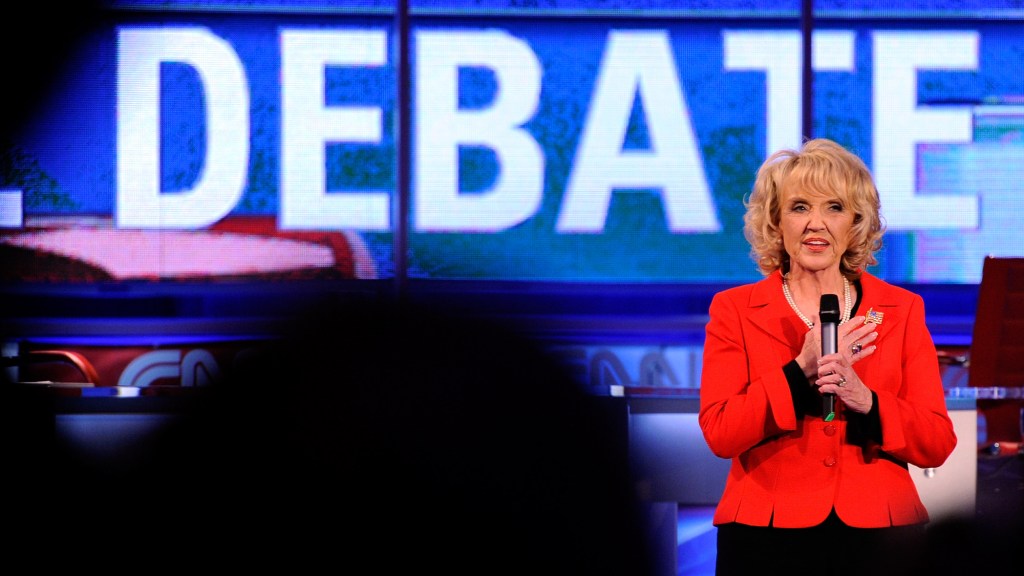
Republican Gov. Jan Brewer’s 2010 campaign was not without its debate-related hiccups. In an Arizona PBS debate against Democratic Attorney General Terry Goddard and other challengers, Brewer repeatedly froze during her opening statement. She opened by acknowledging the moderator and her fellow candidates before turning to look directly in the camera.
“I have, uh…” Brewer said before putting her head down while clasping her hands. “…done so much,” she finally continued after looking up. “And I just cannot believe we’ve changed everything since I’ve become your governor in the last 600 days. Arizona has been brought back from its abyss.” She got through another sentence about the budget before pausing again, with her hands clasped, to take a deep breath. She was wordless for 13 seconds, looking down at her hands and letting out a sigh-like giggle, a smile growing across her face. At last, she looked at the moderator and reboarded her train of thought. “We have,” she said, taking another brief pause, “um, did what was right for Arizona.”
Brewer ultimately finished her minute-long opening statement, touting her accomplishments in passing the state’s infamous Senate Bill 1070 and her efforts pushing back against the federal government. But the moment lives in political infamy. “I honestly thought that she had some kind of health issue,” Goddard recalled in a recent conversation with New Times. “And that maybe a Heimlich maneuver was what needed to be done.” Political consultant Chuck Coughlin, then Brewer’s campaign manager, attributed her freeze-up to Brewer listening a little too intently to the other candidates, which left her unprepared when it was her turn.
In the aftermath, Brewer decided she had little to gain — and potentially a lot to lose — by participating in another debate. “(Debates are) not her strength,” Coughlin told New Times. “You have to understand who you’re dealing with and what their skill sets are. And then you’ve got to prep them for that.” Brewer declined to debate Goddard a second time, and faced criticism for avoiding him. Then, perhaps proving the wisdom of avoiding a debate, she drubbed Goddard by more than 200,000 votes and remained in office.
In 1998, Democratic gubernatorial candidate Paul Johnson blasted Republican Gov. Jane Hull for not agreeing to a larger slate of debates. As is often the case with the debate debate, the actions of both sides were informed by political calculus. Johnson, now 67 and the chair of the Arizona No Labels Party, admitted to New Times that he pushed for the slate “probably because I was behind in the polls” — after the first debate, his campaign’s early internal polling showed his support jumped from 20% to 40%. Hull’s campaign didn’t want to debate anymore, arguing that she was also too busy acting as the state’s governor.
A popular incumbent, Hull was so far ahead of Johnson that she didn’t need to stoop to debating him. “That’s a classic strategy if you are far ahead,” the pollster told the Arizona Republic at the time. “It makes it literally impossible for the competition to get any publicity.” Johnson lost to Hull in a landslide.
It’s old hat for candidates to decline debates, and for their rivals to claim they’re scared. In 1974, former Phoenix Mayor John Druggs passed on debating one of his primary opponents, Milt Graham, arguing that there were more people in the race. In a 1986 contest to take over Barry Goldwater’s seat in the U.S. Senate, Democratic candidate Richard Kimball accused Republican John McCain of refusing to debate him. In 1994, incumbent Gov. Fife Symington was criticized for not attending a debate hosted by a youth crisis shelter in Tucson. He cited a conflict.
And sometimes, especially when an incumbent is in the race, a candidate is actually too busy. In 2002, Democratic Gov. Janet Napolitano was criticized for skipping a candidate forum hosted by a Spanish-language radio station. Mario Diaz, her campaign manager at the time, attributed the absence to a previous commitment. Speaking to New Times recently, Diaz said Napolitano’s campaign would receive many debate invitations from special interest groups but that preparing for them was “laborious.” You can’t accept every invitation.
“You’re going to get criticized for any decision one makes, but as a campaign manager, we have to make those tough calls,” Diaz said. “I wouldn’t run the campaign based on what other people are saying. It’s just about what’s best for my candidate.”
In 2022, that seemed to be the strategy for Hobbs, an uneasy public speaker whose opponent was a tremendous bullshit machine that no debate format could hope to contain. That avoidance couldn’t have hurt her too much, given that Hobbs went on to win, albeit narrowly. But it did break with a tradition of at least one gubernatorial debate each cycle going back at least 70 years.
That debate-less win raised another question: Do these debates even matter?
Diannie Chavez/Arizona Republic – Pool
Do debates matter?
Debates certainly can do harm, which might explain why candidates try to avoid them. After all, had Joe Biden not speed-run a decline into senility during his lone 2024 debate against Donald Trump, Biden might still be in the White House.
But that was a presidential debate, which was watched by tens of millions of people. For debates at lower levels of government — even with important offices like governor up for grabs — the effect on a campaign is arguable. Rarely is a debate the deciding factor in who wins or loses.
One argument for participating in debates has nothing to do with whether they help, hurt or move the political needle at all. Candidates should debate, Goddard says, because it’s the democratic thing to do.
“I remember considering it to be pretty much as much of a requirement as filling out the form to say you’re a candidate,” Goddard said. “You didn’t duck debates, because for however much they tend to be abused with stunts and with trying to get sound bites out of your opponent, they’re the one chance the public gets to see you outside of the advertising medium. And I think that’s critically important.”
Chris Cumminskey, a former state lawmaker and secretary of state candidate who pushed for the passage of the Clean Elections Act in 1998, agreed. Debates are often the only time voters see all the major candidates “on the same stage,” he said, “and you can kind of do a compare and contrast.” Former candidates and political consultants also point to debates as the only opportunities for the public to witness candidates discuss important issues in an open forum rather than in television ads, campaign mailers or at political rallies. In a debate, you can’t hide behind money or a campaign manager.
“Nothing is a perfect forum,” Goddard said. “But when everything else that you see is some kind of structured advertisement, it makes the debate even more important.”
Well, maybe. Research says that political debates have some effect on voter knowledge, but that effect isn’t large.
A 2013 University of Missouri study found that voters find debates most useful when one candidate is “relatively unknown,” many voters are undecided, the race is close and party allegiances are weak. Even under those conditions, voters use debates to gauge candidates’ personalities and character rather than their policy positions, which are often wonky and difficult to distill into 90-second sound bites.
Still, the study also found that voters’ “democratic attitudes and behaviors” are positively affected when they tune in to debates, which heighten a viewer’s interest in the ongoing campaign and encourage voters to “seek out additional campaign information following their debate viewing.” A 2020 study in the Journal for Political Economy found that watching debates led to voters gaining higher political knowledge, including awareness of candidate policy stances and improved “alignment” between voter policy preferences and those of their elected candidate.
But do debates sway people? Not really. The University of Missouri study also showed that general election debates have little effect on voter choice. More than 86% of voters don’t change their candidate preference following a debate. Debates lead undecided voters to choose a candidate only 7% of the time, and only 3.5% of debate-watchers switched from one candidate to the other.
Gage Skidmore / Creative Commons
And that’s people who watched the debates. Not many do. Take the gubernatorial debate in the GOP primary this year, arguably the highest-profile race on any primary ballot. While over-the-air viewership numbers are hard to come by, the YouTube view counts of the 32 news organizations that streamed the debate totaled roughly 28,000. For comparison, more than 603,000 voters turned out during this year’s GOP primary for governor, when Biggs bested Rep. David Schweikert by more than 359,000 votes.
If you’re a front-running candidate, what is there to gain by debating? Campaigns don’t believe there’s a downside to skipping debates, Cumminsky said, because the public doesn’t demand them anymore. There’s more risk than upside — a gaffe winds up in your opponents’ ads while your minute-long soliloquy on water scarcity is forgotten almost as quickly as the words came out of your mouth.
“The risk in participating in these debates is that you can’t control some of the things that happen,” Cumminsky said. “And if you’re ahead, you don’t want to make a mistake.”
The influx of money in politics has afforded candidates much more efficient — and controllable — ways of getting their political message across. In 2014, the total spending in Arizona’s gubernatorial race amounted to less than $20 million. This cycle, Hobbs and Biggs have combined to raise more than $14.5 million, and the general election is more than three months away.
Those war chests allow candidates to carefully curate their political image through advertisements. Maidi Terry, a Phoenix-area middle school teacher who worked to pass the Clean Elections Act in 1998, thinks the quality of debates has “certainly deteriorated” because candidates can just get their names out and “convince rich people to give money.”
“For a politician that is focused on getting reelected and courting power, it doesn’t make sense to spend time with voters” — or their opponents, Terry said. “It’s been a slow, downhill climb to where we are now, which is a system that’s completely driven by money interests.”
One Democratic political consultant, who was granted anonymity to speak freely, echoed that sentiment. “It matters a lot less to take the risk on this high-intensity, high-impact moment” of a debate, the consultant said, “when you can just spend another million dollars to communicate exactly what you want to voters.”
Coughlin used to work for campaigns, but the modern political climate has deterred him from doing that anymore. Today’s campaigns — and, by extension, debates — are all about “shitting on the other guy and finger-pointing,” he said, calling them “just vacuous affairs, completely devoid of any substance.”
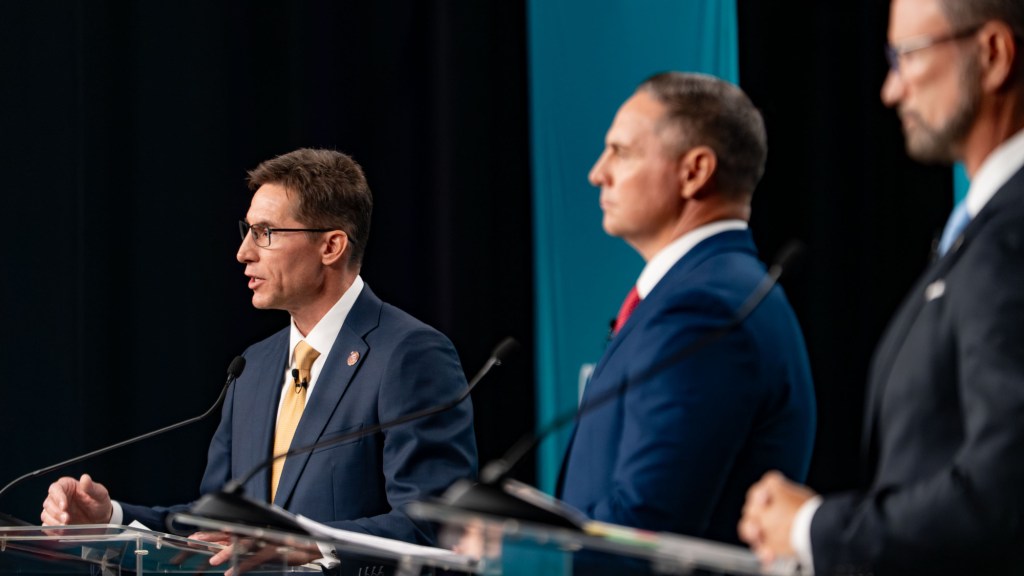
That’s probably obvious to anyone who’s watched any of them. Some are childish fistfights, like the GOP primary debate between attorney general hopefuls Warren Petersen and Rodney Glassman. Others, including the GOP gubernatorial debate, are snoozefests — boring candidates answering esoteric questions and never actually addressing each other, much less matching wits.
For Nelson Morgan, the chair of the Arizona Democratic Party’s redistricting committee, debates may produce a “good soundbite” or a “good gotcha” but little else. He made similar arguments in a 2022 op-ed defending Hobbs for not debating.
“Barring some complete blunder by someone, or just some real performance problem,” Morgan told New Times, “I don’t think they have that much of an effect.”
Photos by Elias Weiss and Gage Skidmore
Will they/won’t they
Will we, at long last, get a gubernatorial debate? The political tea leaves suggest not.
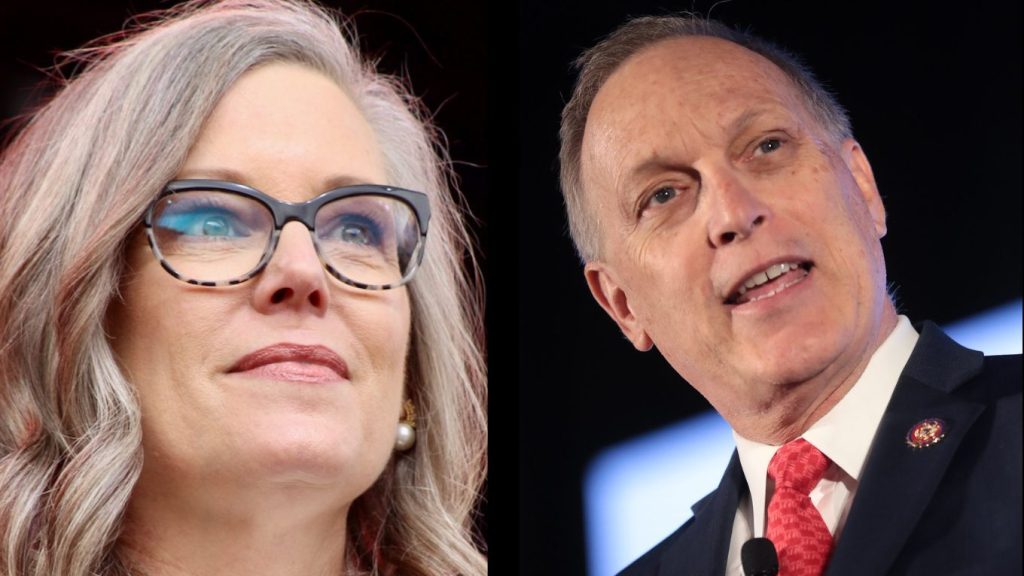
Biggs is raring to get one. Speaking to New Times before a get-out-the-vote rally in Gilbert on July 17, he made the case for why Hobbs should suck it up and take one for the voters. The race for governor is a “high-profile statewide campaign,” he said, and voters want candidates to “stand up and defend your positions.”
“That’s important just to show some minimal level of competency and ability to communicate,” he said.
Whatever one thinks of Hobbs’ governance — whether she’s been a bulwark against harmful GOP policies or a roadblock to common-sense, conservative legislation — “ability to communicate” has never been one of her fortes. Even when speaking on relatively trivial subjects, Hobbs can appear wary of letting loose an extemporaneous phrase. In June, as she made an appearance at the opening of Arizona’s first Buc-ee’s mega-gas station in Goodyear, opponents ridiculed her for having to read her short remarks off an iPad.
That visible crutch is likely a symptom of what one of the consultants who spoke to New Times described as the “bubble” that Hobbs’ team, headed by campaign manager Nicole DeMont, has built around her to protect her “out of concern for the delicateness of her personality.” Johnson, the former Democratic candidate for governor, agreed. Hobbs’ team has “intentionally done the best they can” to keep her from having “to talk about complex ideas of complex issues,” he said. “There’s no real long-form content she’s doing. I mean, she does ‘Bruce and Gaydos.’”
That’s why many think it’s unlikely that Hobbs will debate Biggs.
“They’ve kept her in the bubble and it’s hurt Hobbs,” the consultant said. “I’m sure she could do it. She doesn’t want to do it; nobody wants to do it.’”
The debate question may also depend on how campaign season progresses. As the challenger, Biggs has every incentive to press Hobbs on the issue and to go after her should they ever share a stage. In the primary, the political wind blew the other direction — as the frontrunner, Biggs participated in one debate, which he used to sell himself as more moderate than he’s ever been in his life. He skipped subsequent debates, arguing that he’d gotten his message across to voters. Seemingly without irony, Hobbs’ campaign blasted him for trying to avoid scrutiny.
Hobbs’ team is considering that same cost-benefit analysis now. A debate’s influence on a healthy democracy is unlikely to be part of the equation.
“If Katie thinks she’s ahead by 10 points, the answer will be no,” Johnson said. “She’s one of the few candidates that if she were losing, I think she might still say no. But I could guess that if Andy Biggs was winning, he’d say no. Whereas if he was losing, he says yes.”
Speaking to New Times, Biggs acknowledged that a debate might not make much difference. Not every voter would tune in, and fewer would change their minds afterward. Still, he said, there could be a small percentage of “folks that are questioning which way they want to go and who can be persuaded to one way or the other. That might not even be 10% of the viewing audience, but you might get a half a point to one and a half points of movement, and that in a close election is huge.”
So he’ll keep pushing for one, maybe because it’s good for democracy, and definitely because it’s politically good for him right now. Hobbs may be working with a different set of variables — the advantage of incumbency, the risk a debate gaffe could cause, her apparent discomfort in front of a microphone — but her ultimate debate decision will be just as self-interested.
“I don’t think she wants to debate with me,” Biggs told New Times. “I don’t think that debating is really something that she’s comfortable with or really wants to do.”