
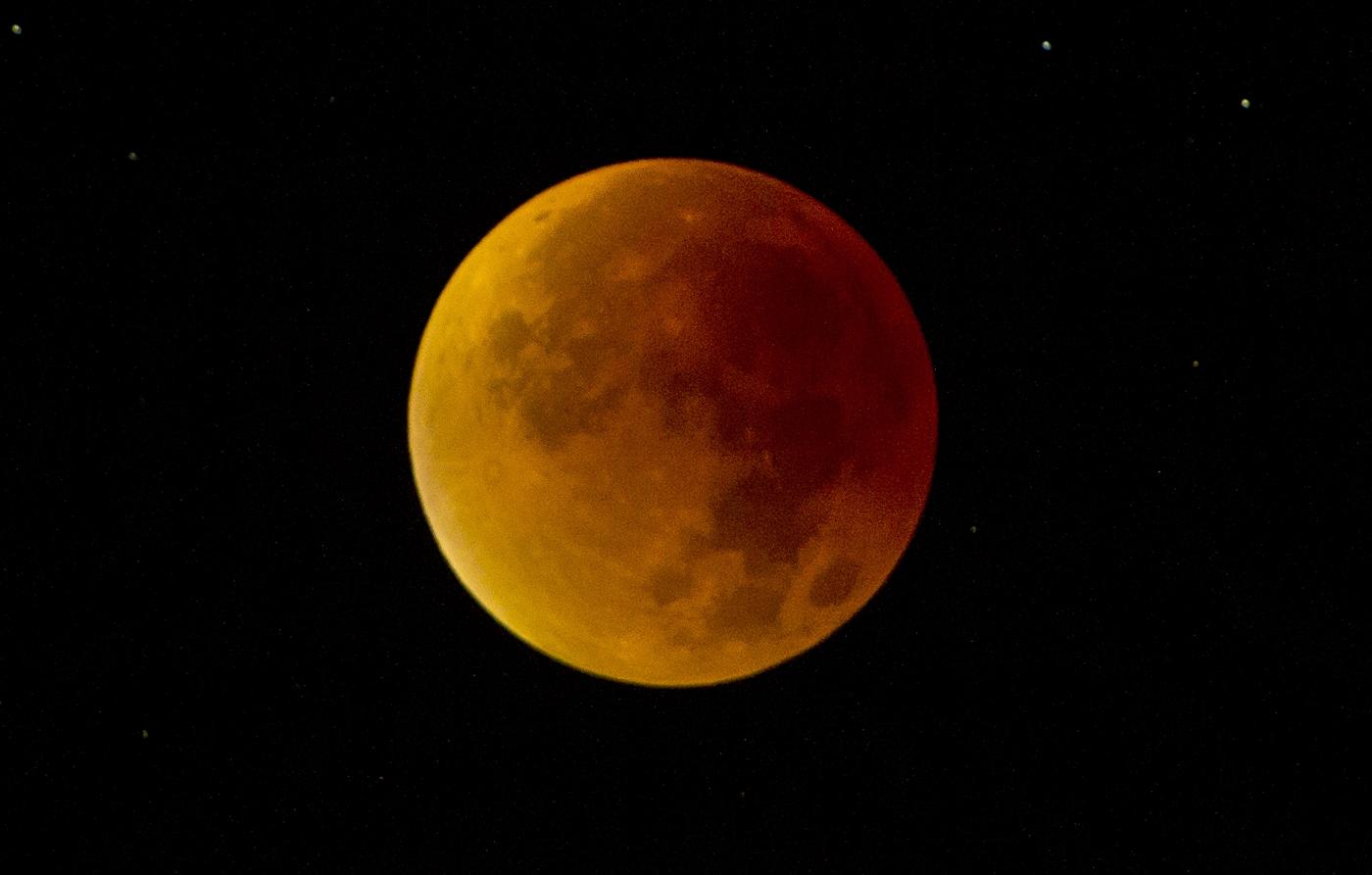
Tambako The Jaguar/CC BY 2.0/Flickr

Audio By Carbonatix
Arizona may have missed out on this month’s solar eclipse, but local skywatchers have another chance to see a rare celestial spectacle this week: a blood moon.
A deep partial lunar eclipse will be visible in Arizona on Thursday evening when 96% of the moon will enter the Earth’s shadow, giving the lunar surface a reddish-orange glow.
NASA says this week’s lunar eclipse will be viewable across the U.S., with Arizona skywatchers getting to see the phenomenon during prime viewing hours. That is, unless summer monsoon storms cause cloudy skies to block the view.
Here’s everything to know about Thursday’s partial lunar eclipse, including when and where to look for the blood moon in Arizona.
When is the lunar eclipse in Arizona?
The partial lunar eclipse will occur on Thursday evening and will be visible throughout the state.
What time is the lunar eclipse in Arizona?
The full moon will rise at 6:51 p.m. with the partial lunar eclipse beginning at 7:33 p.m. The eclipse will then reach its maximum point at 9:12 p.m. when 96% of the moon will enter the Earth shadow and feature a reddish-orange glow. The eclipse ends at 10:51 p.m.
Where to watch the blood moon in Arizona
The partial lunar eclipse will be visible throughout Arizona. The moon will rise in the eastern to southeastern sky. When it reaches maximum eclipse at 9:12 p.m., the moon will be located in the southeastern sky.
Will clouds block the lunar eclipse in Arizona?
Possibly. Thursday’s weather forecast calls for mostly clear skies in Arizona, but the summer monsoon can change quickly and evening storms can develop. Keep an eye on the forecast that day before heading out.
Why does the moon turn red during a lunar eclipse?
The Moon’s spectacular reddish-orange glow during a lunar eclipse is caused by sunlight passing through Earth’s atmosphere, where it gets filtered and bent toward the lunar surface. It’s more or less the same effect that creates colorful sunsets on Earth.
Do you need binoculars or a telescope to see the lunar eclipse?
No. Thursday’s partial lunar eclipse will be viewable to the naked eye. A pair of binoculars or a telescope will allow you to see the moon’s surface with more detail, though.