
Bógar Adame

Audio By Carbonatix
It all started with an anecdote.
A young man listening to a rock radio station in Mexico City feels a deep calling to music.
The young man later migrates to New York and studies at Berklee. He becomes a brilliant drummer, eventually playing with none other than a musician he admired and first discovered in his hometown, years earlier, through the radio waves: jazz legend Pat Metheny.
Then, at an afterparty following a long show in Los Angeles, a random fellow, also Mexican, congratulates the musician on his performance. He turns out to be the same man who once worked as a DJ at the rock station the musician used to listen to. He is also the director of the successful early-2000s Mexican film: “Amores Perros.” They click.
That was the first encounter between two Mexican giants: four-time Grammy Award winner Antonio Sánchez and five-time Oscar winner Alejandro González Iñárritu.
A few years later, Sánchez would receive a call from Iñárritu with a plan: He wanted the musician to create a score, entirely on drums, for his upcoming film, “Birdman (or The Unexpected Virtue of Ignorance).” Just like that, a legendary partnership was born.
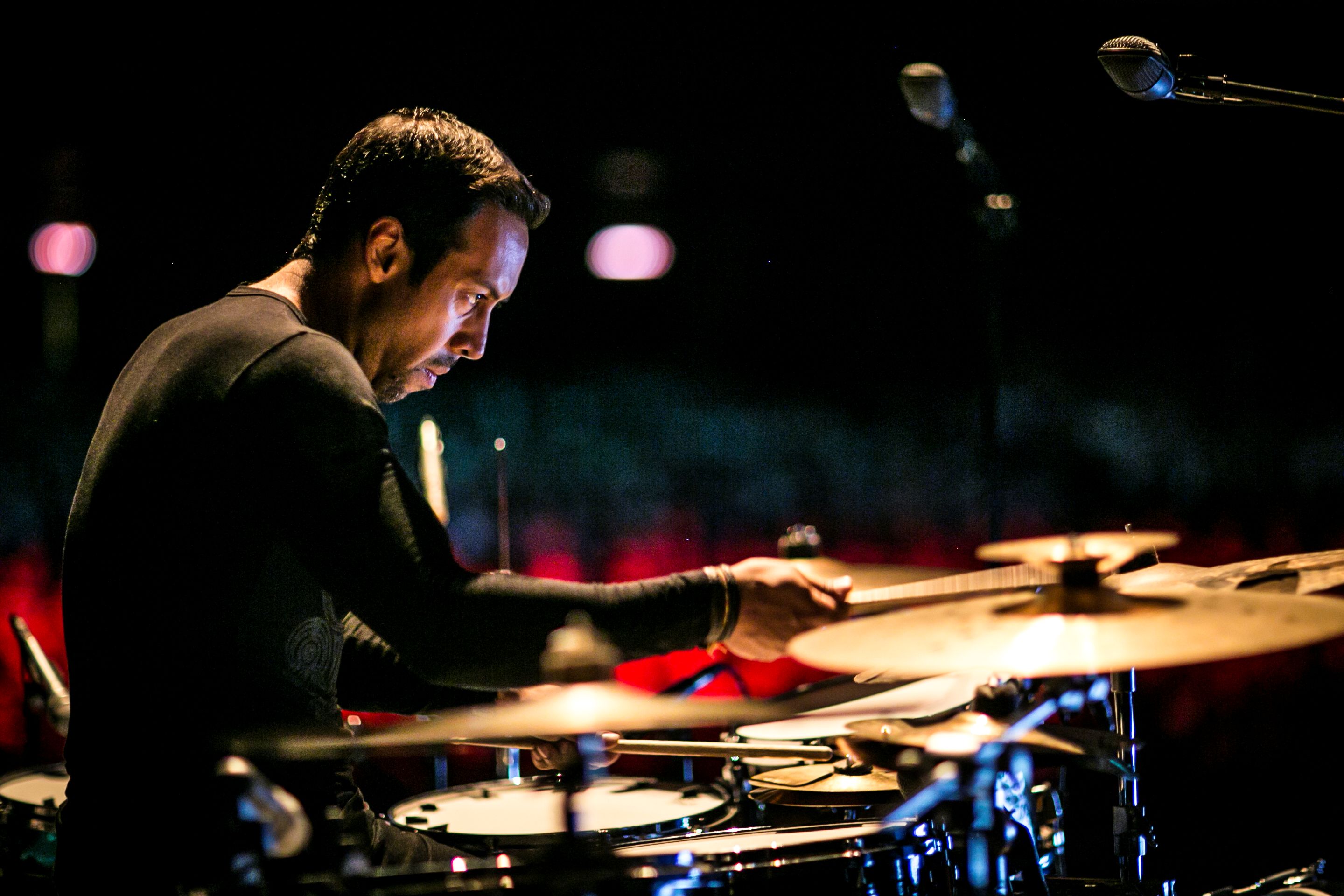
That story, narrated in person by Sánchez himself, served as the foreword to his “Birdman Live” event, which took place at Scottsdale Center for the Performing Arts, where he performed the score live alongside the film, winner of the 2015 Oscar for Best Picture.
“Birdman” is a reflection on what we are capable of doing (or failing to do) for love and validation. Or, as one of the characters puts it, on how the need for love can easily be confused with the desire for admiration.
The movie follows Riggan Thomson (Michael Keaton), a Hollywood actor who refuses to fade under the shadow of the fame he earned playing a Marvel-esque superhero that made him rich and famous. Instead, he pursues the artsy dream of conquering Broadway.
Presented as one continuous take, the film finds its emotional breaks and tonal shifts through Sánchez’s multitonal, polyrhythmic, jazzy grooves, which guide the spectator through the anguishes, dreams, rises and falls of Thomson and the people around him — friends, relatives and coworkers.
In the movie, the drums are not merely background music. They become a character, one that hides and reappears constantly, whispering, screaming or spitting toward the audience a torrent of emotions contained in the light and darkness of Thomson’s life and imagination.
For the live performance, Sánchez told the audience he would play the soundtrack the way he imagined it, with plenty of improvisation. The greatest treat came during the extended ending and credits, when the audience could fully focus on his virtuosity and magic.
Listening to him, you might have thought (as I did) of reminiscences of legends such as “Bonzo,” Neil Peart, Art Blakey, Elvin Jones or even Igor Stravinsky or Silvestre Revueltas. Yet any comparison ultimately feels unfair, or simply misplaced, for an artist who remains fully committed to his own art in a movie that accurately condemns critics.
Ten years ago, the Academy of Motion Picture Arts and Sciences famously rejected the “Birdman” soundtrack as a contender for the 2015 Oscar for Best Original Score (an absence that revealed more about the Academy’s expected lack of virtue and ignorance, to put it in some way). However, Sánchez’s composition did win the Grammy Award for Best Score Soundtrack.
And now, more than a decade after its premiere and success, both the movie and the musician, the “Birdman” and the drumsman, continue to surprise audiences.