
Melissa Pickering

Audio By Carbonatix
Keep Phoenix New Times Free
We’re aiming to raise $10,000 by April 26. Your support ensures New Times can continue watching out for you and our community. No paywall. Always accessible. Daily online and weekly in print.
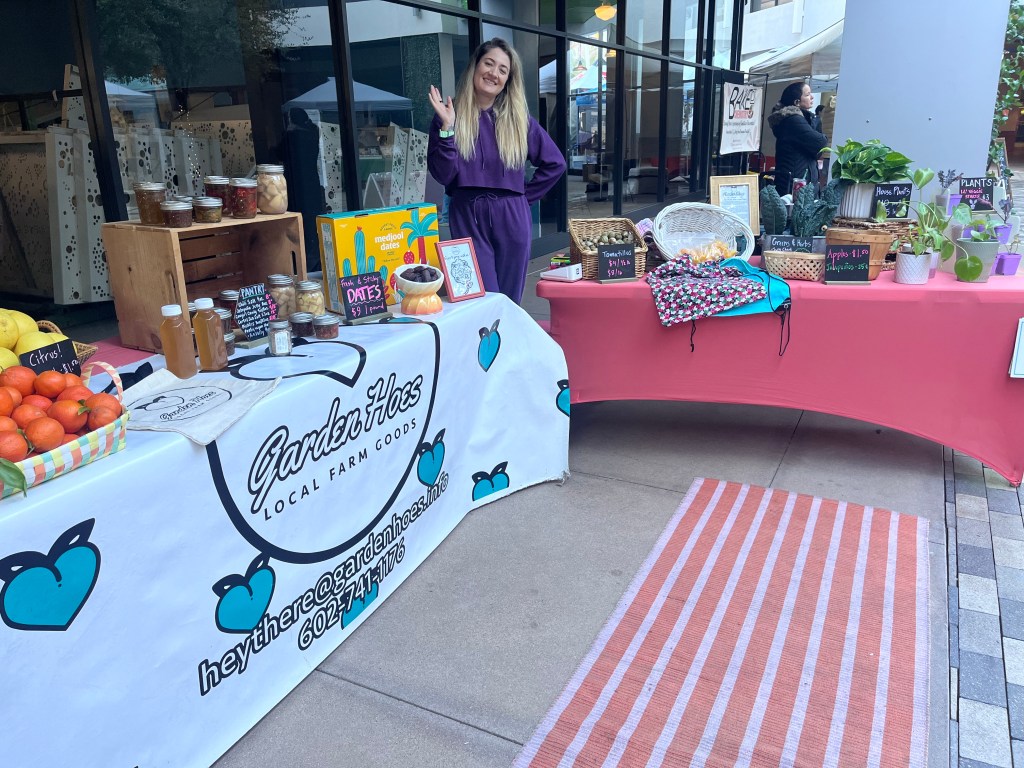
The Downtown PHX Farmers Market has a new addition with a memorable name. Every Saturday, shoppers can now buy hyperlocal produce, eggs and other goods from Tabitha Helton’s urban farm, Garden Hoes Local Farm Goods.
Helton began gardening at home about five years ago. With an abundance of eggs and produce, she began selling at First Fridays. Within a few years, what began as an incidental trade turned into a passion not just for gardening, but for promoting a robust food system built on small home gardens.
The project also incorporates Helton’s advocacy for sex positivity, bodily autonomy and celebrating women in sustainable farming.
“Being sex positive is something that we need just as much as we need food,” Helton says. “My goal is to help plants and people grow through sustainable stewardship, autonomy and resilience.”
Putting all of those passions together, Helton began selling at farmers markets and Garden Hoes came to fruition. According to the website, “Garden Hoes is a femme-forward initiative shining light on all the great things women do in the realm of sustainable farm goods.”
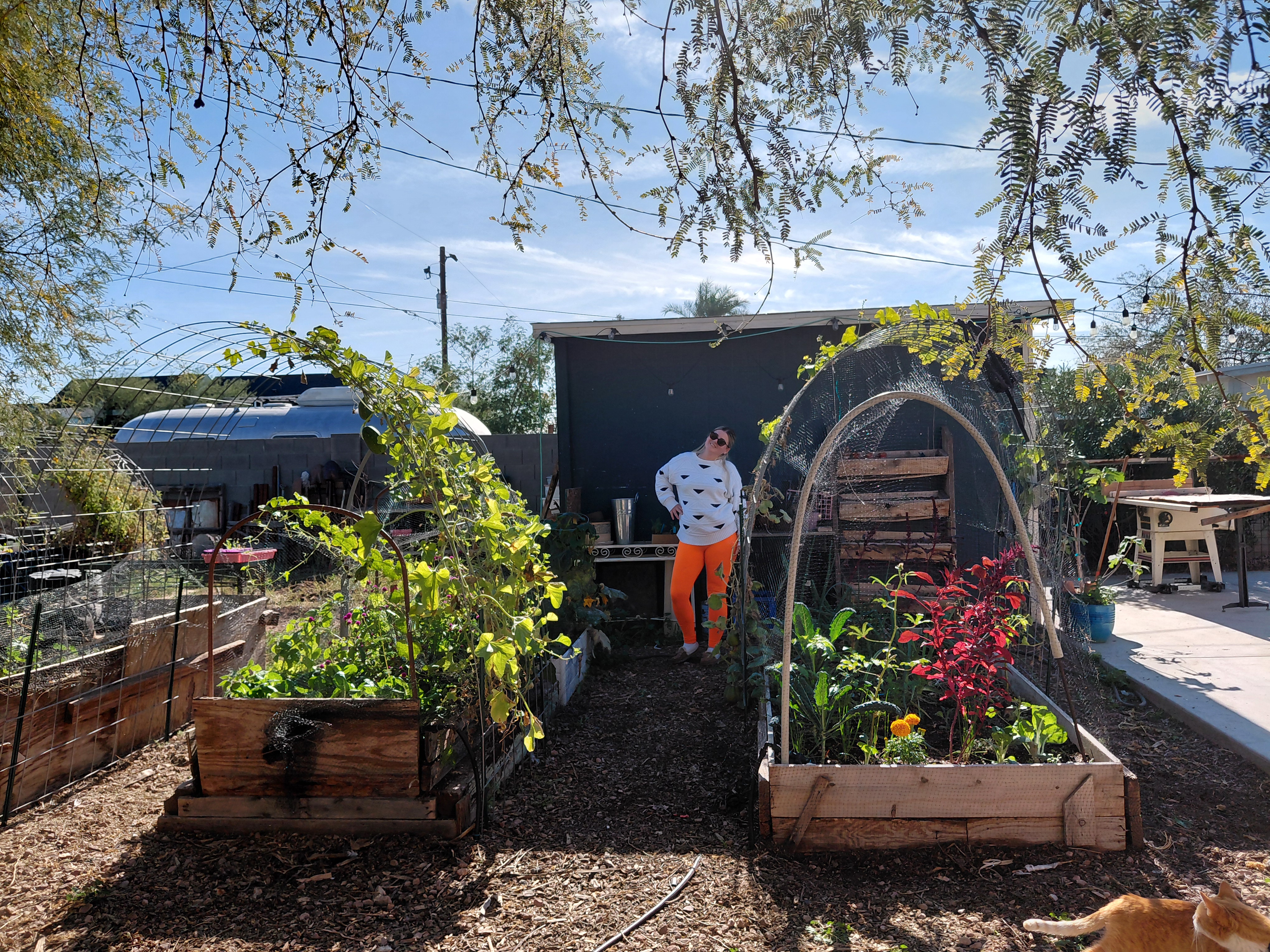
The farm is located on Helton’s property in the Garfield district, a historic neighborhood just south of Interstate 10 between Seventh and 16th streets. With two large raised plant beds, a duck and chicken coop, an aquaponics bed and a soon-to-be-completed greenhouse, the farm produces an impressive array of foodstuffs.
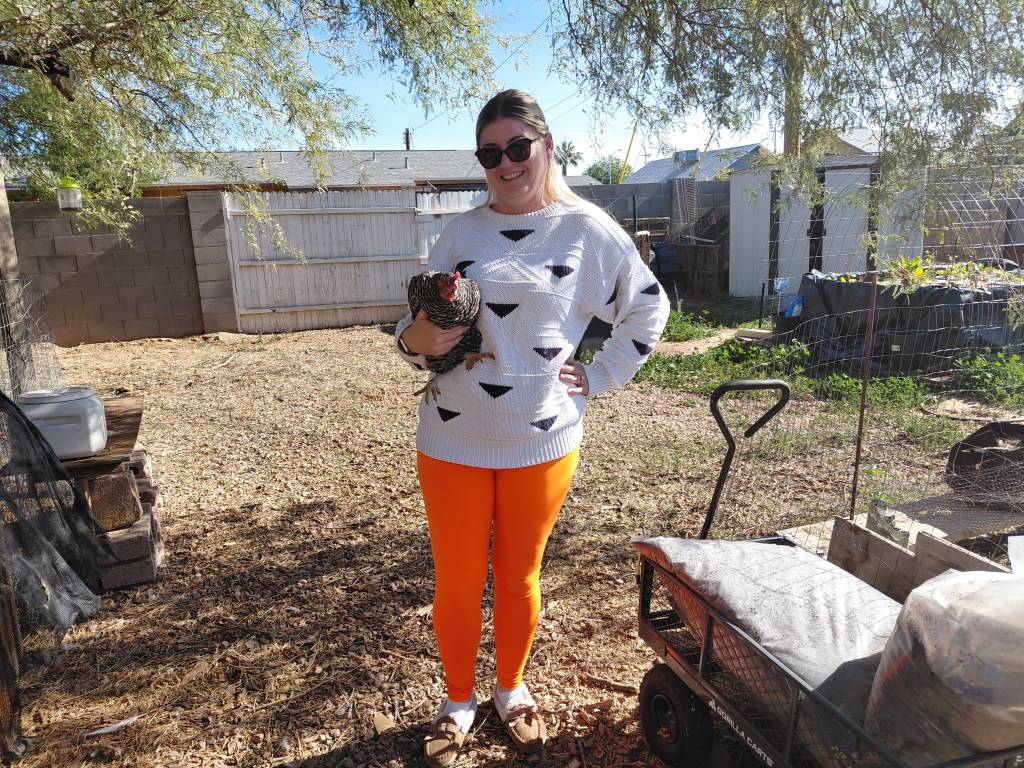
Chickens and ducks roam freely in a fenced area and are fed well, thriving on a diet of scraps from the garden and kitchen.
“They’re really healthy birds,” Helton says, recounting how many large egg farms were decimated by the bird flu not long ago. “It’s better to have small flocks and replicate small, little gardens.”
The plants grown on her farm are treated with equal care, using organic and all-natural methods. The Garden Hoes farm is on track to become Regenerative Organic Certified (ROC) by the end of this year.
“Regenerative Organic insists on your partnership with the soil that you’re maintaining, that you are more of a steward of the parcel,” Helton explains. As opposed to organic gardening, which relies on use of salts or other natural pesticides, ROC gardens rely on naturally occurring bacteria, mushrooms and bugs to naturally maintain the health of the soil.
Helton does not use any fertilizers or pesticides on her thriving farm of over 80 plants.
“I’ve got worms in the soil and millions and millions of bacteria that are just naturally occurring because I don’t kill them,” Helton explains. “That’s what makes it regenerative, and it’s more than just organic.”
Melissa Pickering
More than an urban farm
As the name suggests, Garden Hoes Local Farm Goods has bigger intentions than producing food in an intentional and collaborative way.
Helton, who is a Phoenix native and University of Arizona alum, has an educational background in psychology and conflict resolution. After her studies, she moved to several cities, including Portland and Reykjavik, Iceland, starting gardens as she moved.
However, feeling disillusioned by her work with people and the lack of growth they sometimes displayed, she decided to work with plants instead. Helton later worked on large-scale cannabis farms, an experience that was crucial to learning how to grow fruits and vegetables.
At the same time, she saw firsthand that farming isn’t always sustainable, in more ways than one.
“As I began working on farms, I found that it was male-dominated and extractive to the environment,” Helton explains, with a heavy reliance on chemical pesticides.
During the same time, Roe V. Wade was being overturned and the Me Too movement had exposed a considerable amount of abuse against women.
“I felt that a woman’s sex positive expression was the antidote to a society closing doors that other matriarchs fought so hard to open,” Helton says. “I will not sit by while men deplete our rights and planet.”
In her endeavor to promote a more sex friendly culture, in addition to sustainable farming, she decided to combine her two passions and got to work.

Melissa Pickering
A diverse selection
Visiting Helton’s farm, I was struck by its level of production given its modest size. The great diversity of produce growing was also immediately evident. While some plants were easily discernible, such as the cherry tomatoes growing up a trellis over the aquaponics bed, others were not. When I spotted what resembled a large avocado growing on a vine in one of the raised beds, Helton explained that no, it was not some viny avocado tree hybrid, but in fact, a loofah gourd.
“At the farmer’s market stand, we always have what’s fresh, seasonal and harvested that week,” Helton says.
Depending on availability, customers will find a variety of produce for sale that may include greens, squash, herbs, alliums, melons and root vegetables as well as produce outsourced from other local farms such as dates from Desert Fruit Farms in Yuma, or beans from Ramona Farms.
“It’s more about supporting others and uplifting other Arizona small farms and food producers specifically,” Helton says.
She regularly helps other farms liquidate produce they need to offload. This collaboration allows her to offer more variety at her stand, and benefits the other farms by selling produce that they otherwise may not be able to.
In addition to produce, customers can choose from a variety of duck and chicken eggs, sauces, jams, relishes and even T-shirts and tote bags.
The Downtown PHX Farmers Market is held every Saturday at The Arizona Center, from 8 a.m. to 1 p.m. Many payment options are available, including EBT, cash, credit and Zelle. Helton also accepts SNAP double-up coins, which allow produce purchases to go twice as far.
Melissa Pickering
Supporting the local food economy
Helton advocates trading and sharing as integral components of the food economy.
“What I’m doing with it retains this sort of moving, breathing structure that keeps farmers moving. I think that’s a big pull in the farming community in that there’s no money in it, it’s all heart and soul. But people get burnt out on heart and soul after a while,” Helton explains.
Over time, Helton thoughtfully grew her business. She now employs six part-time “Hoes,” who put their skills to work assisting with social media, running the market stand and making jams and sauces.
“I’ve always wanted to scale sustainably. I don’t want to get too big and lose the attention that comes to this kind of grown food,” Helton says.
Helton also made use of several programs offered by the city to advance her endeavor.
“I got a lot of help from the City of Phoenix. They’ve got a lot of administrative programs, classes on stewardship, how to raise funds,” Helton explains.
She completed five programs associated with the City’s Resilient Food Systems Initiative, or RFSI grant. Courses included cooperative business models and aquaponics. Having been set up with an aquaponics garden via this course, Helton now uses it to help get her seedlings started.
“I’m using it as a baby plant incubator,” Helton says. Once the seedlings are more established, she either plants them in soil, or keeps them in the aquaponic tank if they require a lot of water, such as the lettuces.
Helton was also awarded a grant by the City of Phoenix to build a greenhouse on her farm.
“They definitely have a resilient systems agriculture focus going on at the City of Phoenix. So I’m glad to live in this city and not one zip code over, where maybe this isn’t going on,” Helton says.
The greenhouse will be used to grow tomatoes year-round.
“Who doesn’t love a homegrown tomato? They are killer, they bring people’s nostalgia back. It makes them more invested in their homegrown food when they taste one tomato that doesn’t taste like water,” Helton said as she offered me one. True enough, the small yellow tomato was firm but not hard, and biting down released the sweetest explosion of tomato juice I have ever experienced.
Soon, Helton will be using the tomatoes harvested in the greenhouse to make her own preserves and jarred sauces.
“I think that those value-added products are going to bring people closer to their local food system,” Helton explains.
In addition to selling produce, seedlings and farm goods at the farmers market, Garden Hoes is charging forward with its backyard farm, free-roaming chickens and sex positive attitude. Helton hopes that her small farm model will spread and further enhance the local food economy.
“I’m wanting to be the change I want to see in the world,” Helton says. “I want it to be something that is revolutionary.”
That revolution may just start at the farmers market.
Garden Hoes Local Farm Goods
Saturdays at Downtown PHX Farmers Market
455 N. 3rd St.