

Photos by Sanjay Suchak/Illustration by Eric Torres

Audio By Carbonatix
Keep Phoenix New Times Free
We’re aiming to raise $10,000 by April 26. Your support ensures New Times can continue watching out for you and our community. No paywall. Always accessible. Daily online and weekly in print.
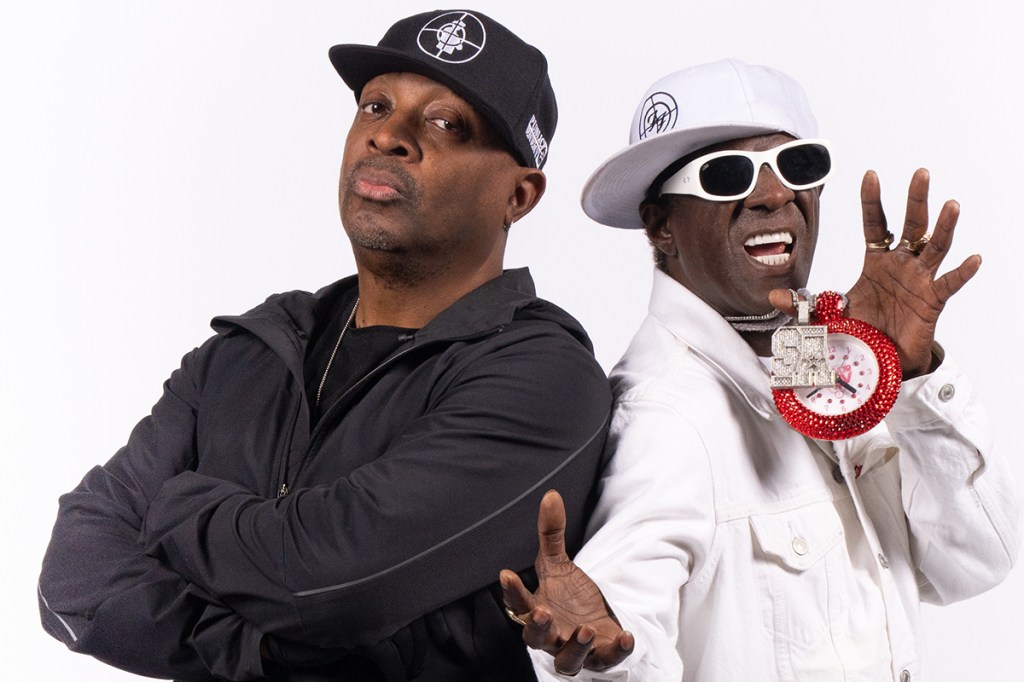
When I ask Chuck D, the legendary Public Enemy frontman, whether he ever thought the group that revolutionized hip-hop would still be active after 40 years, he replies matter-of-factly, with a casual smile.
“I never went at anything half-assed,” he says. “So I knew whatever I was gonna do was going to have a lasting quality to it.”
If you make it to Tempe Beach Park & Arts Park on Sunday to catch the Public Enemy set at Innings Festival, you’ll be struck by the lasting quality of Chuck D’s lyrics. The young artists who told you in 1989 to fight the power were still at it in 2020, putting America’s “Nazi gestapo” on blast in the blistering track “State of the Union (STFU).” That single dropped just before Chuck D turned 60.
Hearing Chuck D drill down on his commitment to the fight reminds me of a line from “Welcome to the Terrordome,” the 1990 track on which he raps: “Still some quiver when I deliver.”
Some quiver? Nah. His intensity has always equated to “go big or go home.” His ability to get us shook has never been shaken. The difference today is not in his message or in his fire. It’s knowing he has to pick his spots. He’s still down for touring but now prefers festivals to a three-month, night-after-night grind.
“I’m 65,” he says, “and now I’m leaning into less is more and quality over quantity. I’m in the arts and always working on something, making records, books, art. As we get older, we have fewer guarantees than we did at half our age, and I think that makes us better. I like to enjoy and cherish every moment and stay productive and energized.”
Sanjay Suchak
‘The Rolling Stones of the rap game’
Public Enemy owes its staying power to an ability to evolve. Their music came out of the gates like a bomb with loudspeakers, as they told us in ’88 with “It Takes a Nation of Millions to Hold Us Back”: delivering messages about social injustice from a Black perspective that couldn’t be ignored.
Chuck D, Flavor Flav, Professor Griff and DJ Terminator X worked together in a union you couldn’t, and didn’t want to, avoid. That chemistry led to massive sold-out tours, platinum records, tons of quotable songs and a Grammy Lifetime Achievement Award. Their messages and intense delivery rocked so many worlds. Hip-hop fans loved this new, intense presence. Punk and hardcore crowds connected to the raw energy and the critique of the country’s power structures.
Audiences saw something original and undeniable in Public Enemy. Chuck D simply saw a chance to be true to his experience.
“You have to have that same approach to everything and have the same moxie and makeup that you have as a human being,” Chuck D says. “Why would you make yourself up in the mirror and go outside and ask somebody how you look? That’s killed 90% of artistry: the focus on what the reception will be. I’ve never made a song for anybody else.”
By the time “Fear of a Black Planet” dropped in 1990, the country understood its most iconic track, “Fight the Power,” as marching orders. The rest of the record is simply a motherfucking masterpiece, a collage of sounds and samples, instrumentals and interludes that make revolution feel like a block party. Public Enemy spared no one: “911 Is a Joke” and “Burn Hollywood Burn” — which features Ice Cube and Big Daddy Kane — became instant anthems.
Throughout the group’s lengthy run are Chuck D’s deep-toned flow and Flav’s equally wicked, higher-pitched vocals. The pair are the only original Public Enemy members carrying the torch.
As they continue to spotlight oppression and injustice, they also explore their musicality.
“I don’t know if Flavor (Flav) is Mick and I’m Keith or if he’s Keith and I’m Mick, but we’re the Rolling Stones of the rap game, and we built it to be a lot of different things,” Chuck D says. “We represent the genre, and I think we represent an aspect of musicology and DJing. We try to transform, come up with different lineups and find different ways to do things. We feel like it’d be corny and boring to do things the same way we did. We like to move with the technological changes and find what works for that moment.
“I’m an old head, so I understand what was there and what was lacking. So therefore, I have exuberance for the tools today because I’m a user of the tools across the span of time,” he continues. “I’m not intimidated by new technology as it comes up. I know what art is, and I’m not in competition with the tool. As artists, we should embrace our mistakes; that’s our human pulse. You can’t be beat by a machine. The machine is always trying to be perfect, and our imperfections, our scars — that’s what makes us.
“There’s always going to be something new that threatens people. The horseshoe industry was threatened by the fucking horseless carriage. That’s life. That’s evolution.”

Sanjay Suchak
‘It behooves me to study artists’
For the man who grew up in a musical household — his folks rotated Earth, Wind & Fire, The Commodores, Stevie Wonder, and Led Zeppelin through the speakers — life has always been about art. But he didn’t always know it would be the path he’d follow.
“Music was supernatural,” Chuck D says. “But if somebody would have told me in high school that I’d be in the Rock and Roll Hall of Fame, I’d be like, ‘What?!’ I graduated from high school in 1978. There weren’t rap records.”
Being on the radio was his first calling. He liked the DJs on AM and FM radio; he liked the sports announcers. But art wouldn’t let go. He found inspiration in illustrations, paintings, flyers, sports caricatures, political cartooning. None of that passion has waned.
As we chat, he lights up about his upcoming books (published by Akashic), fine art projects and a collab with John Densmore, the drummer for the Doors. They met in 2014 when Chuck D was in Los Angeles as a Record Store Day ambassador. Densmore gave Chuck D some beats, Chuck D rhymed over them and soon, toying around turned into something more substantial. What transpired is a record of spoken word and rhythmic beats called “No Country for Old Men,” by this two-person act called doPE, merging the names of their bands, the Doors and Public Enemy. Look for the release this coming Record Store Day, April 18.
As he discusses his projects, he mentions the magazine he launched, Rap Central Station, which focuses on hip-hop art, culture and history and aims to combat algorithm-driven media. The physical 12″x12″ vinyl-sized publication raises artists’ voices and includes creator-written reviews. Cypress Hill, Monie Love and Grandmaster Flash are among the contributors.
After four decades, he still sees art as a road to personal growth that can lead to broader transformations. Increasingly, to him, those transformations arise out of a tension between technologies bent on speed and living histories that are at risk of being forgotten.
“People gotta be open to reading and studying,” he says. “Study artists. I’m an artist, so it behooves me to study artists before me. Study the past to think about the future. It makes you ask yourself questions, like ‘What did they go through? When they looked at their world, how big was it?’ and to think about how things developed.”
The magazine, the music and Chuck D’s other artistic contributions keep him grounded. The lifelong hell-raiser seems so deeply content you wish he’d bottle that inner peace and sell it.
The years have also given him grace and humility. When I mention the inspiration he has provided since the ’80s, he replies: “I’m here to give some answers, not the answer. That’s gonna be in the context of every person’s life.”
Public Enemy performs on Sunday, February 22, at Innings Festival at Tempe Beach Park.
