
Keystone/Getty Images

Audio By Carbonatix
Keep Phoenix New Times Free
We’re aiming to raise $10,000 by April 26. Your support ensures New Times can continue watching out for you and our community. No paywall. Always accessible. Daily online and weekly in print.
One of the nice things about the COVID lockdown was that you could spend a lot of time doing whatever. You could alphabetize your medicine cabinet, deep-clean your belly button, or finally attack that stack of books you’d been staring down for a few years. I re-read about 60% of my graphic novel collection during that extended period of domestic solitude. I also, though I honestly don’t even remember doing it, started an obscure psychedelic ‘60s rock playlist on Spotify. That was in April of 2020. Last month, someone offered to buy the playlist from me for $1,500. Weird. Right?
How a quarantine playlist took a life of its own
During 2020, I contributed seven articles to It’s Psychedelic Baby Magazine, an English-language psych-rock mag based in Slovenia. I asked Klemen, the founder, if he’d like to join forces to grow his publication. He declined, so I started my own. In April 2021— one year after starting my playlist — I launched Psychedelic Scene, an online publication devoted to psychedelic music, art and culture.
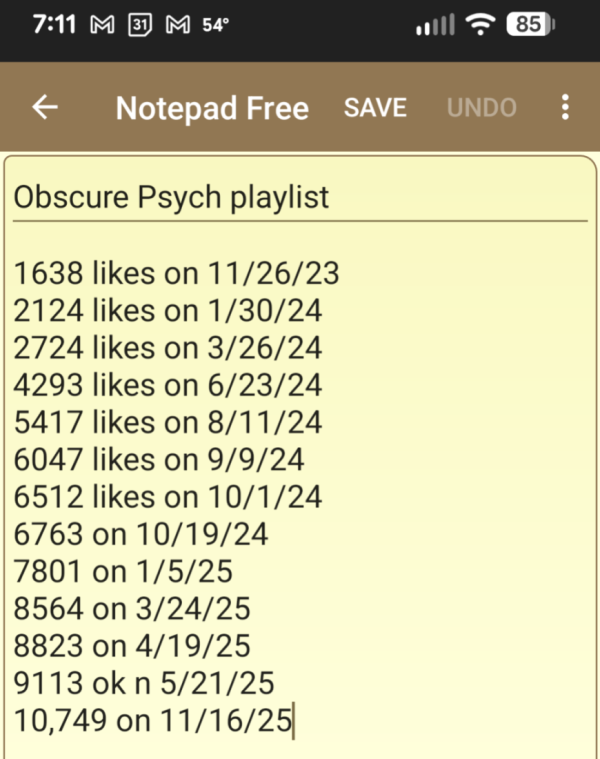
As the editor of Psychedelic Scene, I became exposed to tons of bands and interacted with other psych-rock fanatics. Whenever I heard of a psych band I wasn’t familiar with, I’d check out a song or two. If I heard a genuine psychedelic song, I’d throw it on my playlist, which kept getting longer. I thought it was amazing that a couple hundred people had saved my list. But it didn’t stop there. Every time I checked, there were dozens, or even hundreds, more followers. Two years ago this month — when the playlist had 1,638 saves — I started charting its growth on my phone. As of this writing, there are 10,841 saves, 354 songs (no artists repeated), and over 21 hours of music.
Jason LeValley
What counts as psychedelic?
But numbers are one thing. The real story is what qualifies a song for the list. Not every rock song released in the late 1960s was psychedelic. In fact, there were other subgenres that danced around psychedelia, but weren’t—sunshine pop, early prog, and especially garage rock. Many garage rock bands muddied the waters by veering into psychedelic territory. The Seeds, The Shadows of Knight and The Chocolate Watchband are some of the better-known, yet far from mainstream, bands that were garage-rockers that occasionally sounded psychedelic. The 13th Floor Elevators, despite announcing their trippy intentions on the release of their 1966 debut album, were still more grounded in garage than psychedelia — at first. They honed their sound and dialed up the psychedelic quotient on their second album, 1967’s “Easter Everywhere.”
When you’re curating obscure psych, you have to separate the genuinely mind-bending from the merely fuzz-laden. Because so much was labeled, and mislabeled, as “psychedelic” during this fertile and spirited period of rock history, the only real way to determine what qualifies a song to be added to my list of obscure psychedelic rock is by listening to it. Regarding porn, some say it’s difficult to define, but they “know it when they see it.” By the same token, I know psych when I hear it.
All the songs on the list incorporate elements of psychedelia, but attempting to define exactly what they are is nearly impossible. Additionally, while the vast majority of these songs were released in the late 1960s, a few came out in the 1970s. Thus, the playlist is titled Obscure 60s/70s Psychedelic Rock.
Michael Ochs Getty archives
The Strange Economics of Playlist Culture
In August of last year, I was offered $300 by an entity called Lofi Restricted to buy my playlist. I didn’t even know how that would work, but I declined.
This October, I was contacted on Instagram by a man named Ashwin Sriram, who initially proposed gaining access to my playlist for one month for $300. He said he would add songs to it, then relinquish access to my playlist at the end of the month. This sounded sketchy—I wasn’t about to surrender my Spotify login credentials to a stranger. Instead, I told him I’d sell him the playlist for five grand. He countered with $1,500 and said I’d have to hand over my entire Spotify profile, full of playlists, claiming there was no way to transfer just one playlist.
He wanted the playlist so he could insert multiple songs by some modern pseudo-psychedelic artist he represents. No thanks. It would destroy the playlist’s identity by mixing eras and repeating artists.
So, I don’t know where this playlist journey is going, but it’s been fun to watch it take on a life of its own. Maybe someday Spotify will even compensate me for it. Ha! Right! And then maybe my alarm will go off, and my sweet dream will be over. But until then, I’ll just keep adding the old-school mind-benders, the fabulous freakouts, and the trippy tunes that actually deserve the “psychedelic” label — and see just how far this thing goes.