
Annapaola Martin

Audio By Carbonatix
Do you love music that doesn’t ask for permission? What about music that doesn’t worry about whether it fits neatly into a scene, a moment or even a genre? It wouldn’t surprise me if right now, here in 2026, you crave music that shows up loud, alive and fully aware of the mess we’re all standing in.
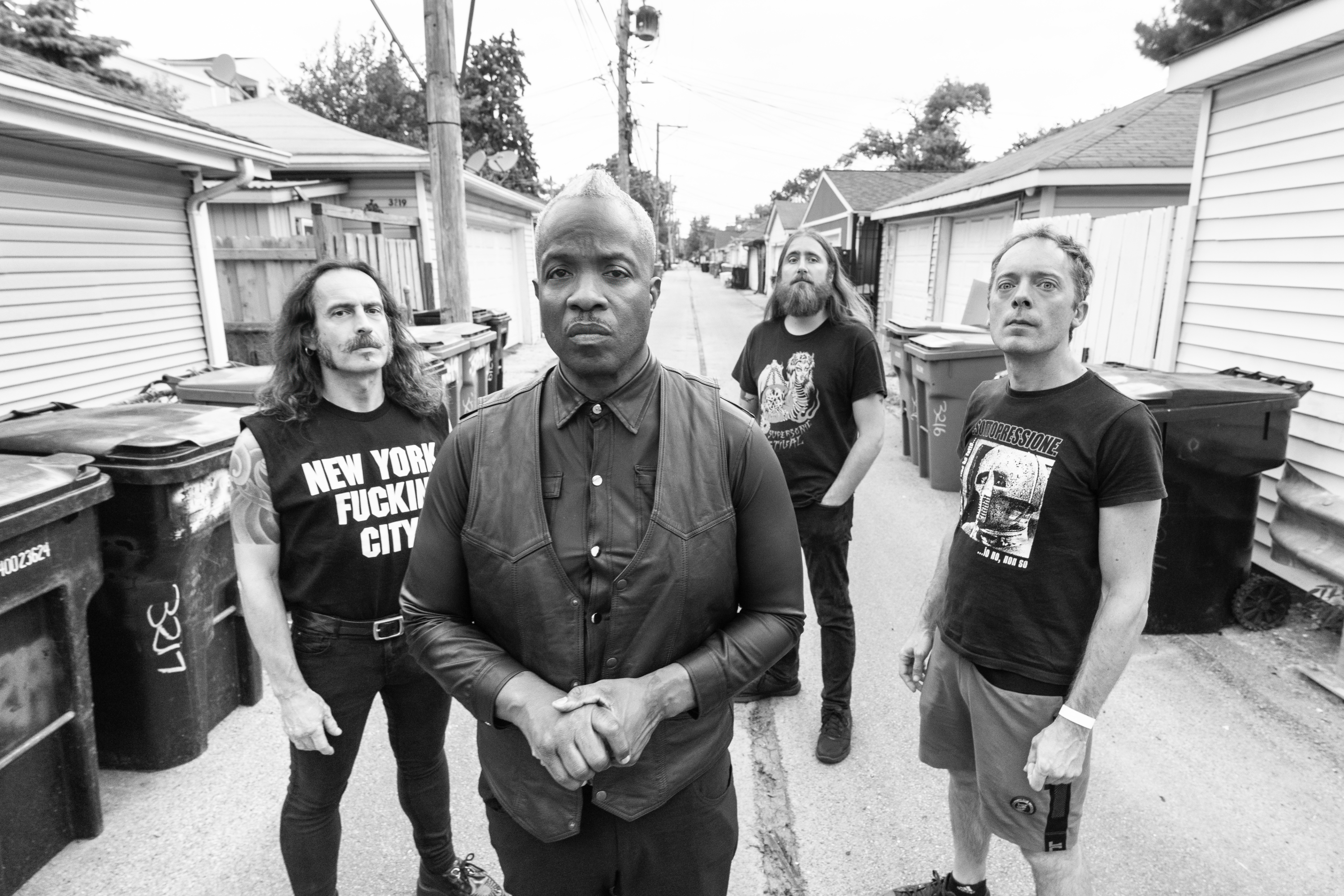
This is Buñuel, and they are that kind of band.
If you know Eugene Robinson at all, either from his previous band, Oxbow, from his writing or his long-standing refusal to sand down sharp edges, then you already understand that comfort has never been the goal: not his comfort, your comfort or the unsuspecting friend you might drag to the show on Monday, Feb. 16, at the Rhythm Room. What Buñuel delivers to its audience is something far more compelling: music made by adults who chose this, who still believe in the power of sound to articulate what language alone can’t carry.
This will be Buñuel’s first show in Phoenix. It’s happening quickly, without a lot of buildup, and honestly, that feels appropriate. This is not a band that arrives with hype first and substance later. The substance is the point.
Over Zoom on a Friday afternoon, Robinson talked about his band.
“These guys are phenomenal musicians. Lifelong musicians,” he says.
Buñuel formed in a way that feels almost accidental, at least on the surface. Robinson was contacted by some musicians he didn’t know personally but whose work carried real weight. Guitarist Xabier Iriondo and Pierpaolo Capovilla, formerly of post-prog heavy math rockers One Dimensional Man, had a vision for a project with international scope. There was just one condition: It needed an American singer.
Capovilla had seen Oxbow play in Rome. Robinson’s name came up. Music was exchanged. And something clicked.
“I heard the music and immediately thought of all that stuff from the ’90s I loved — Shellac, Big Black, The Cows,” Robinson says. “That whole Albini-influenced generation. But the vocal delivery in those bands was always sardonic. I don’t do sardonic.”
That distinction matters. Where a lot of noise-adjacent or post-hardcore bands lean into detachment or irony, Buñuel goes in the opposite direction. Robinson’s vocals are confrontational not because they’re distant, but because they’re fully present. There’s no smirk. No safety net. No remove.
There is power, though. Lots of it.
“I thought what (the project that would become Buñuel) needed was a guy like me,” he says. “And they gave me the opportunity to put my money where my mouth was.”
That was 10 years ago. Buñuel is not a side project. It’s not a novelty. At the moment, it’s Robinson’s main musical focus, and it shows.
The band’s most recent record, “Mansuetude,” lands like a punch to the face in the best possible way. It’s dense, physical and cinematic without ever feeling indulgent. The songs don’t rush, but they don’t wander either. They move with purpose, even when that purpose is unsettling.
Listen to “Class,” for example, and hear it for yourself. It feels like you are in a boxing ring with Robinson and instead of punching you with his fists, he’s daring you to ignore him.
But you can’t.
Robinson describes the band’s current trajectory in terms that have nothing to do with genre and everything to do with atmosphere. “It feels like 1969,” he says. “After the Summer of Love. After Altamont. When things got dangerous and weird.”
That reference isn’t accidental. Buñuel draws heavily from late-’60s and early-’70s cinema — films where morality is ambiguous, endings are bleak and nobody walks away clean. “Five Easy Pieces.” “The French Connection.” Kris Kristofferson movies where the system wins and the protagonist is left broken. These aren’t stories about redemption. They’re stories about consequence.
“Ugly doesn’t necessarily mean noisy,” Robinson says. “It means unforgiving. Bleak. Honest.”
What makes Buñuel compelling is that this bleakness isn’t nihilistic. There’s joy here — not the shiny, performative kind, but the real satisfaction that comes from collaboration that works. To hear Robinson talk about the band and what they are doing as they travel the U.S. together right now, the enthusiasm for making music with these guys, right now, is paramount to anything else.
Robinson is quick to praise his bandmates, all of whom have serious résumés in Europe. On Buñuel’s first tour, audiences recognized everyone else immediately. Robinson told me how bassist Andrea Lombadini (The Framers) would step out and the crowd would explode. Then drummer Francesco Valente (who was Capovilla’s bandmate in One Dimensional Man) would get the same reaction. Iriondo (Afterhours and A Short Apnea), too.
Then Robinson would walk out.
“People were like, ‘Who is this guy?’” he laughs.
That dynamic has long since shifted. What remains is a band built on mutual respect, deep experience and the understanding that this kind of work doesn’t happen by accident. These are not kids grinding it out for the romance of the road. These are adults with families, responsibilities and hard-earned clarity about what touring actually costs and the toll it takes financially, emotionally and physically.
“There’s a lie bands are willing to propagate that this pays,” Robinson says. “You have to be really clever just to not lose money.”
And yet, they do it anyway. Because the moment a song that once existed only in someone’s head becomes real, the moment it becomes loud, shared, and takes over a room, the math changes. The value becomes immediate.
When Robinson talks about Buñuel live, what comes through most clearly is pleasure. It’s not a sense of ease. No, this isn’t easy music, but it oozes enjoyment. The band likes each other. They trust each other. They’re invested.
“There’s a direct connection between people getting along and the quality of the art,” he says.
That connection is audible. You can hear it on the records, and you can feel it even more in a room when the band is playing five feet in front of you. This is not a nostalgia act. Buñuel isn’t interested in recreating the ’90s or paying homage to a scene. Whatever echoes of that era exist here have been metabolized into something heavier, stranger, and more present-tense.
“This is music that absolutely could not have been made by somebody who was 20,” Robinson says.
If you’re looking for a reason to show up on Monday night, that might be the most compelling one of all.
Phoenix doesn’t always get first looks at bands like this. We get tours on their way through, and sometimes bands that are as affecting as Buñuel hit our town years after their peak. Buñuel arrives now while they are vital, evolving and clearly still hungry.
Frankly, it feels like a small gift. A reminder that challenging music doesn’t belong to the past, and that intensity isn’t like milk or a nice piece of pie. Intensity doesn’t expire with age.
This show isn’t about comfort. It’s about witnessing something real, made by people who mean it, in a moment when meaning feels increasingly hard to come by.
Buñuel won’t fix the world. But for a night, they might help you understand it a little better or at least remind you that you’re not alone in feeling how strange and unforgiving it’s become.
And sometimes, that’s more than enough.
Buñuel: With Squid Pisser and Bright Sunshine. 7 p.m. Monday, Feb. 16. The Rhythm Room, 1019 E. Indian School Road. Tickets are available on the Rhythm Room website.