Tempe History Museum

Audio By Carbonatix
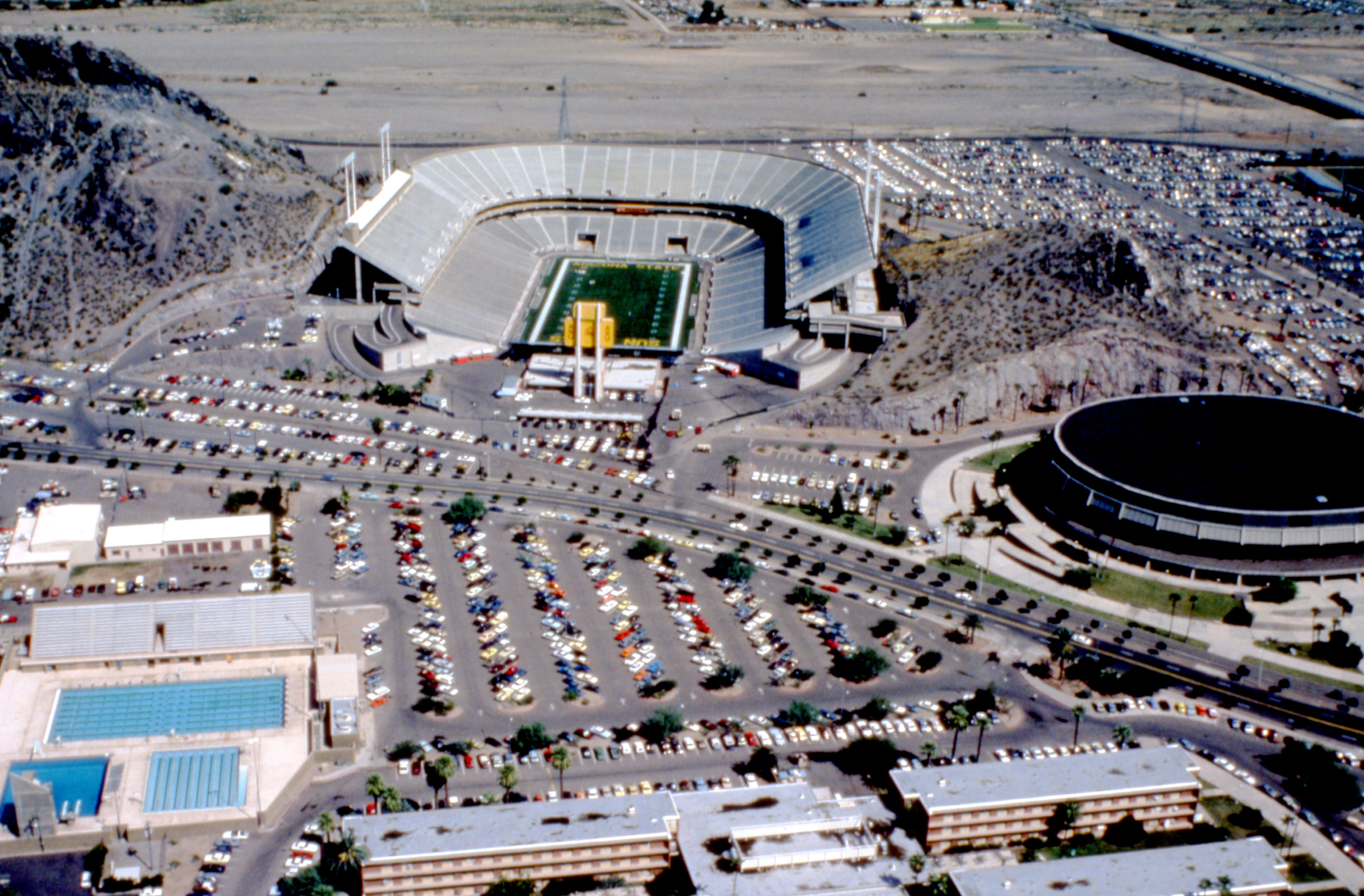
It was December 13, 1981. Helicopters circled the skies over Sun Devil Stadium, while inside, Mick Jagger floated over the crowd on a cherry picker. Roughly 74,600 fans filled the stadium for the show, later immortalized in footage from the Rolling Stones concert film, “Let’s Spend the Night Together.” And all of them had their lighters in the air.
“The whole Sun Devil Stadium was like a Christmas tree,” Larry Mac recalls. “Everybody lit their lighters in the air — before cell phones — and it was one of the coolest things I’d ever seen.”
Mac, who became a radio DJ in 1985 and has worked the knobs for Phoenix station 98 KUPD and 96.1 KLPX in Tucson, was around 16 years old at the time. He’d camped out in line to get tickets for the concert, which was common before digital tickets existed. “This wasn’t just a concert — it was an event,” Mac says. The massive Stones show at Sun Devil Stadium (now called Mountain America Stadium) also wasn’t an outlier — it was routine back then.
From the 1970s through the early 1990s, ASU-connected venues — including Sun Devil Stadium, the ASU Activity Center, Tempe Diablo Stadium and Phoenix Municipal Stadium — doubled as some of the Valley’s biggest concert stages, hosting marquee artists from the Rolling Stones and Pink Floyd to U2 and The Who. That era faded as touring economics, production demands and purpose-built arenas reshaped the live-music industry. Its legacy still echoes today, as massive events return in new forms at places like Chase Field and Tempe Beach Park, home of the annual Innings Festival. But the concert experience — and what it means to see a show in Phoenix — has fundamentally changed.
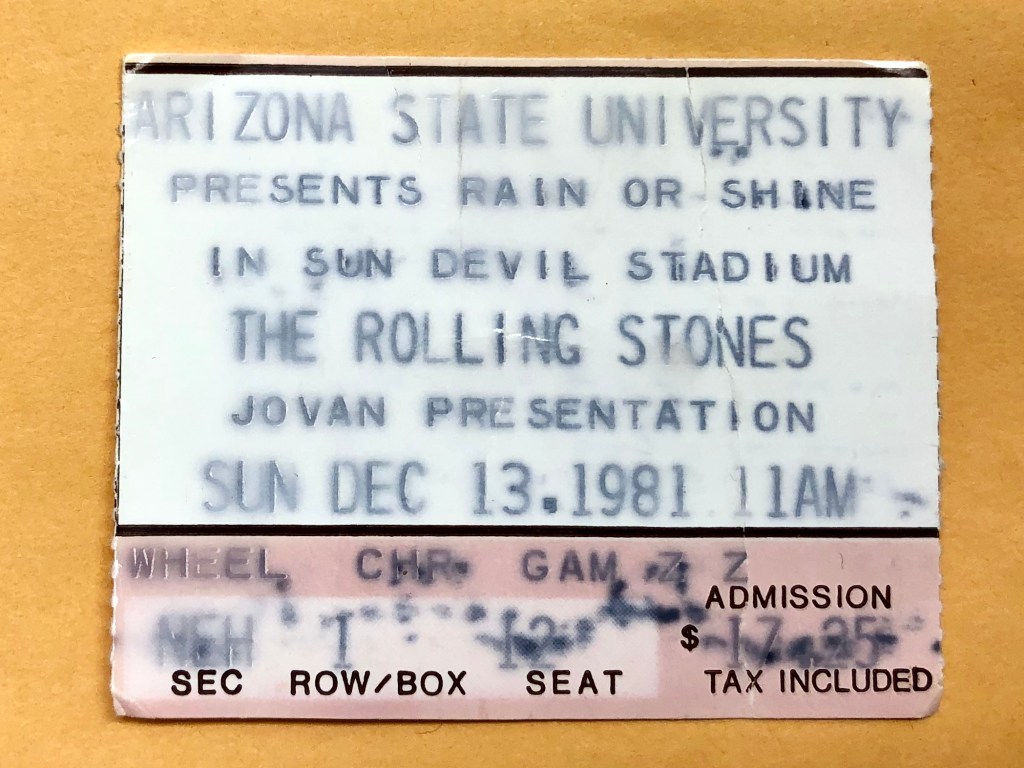
The Rolling Stones’ 1981 show at Sun Devil Stadium was filmed for a 1983 concert film.
Tempe History Museum
Concert promoter Danny Zelisko has been booking shows in the Valley since 1974. He brought some of the biggest acts in the world to ASU venues, including Bruce Springsteen to the ASU Activity Center in 1980, The Police to Phoenix Municipal Stadium in 1983, and Paul McCartney to Sun Devil Stadium in 1990.
“Phoenix was necessary to get across from L.A. to Texas or to Colorado. It was more of a routing date than anything else,” Zelisko says. “Most smaller towns only had one arena. Phoenix had the Activity Center, and that was the new building. Back then, Phoenix didn’t have a lot of choices. If you wanted to play a big room, that’s what you had.”
For the people in the stands and on the grass, those limitations barely mattered. What they remember instead is how close, loose, and communal those shows felt — more like shared experiences than precision-engineered spectacles.
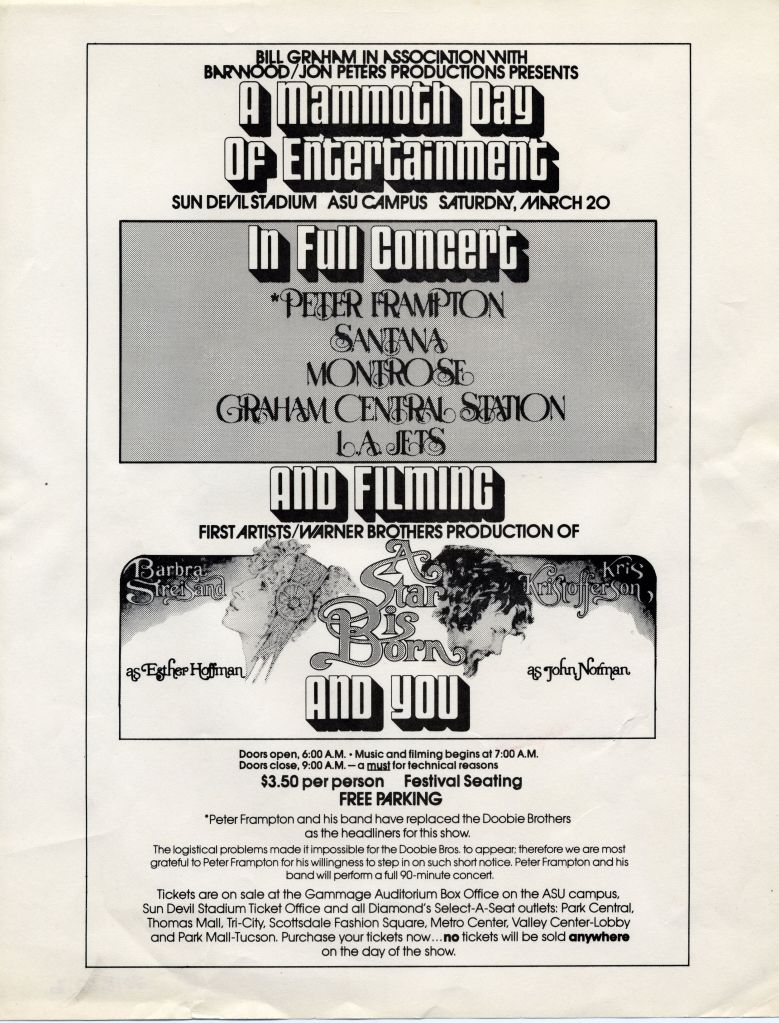
At a sweltering Crosby, Stills, Nash & Young show at Tempe Diablo Stadium in 1974, former Phoenix New Times music writer Jimmy Magahern remembers crowds sprawled across the grass in what felt more like a picnic than a concert.
“We brought a huge beanbag chair, a cooler filled with bags of ice, and just carried it in,” he recalls. “People brought blankets, picnic baskets — it was first-come, first serve on the grass.”
“It was like, 104 degrees,” Magahern says. “The sound wasn’t great, but you put up with it. These were the bands you wanted to see.”
Tempe History Museum
Scott Liem, a longtime Tempe resident and former president of the Tempe Diablos — the nonprofit group that helped establish Tempe Diablo Stadium — attended many of the concerts held there in the 1970s. “It felt a little like Woodstock,” Liem recalls. “There weren’t a lot of rules. People were there for the music, and everybody kind of took care of each other.”
That anything-goes atmosphere didn’t disappear indoors — it just got more concentrated. “The place was just a cloud of weed,” recalls Cathie Mancini, a Tempe native who attended Ozzy Osbourne and Motörhead in 1981 at the ASU Activity Center (now Desert Financial Arena). “I got really stoned — probably too young — and just remember trying to stay awake, drinking my Coke, and feeling completely overwhelmed.”
Inside the basketball arena, the setting was stripped down and brightly lit. “It was like a movie theater,” Mancini adds. “Bright white lights. Folding chairs. Aluminum bleachers. No video screens. Just a band playing.”
Those kinds of nights felt electric in the moment, but they also exposed the limits of venues that were never designed to carry the weight of a growing touring industry. Former Phoenix New Times production manager Conni Ersland remembers that sense of scale colliding with logistics firsthand. She was 17 when she camped overnight in the Metrocenter parking lot for Rolling Stones tickets in 1981, lining up with strangers who would later become friends. “The waiting was half the experience,” she recalls. “You met the people you were going to sit with. It felt like a festival before you even got inside.”
Inside the stadium, the sound and sightlines were imperfect, but that wasn’t the point. “Nobody cared,” she says. “You were just happy to be there.”
For promoters and venue operators, though, those imperfections added up. “The Activity Center was built exclusively for basketball. For concerts, you could only put about 7,500 people in front and to the sides of the stage,” Zelisko says. “The other half of the building was either beside or behind the stage — and people don’t want to buy tickets behind the stage.”
As touring productions grew larger and more expensive, that math stopped working. “Major touring groups needed 12,000 to 15,000 seats,” he says. “And that was a problem.”
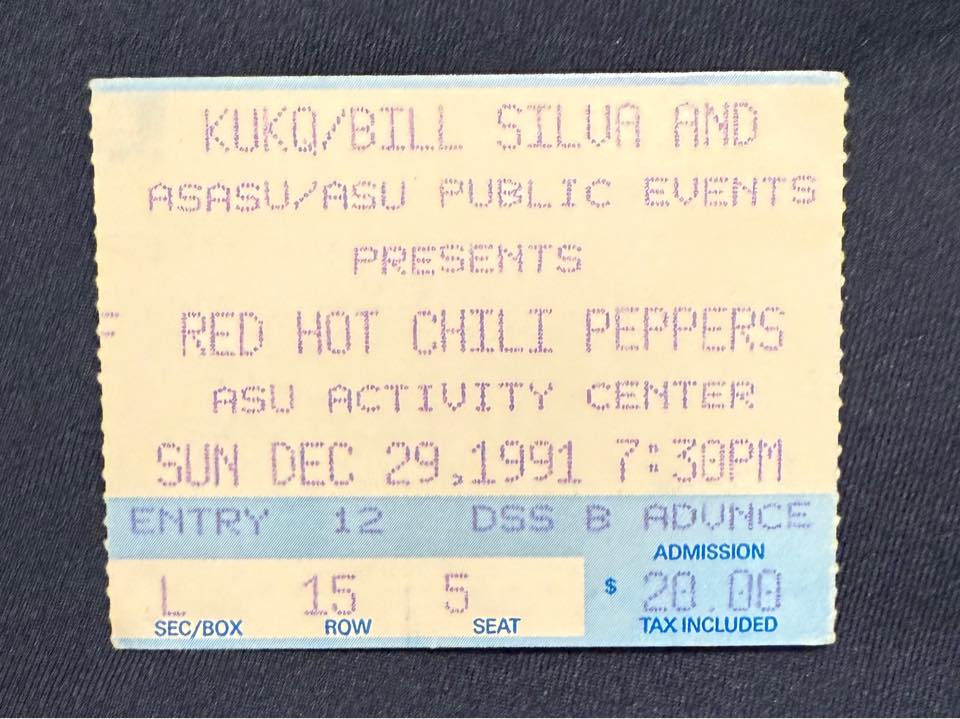
Courtesy of Niki D’Andrea
The last major concert Zelisko promoted at the ASU Activity Center was Jane’s Addiction in 1990. Within a year, the band would help launch the first Lollapalooza tour — a signal that live music was moving beyond campus arenas and into a new, festival-driven era.
Colleen Jennings-Roggensack, ASU’s vice president for cultural affairs, notes that the Activity Center was never designed as a concert-first venue. “These buildings were created for athletics and academic use,” she says. “(They) were never designed to carry the scale, production demands and infrastructure that modern touring requires.”
By the early 1990s, Phoenix had a new NBA-grade basketball arena downtown (currently known as Mortgage Matchup Center), a modern outdoor amphitheater on the west side (currently known as Talking Stick Resort Amphitheatre), and the 20,000-capacity relocated Compton Terrace amphitheater in Chandler. The Valley had outgrown its reputation as a routing stop, emerging as a reliable tour market — not yet a hub, but no longer an afterthought.
Jennings-Roggensack says the “multiplicity of large-scale venues” fundamentally changed where and how major tours could land. As touring productions grew more elaborate — with heavier staging, more lighting, and loftier logistical demands — venues that once felt expansive began to show their limits.
Today, Jennings-Roggensack oversees touring Broadway productions at ASU Gammage — a venue built for repeatable, technically exact performances, where shows arrive with tightly specified staging, sound, and lighting requirements and run for weeks at a time. “People expect the high end of things,” she says. “They expect good sound. They expect great seats.”
For the artists who performed in the ASU venues, the shift toward arenas made sense for many reasons. Judas Priest singer and longtime Valley resident Rob Halford performed at the ASU Activity Center on November 7, 1990, as part of Judas Priest’s Painkiller tour. “Arenas are better suited … from all angles,” he says.
“You can dilute a stadium event into an arena and not lose that much with production — unless you’re Beyoncé,” Halford adds. “Then there’s the outside weather: heat, wind, rain, for bands and fans to cope with.”
Fans followed whatever venue the music led them to, and the shift wasn’t felt as a loss so much as just another chapter. “Nobody felt like, ‘Oh my God, we’ve lost Diablo Stadium,’” Liem says. “It was, ‘Okay, now we’re going to Compton Terrace.’ That was the evolution.”
Is the next step in that evolution a resurgence of touring concerts in mid-size stadiums and sporting venues? No. But there have been huge concerts at large sporting stadiums like Chase Field and in outdoor areas like Tempe Beach Park, where fans fill bleachers for the Innings and Extra Innings festivals for two weekends every winter.
The Tempe Diablos, whose name is synonymous with decades of baseball and concerts at Tempe Diablo Stadium, are now sponsors of the Innings Festival.
“Yes, the music is important,” says current Tempe Diablos president Greg Garcia. “But people are just as happy to be a hundred yards away from the stage, where they can spend time with each other and actually hear each other talk.”
Perhaps Chase Field and Innings Festival work now because they combine modern production scale with the feeling of a shared civic event — delivering the spectacle audiences expect while echoing the communal spirit that once defined stadium and park concerts. “Venues with a backdrop and room to move — places like Tempe Beach Park — are better than amphitheaters that are just loud with no ambiance,” Garcia says.
The venues have changed, the city has changed, but the urge to gather around music hasn’t.
“If you lived it,” Liem says, “you don’t forget it.”