

Gage Skidmore/Flickr/CC BY-SA 2.0

Audio By Carbonatix
Keep Phoenix New Times Free
We’re aiming to raise $10,000 by April 26. Your support ensures New Times can continue watching out for you and our community. No paywall. Always accessible. Daily online and weekly in print.
Monday morning, a meeting of the Arizona State Board of Education at the Arizona Capitol Executive Tower was halted and attendees were asked to evacuate due to an emergency in the building. It turned out to be much ado about nothing — a holiday potluck on another floor had set off the fire alarm, filling the building’s staircase with people in ugly Christmas sweaters.
But something much more alarming to education advocates happened once the meeting resumed. After punting on the issue in October, the Board of Education voted without objection to move forward with a process that could result in the banning of so-called DEI — that is, diversity, equity and inclusion — from the state’s teaching standards.
Most members of the board — which has 11 spots, though two are currently vacant — did not respond to requests for comment from Phoenix New Times. But board member and Arizona Superintendent of Public Instruction Tom Horne, a Republican and a longtime opponent of DEI and seemingly anything that acknowledges minority groups, lauded the move in a press release as “an excellent decision.”
“All people should be judged based on their character and ability, not their race or ethnicity,” Horne said in the release. “DEI language and programs promote the exact opposite, and they have no place in the classroom.”
There are a few problems with that, though.
First is that in right-wing circles, “DEI” has come to mean anything that doesn’t reinforce white people’s — and especially white men’s — spot atop the societal hierarchy. Under President Donald Trump, battling DEI has been used as an excuse to fire non-white and female military leaders, rename military bases after white people and scrub Black, LGBTQ and other minority references from federal websites. (Early in Trump’s administration, that included mentions of Black baseball pioneer Jackie Robinson and the Navajo Code Talkers.)
The second problem is that the supposed reason that Arizona needs to strip DEI from its teaching standards — that Trump will withhold $866 million in funding from Arizona schools if the board does not — has been halted by the courts. Since August, when a federal judge blocked a Trump executive order that imperiled the funding, nothing has legally compelled Arizona to go to war against DEI.
As far as explanations go, that just leaves a culture war that Horne has relished in fighting. Even before Trump regained the White House, Horne has railed against Pride flags and Black Lives Matter stickers on school campuses and has crusaded against the largely non-existent danger of transgender kids using bathrooms that align with their identities.
Creighton School District Governing Board Member Nicole Marquez, who sat toward the back of the meeting room holding a small sign that read “this is fascism,” criticized the board’s decision as a “targeted attack” that is “premature and irresponsible.”
“It has nothing to do with improving outcomes for students,” she told Phoenix New Times after the vote. “It has everything to do with capitulating to what Trump wants.”
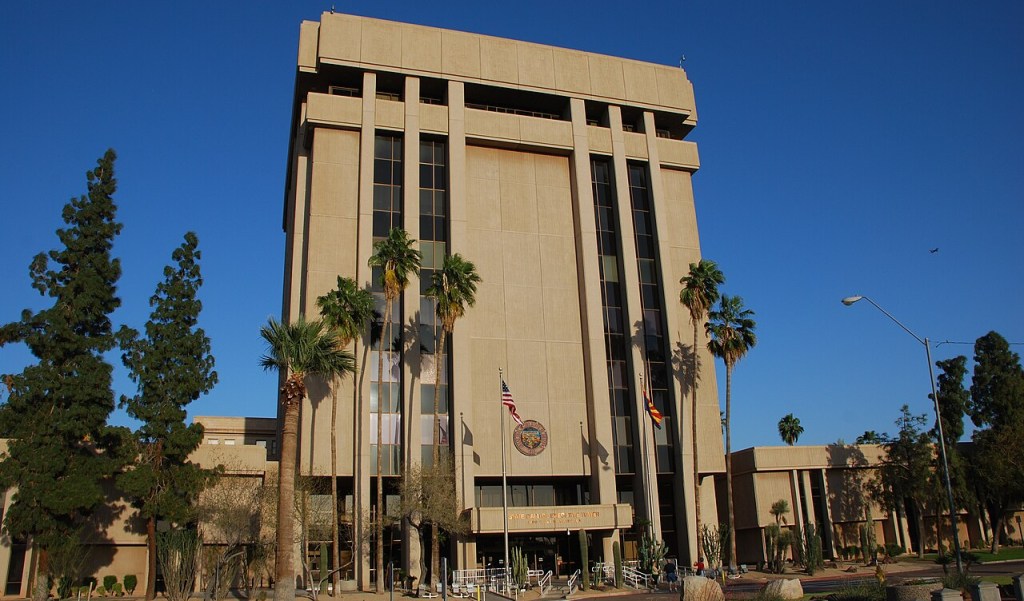
Adavyd/Wikimedia Commons/CC BY-SA 3.0
Blocked in court
Horne’s ideological mission aside, the drama over the state teaching standards and DEI began in February.
That month, the Arizona Department of Education received a “Dear Colleague” letter from its federal counterpart, demanding that educational institutions follow Trump’s January executive order to eliminate DEI or lose federal funding. In the executive order, Trump ordered that “illegal” DEI “mandates, policies, programs, preferences and activities” must be eliminated from the federal government.
Horne readily took up arms, gravely warning about the risk to federal funding if, in essence, any language that acknowledges the existence of race-, sex- and sexuality-based discrimination remained on the books.
In August, U.S. District Judge Stephanie Gallagher struck down the U.S. Department of Education’s guidance, which Gallagher said caused “millions of educators to reasonably fear that their lawful, and even beneficial, speech might cause them or their schools to be punished.” Gallagher also struck down an order to force K-12 districts to certify they aren’t using DEI practices or risk federal funding, although the department had already rescinded that requirement due to a prior court ruling.
The Department of Education appealed that ruling to the U.S. Court of Appeals for the Fourth Circuit in October. The appeals court has not yet issued a ruling. In the interim, there is no active threat to Arizona’s federal education funding, DEI language or not, leading education advocates to ask what the rush is.
“We just don’t think this is necessary at all,” said Tyler Kowch, the spokesperson for the education organization Save Our Schools. “This is not a top-down thing. This is Horne, who’s leading the charge in trying to get funding cut from our schools.”
Horne is indeed a longtime anti-DEI crusader. He’s especially warred against the concept of dual-language immersion in schools, in which students spend half of their time learning in English and the other half learning in Spanish. He has fought losing battles in state court over the issue. In 2023, Horne also launched a hotline for parents and teachers to report the use of DEI and critical race theory — the latter a subject taught only in some advanced law school classes.
Education advocates like Kowch and Marquez view Horne with suspicion, at best.
“The role of the superintendent should be to fiercely protect our students and defend learning, and our schools and he’s just giving it away,” Marquez said. “He straight up said he’s going to report the districts.”
DEI — or whatever conservatives claim is DEI — isn’t gone from Arizona schools yet. The state’s standards are based on the national Interstate Teacher Assessment and Support Consortium, or InTASC, standards, which have been accepted by federal agencies and state education departments alike. The state board updated its guidelines based on InTASC most recently in 2018, and InTASC hasn’t changed any of its standards to reflect any of the Trump administration’s actions.
So-called DEI may not be in there at all, but the board’s first step was to establish a working committee to figure out if it is. That includes finally defining what “DEI-related language” really is. The committee, which will represent all 15 counties and feature members from different educational professions, will meet monthly to mull that question. From there, the committee will determine whether language from Arizona’s professional teaching standards should be removed or revised.
The committee aims to finish its work by September, but Marquez worries its work could amount to a waste of taxpayer dollars if the ruling blocking Trump’s executive order is upheld. More seriously, though, she is concerned about what will happen if the board does go after whatever it defines as being DEI. She’s concerned it could mean the elimination of the district’s Native American families program, Dia de los Muertos decorations, Spanish teaching or any other “DEI” lesson.
“There is no definition of illegal DEI,” Marquez said. “How far are they going to take it?”