
Mario Tama/Getty Images

Audio By Carbonatix
Talk to anyone about Arizona weather and you can’t avoid the dryness of the climate.
Newcomers complain about waking up feeling hungover without having had a sip of booze the night before. People discuss which body lotion they buy in bulk and slather onto their skin in a futile attempt to avoid looking like a desiccated raisin. And no matter what, someone — most likely giggling — is bound to say “It’s a dry heat!”
But seriously, it’s no laughing matter. Arizona really is dry. Fifteen percent drier, to be precise.
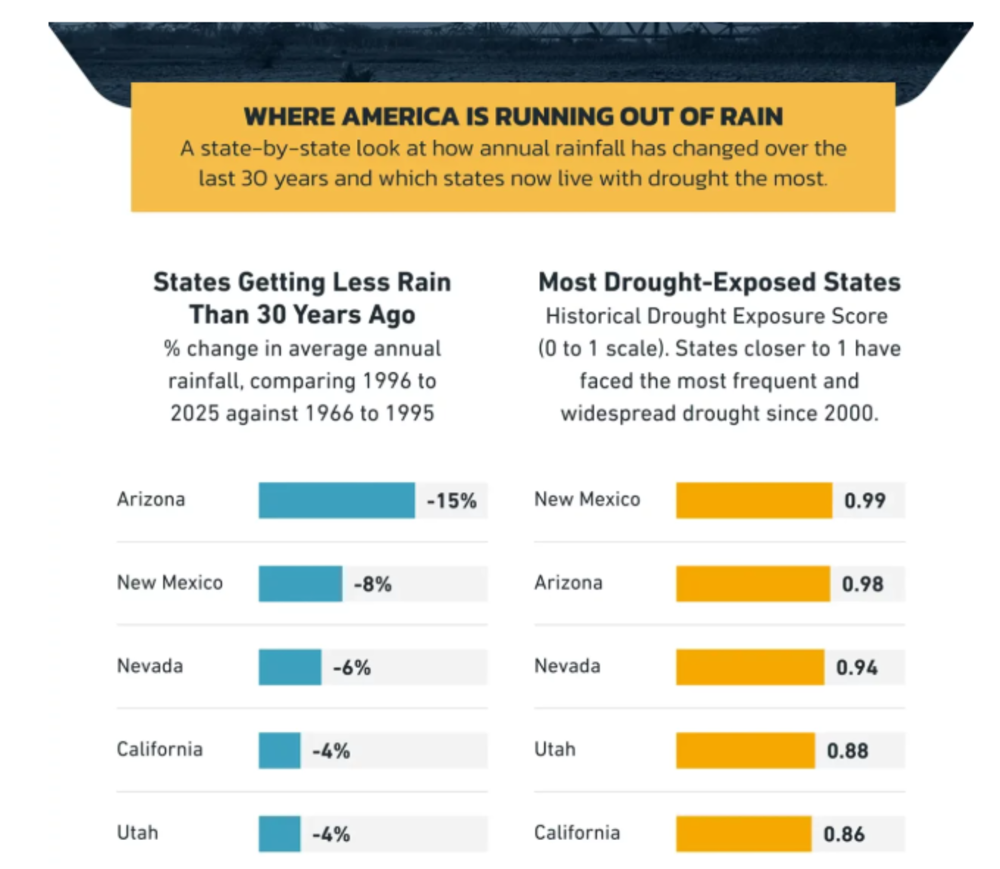
Arizona received 15% less rain per year over the past 30 years than in the 30 years before that, according to a study by Texas-based energy company Payless Power. That’s the biggest decrease in rainfall of any state in the country, and nearly twice the decline seen by New Mexico, the state with the second-biggest dip in rainfall over the same time period.
Arizona was also the state with the second-highest drought exposure, which combines how frequently and how much of the state has been in drought since 2000, and the second-highest risk for increased dryness over the next 10 years.
Payless Power analyzed rainfall data for the 48 contiguous states, excluding Alaska and Hawaii, from the National Oceanic and Atmospheric Administration for 1966 to 2025. It calculated the average annual rainfall and then compared rainfall between 1996 and 2025 with data from 1966 to 1995. It calculated drought exposure by state using data from the U.S. Drought Monitor from 2000 to 2025 and determined dryness risk using data from the U.S. Geological Survey.
Payless Pow
Phoenix-based National Weather Service meteorologist Theodore Whittock noted that the study is not peer-reviewed, but he said it uses reliable data and matches up with the findings of peer-reviewed studies.
“They’ve come to this conclusion,” he said. “Dry areas are getting drier, some wet areas are getting wetter.”
From Whittock’s anecdotal experience analyzing and predicting daily weather patterns in the Phoenix area, the study’s findings seem to align with the weather the region has seen in recent years.
The state is in the midst of a historic drought that some models say could last past the end of this century. The Valley has also seen particularly dry years, with Phoenix nearly breaking a record with a 159-day rainless streak that bridged 2024 and 2025.
“Since 1991, our monsoon seasons have been getting drier, and that’s just anecdotally right, just from the data that I’ve seen,” he said, emphasizing that there is no peer-reviewed study on the issue. But that doesn’t mean it’s always drier.
“You can have some very impactful, some very prolific monsoon seasons,” Whittock said. “It’s highly variable from year to year.”
How much rain the state gets varies by region, too. The high country, like the Mogollon Rim, is more likely to get more rainfall than the low desert regions, like the Phoenix area.
As for whether the El Niño this year will change anything, don’t expect Noah’s flood.
“We might see wetter than normal conditions during the winter,” he said.