
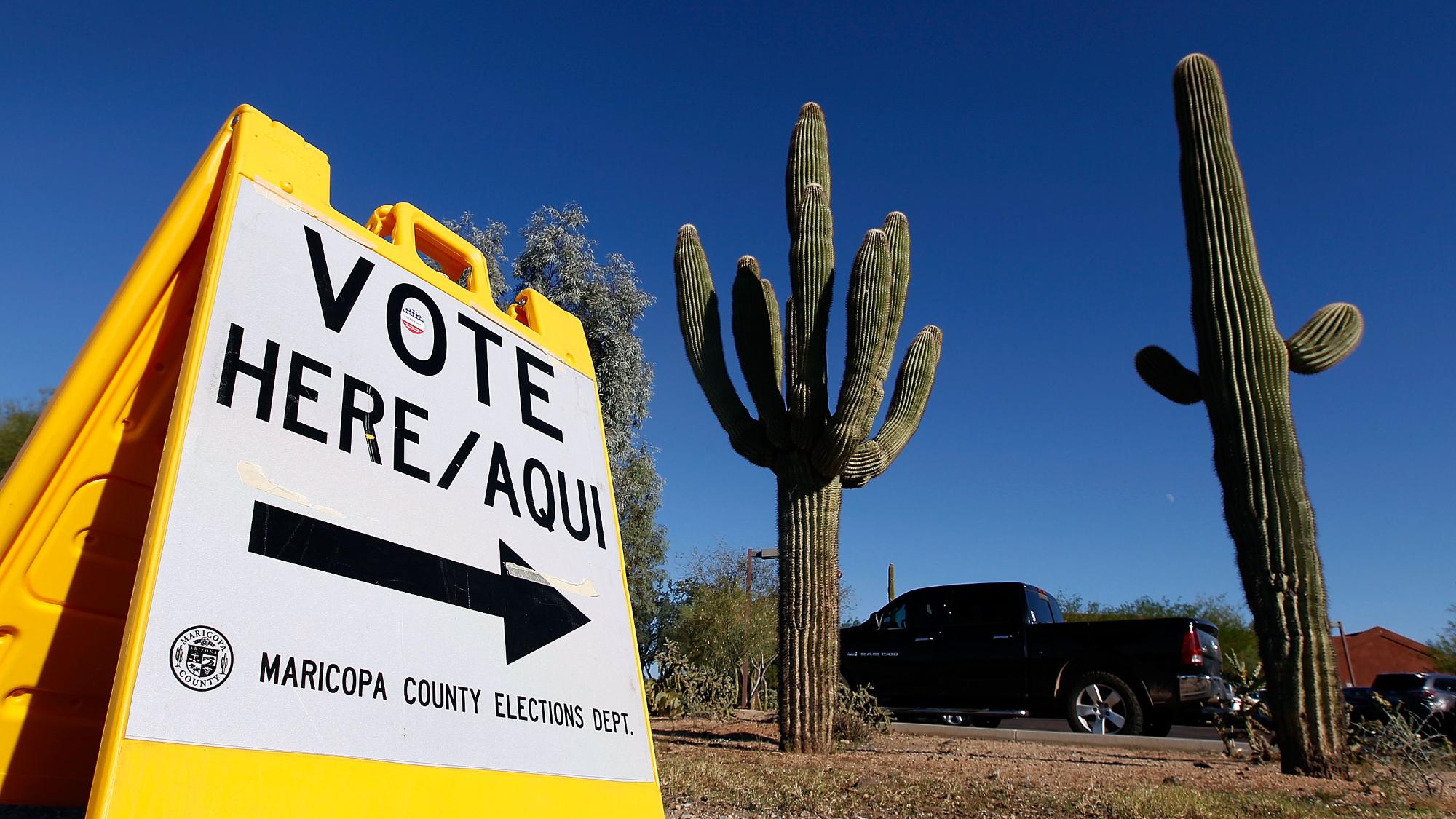
Ralph Freso/Getty Images

Audio By Carbonatix
The measures Arizona voters will weigh in on in November are finally set.
In nearly two months, Arizona voters will head to the polls or mail in their ballots to cast votes in major state and local races. Several high-profile offices are in play, including governor, secretary of state and attorney general.
For the second straight general election, voters also will decide a number of statewide ballot measures. Eight of the proposed 11 measures officially made the ballot, which election officials began printing Aug. 21.
The measures, also known as propositions, include proposed laws to bar transgender girls from girls’ sports, to require every voter to show identification when casting a ballot and bar cities from implementing grocery taxes.
A lower court knocked off two GOP-backed propositions that aimed to curtail teachers’ unions and protect the state’s voucher program by safeguarding military families’ Empowerment Scholarship Account funds. The Arizona Supreme Court upheld that ruling. Public education advocates, including the state teachers’ union, believed the GOP-backed ESA measure was a poison pill that aimed to disqualify their own citizen-led ballot measure, which, if passed, would have placed guardrails on the program that’s been rampant with abuse and fraud. That measure didn’t make it to the ballot either. The Arizona Supreme Court found that advocates didn’t gather enough signatures to qualify.
After lawmakers nearly called a special session over the issue in June, no ESA-related measures will be on the ballot.
The eight remaining ballot measures were put forward by GOP state lawmakers through the legislative process. If approved, the concurrent resolutions, or ballot referrals, will go directly to voters and bypass Democratic Gov. Katie Hobbs’ veto pen.
Here’s what you need to know about the nine measures slated for your November ballot.
Prop. 144: election changes
HCR 2001: Change to the state constitution.
This GOP-backed measure is an election reform proposal that mirrors much of what is already in state or federal law. It requires that only citizens may register and vote in the state’s elections, that foreign nationals may not contribute money to influence a state election, that every voter must show a valid, government-issued ID to vote by any method and that voters have the right to have their ballot tabulated at their voting location.
“The Arizona Secure Elections Act puts the rules where they belong: in the Constitution,” resolution sponsor Rep. Alexander Kolodin — also a candidate for secretary of state — wrote in a press release.
Democrats argue that the bill’s vague language could cause significant confusion in the state’s election processes. The ACLU of Arizona said the bill would force voters to resubmit proof of ID every time they vote and would give the legislature “unchecked power to end voting by mail completely,” the group wrote in a social media post.
Central to the issue is the question of how mail-in voters would provide ID. The identities of mail voters are already confirmed by comparing the signatures on ballot envelopes. Additionally, every Arizona voter must provide proof of citizenship when registering to vote. Arizona is the only state with such a law.
“Arizona’s strength in elections comes from giving eligible voters ample opportunity to cast their vote. Mail-in ballots, Election Day drop-offs, and early voting are essential parts of that equation,” wrote Katelynn Contreras, an ACLU of Arizona policy strategist, in a statement. “This is another senseless attempt by lawmakers to urge people to vote against their own best interests.”
Randy Keating, a member of Tempe City Council, unsuccessfully challenged the measure in court. The Arizona Supreme Court upheld the lower court’s decision to keep it on the ballot. The Arizona Supreme Court also rejected arguments from a Trump-linked law firm challenging the proposition’s description.
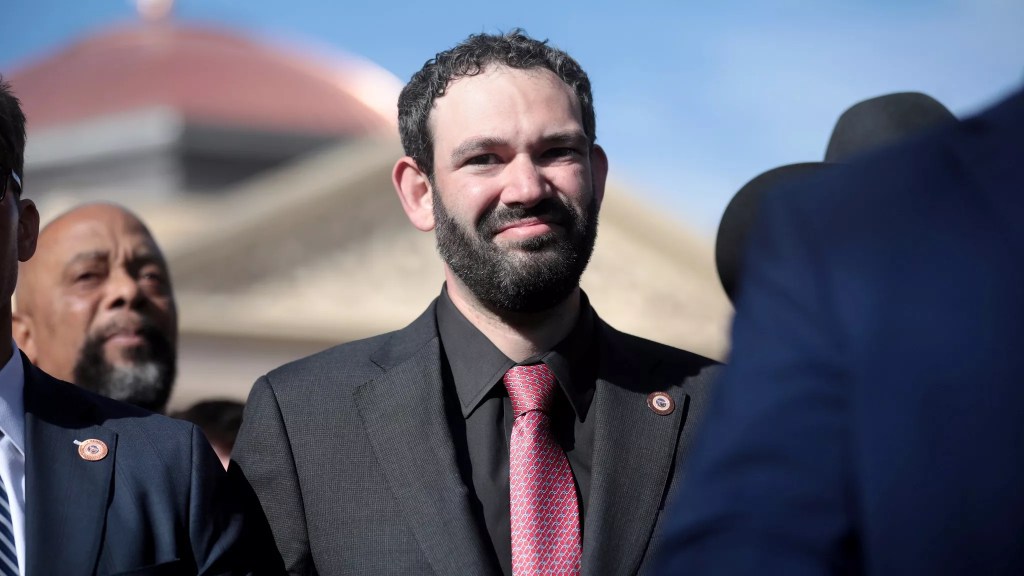
Gage Skidmore
Prop. 142: a DEI ban
HCR 2044: Change to state law.
This measure aims to be the final nail in the coffin for any remaining diversity, equity and inclusion policies in Arizona. It aims to eliminate “preferential treatment or discrimination against an individual or group based on the basis of race or ethnicity,” the bill reads.
Specifically, state institutions would be banned from requiring DEI statements in hiring, admissions, promotions, contracts or scholarships. It’d block public money from being used to fund public education jobs, programs or training regarding race-based preferential treatment and prohibit “requiring or soliciting an individual to confess race-based privilege or discuss the individual’s race or ethnicity.”
It’s the latest iteration of the willful conservative misunderstanding of what DEI initiatives are meant to achieve. Instead of giving preferential treatment based on minority status, as many MAGA types claim, DEI policies are intended to ensure that people from groups that have faced historic discrimination are given a fair shake.
In a statement, ACLU of Arizona policy director Darrell Hill wrote that the resolution could violate the First Amendment rights of students, teachers and administrators.
“Ideas are not illegal, and there is no ‘government-approved’ speech exception to the First Amendment,” Hill wrote. “The state cannot adopt a policy or rule that punishes faculty, administrators or students for expressing their beliefs or prohibits wide scopes of ideas from being debated at universities.”
Will the People, an advocacy group, challenged the measure, arguing that it violated free speech protections. A Maricopa County Superior Court Judge disagreed, allowing the measure to be on the ballot.
Prop. 319: traffic camera crackdown
SCR 1004: Change to state law.
This measure would largely ban photo-enforcement traffic camera systems in cities and require municipalities with existing photo-enforcement contracts to obtain voter approval to continue operating them.
If the local authority doesn’t receive voter approval to operate its system, it must cease operations within 90 days of the November election. However, if the city does receive approval, it may continue its photo enforcement operation for 10 years, until the question must be placed before voters again for approval.
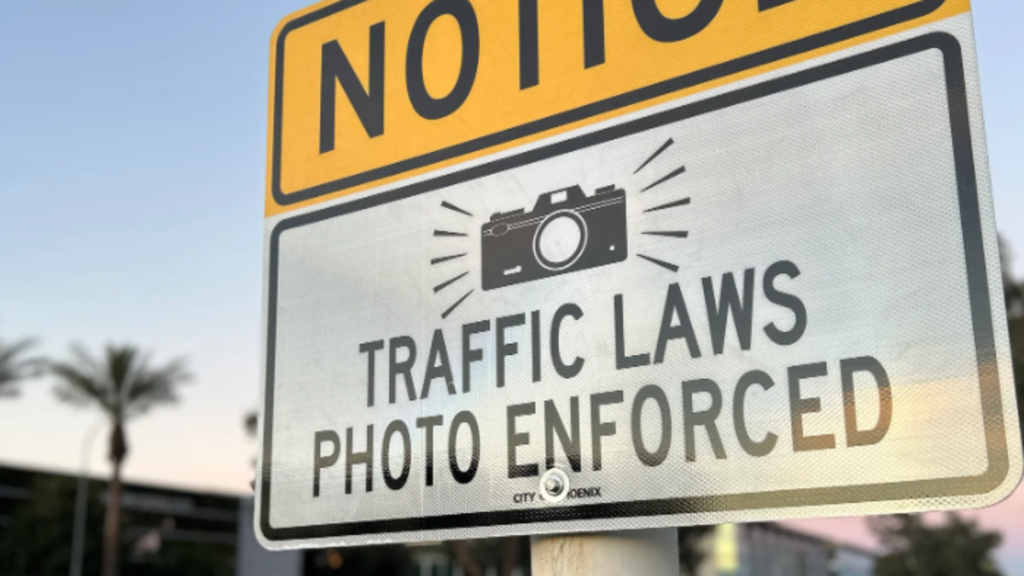
City of Phoenix
Prop. 318: anti-trans locker room bill
HCR 2003: Change to state law.
This measure would bar any athletic association that sponsors an interscholastic or intramural sport from allowing a person to use a restroom, locker room or shower room that is not “designated for that individual’s sex,” which is defined as the person’s designated sex at birth, according to the bill’s text.
It’s a culture war bill that takes aim at the small population of trans youth athletes in Arizona who almost certainly are not having a deleterious effect on girls’ sports. However, in a 6-3 ruling on June 30, the U.S. Supreme Court ruled that states can legally bar transgender women and girls from competing on female sports teams at publicly funded schools and colleges. That ruling could unblock Arizona’s stalled 2022 ban on transgender female athletes that was struck down in federal court.
Still, two pastors, backed by the Will the People PAC, sued to block this ballot measure from being on voters’ ballots in November, citing constitutionality concerns. A Maricopa County Superior Court disagreed. The measure will be on the ballot in November.
Notably, no one pushing such a ban has been able to say how many trans girls are actually playing girls’ youth sports.
In a statement, Hill wrote that “Arizona lawmakers continue to play cruel political games with the health, safety, and lives of Arizona children.”
Prop. 320: limiting administrative use of school funding
HCR 2007: Change to state law.
This budget measure would require school districts with more than 7,500 students — and all school districts in Maricopa, Pima and Pinal counties — to spend at least 60% of their operational budget on direct instructional expenses.
“Too much of that money never reaches the classroom,” the resolution’s sponsor, GOP state Sen. Jake Hoffman, wrote in a press release. “This referral establishes a clear standard and finally holds districts accountable for putting bureaucracy ahead of students.”
If a school district failed to meet this funding threshold, it would lose 25% of its state funding. After four subsequent years of noncompliance, that penalty would increase to 100% of state funding.
Save Our Schools called the measure an “unreasonable benchmark” that school districts “have not met at any point since 2003.” School advocates have also criticized the measure for running the risk of preventing schools from affording counselors and specialists who work with needy students.
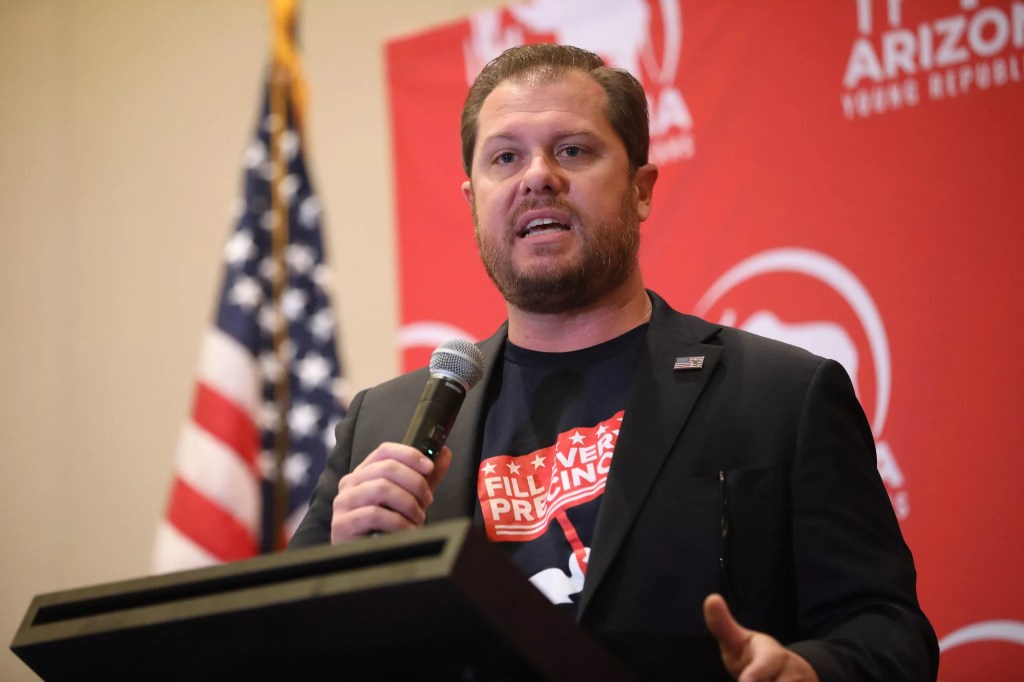
Gage Skidmore/Flickr/CC BY-SA 2.0
Prop. 317: designating drug cartels as terrorist organizations
HCR 2055: Change to the state law.
This measure, which was passed through the legislature in 2025, would officially declare drug cartels terrorist organizations if passed. It would direct the state Department of Homeland Security to “do everything within its authority to address the threat posed by drug cartels,” the bill text reads. It’s unclear what the overly broad and vague policy would mean in practice.
Hobbs previously vetoed a policy under a different bill over concerns about tasking a department, whose main job is administering federal grants, with law enforcement duties. Additionally, the measure states that the designation will do nothing to help an asylum seeker’s claim — even if they’re escaping violence from the same organization the state has designated as a terrorist organization.
Prop. 141: banning mileage-based tax on vehicles
SCR 1004: Change to the state constitution.
This measure, passed by the legislature in 2025, prevents municipalities from imposing a tax or fee based on a vehicle’s mileage, according to the bill’s text. That’s not something the state currently imposes, but the measure would prevent the state from imposing any such rule or law.
Specifically, the proposal is an attempt by sponsor Hoffman — the driver of a Tesla Cybertruck — to remove an option lawmakers have to ensure that electric-vehicle owners pay a share of future road construction and repair costs that would otherwise be funded by a gas tax. With the rise of electric vehicles, imposing a mileage tax would help offset declining revenue from the state’s 18-cent-per-gallon gasoline sales tax.
Prop. 316: capping grocery taxes
HCR 2021: Change to state law.
This measure, passed by the legislature in 2025, prevents cities from imposing a future tax on groceries above 2%, according to the bill text. Cities that already tax groceries can generally continue to tax them. A city wishing to implement a grocery tax needs voter approval, and that tax cannot exceed 2%.
This story has been updated.