
Diannie Chavez/Arizona Republic – Pool

Audio By Carbonatix
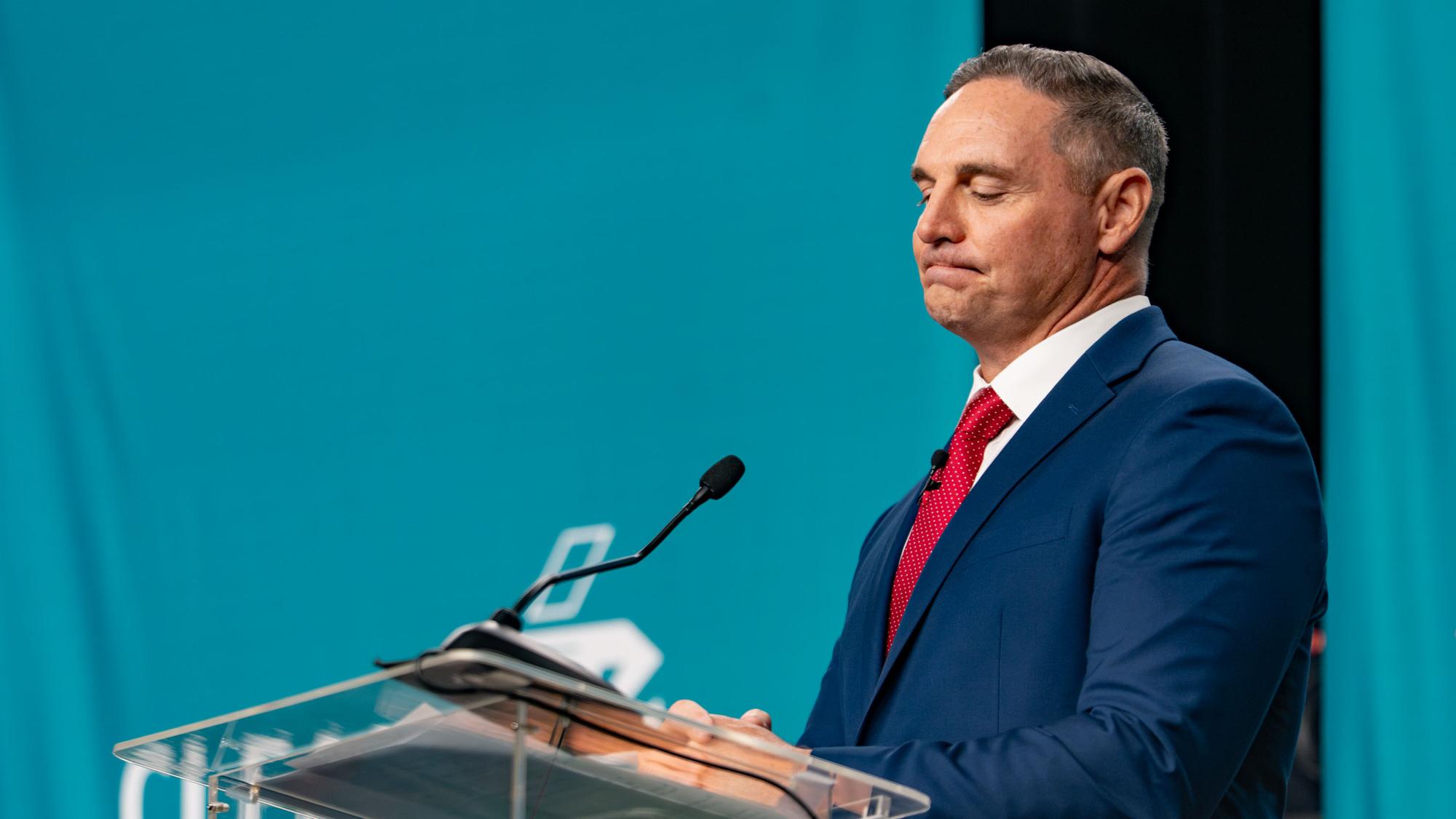
Jay Feely is hardly the Trumpiest candidate in the GOP primary race for the Phoenix- and Scottsdale-based Congressional District 1, a title that may rightfully belong to former state Rep. Joseph Chaplik. But at Wednesday’s GOP debate, the Trump-endorsed Feely did his best to live down to the MAGA mantle.
Specifically, when asked about affordability issues in Arizona, the former NFL kicker xenophobically scapegoated immigrants, falsely blaming rising housing costs on the state’s undocumented residents. He also pejoratively referred to those residents as “illegals,” a descriptor that stigmatizes a largely brown-skinned group of people, many of whom have lived productive and law-abiding lives in Arizona for years.
“When they willingly allow tens of millions of illegals to come across the border, and then they changed the verbiage and said that they were lawfully present,” Feely said in a rambling, incomplete thought on the debate stage, which included repeating misinformation about undocumented immigrants dragging down Medicaid and the Supplementary Nutrition Assistance Program. “Now those people are here, and they’re buying homes and they’re renting homes and they’re driving up the cost.”
Put simply: That’s wrong, and it repeats a time-worn racist dogwhistle of blaming immigrants for societal problems.
Numerous studies show that immigrants have a net positive effect on the economy and, more specifically, are not causing the housing crisis. For one, immigrants — including undocumented people — make up a disproportionate share of the construction workforce, and deporting them all would devastate that industry and stymie homebuilding. Additionally, just as undocumented immigrants are hardly taking all the high-paying, white-collar jobs, they’re not buying or renting the most desirable properties and boxing out citizens who are generally more financially stable. Immigrants aren’t why Scottsdale rents are so high.
To back up his claim, Feely cited a March 2026 Federal Reserve report, specifically from the Federal Reserve Bank of Dallas, which he said found “30% of the cost of buying a home is because of illegals, and 20% of rent prices are because of illegals.” The study, titled in part “The Impacts of Unauthorized Immigration on U.S. Labor and Housing Markets,” does cite a “back-of-the-envelope calculation” that “suggests” unauthorized immigrant worker flows can explain about 30% of total growth in house prices and 20% of total growth in rents over the “boom period for the average local market,” between March 2021 and March 2024.
However, this hasty calculation tells far from the whole story. In the typical local housing market, undocumented immigration drove only a 2.9% increase in housing prices and a 1.9% increase in rents for the median market, according to the study’s figures. Generally, housing experts believe that immigrants aren’t driving housing price growth. The numbers simply don’t line up.
Home and rental prices surged in both 2020 and 2021 during the COVID-19 pandemic as construction came to a halt, particularly in Phoenix and in Arizona as a whole. The number of immigrants arriving in the U.S. did surge in 2022 and 2023, largely due to asylum claims rather than people sneaking across the border. But the timing of this surge does not align with the substantial increases in home prices and rents in recent years, according to a report from the Harvard University Joint Center for Housing Studies.
Instead, in addition to construction slowdowns, the Harvard study blamed the dramatic increase in housing costs on pent-up demand from millennials, people wanting more space after being stuck inside their homes and the Federal Reserve’s historically low 30-year mortgage rates.
Additionally, while immigrants account for a small share of housing demand, they also help expand the country’s housing supply due to their “outsized role in the construction industry,” the Harvard study found. According to 2023 U.S. Census Bureau data, immigrants account for 34% of construction workers, with the highest shares of immigrant workers being plasterers, drywall installers, roofers, painters and installers of carpet, floors and tile.
Diannie Chavez/Arizona Republic – Pool
A separate study by the American Immigration Council found that immigrants generally aren’t moving into highly desirable and competitive housing areas. Instead, the roughly 40 million immigrants in the country have helped create $3.7 trillion in housing wealth by moving into and stabilizing “less desirable communities” where home prices are already declining.
After the debate, Phoenix New Times asked Feely why he blames immigrants when studies show they account for such a small percentage of rising housing costs.
‘When you bring 20 million people into a county, they have to rent homes, they have to have the ability to provide housing for themselves,” he said. “When you have a larger number of people there, that’s going to drive up prices, and when you drive up rent prices, that correlates directly to housing costs and that’s going to drive up the cost of housing as well.”
Reasonable in theory but not in practice, according to studies, which show that the supply side of the equation is much more responsible for the housing pinch.
Feely went on to talk about having an “honest conversation about illegal immigration” and shared the story of helping a Haitian man he met on a mission trip move to the U.S. He was also asked about the housing reform bill that passed Congress with overwhelming bipartisan support. The bill was set to be signed by President Donald Trump before Trump threw a fit and canceled the signing, refusing to sign it into law unless the Senate also passes his flawed voter ID reform, dubbed the SAVE Act.
“It’ll get signed,” Feely said of the housing bill. “All I care about, when it comes to the president, always is the end result.”
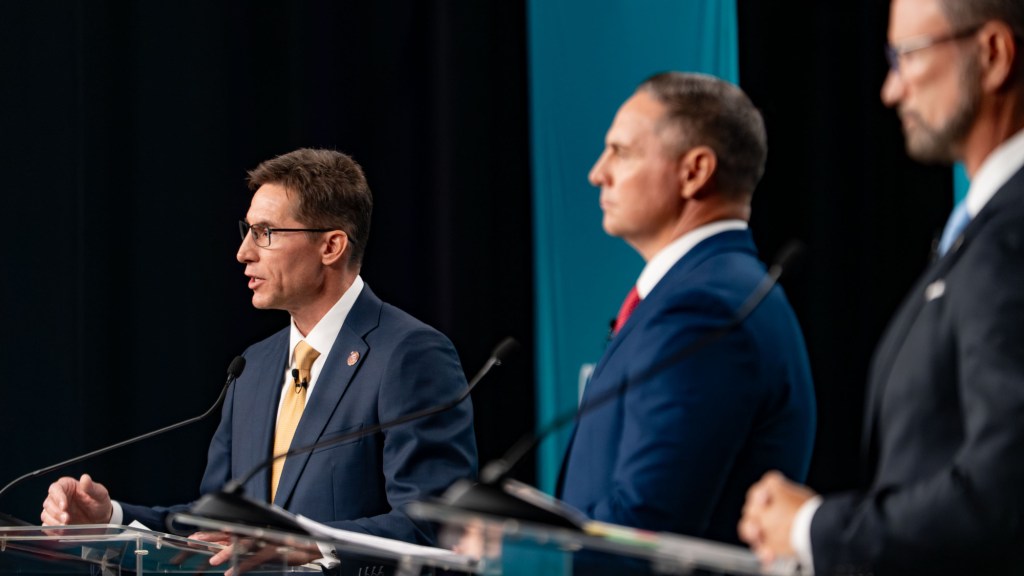
The third candidate in the race, businessman and longshot John Trobough, also said he supports the housing bill, adding that he wished Trump would sign it independent of the SAVE Act. (Trobough also peddled in blame-immigrants-for-affordability tropes.) Chaplik didn’t say whether he supported the housing bill, but added that he worked toward housing affordability while in the legislature.
Notably absent from the debate was the sniping that has so far defined the Feely-Chaplik showdown, which has included trading social media barbs about Haitian immigrants and accusations of racism. Though the pair did get into a brief tiff about an AI video of Chaplik made by a PAC that Feely said has no affiliation with him.
Still, the evening was rampant with misinformation and unverified claims. Feely spoke about ballot harvesting in California and suggested, without evidence, that there was fraud in the recent Los Angeles mayoral primary. He also shared that he stood armed guard in his neighborhood of Agritopia — which is not in CD1, though Feely said he and his wife will buy in the district — during the Black Lives Matter protests of 2020 because he saw a Facebook post that said it’d be targeted. It wasn’t targeted, which goes to show you can’t believe everything you see on Facebook.
Chaplik said that the federal government may take 77% of Arizona’s water; in reality, it could be 77% of Arizona’s water from the Colorado River, which makes up only a portion of the state’s supply. Trobough cast Arizona’s fight over the river as a matter of national security, given the state’s status as a growing hub for technology infrastructure. He said Arizona can choose to be the gateway to the country’s economy or the bachelorette capital of the world, and then said — presumably mistakenly — that he preferred the latter. Dirty dog.
But of all the bullshit peddled at the debate, Feely’s “immigrants took your housing” claim may have been the most obviously and offensively false.