

Kevin Hurley

Audio By Carbonatix
This story was first published by LOOKOUT, an investigative nonprofit news organization covering Arizona’s LGBTQ+ communities.
Two of the state’s longest-running LGBTQ+ rights advocacy organizations have been crafting language for a potential marriage equality ballot referral with religious exemptions since the fall, despite initial concerns from a chair of the LGBTQIA Caucus.
During the legislative interim, Equality Arizona and ONE Community developed a new approach to removing the state’s constitutional ban on same-sex marriage: adding carveouts for religious objectors, which would allow pastors or people who certify marriages to reject performing them if they have a sincerely held religious belief against it.
Equality Arizona President Michael Soto, who is also on the ONE Community advisory board, said their push to propose a state-level marriage equality referral with religious liberty exemptions is “straightforward” and “proactive.” He said the language draws from the federal Respect for Marriage Act (RFMA) and the Supreme Court’s 2015 ruling in Obergefell v. Hodges, which established the constitutional right to marry for LGBTQ+ people.
Late last year, the Supreme Court declined to take up a case challenging that decision. Kim Davis, a former Kentucky clerk who made the appeal, has long argued that “religious convictions” conflict with the decision. In 2022, former President Joe Biden signed into law the RFMA, revoking the Defense of Marriage Act and affirming the validity of same-sex and interracial marriages. Even if the court decided to hear Davis’ case and later overturn Obergefell, same-sex marriage would still be protected at the federal level. But without Obergefell, states like Arizona could refuse to recognize same-sex marriages.
But the RFMA didn’t originate with LGBTQ+ rights groups. In fact, it also outlines broad exemptions for religious organizations, a strategy political insiders dubbed “the Utah compromise.” At the time, many activists described the federal legislation as “a way for Republicans to hide behind the language of inclusion while cementing further protections for religious individuals to discriminate against LGBTQ+ Americans,” Theia Chatelle reported for The Nation.
State Rep. Brian Garcia, a Tempe Democrat, called an earlier version of Equality Arizona and ONE Community’s policy draft that was leaked to LOOKOUT “a rollback.”
Garcia told LOOKOUT that when a fellow Democratic lawmaker first contacted him with early notes about another marriage equality initiative, he let her know about the problems he had with the religious exemption language and the provision to stop people from legal action on that specific issue. “I’m generally not a fan of passively allowing discrimination on those grounds and others without a recourse,” said Garcia, who added that the contents of LGBTQ+-related bills require a strict analysis. “Anti-LGBTQ folks are really creative and innovative in weaponizing the legal structures in a way, obviously, to benefit them but also to a detriment to us.”
Since then, Soto said the groups met with the LGBTQIA Caucus to present “a draft document for potential legislation that would ensure marriage equality in Arizona is codified into law. There was a request for a two-word change to the language, which we happily obliged.”
State Rep. Sarah Liguori, a Democrat from Phoenix, confirmed that Soto and ONE Community President Angela Hughey expressed their interest in working on marriage equality with her. “As those policy conversations developed, I engaged members of the LGBTQ+ caucus, individually and collectively, to seek their guidance.”
“Throughout this process, I have been clear with all involved that I will follow the lead of my LGBTQ+ caucus colleagues,” Liguori said. “Marriage equality is critically important, particularly at a time when we have seen a push in the courts and a pattern of this administration challenging long-standing rights. Above all, any approach to protecting marriage equality in Arizona must be done thoughtfully, collaboratively, and with LGBTQ+ leadership at the center.”
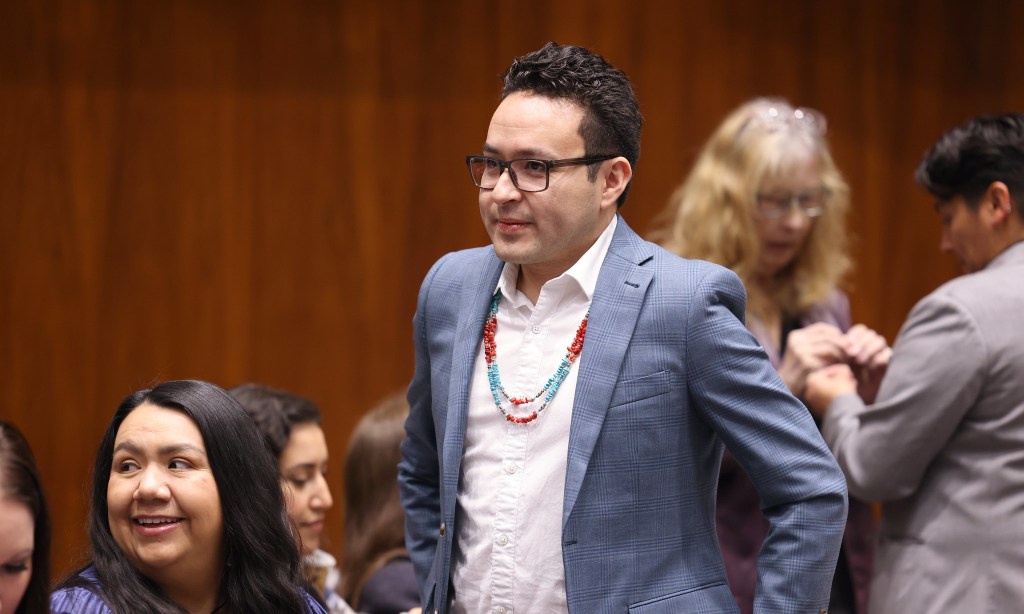
Gage Skidmore/Flickr/CC BY-SA 2.0
Past efforts
The Legislature’s LGBTQIA Caucus leadership had, in previous sessions, led the efforts to amend discriminatory language from the state constitution to include same-sex marriages.
Last year, Garcia filed a resolution that would have asked voters in 2026 if they wanted to repeal Arizona’s marriage requirement and replace it with a simple marriage equality protection. “That has been kind of the standard in the mirror for other states,” Garcia said of his policy approach. “The reason that, previously, (Arizona House of Representatives Minority) Leader (Oscar) De Los Santos and then me, subsequently, (were) putting out our version of the bill is because we’ve consistently gotten the feedback that this is the version to move forward.”
State Sen. Lauren Kuby, a Democrat from Tempe, introduced a companion bill in the Senate around the same time, but leadership in both Republican-controlled chambers failed to schedule either for a committee hearing.
For that reason, Soto said, “One approach, deleting discriminatory language from the constitution and adding simple protection language, has been tried before. We have participated in many of those efforts and learned firsthand why they failed.
“To be clear, we do not oppose this type of bill; we are offering an additional strategy that may move us closer to our shared goal of protecting marriage equality.” Neither Soto nor Hughey, both registered lobbyists at the Capitol, signed in to support the measure, according to records from the Request to Speak system.
Equality Arizona and ONE Community have a history of crafting LGBTQ+-related bills with religious carveouts – and finding centrist lawmakers to pitch them at the Legislature. For example, the past several years they’ve endorsed a bill to add sexual orientation and gender identity to the current public accommodations law that would’ve also allowed religious organizations, including nonprofit businesses, to openly discriminate against transgender, gender-diverse and LGBTQ+ people. Some drafts of the bill also contained a section to ban conversion therapy.
It’s never advanced far at the legislature. (In fact, no expansive anti-discrimination bills in Arizona have gained traction.)
“Being a freshman member this last session, I remember that particular bill, and my thought at the time was: We need every single approach to protect our communities,” said Garcia, who didn’t sign onto it. “It was brought to my attention particular language (was) hidden in that bill – separate but equal language. That was a stark reminder and realization that, no, we need to be way more intentional, way more thoughtful about how we’re approaching these pieces of legislation.”
In the first half of 2025, at least nine states entertained bills and resolutions contesting marriage equality, according to Lambda Legal. At its June convening, the Southern Baptist Convention, the nation’s largest Protestant denomination, called for the reversal of Obergefell. After Obergefell was handed down, 17 states tried to pass a “Pastoral Protection Act,” according to the American Civil Liberties Union.
Only one, Florida, enacted it as law, though the statewide LGBTQ+ rights advocacy organization took a stance against it. “Pastors and other ministers from across the state told members of the House Civil Justice Committee that the bill is not only unnecessary — but also a divisive attack on LGBT families,” it said in a statement made while the 2015 session was ongoing. “Other speakers warned that the bill could become a vehicle for other religious exemptions meant to undermine civil rights laws.”
The Texas Supreme Court approved new language in October that allows judges to “publicly refrain” from performing same-sex weddings due to their religious beliefs.
Few other LGBTQ+ rights advocacy organizations in Arizona have backed Equality Arizona and ONE Community’s former bills with religious exemptions. The ACLU of Arizona, the Human Rights Campaign, GLSEN, Lambda Legal, AZ Trans Youth Parent Organization and Secular Arizona launched a separate anti-discrimination effort in 2024 that has since run parallel to the former. It’s been stagnant as well.
“Broad religious exemptions open the door to brazen discrimination against LGBTQ+ people,” said HRC’s Deputy Director of Regional and State Campaigns Bridget Sharpe, arguing that religious freedom is already a constitutional right. “We can and must eliminate Arizona’s ban on marriage equality without leaving the door open to discrimination.”