

Photos by TJ L’Heureux and Gage Skidmore/Flickr/CC BY-SA 2.0

Audio By Carbonatix
Few would claim Arizona Attorney General Kris Mayes was in cahoots with Tom Horne, the state’s superintendent of public instruction. Mayes is a Democrat while Horne is a Republican, and the two have sparred frequently and publicly over Horne’s lax administration of Arizona’s permissive school voucher program, which costs taxpayers about $1 billion a year.
Yet in their zeal to look tough on voucher fraud — or, in Horne’s case, to allegedly throw investigators some red meat — the pair may have ruined the life of a whistleblower in the Arizona Department of Education.
That’s the tale told by a recent complaint filed in Maricopa County Superior Court by Dorrian Jones, a former employee of the Arizona Department of Education tasked with overseeing compliance issues in the Empowerment Scholarship Account program, which doles out millions of dollars to parents looking to homeschool their children or send them to private school. Jones is suing Horne for defamation and malicious prosecution, and is suing Mayes’ office for gross negligence.
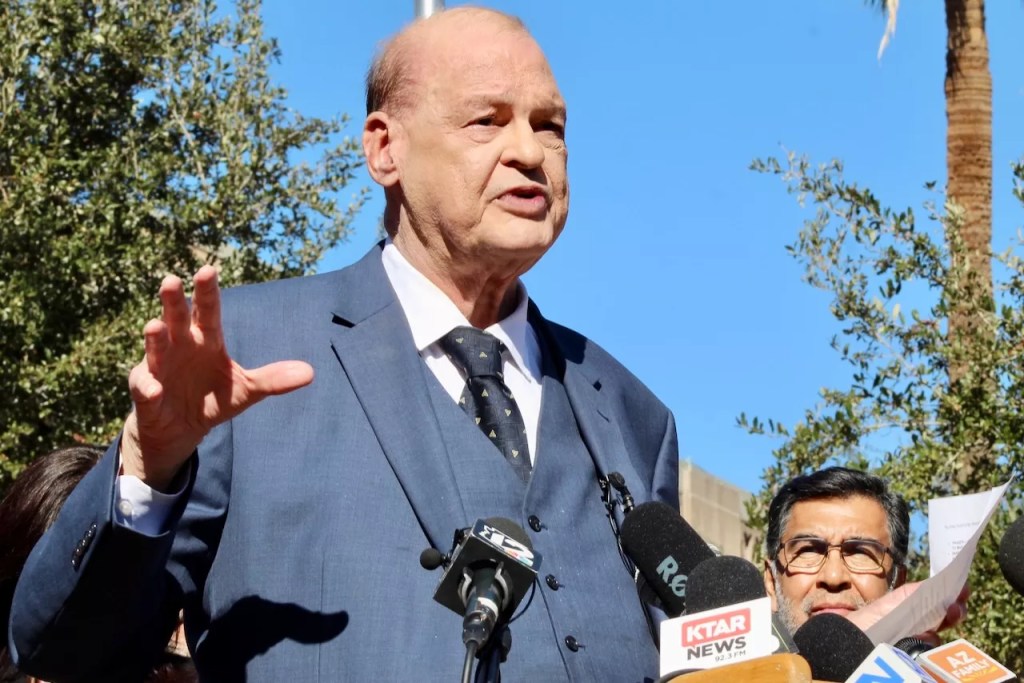
Jones’ suit claims that Mayes’ office served as a cat’s paw to Horne. In February 2024, Mayes announced in a press conference that Jones and four others, including two employed by the department, had been indicted on multiple counts of fraud, in part for creating “ghost children” that helped them bilk the system for a total of more than $600,000.
Four defendants eventually pleaded guilty to various charges. But Jones, who held the title of Lead Compliance Specialist for the ESA program, refused to plead despite facing a 17-count indictment on fraud and forgery charges that could have resulted in mandatory prison time of more than 50 years. Mayes’ prosecutors even got one of Jones’ coworkers to testify against him — as part of a generous plea deal — at a two-week trial in February 2025.
Yet Jones was found not guilty on all counts, lending credence to his accusations that he was scapegoated for a process that is de rigueur at the department when it comes to ESA accounts: the knee-jerk approval of expenditures submitted by parents.
The suit claims that Mayes’ case against Jones was so poor that her investigator could not indicate why Jones was guilty of the crimes with which he was charged. The complaint described jurors actually embracing Jones after his acquittal, apologizing that he had ever been prosecuted.
Notwithstanding the acquittal, Horne doubled down on the accusations against Jones. Horne alleged in a statement that his office had tipped off Mayes to the perfidy of Jones and the others but that Mayes was so “incompetent” that “someone who should have been convicted was acquitted.”
The Attorney General’s Office may not be “incompetent,” but according to Jones’ complaint, it placed its faith in the tale being told by Horne’s staff without skeptically investigating the accusations against Jones, who was the most senior former education department employee accused of wrongdoing.
If true, Jones’ claims identify a serious blind spot at Mayes’ office. The complaint states that Jones was actually one of the few senior education department employees who asked questions about the department’s policies on ESAs. And the criminal attorney who won Jones’ acquittal says that the Attorney General’s Office blew it, indicting Jones instead of using him as a witness to the corruption and mismanagement that plague the system.
TJ L’Heureux
Rubber-stamping
According to his suit, Jones joined the Department of Education’s ESA section in 2019 and steadily worked his way up the ranks to become a leader on the compliance team, reviewing parental requests to spend money.
The ESA program began in 2011 as a limited effort to benefit students with disabilities. Since then, it has been greatly expanded. In 2022, the Arizona Legislature made the voucher program universal, opening it up to all students — even those attending private schools. Parents can receive up to $8,000 in reimbursements per school year, and if they can demonstrate that their child has a disability, the payoff can be up to $45,000 per year.
For years, the ESA program has been accused of lax oversight, opening the door to the possibility of widespread fraud. News accounts have uncovered parents seeking reimbursement for luxury items, like lingerie, and lavish trips that had nothing to do with education. The program now reportedly boasts more than 100,000 students, at a cost of close to $1 billion in fiscal year 2025.
From the beginning of his employment with the Department of Education, Jones and other ESA employees were encouraged to rubber-stamp applications and reimbursement requests, he says. According to his complaint, the account creation department “was explicitly told by every ESA Director since at least 2020, not to investigate potentially fraudulent application documentation.”
The problem grew worse with the expansion of the program in 2022, the same year Horne was elected Superintendent of Public Instruction. The suit claims that in Horne’s first days in office, his agency “approved nearly 25,000 pending ESA requests with little to no comprehensive review.”
Spending requests were approved en masse with the encouragement of ESA directors, as Horne pushed to “expand the ESA program to a size that would be beyond what outside interests could discontinue” — essentially, too big to be canceled. The Department of Education even invested $10 million “advertising the ESA program on television and other forms of media,” encouraging parents to enroll their kids, the lawsuit says.
Jones says he raised concerns about questionable spending requests with higher-ups, including current ESA director John Ward. Yet Jones’ cavils “would more often lead to approval of a request that Mr. Jones initially questioned or recommended denying,” the complaint states.
Jones “warned his supervisors that the new system of mindless mass approvals created a high risk of fraud,” but his concerns were dismissed “with empty promises that an audit would be performed,” his lawsuit claims. Jones’ persistent complaints were proving a nuisance to his superiors, supposedly making him a “target” for retaliation within the education department.
When a bank alert about questionable withdrawals triggered an investigation into ESA fraud by the Attorney General’s Office, education department honchos saw an opportunity to be rid of a troublesome employee and identify a scapegoat for a flawed system, Jones claims.
Though the bank alert had nothing to do with Jones and would lead to the indictment and conviction of four others, Ward allegedly spoonfed the Attorney General’s investigator, Annalisa Madsen, into believing Jones had knowingly approved his co-workers’ fraudulent requests.
But, per the complaint, the reimbursement requests “were all within the parameters of what Mr. Jones was expected to approve within the ESA department.” Jones was “continuously told not to investigate such requests,” a situation that allowed fraudsters “to use the system to syphon taxpayer dollars into their personal accounts with no needed assistance from Mr. Jones.”
The education department fired Jones in late November 2023. Three months later, in February 2024, Mayes announced a grand jury indictment of Jones and four others at a press conference, alleging that the defendants had defrauded the state of more than $600,000. If convicted on all 17 counts, Jones would have spent half a century behind bars.
His co-defendants took deals in exchange for guilty pleas. Jones took his case to trial — and won.

Kevin Hurley
Victory and ruination
Neither Jones nor his civil attorneys responded to interview requests from Phoenix New Times. The Department of Education did not reply to a request for comment, and a spokesperson for Mayes’ office said it had no comment on the litigation.
But Adam Feldman, the criminal attorney who helped Jones beat the rap, told New Times that Mayes’ office missed its chance to have his client as a star whistleblower, instead targeting Jones for prosecution despite having zero evidence that Jones profited from his co-workers’ fraud.
“There was not a single dollar transferred to his account or his wife’s account or anybody’s account on his behalf,” Feldman told New Times, adding, “So what’s the motivation for him to do these things?”
According to Feldman, the best the Mayes’ prosecutors could do was to say that his client “somehow assisted these people” in committing fraud. But at trial, Feldman and his client — who testified in his own defense — were able to prove “how little oversight there was” of the ESA program.
“There was no auditing process,” Feldman said. “And anytime my client tried to promote appropriate self-auditing or external auditing, anything like that, he got so much pushback and was eventually prosecuted.”
Prosecutors handed a sweetheart plea deal to one of the fraudsters, Jennifer Lopez, who was allowed to plead guilty to one count of forgery and be sentenced to four years of probation in exchange for testifying against Jones. Feldman called the deal an “absolute farce,” but he said that prosecutors were “so desperate for some ability to proceed against my client that they went forward” with Lopez as their chief witness.
Feldman said the defense easily demonstrated the inconsistencies in Lopez’s testimony. “We wiped the floor with her,” he said. Tellingly, the prosecution called no current Department of Education employees as witnesses at trial.
Mayes’ investigator did not understand the ESA program, Feldman said, and was led down the primrose path by Horne’s office. “They should have recognized very early on with this case that they were doing someone else’s bidding,” he said. “This was truly a political prosecution.” And ironically so, given Mayes and Horne are political enemies.
Of course, Mayes’ office did expose some actual fraud on the part of the four others charged in the indictment, involving fake birth certificates, fake certifications of disability and the “ghost children” Mayes identified in her press event. Jones’ coworker, Delores Sweet, pleaded guilty to one count of fraud and one count of forgery and was sentenced to 15 months in prison. Two of Sweet’s adult children, Jadakah and Raymond Johnson, each pleaded guilty to one count of facilitation to commit money laundering and were sentenced to three years of probation.
But Feldman says Mayes’ office screwed the pooch by prosecuting Jones instead of utilizing him as a veritable road map to the mismanagement of the ESA program.
According to the civil complaint — which Feldman is not a part of — after a two-week trial, the jury delivered its not guilty verdict after less than an hour of deliberation. Some members of the jury expressed “their sympathy” with Jones that he had been charged with a crime in the first place.
That’s more than he’s likely to ever get from Mayes or Horne, both of whom participated in a “gross miscarriage of justice” that ruined a man’s life, the complaint asserts. Jones has been reduced to supporting himself “through Door Dash delivery and any other gig he can get.” He owes $45,000 in legal fees and rightly fears that the record of the indictment will continue to hound him online, despite the not guilty verdict.
“At the end of the day, even if you’re found not guilty, you get the presumption of innocence, but not in the workforce,” said Feldman, noting that “just because a jury finds you not guilty doesn’t make you innocent in the mind of the public.”
This story is part of the Arizona Watchdog Project, a yearlong reporting effort led by New Times and supported by the Trace Foundation, in partnership with Deep South Today.