
Mario Tama/Getty Images

Audio By Carbonatix
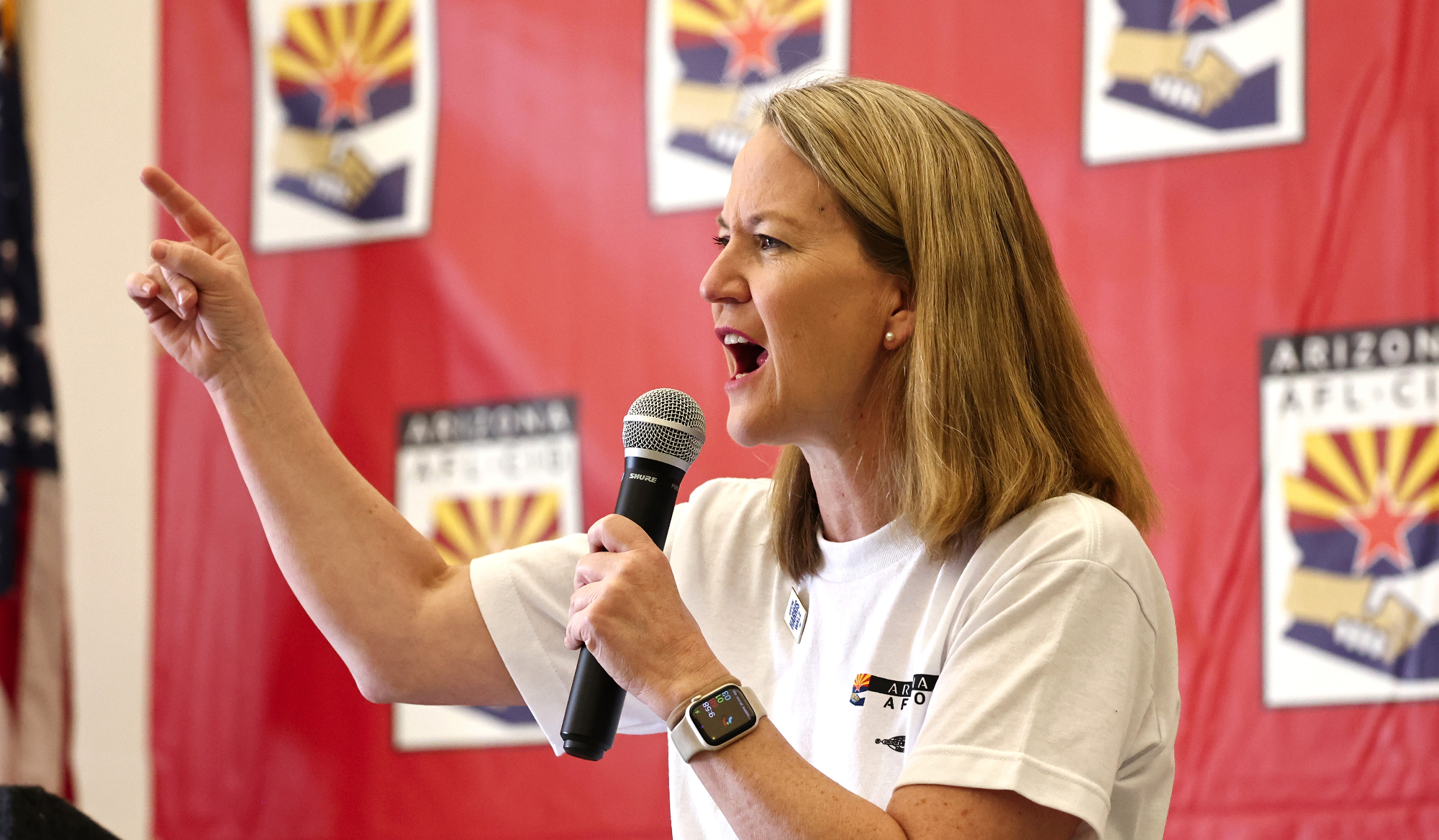
Earlier this week, Arizona Attorney General Kris Mayes sat for an interview with veteran journalist Brahm Resnik of 12 News. One segment of that roughly 20-minute conversation with the Democrat has since taken on a life of its own.
Rodney Glassman, a converted Republican who is vying to unseat Mayes in November, claimed on social media that she “openly suggest(ed) how to kill ICE officers and avoid prosecution.” Arizona President Warren Petersen, another of Mayes’ Republican challengers, said in a campaign email blast that Mayes “defend(ed) the use of lethal force and shooting law enforcement” and “encourag(ed) violence against them.” State Sen. John Kavanagh, the majority leader in the Arizona Senate, called in a press release for Mayes to resign.
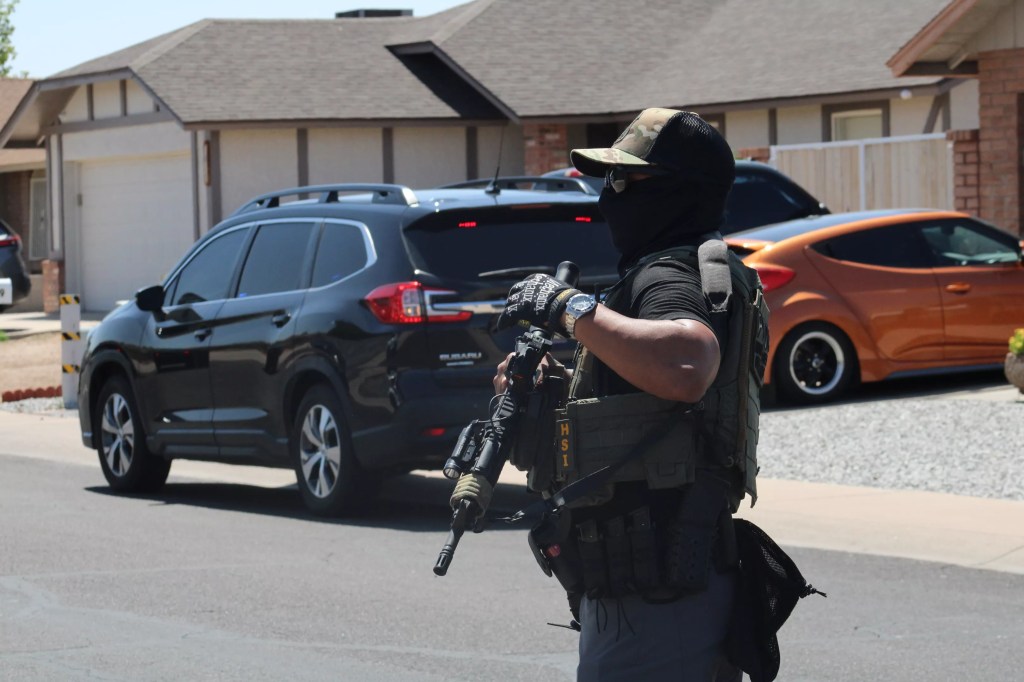
So, did Mayes really say people should shoot Immigration and Customs Enforcement agents? No. What she actually said is that the combination of masked and hard-to-identify ICE agents and a gun-friendly state with robust Stand Your Ground laws is a dangerous mix that could result in someone getting hurt or killed. The crux of her comments — arguably expressed with less precision than was ideal — was that ICE agents should be clearly identified as such to avoid deadly mistakes.
Mayes raised the subject herself midway through the interview:
The other thing I want to bring up with you, that I am worried about and that makes Arizona very, very different from almost every other state where this buildup is happening, is that we’re a Stand Your Ground state. We have one of the most expansive Stand Your Ground laws in the entire country, that rivals even Florida. We also have a lot of guns in Arizona. We’re a gun culture in this state. It’s kind of a recipe for disaster. You have these masked federal officers with very little identification — sometimes no identification — wearing plainclothes and masks. And we have a Stand Your Ground law that says you reasonably believe your life is in danger, and you’re in your house or your car or on your property, that you can defend yourself with lethal force.
She concluded with a shrug, as if to say, You do the math.
Resnik responded by asking her to clarify. “I want to be careful with that and understand what you’re saying, because you know how that could be interpreted,” he said. Here is the rest of their exchange:
MAYES: It’s a fact. It’s a fact that we have a Stand Your Ground law and we have, in other states, ununiformed masked people who can’t be identified as police officers. That is a problem. That is why it’s so important to have uniforms and be identified, especially in a state like Arizona that has a Stand Your Ground law. Now, you’re not allowed to shoot peace officers.
RESNIK: Let’s put a big pause there and go into that question.
MAYES: How do you know they’re peace officers?
RESNIK: Some might say you’re giving a license to an individual to shoot a peace officer?
MAYES: Absolutely not. But how do you know they’re a peace officer? That’s the key. If there’s a situation where somebody pulls out their gun because they know Arizona is a Stand Your Ground state, then it becomes did they reasonably know they’re a police officer. This is a very different set of circumstances in the state of Arizona.
RESNIK: To be clear… It’s ironic because this is a Second Amendment issue.
MAYES: This is a Second Amendment issue…
RESNIK: But to be clear, you’re not telling folks, “You have a license, if you are threatened to shoot a peace officer.”
MAYES: No. But again, if you’re being attacked by someone who is not identified as a peace officer, how do you know? If somebody comes at me, wearing a mask — by the way, I’m gun owner. If somebody comes at me wearing a mask and I can’t tell that they’re a police officer, what am I supposed to do? Honestly, Brahm. Look what happened in Minnesota to the two legislators, one of whom was killed by a guy impersonating a police officer. That is why this is so incredibly incendiary, and again, it’s a situation being caused by ICE and the federal government. We are a Stand Your Ground state. It creates this combustible situation. No, I am not suggesting that people pull out their guns. But this is a Don’t Tread On Me state. This is a Second Amendment state. This is a state with a lot of guns in it. We have a law on the books that the Republican legislature passed that says you have the right to defend yourself if you reasonably believe that your life is in danger — except when it involves a police officer. But we also have a federal government that is putting officers on the street without any identification. That is combustible. It’s got all the makings for the shootout at the OK Corral all over again.
Morgan Fischer
Stand Your Ground
Arizona law allows someone to use lethal force if that person “reasonably believes that physical force or deadly physical force is immediately necessary” to prevent the commission of a litany of crimes, including arson, burglary, armed robbery, kidnapping, manslaughter and murder, among others. It also allows someone to use deadly physical force when it’s “immediately necessary to protect himself against the other’s use or attempted use of unlawful deadly physical force.” That person has “no duty to retreat” — hence “Stand Your Ground” — “if the person is in a place where the person may legally be and is not engaged in an unlawful act.”
Does Arizona law allow such force to be used against law enforcement officers? It does not, as Mayes acknowledged. “You have the right to defend yourself if you reasonably believe that your life is in danger — except when it involves a police officer,” she told Resnik. And in situations in which ICE agents are clearly identified, with markers on their vests or arms and with badges, the state’s Stand Your Ground law does not justify using lethal force. But, as Mayes repeatedly said, when federal agents aren’t clearly identified as such, someone fearing for their safety might shoot without realizing who they’re shooting at.
To Bret Royle, a Phoenix criminal defense attorney, Mayes’ comments make perfect sense.
“All she’s saying is, ‘Hey, this is a warning. Something bad is going to happen. Just so you know, if it does, I warned you. You should do something about this. Think about this. Think about the interaction between these actions and our justification law,'” Royle told Phoenix New Times.
Royle laid out a hypothetical scenario. “If you’re sleeping in bed at home with your family and I come through your front door, you don’t have to look around and peer around to know whether I have a gun or not,” he said. “You can shoot me to death.” If the person coming through that door is an ICE agent who is masked and unmarked, that reasonable fear still exists, Royle said.
“You have to know or should have known that’s a law enforcement agent,” he said. “That’s the exact problem. They’re not identifying themselves, they’re masking themselves. Honestly, it’s already happened a couple times. What’s going to happen when somebody masquerades as an ICE agent and starts kidnapping people?”
Rick Romley, a Republican who served as Maricopa County Attorney from 1989 to 2005, agreed. “I think she’s absolutely correct,” he told New Times, noting that he supported Mayes in her first election bid in 2022. Romley noted that the masking of ICE agents creates problems. (As if to underscore that, the Phoenix Police Department said in a statement Friday that its officers “are not permitted to wear full face coverings.”) Romley also pointed out that ICE has recently been entering people’s homes without a signed judicial warrant.
This week, the Associated Press reported on an ICE memo that lays out a justification for agents to enter the home of someone with a final order of removal with only an administrative warrant — and not one signed by a judge. Many say that’s a blatant violation of the Fourth Amendment’s protections against unreasonable search and seizure, and immigration advocacy groups have long counseled immigrants that they have no obligation to open their doors to agents who lack a judicial warrant. That hasn’t stopped ICE agents from blazing into people’s homes. On Jan. 11, armed ICE agents barged into the Minneapolis home of a Liberian man using only an administrative warrant as justification.
The memo reportedly says officers must first knock on the door and identify themselves, and that they can only approach a target’s home between 6 a.m. and 10 p.m. But Romley said it only increases the likelihood of a fatal tragedy in which someone mistakes a federal agent for a home intruder.
“It’s a recipe in which somebody is going to get hurt,” he said. “It can be the homeowner or it could be the ICE agents.”
Gage Skidmore/Flickr/CC BY-SA 2.0
Escalation?
Mayes’ comments may have been legally defensible. But it’s probably not unfair to say they could have been more precisely communicated, or that Mayes should have anticipated the firestorm they ultimately caused. Resnik, her interviewer, seemed to recognize that, interjecting several times to clarify that Mayes wasn’t excusing the shooting of federal agents. Mayes offered that clarification — “No, I am not suggesting that people pull out their guns” — but often quickly segued to her talking points about masking and fatal misidentification mistakes.
Royle, the defense attorney, admitted that Mayes was “not using the tightest language,” though she was “putting out a fact.” Seth Goertz, a former federal prosecutor who is now a partner at the Phoenix law firm Dorsey & Whitney, wrote in an email to New Times that Mayes’ comments seem “intentionally opaque” and “(don’t) do anything to de-escalate the current situation.” While “we should all agree that images of ICE Agents in facemasks is troubling, and there’s so much about how ICE is currently operating that needs to change,” he said, there is currently plenty that identifies ICE officers as federal agents, such as placards and vests.
“The AG has all manner of legal mechanisms to lawfully push back on federal overreach, which she has demonstrated throughout Trump’s second term,” Goertz said. “This is not that.”
Frank Milstead, the former director of the Arizona Department of Public Safety, felt Mayes was guilty of “muddying the waters.” Milstead said he “respect(s) her and what she does,” but thinks the focus on masking is beside the point. “The ICE agents all seem to be wearing identification that says they’re ICE,” he told New Times. “They’ve got vests on and helmets on, they’ve got patches and things. Talking about the Stand Your Ground law was misguided, he feels.
“I understand what the far-right is saying, that she’s leading people down the path,” Milstead said. “It seems to me that it would be very easy to read that into what she said. I think what she should have said was ‘Everybody should cooperate with law enforcement, and if you don’t agree, there’s internal affairs, there’s professional standards, there’s courts of law and you can use those after the fact.’ Almost nobody gets hurt when they comply and they cooperate with law enforcement.”
Mayes’ comments also riled David Gonzales, who spent a quarter-century as a state trooper and 22 years as a U.S. Marshal before retiring in 2023. “She would be one of the first to say that law enforcement should de-escalate potentially violent situations,” Gonzales told New Times. “Her comments escalate these potentially violent situations.” Gonzales, who defended the masking of agents to protect their identities, said he worries about an unhinged person taking Mayes’ remarks as a justification for violence against ICE agents.
“If you get somebody who might be unstable and here’s our leaders making comments like this, I think it gives them the green light that they could commit some kind of crime and shoot a federal officer,” he said.
That’s the line many of Mayes’ political opponents have taken. Petersen wrote that “Mayes should be fully aware of her dangerous rhetoric,” which he called “reckless, dangerous, and disqualifying.” Glassman called her comments “shameful” and a “betrayal of her oath.”
Those criticisms don’t go far with Romley.
“Hey, it’s a political opponent,” he said, noting that Petersen in particular “never really practiced law” despite running for attorney general. “Quite frankly, it’s important for an elected official to speak out on potential dangerous situations that may be coming up so you can prepare and make sure that it doesn’t occur.”
Mayes isn’t backing down either. When asked by New Times whether the attorney general regrets her comments in any way, or if she should have anticipated how some would interpret them, Mayes spokesperson Richie Taylor said no.
“Attorney General Mayes believes words matter — and that the words in our Constitution matter most,” Taylor wrote in a statement to New Times. “When armed, masked agents force their way into the homes of U.S. citizens without warrants, the risk of dangerous and volatile situations rises dramatically. What we should all be doing is demanding a federal government that acts within the bounds of the law and the Constitution to maintain public safety and avoid the types of situations that could lead to tragedy. And that is precisely what Attorney General Mayes communicated earlier this week.”