

Sam Eifling

Audio By Carbonatix
When Barry Schwartz began visiting the city’s tow yard with alarming regularity, he knew it was time to get out of San Francisco. “My car was towed like three times a month,” he said, and nearly “everything I made went to tickets.” Frustrated by an army of meter maids and the constant struggle to find a parking spot, he moved to downtown Phoenix roughly 20 years ago.
“I came here, and I haven’t even got one ticket to this day,” Schwartz said.
That may change.
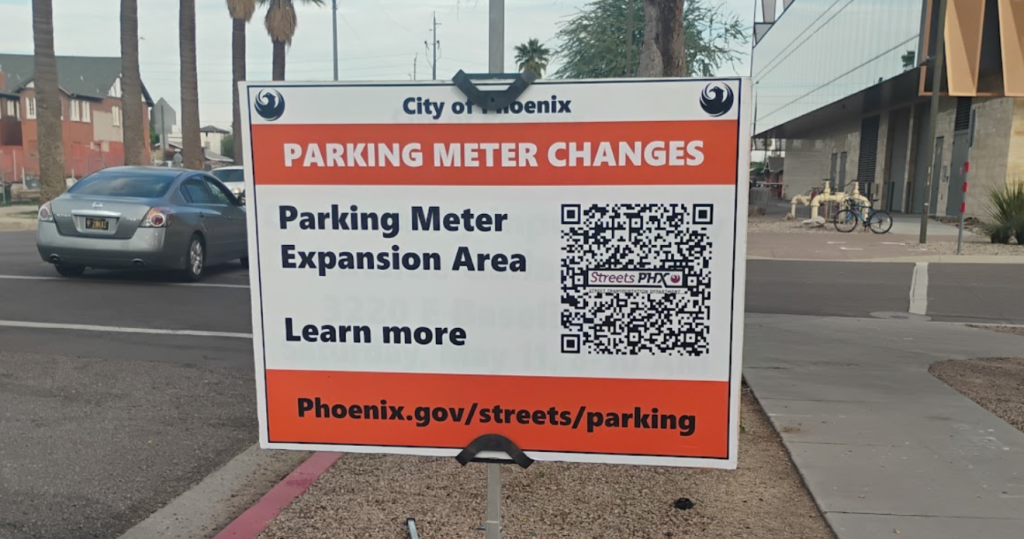
Not long ago, Schwartz came across a white and orange-striped message board along a street in his neighborhood. On it was a QR code, directing residents to more information about a new city initiative. That project: installing (or reinstalling) parking meters on streets that had previously offered free parking.
Schwartz found this alarming. Parking is already hard to find in downtown Phoenix, which has grown thanks to Arizona State University’s downtown campus. Pay lots can charge an arm and a leg during events like First Friday and the Downtown Phoenix Farmers Market. The unmetered streets were blissful oases for downtown residents whose apartment and condo complexes charge expensive garage fees.
“(The city didn’t) give a chance for people to fight this,” Schwartz said. “I think it’s awful.”
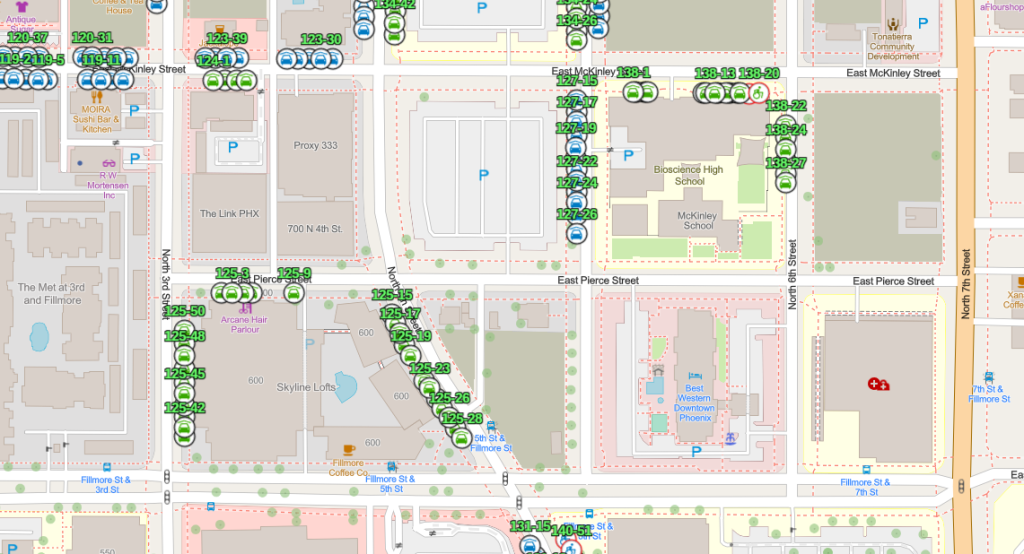
The meters are being installed between East Filmore and McKinley streets and between North Fourth and Sixth streets. Some of those streets still feature headless steel rods where old parking meters used to be.
Brian O’Connor, the city’s interim parking meter supervisor, said that the Phoenix Street Transportation Department has been monitoring parking habits on those streets. “We tend to see people parking there for a long term, essentially overnight,” he said. By adding meters, the city aims to increase parking turnover, making it easier for people to shop at local businesses, enjoy other nearby amenities and manage pick-up and drop-off services.
“We came to the conclusion that the best solution was to reinstall the meters in the area,” O’Connor said.
T’Azia Spencer
‘Really upset’
But Schwartz and other residents are not convinced.
Ever since ASU and the University of Arizona established downtown campuses more than a decade ago, tens of thousands of students have flooded the area each year. “The demographic is students, and students scramble to park,” Schwartz said. “These are not people that are going to go and spend more money.”
That describes Avery Olenik, an ASU student who lives and works at the Tempe campus full-time but travels downtown to attend her nursing classes. The street where she regularly parks will now be lined with meters. Most of her paycheck goes to tuition and rent, and paying for parking will mean “an extra expense that I didn’t need.”
“I’m honestly really upset about it,” she said, “and I know a lot of my friends are too.”
During busy times, Phoenix’s downtown paylots can cost upwards of $40 for a several-hour stay. Phoenix’s roughly 2,000 parking meters are cheaper at $1.50 an hour, but they’re time-limited. Despite running from 8 a.m. to 10 p.m. seven days a week, most offer parking for only an hour or two, funneling drivers to the more expensive long-term lots.
Dustin Newman, another downtown resident, thinks preserving at least some free parking is key to attracting people downtown. “They need to have some free parking down here or some kind of option, I think,” Newman said. “Because it’s going to discourage business if they don’t have anything for people to park at.”
That’s frustrating for visitors — “My friends have to pay $20 to park to hang out with me on a Friday,” Newman said — but it’s a bigger headache for downtown residents who need somewhere to park overnight.
That’s a puzzle Kylee Evans will have to figure out. The 24-year-old Grand Canyon University graduate moved to the downtown area in July. Evans lives with her sister, who has a “big-time corporate job” and can pay $175 a month for a dedicated spot at their complex, but free street parking is how Evans gets by. She stresses about losing a parking spot when she leaves for work, and during busy periods like First Fridays, “I do not leave my apartment.”
“I just feel like everything’s a money grab these days,” she said. ”There’s people that live here that can’t get a parking spot.”
City of Phoenix
Parking meters galore
The parking meterization of Phoenix reflects a broader pattern: As cities become more densely populated, free street parking is likely to vanish over time.
San Francisco ranks among the most densely populated cities in America and will begin charging for parking at Golden Gate Park — one of the last free parking sections in the city — starting January 2027. It and other cities, including San Diego and Baltimore, have turned to parking meters partly to address rising expenses and budget deficits.
Phoenix also faces a multi-year deficit, according to the General Fund 2025-2026 Preliminary Budget Status and Multi-Year Forecast Report. After the Arizona Legislature eliminated the residential rental sales tax and lowered the individual tax rate to 2.5%, the city is projected to face a $36 million budget deficit this fiscal year, a deficit of $86 million over the 2026-2027 fiscal year and $6 million deficit for 2027-2028.
O’Connor, the city parking meter supervisor, said the meter expansion is not a way to fill city coffers and is more about creating more parking availability for downtown visitors. And while Schwartz said he was surprised by the new meters, O’Connor said Phoenix sent notification letters to residents weeks before the meter expansion signage went up. He said the only feedback the city got on the plan was from ASU itself.
“We try our best to notify the public of what’s coming,” he said. And if anyone has a question or comment, “the city is always open to receive comments by phone.”
O’Connor also said most of the meters have been installed and there is just one more street to finish, and that the new meters will be operational by mid-December. They’ll have a maximum parking limit of four hours. More meters could come to downtown in the future, he added, though the city is not currently pursuing further meter expansion.
Residents like Newman hope it doesn’t come to that.
“I understand having it going during the main hours of school to discourage the ASU students from parking there all day,” Newman said. “But at the same time, it makes it really not feasible for a lot of people.”