

Audio By Carbonatix
Earlier this summer, my husband and I were letting our dog, Reese, run after bunny-foo-foos — known more commonly as desert cottontails or even just bunnies — in a wash near our house in central Phoenix. For our pittie, the short sprints after rabbits and the occasional ground squirrel who easily outraced her was great exercise before the heat set in for the day. So when she developed a limp a few weeks ago and we didn’t see any visible injury, we assumed it was a strain from her brush adventures.
But the limp didn’t go away. Then one night she had a coughing fit. In the nearly six years we’ve had her in our family, we’d never seen her cough so long, so ferociously. As she lay hacking at the foot of our bed, we nervously checked her breathing, and peeked in her throat to make sure she didn’t have something stuck. Our Sweet Muffin coughed all night.
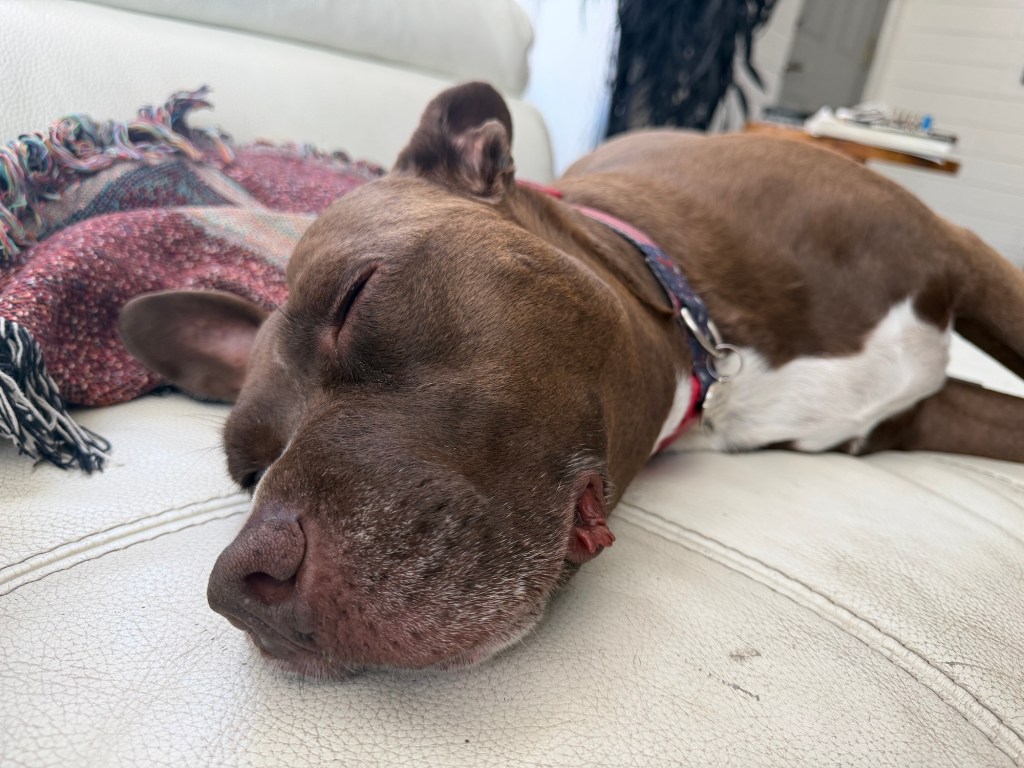
When our energetic Velcro dog started sleeping alone in our bed during the day, my husband put it all together. The limping, the lethargy, the cough …
“There’s no way she doesn’t have valley fever goddammit,” he texted me.
Clarissa Sosin
As new(ish) residents of Arizona, we knew humans could get valley fever, a fungal infection caused by breathing in fungal spores endemic to the dirt in deserts like the one we live in. Most humans who live here will get it at some point. What we hadn’t realized was that our dog could get it too. Turns out that each year in Pima, Pinal and Maricopa counties, about 6 to 10% of dogs will get valley fever, according to the University of Arizona’s Valley Fever Center for Excellence.
We took our dog to a vet who thought she most likely had arthritis and kennel cough. But she indulged us and drew blood for the test. A few days later she called telling us to come pick up a prescription for fluconazole. Reese did have valley fever and she would need to be on meds for the next nine months or so.
My dog’s health scare sent me down a valley fever rabbit hole, so to speak. That’s how I ended up interviewing Dr. Lisa Shubitz, a veterinarian and research scientist who has worked for the center since 1996. She is at work developing a vaccine to prevent the illness in dogs.
Our interview has been edited for brevity, and clarity.
You mentioned in our emails that Arizona dogs are hit particularly hard by valley fever and that if you put five dog owners in a room at least one will have a story. Why is that?
The No. 1 creature in our domestic lives that has to deal with valley fever is dogs. I’ve talked to a lot of dog audiences over the years and everybody’s got a story. We think that the dog’s immune system has something to do with it.
Do dogs get it the same way humans do? By breathing in the spores?
They breathe it. Dogs have a lot of behaviors that cause them to investigate soil. They like to dig. They like to smell things. A third of the dog’s brain is related to olfaction, so they’re sniffing everything all the time — there are studies that show a relationship between digging and increased risk of disease. And also probably the way their nostrils work. They might inhale a lot more spores than a human does.
So some of it might be related to dose, some of it might be related to their general interest in rodent holes, and some of it might be related to some inherent weaknesses in their immune system compared to people or horses or cows. It’s pretty uncommon that horses get sick from it. Cows never get sick from it. And cats have less illness than dogs. And it’s not just that they’re indoors because I see valley fever in indoor cats. I don’t see that much valley fever in cats, period.
So it’s not just that my dog loves to shove her beautiful snout into holes. It’s also that she’s just likely more predisposed.
She’s a dog, and not a person or a cat. Even among dogs, some breeds are more likely to get really sick than other kinds of dogs. Boxers are one. German shepherds, too. There’s a list of about 20.
Are dog owners aware of valley fever, from your experience?
Arizona dog owners have a pretty high awareness. People who came here from someplace else can get an unpleasant surprise. It’s very expensive getting valley fever as a dog. If you’re a human, you have a better chance of having health insurance than if you’re a dog. And so the owners often have to bear the total cost of the disease. Most people are going to spend a couple thousand dollars — buying some fluconazole, treating it for a year or a year and a half, and doing some monitoring. And if it gets a little bit complicated, the price skyrockets.
Clarissa Sosin
Our dog’s symptoms were subtle in the beginning. What symptoms should dog owners watch for?
Coughing, limping, back pain and neck pain should not be ignored. These are common with valley fever. If you brought a dog to the vet in Arizona for those symptoms, they would consider valley fever. Lack of appetite is really common. Either the dog’s gotten really fussy about what it will eat, or it won’t eat anything. Some people report the dog is eating OK but they’re losing weight. It causes lameness. A lot of dogs will develop a cough. Some people report that the dog is breathing hard or having difficulty breathing. Some dogs never cough.
Some people bring their dogs to the vet because they’re dull: ‘This is my puppy and last week it was playing ball with me all the time and this week the dog doesn’t want to play ball as much.’ Lethargy is very common and it can be very subtle. Dog owners are surprisingly observant. They know what their dogs do all day long. Some people say, ‘We used to go for a three-mile walk, but now we go for a mile and the dog wants to turn around and go home.’ These dogs, they just don’t feel well. And they don’t want to do their normal activities and their owners are usually really sensitive to this.
Your colleague Dr. John Galgiani told me valley fever is under-diagnosed in humans because not enough doctors test for it. But he said that veterinarians are actually pretty good at testing. Why is that?
I think it is because severe disease, severe valley fever that needs treatment, is more common in dogs than it is in people. Many people get a respiratory illness and doctors say, “You have the flu, go home and rest. You still have the flu, go home and rest.” It takes an average of 2.3 visits to a doctor to get a diagnosis of valley fever in a person.
In Arizona, dogs that are sick with valley fever that need medicine to get better are very prevalent. And most signs that are vague or are respiratory or are orthopedic, a diagnosis of valley fever is going to be considered by an Arizona veterinarian anywhere between Tucson and Phoenix. It’s really common here and people look for it. Veterinarians look for it early.
If your dog does test positive for valley fever and goes on treatment, what should you keep an eye on?
Fluconazole is overwhelmingly the drug of first choice. It’s inexpensive, it’s well absorbed by dogs, it’s less hard on most livers than the other drugs that we have, and the adverse effects are usually mild, tolerable, and diminish over time.
Many owners report to me that the dog begins to feel better within the first two weeks of starting medication if it’s an ordinary, run-of-the-mill kind of infection. They usually report better energy, more engagement. Coughs usually take quite a while to go away. Some dogs eat better almost right away, unless they have adverse reactions to the drug.
The adverse effects of fluconazole include nausea, vomiting, diarrhea and lack of appetite. The lack of appetite is a big deal to people. It is so hard on them to see their dogs not want to eat. Sometimes all we have to do is give them a drug that reduces nausea and they eat better.
Fluconazole is the easiest on livers, but I’ve seen some dogs with really dramatic liver problems from it. Some dogs tolerate it great, but I always test their liver enzymes one month into treatment. The liver enzymes and the gastrointestinal signs are the biggest things.
So, the vaccine. When might it be available? What are your hopes for it?
My hopes for it is that it was available three years ago, but obviously that came and went. The USDA regulates animal vaccines. They’ve been very slow to review it. They’re kind of afraid of it, I think, because it’s outside their experience. They mostly deal with viral vaccines. This is a fungal vaccine. But we feel pretty comfortable about its safety. The safety studies are almost done. They have a couple more studies they have to complete.
We did a study where we vaccinated the dogs and then challenged them with the fungus in a high level laboratory. It exceeded my hopes for how well it protected the dogs. I was really excited by how it came out. So I have very high hopes that this will be a very useful and pretty effective vaccine in the real world.
Now, does that mean it’s going to protect every single dog? There are gonna be strains of the fungus that are really hard to protect against, and there are gonna be dogs who have immune systems that can’t make a good enough response. But most will receive some level of protection from the vaccine and prevent it altogether or reduce how sick the dogs get.
I think we can benefit dogs and ultimately humans. When we wrote the grant for the vaccine, we wrote it with the dog as a stepping stone toward a human vaccine. I do believe this vaccine will be approved eventually. I think it’ll take another year to get approved. But don’t quote me. I have no control over it.