
Morgan Fischer

Audio By Carbonatix
When President Donald Trump took office in January 2025, he promised a wave of mass deportations. And Immigration and Customs Enforcement certainly has been busy in Phoenix.
During the first year of Trump’s second administration, more than 100 ICE sightings in the Valley have been publicly reported by community groups. That’s just the tip of the iceberg; the actual number is likely much higher.
“Last year was already a tough year for our district,” said Democratic Rep. Yassamin Ansari, who represents parts of Phoenix and the West Valley. “People were scared to go to work, to go to school, to just live their normal lives.”
A coalition of community groups, including Puente and the Borderlands Resource Initiative, contributes to a “community project” to collect and disseminate information about ICE sightings to residents. Confirmed sightings are posted to the project’s social media accounts, including the Phoenix Rapid Response account on Instagram.
The groups have trained more than 3,000 volunteers to take calls on the groups’ Migra Watch hotline and confirm an ICE sighting. At the group’s last rapid response training on Jan. 14, more than 500 people showed up. Confirmed sightings are shared so that Valley residents are aware of what’s happening in their communities.
“That might mean that somebody who works in the area is like, ‘Oh, I need to be aware of that. I’m glad that I know. I want to stay away from there,” Beth Strano, the executive director of Borderlands, told Phoenix New Times in August. “But that might also mean that some neighbors are like, ‘I can go down there and I can film and I can offer support.”
This activity – essentially, describing the public activity of police – constitutes protected speech, First Amendment experts say, although some Republicans claim it’s obstruction of justice. Over the summer, Warren Petersen, the Republican president of the Arizona Senate and a candidate for attorney general in 2026, asked federal authorities to investigate Democratic state Sen. Analise Ortiz for reposting one such ICE sighting alert on her Instagram story.
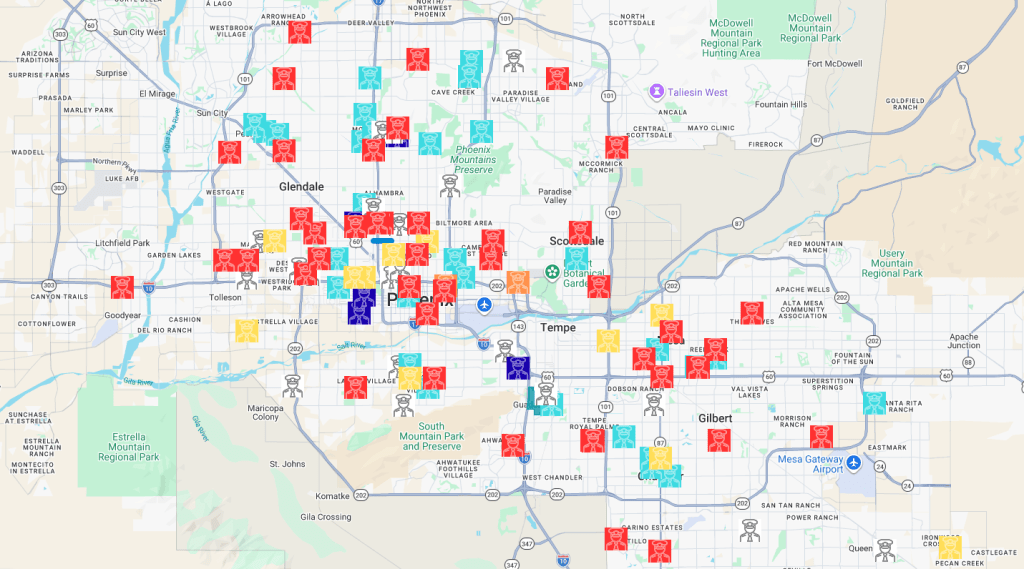
New Times has collected these alerts to plot a map of ICE sightings in the Valley since the beginning of Trump’s term. It reveals interesting trends about ICE activity, though it represents far from a full dataset. Many ICE sightings don’t get reported publicly because ICE “moves really fast,” Strano said. If a call comes in to the hotline more than 20 minutes after a sighting, ICE likely isn’t in that location anymore. So, the project only posts things that are “verified” and “active” — otherwise, “it’s just going to scare people,” Strano said.
Borderlands and other groups keep their own internal map, but they declined to share it with New Times, citing privacy concerns. Thus, what follows is an incomplete snapshot of ICE activity in the Phoenix area. New Times initially posted this story in early August and updated the story again in January, as more ICE activity is expected to ramp up in the new year. Sightings are color-coded, with the earliest sightings in dark blue, progressing to light blue, white, yellow, orange and then bright red for the latest sightings. View an interactive version of the map here.
(Note: This map does not include the raids at Valley locations of Zipps Sports Grill.)
Morgan Fischer
Where ICE has been seen in the Valley
As far as public sightings can show, ICE’s operation in Phoenix was slow-moving at first. Sightings were first reported in early February after ICE agents brought an armored truck, a dozen unmarked vehicles and flash-bang grenades to arrest one 61-year-old man in a Sunnyslope neighborhood. Despite the overkill, sightings remained low until late May.
That’s when White House deputy chief of staff Stephen Miller tasked ICE officials with making 3,000 arrests per day. Shortly after that meeting, dozens of undocumented immigrants were arrested at immigration court in downtown Phoenix, with the administration using legal loopholes to expose them to deportation.
Then, in early June, ICE sightings began to skyrocket across the Valley. Beginning on June 9 — after local immigration lawyers warned of incoming raids — ICE sightings and activity began to happen nearly every day, if not multiple times a day, in neighborhoods across Phoenix. That high level of activity has continued into late September. That month, ICE activity also ramped up in San Tan Valley as ICE conducted a joint enforcement operation with the Pinal County Sheriff’s Office called Operation Road Guardian. Many Latino men in work trucks were pulled over and detained, including a legal visitor to the U.S. who was released after more than 70 hours in custody.
ICE activity in Phoenix slowed down over the holidays, as only a few sightings occurred in October through December. Still, that doesn’t mean ICE wasn’t in Phoenix. On Christmas Eve, ICE picked up a DACA recipient in a Phoenix parking lot.
After the holiday slowdown, ICE activity and sightings are picking up again in Phoenix. Phoenix Rapid Response has posted about six verified ICE sightings in the last week and a half alone. Immigration activists are prepared for the city to be hit by sweeping immigration enforcement next, which cities like Los Angeles, Charlotte and Minneapolis have already seen.
“We expect them to have even a higher presence here very soon,” said Ricardo Reyes, the executive director of the progressive veterans organization VetsForward. “We think that basically what’s happening in Minneapolis and Minnesota kind of distracted them from coming over here … but we do think that it’s going to be New Orleans and then Phoenix.”
The sightings map shows a smattering of ICE sightings in the East Valley, with most of the activity concentrated in central Phoenix and the West Valley – particularly in Tolleson, Maryvale, Glendale, Peoria and north Phoenix – which have a significant Latino population. Rich (and white) enclaves like Scottsdale are largely untouched, although work sites in Scottsdale have been targeted.
“They’re trying to hit these very Latino, heavy presence areas where they’re just showing up,” Reyes said. “It’s like shooting fish in a barrel. If you jump into Home Depot and there’s six, seven guys standing there, day laborers, looking for work, and then just running out and grabbing them.”
But ICE’s activity over the last year is only the tip of the iceberg. With the passage of Trump’s “One Big, Beautiful” bill, ICE got a $75 billion budget boost, which is likely to fundamentally change immigration enforcement across the country and in the Valley. That means it’s “actually a little bit early for us to be drawing any kind of big conclusions” about which communities ICE is targeting, said ACLU of Arizona border policy strategist Noah Schramm told New Times in August. Immigration-related prosecution trends show that ICE is going after anyone it’s “able to get its hands on.”

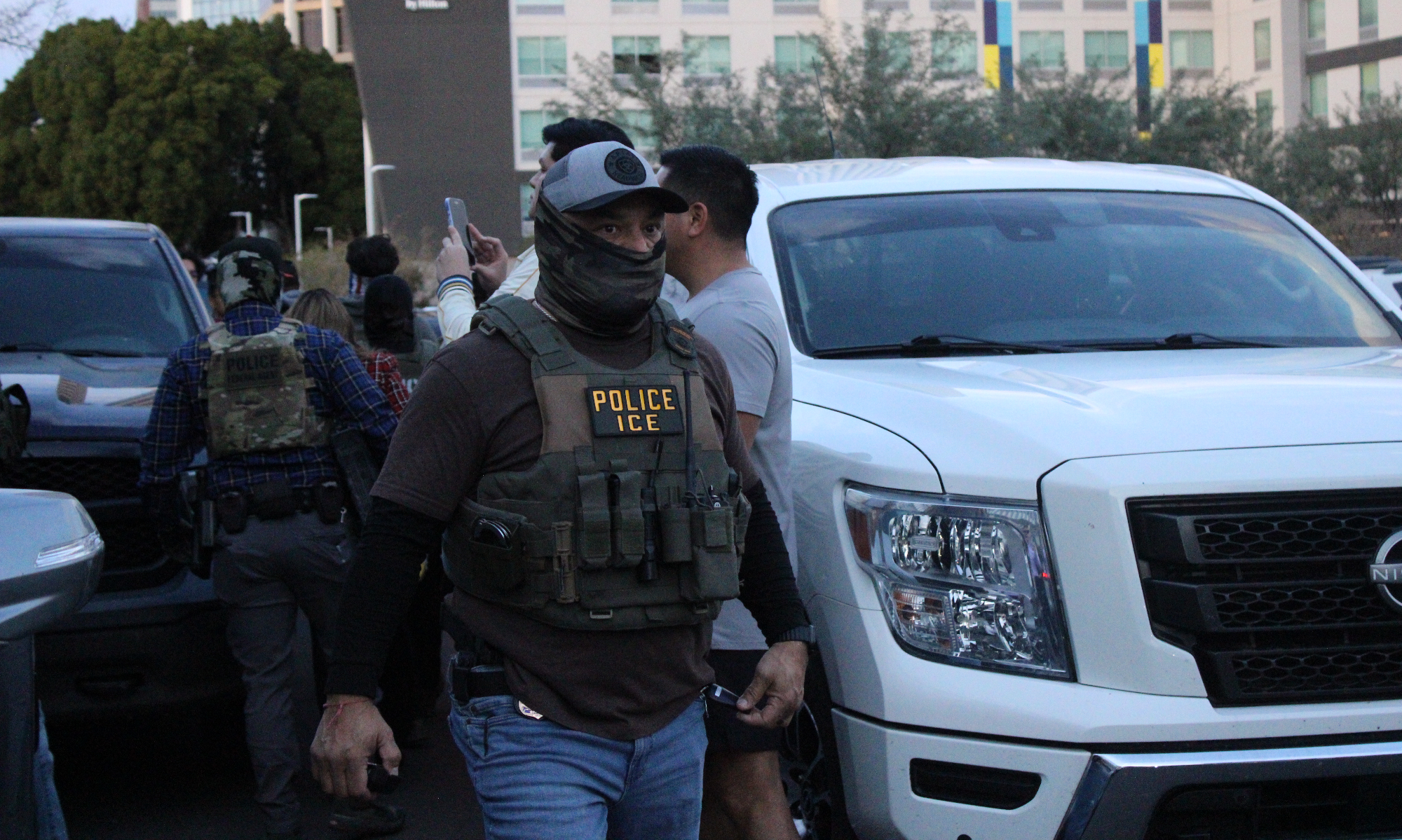
Police officers and a masked agent from Homeland Security Investigations mill about the back lot off a Walmart Neighborhood Market in June.
TJ L’Heureux
How are sightings reported?
The Migra Watch hotline model is based on other rapid response networks around the country, such as the grassroots organization Siembra in North Carolina. By calling 480-506-7437, Valley residents can report a suspected ICE sighting. From there, in an effort to weed out potential unrelated police activity happening across the Valley to verify the sighting, organizers work with the witness by asking a series of questions.
Volunteers will make sure the person calling is the witness to the event; if not, the witness must call. “That screens out the majority of false reports,” Strano said, citing people calling about things they saw on social media that might not even be in Arizona. Then, volunteers will ask what: What are you seeing? What are the cross streets? What kind of vehicles do you see? What about uniforms? Is there a business nearby? Can you give us landmarks?
These questions help organizers rule out activity that isn’t ICE-related and educate the community about what to look for. For example, Strano said the line constantly gets calls about an “old, beat-up work van” outside a particular business. That’s actually just the business’ vehicle, so volunteers can rule that sighting out. Instead, if ICE were in the area, you would see “fairly new vehicles that are in good shape” with “very dark-tinted windows,” Strano said. “And you would see them clustered together.”
If there is a business nearby, volunteers will call that business to ask about a sighting, as the people there are the “frontline workers,” Strano said. If there are “shoplifters getting arrested or whatever,” Strano said, volunteers can rule those sightings out. But if it is ICE, this call also immediately informs community members on the ground.
While this may seem like it takes a lot of time, Strano said it takes “usually about five minutes, maybe a little bit more” for the community project to post on social media, and “we only post things that have been verified through that conversation.” The vetting process is essential – organizers will post only when they have “really strong reason to believe that the information we have is accurate,” because they are “really opposed to false alarms and creating a fear culture.”
It isn’t a perfect system, and “it doesn’t mean there’s never going to be any false alarms,” Strano said. In early July, the group posted an alert about ICE activity at 40th Street and McDowell Road. However, it was actually the Maricopa County Sheriff’s Department conducting a raid on an illegal marijuana grow operation at the location.