
New Times Photo-Illustration

Audio By Carbonatix
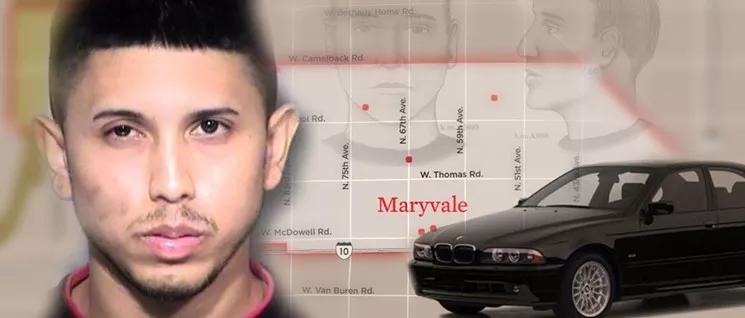
Aaron Saucedo was arrested in 2017 and charged with nine murders and other crimes for a shooting spree that police and press called the Serial Street Shooter.
If he is ever found guilty of those crimes, he will be among the state’s most prolific serial killers. And he faces nine possible death sentences.
But first, Saucedo has to go to trial. He’s been in jail waiting for nine years.
He was originally scheduled to go to court in November 2019, but that trial was postponed. And then COVID descended upon the world, so there were more delays. His May 2021 trial date was also delayed. Ditto February 2024. The trial is now set for December and is expected to last 16 months. There will be a lot of ground to cover.
So what’s going on in his case?
Saucedo has a settlement conference in July, but those are mostly ceremonial in Maricopa County. According to court documents, his attorneys have raised multiple issues about his mental health and whether he is intellectually disabled, which would make him ineligible for execution.
Other than what’s posted in the court docket, there are scant details available.
Neither the prosecutors nor the defense attorneys will talk about the case. Calls, texts and emails to family members of the victims and the defendant go unanswered.
The first murder happened in August 2015 when someone shot and killed Raul Romero outside his north central Phoenix home. Romero was Saucedo’s mother’s boyfriend, but he wasn’t immediately viewed as a suspect.
Then, nothing happened for five months, until New Year’s Day 2016 when someone went on a spree, shooting at seemingly random people from car windows: Two Latino men and three Black females, including a child, were killed. That would be the consistent demographic of the shooter’s targets from then on.
There were more shootings in March 2016, murders and near-misses, and more in June and July. In all, there were 12 incidents and nine dead, with shooting sites scattered across Phoenix, stretching from the east side of the city to Maryvale on the city’s west side.
Police sent out alerts, and the media and the public became aware of the Serial Street Shooter, a name that was reminiscent of another set of serial murders, the so-called Serial Shooters who crisscrossed the Valley and shot total strangers on the streets from car windows. Dale Hausner and Samuel Dieteman were arrested for those crimes in 2006 and convicted of eight murders between them, though they likely committed more. Dieteman was sentenced to life in prison; Hausner was sentenced to death, though he died by suicide in his cell.
Saucedo, then 23, was arrested in April 2017, based on car and suspect descriptions and ballistics from guns he’d allegedly bought and sold at pawn shops. A slight and unassuming man, he had worked as a city bus driver and a laborer. His father is a performer and music promoter well-known in the state’s Mexican community. There was no apparent motive, except perhaps in the murder of his mother’s boyfriend.
He was charged with 22 crimes, the murder indictments joined by aggravated assault, endangerment, attempted murder and weapons charges. The Maricopa County Attorney’s Office filed its intent to seek the death penalty in December 2017.
And then the case dropped from sight.
Screenshot via Maricopa County Sheriff’s Office
Right to know vs. right to fair trial
There’s a fine line between the public’s right to know and a defendant’s right to a fair trial, a lesson learned in the 2013 and 2015 trials of Jodi Arias.
Arias was charged with the murder of her sometime lover, Travis Alexander. She claimed self-defense, the prosecution alleged first-degree murder, and the nascent true-crime media took it from there.
The case featured naked photos, a disreputable prosecutor (who resigned his law license rather than face disbarment), and an eager international audience egged on by a TV true-crime show host. Groupies lined up on both sides of the aisle and stood in line daily to get a seat in the courtroom to see the spectacle.
Attorneys and expert witnesses were harassed, even threatened with death. Some witnesses refused to testify and some actually left the country to escape the trial junkies.
Since then, it has been harder for traditional media to cover courts. Attorneys want to protect their cases; Arias’ case is now on appeal, and her current attorneys have filed more than 140 motions under seal since 2019. Prosecutors also want to keep their cards close to the chest.
And the Saucedo case has been kept under wraps since the get-go. When this reporter and other journalists showed a police-generated composite drawing of the suspected killer to a surviving victim in 2017 and he didn’t recognize it, it spawned outrage from prosecutors and defense attorneys alike.
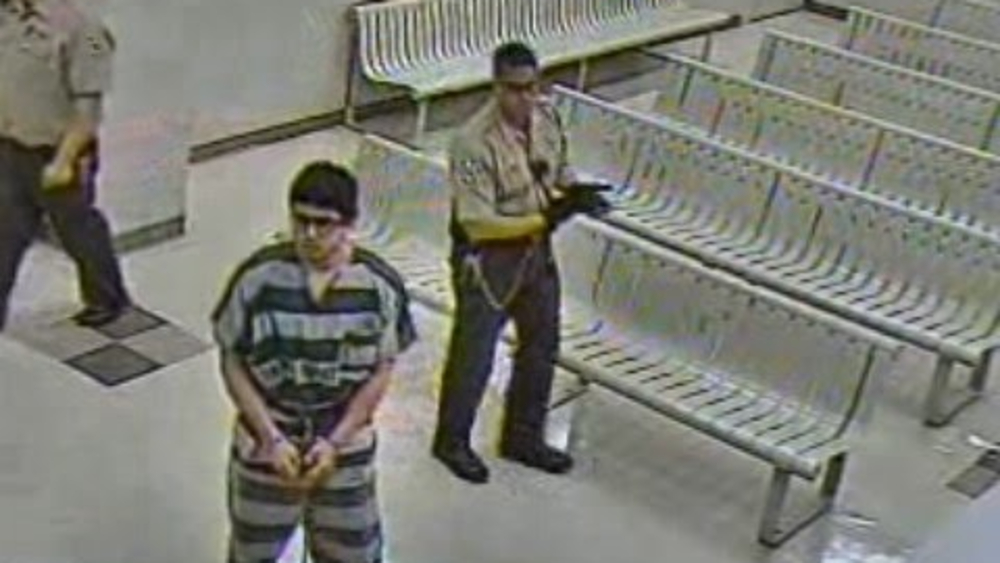
Because Saucedo was a consistent no-show at his hearings, I obtained and published video of him in his jail cell so that the public could see what he looked like. That further enraged the attorneys.
It was not difficult to surmise at the time that it would be hard to cover the case going forward, and that prediction has proven correct. In fact, it’s probably more difficult given how the media has changed.
“It’s hard to define who’s the media anymore,” said Gregg Leslie at the First Amendment Clinic at Arizona State University. His agency helps the media navigate freedom of the press impasses. “I think a lot of lawyers have learned it’s easy to get burned and it’s best to keep facts to themselves.”
In fact, the Maricopa County Office of Public Defense Services has issued rules to its attorneys that closely monitor their interaction with the press.
Rosemarie Peña-Lynch oversees the county’s four public defender agencies.
“Whether to speak with the media is determined on a case-by-case basis,” she wrote in an email. “We believe this approach is essential because our primary obligation is to protect and advance our clients’ interests, and each case presents unique circumstances that require individual evaluation.”
Because granting interviews or providing information entails approvals up and down the chain of command, informed consent from defendants past and present, and curbs on comments about their opponents, some attorneys who have worked at those agencies look at the rules as a de facto ban on speaking to reporters, or at least a reason to ignore them.
“I’d say that’s a policy only a lawyer could love, and that bureaucrats defend as technically doing everything they can to comply with existing law,” Leslie said.
“Even something like written consent from clients — presumably about every interview, not just a standard consent form signed once, early in the process — can end up making a policy like this a complete ban on interviews by just making it too difficult to comply and respond by a reporter’s deadline. Lawyers do need to be concerned about these issues, of course, but overcorrecting doesn’t serve the public interest.”
Judges rarely speak on the record to reporters. Prosecutors tend to communicate via office press releases. One judge who was a longtime prosecutor expressed frustration at how the media chooses to cover crimes and trials.
“Getting facts wrong was always a problem,” said the judge, who was granted anonymity to avoid professional repercussions. “And John Q. Public just doesn’t get it.”

Arizona State University
The true crime effect
Indeed. In the true-crime reporting model, every case is reduced to a parable of good and evil, without nuance, without analysis.
Saucedo has since been renamed “The Maryvale Killer” in some accounts, though only some of the murders took place in that neighborhood. True crime shows think they come up with more marketable names for their subjects. Is “Maryvale” supposed to convey some bad-neighborhood vibe? “The North-Central Phoenix Killer” certainly seems less sinister.
Saucedo is now 32, and the little information that can be gleaned from court records is that he is mentally troubled. He has been submitted to what attorneys call Rule 11 proceedings, specifically to determine whether he is competent to stand trial, and he was declared incompetent on at least one occasion.
If a defendant is deemed incompetent, he or she can undergo “restoration to competency,” though competency only means that the defendant understands the charges against him and is able to assist his attorney in his own defense.
Saucedo was most recently found competent by the court in March 2026, according to court records.
But other court documents indicate that Saucedo’s attorneys are raising claims under a 2002 U.S. Supreme Court decision called Atkins v. Virginia. That opinion made it unconstitutional to execute a person who was mentally retarded, though the terminology had been updated to protect individuals who are “intellectually disabled,” a distinction determined by an IQ of 70 or less.
Saucedo’s most recent IQ test results are sealed in the court records, but on at least two occasions going back to 2017, he tested at 70. Furthermore, according to court records, experts have diagnosed Saucedo with autism, schizophrenia, ADHD, depression, obsessive-compulsive disorder and other psychological issues.
Those are strong arguments to drop the death notices and perhaps enter a plea agreement to a lesser sentence, especially going into a settlement conference in mid-July. If he can’t be legally executed, why go through a death penalty trial, especially if he is willing to plead?
But that is just informed speculation. The lawyers aren’t talking.
And just because there is a settlement conference scheduled doesn’t mean a plea deal is in the offing. Settlement conferences in capital cases are mandatory, ordered by judges. They don’t necessarily mean prosecutors are willing to deal.
Though the Maricopa County Attorney’s Office didn’t elaborate on the case, a spokesperson at least confirmed that the settlement conference was part of a blanket court order in January to schedule settlement conferences for all capital cases within six months.
“It remains a capital case,” the spokesperson texted. “Trial is scheduled for later this year.”
“Nothing else from me.”
And nothing else for you.
This story was first published by Arizona Mirror, which is part of States Newsroom, a network of news bureaus supported by grants and a coalition of donors as a 501c(3) public charity.