
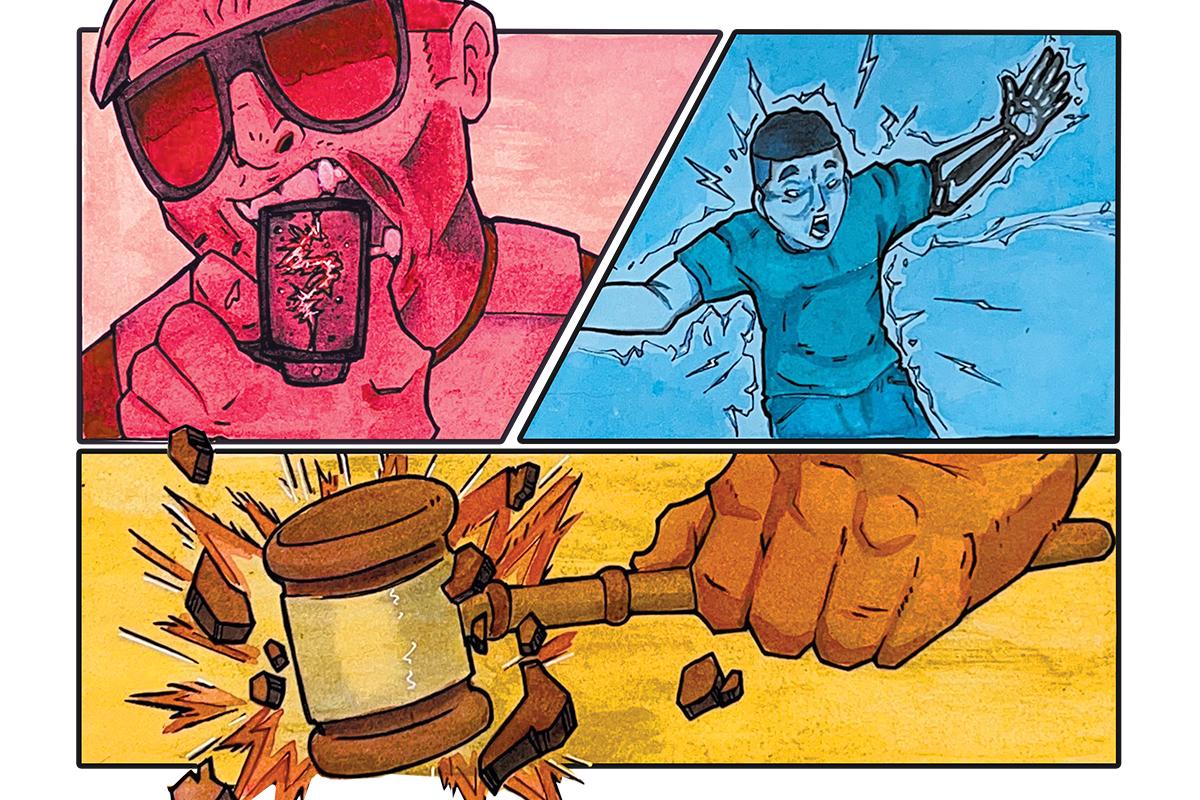
Illustration by Christopher Martinez

Audio By Carbonatix
The judge sighed. He had a lot of hard questions for the young prosecutor in front of him. He’d sized up the young woman who worked for the Pinal County Attorney’s office. He knew the score. The judge, Gilberto V. Figueroa, used to be the Pinal County Attorney himself. He could tell the case before him was a dud and senior prosecutors had left it to her to sort out the mess.
“How did you get tossed into this bucket of worms?” the judge can be heard saying in an audio recording of the July 8 hearing in the Central Pinal Justice Court in Coolidge. “I’ve been around long enough to know when the older guys are ducking.”
The bucket of worms he referred to was a nearly two-year-old case involving William Simpson, a motorist who’d been pulled over by Pinal County sheriff’s deputies on August 5, 2024. Those deputies tased Simpson during the encounter but didn’t issue him any charges or citations.
Now Simpson was facing three criminal misdemeanor charges from the traffic stop: reckless driving, resisting arrest and failure to comply with an officer. The charges, which originally included two felonies –– aggravated assault and endangerment –– were brought before a grand jury two weeks after Simpson filed a notice of claim that he intended to sue for the encounter.
His attorney, Paul Gattone, argued to Figueroa that the charges lacked probable cause and were filed vindictively as retaliation for the notice of claim. The sheriff’s office confiscated video footage recorded by Simpson’s private dashboard camera. His legal team believed the sheriff’s office, knowing the video showed there was no reason to indict, withheld it from prosecutors.
Pinal County Sheriff’s Office
The lawyer also said the county attorney’s office wouldn’t release documents and evidence through discovery that would show that the charges were retaliatory. Because of this, the attorney wanted the charges dropped, a form of sanctions against the county attorney for violating disclosure rules.
The judge agreed.
“Frankly it’s not a hard case to discern what is going on,” Figueroa said. “There’s obviously some hiding the ball going on. I don’t know what’s in those dispatches, phone calls, emails. I don’t know what testimony was presented to the grand jury. But this is, in my opinion –– at least from what I’ve seen in the pictures alone, the two pictures here alone –– this was a grand jury who not only was able to indict a tuna sandwich but did so.”
He dropped the charges with prejudice. That rarely happens in Arizona criminal courts. The reasons he listed on the dismissal were a lack of disclosure, a violation of Simpson’s rights to a speedy trial, and the lack of response to the pending requests. Prosecutors can never refile the charges.
“I’d like to think that I would have made different decisions than what’s happening here,” said Figueroa, who served as Pinal County Attorney in the 1990s. “I’m disappointed. I’m disappointed this process has taken so long and I’m certainly disappointed it would appear to be a violation of Mr. Simpson’s rights.”
Elevated charges against people who try to sue
Simpson’s legal team and other attorneys with clients in Pinal County said they suspect Simpson’s case may be part of a pattern: The sheriff’s office seems to bring criminal charges against people who intend to sue the office. The charges make the plaintiffs’ lives miserable, derail their civil cases and insulate the sheriff’s office from accountability.
Last month Phoenix New Times reported that the Pinal County Attorney’s Office filed two misdemeanors against Thomas Garro. On Jan. 9, a Pinal County sheriff’s deputy so violently detained Garro, a 79-year-old deaf Lyft driver, that his passenger called 911. The passenger was terrified of the deputy and thought he was going to kill them during what should have been a drama-free traffic stop.
Garro was taken to the hospital after the encounter and released with two civil traffic citations, both of which were later dropped. New Times wrote about the incident and the driver’s intent to file a notice of claim in April. The county attorney didn’t file the charges –– passive resisting arrest and failure to comply with a police officer –– against Garro until May 25, more than a month later.
Billy Peard, an attorney who is helping with Simpson’s case but is not licensed in Arizona and is not representing him, read about the charges against Garro and saw parallels with Simpson’s situation. Simpson filed his notice of claim on Jan. 29, 2025. He was indicted two weeks later.
“There might be a custom,” Peard said, using a term for an informal policy or practice within the sheriff’s office.
Simpson has since sued the deputy, Brando Reibschied, in federal court. He waited for the criminal case to resolve, knowing those charges could complicate a civil suit.
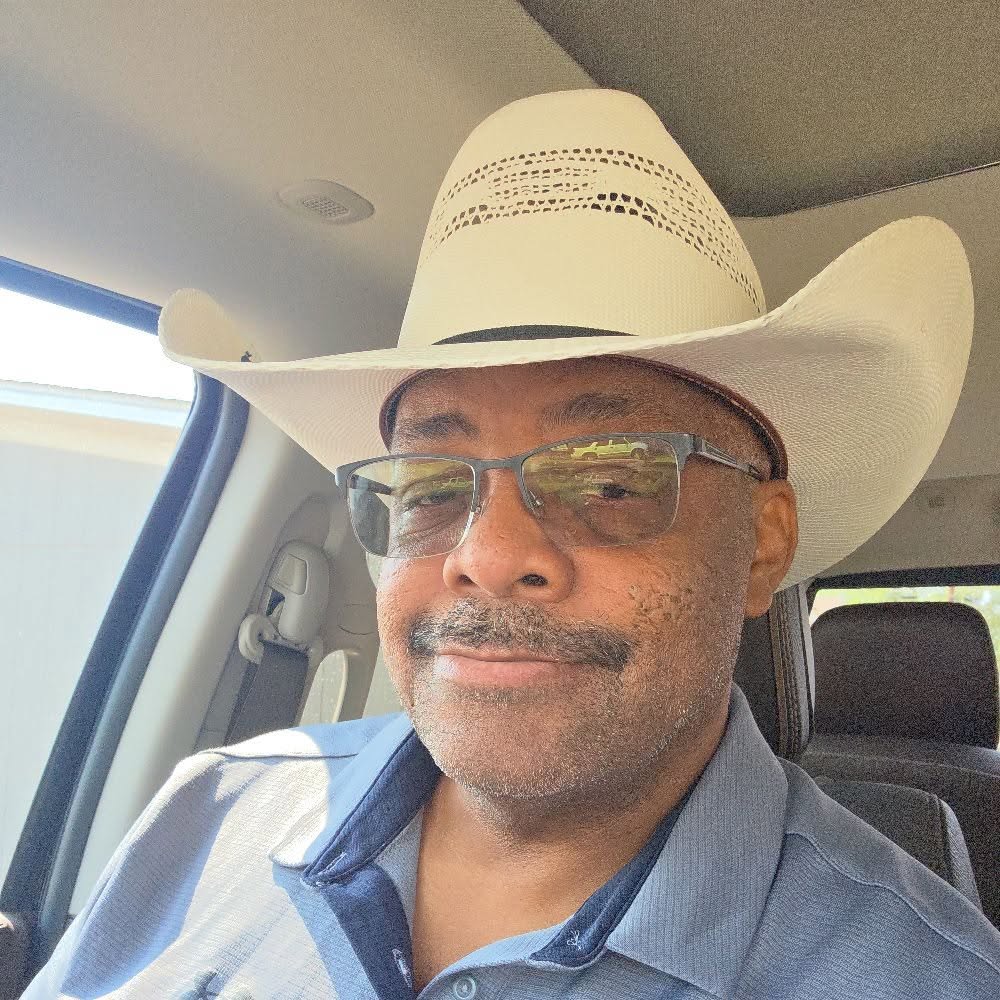
“For the judge to tell me good luck in my civil case in the lawsuit makes me feel that I have a chance against them,” Simpson told Phoenix New Times. “But you know, it’ll only take one other judge to say ‘qualified immunity.’ That’s all it takes and this lawsuit is done.”
William Simpson
In the complaint, Simpson accuses Reibschied of using excessive force when he tased him during the traffic stop. He also claims the deputy submitted the criminal charges against him maliciously as retaliation for his pending civil suit, and violated his First Amendment rights in doing so. Pinal County Sheriff Ross Teeple and County Attorney Brad Miller are not named in the lawsuit.
“I don’t need to fight a cop on the street,” Simpson said of his lawsuit and the resisting arrest charges that Figueroa dropped. “I’ll go to jail. I’ll go spend the night in jail and fight you later. I’ll fight you in court. I’ll fight with whoever I need to fight in court. I’m not gonna fight you on the street. It’s gonna get me dead. The cop is gonna win every time.”
When asked for comment, Sam Salzwedel, a spokesperson for the Pinal County Sheriff’s Office, directed New Times to reach out to the county attorney’s office.
“When we receive notices of claim, we pass them along to the county attorney,” he wrote. “That’s pretty much it. We don’t flag people in our system as having filed a notice of claim.”
Pinal County Attorney’s Office spokesperson Christy Kelly said she was unable to get in touch with the attorneys assigned to the case in time to comment for this story.
How deputies turned a routine stop into a fiasco
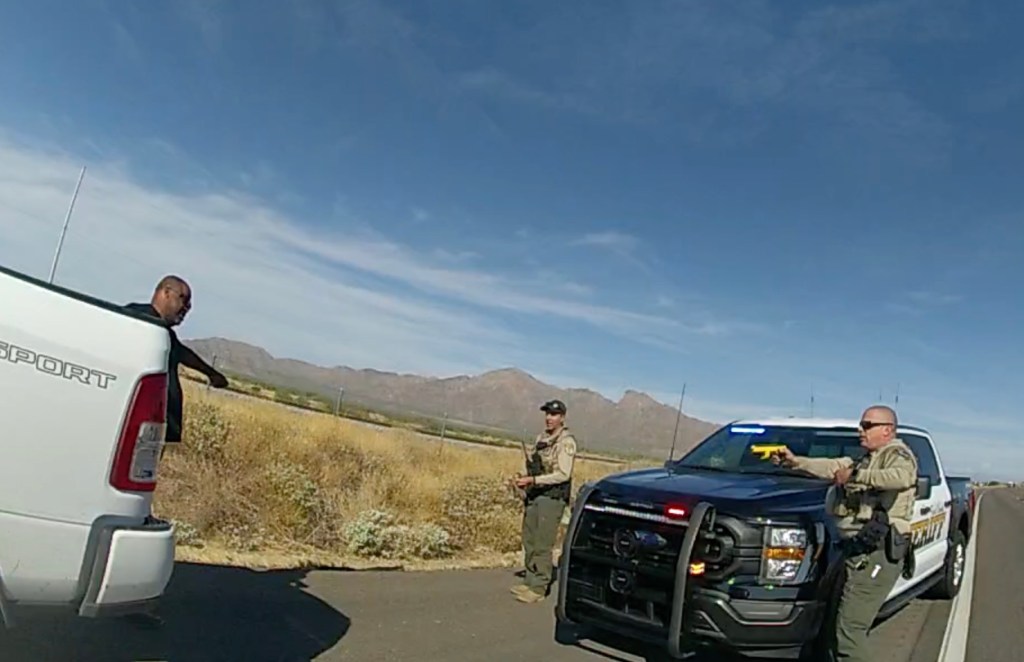
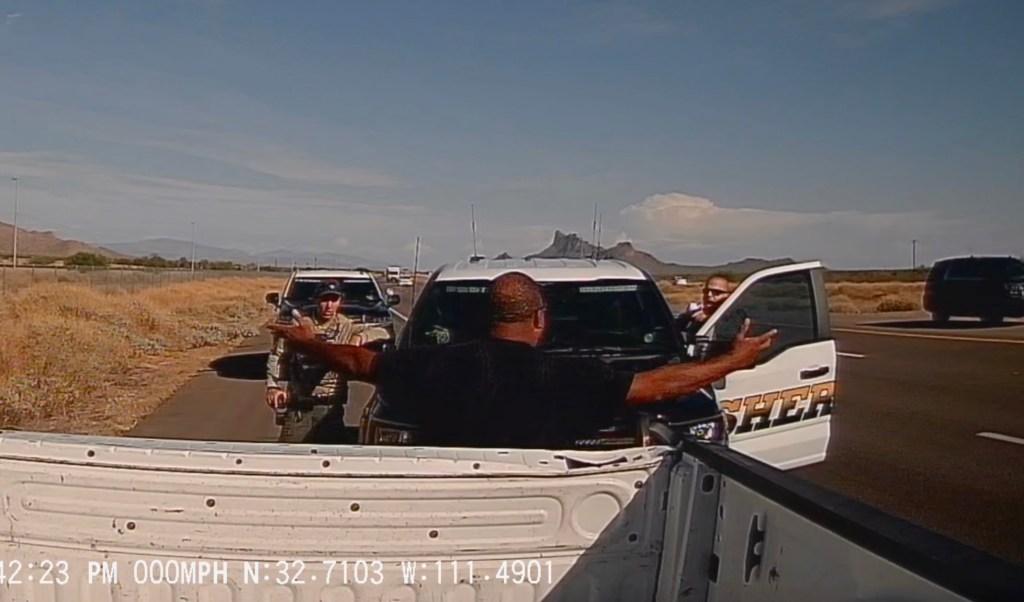
The pictures the judge referred to in the hearing were screenshots from Simpson’s confiscated dash camera footage. They show Simpson, who Reibschied pulled over for speeding, standing at the rear bumper of his pickup truck, where the deputy had ordered him to stand instead of approaching his window. Simpson’s arms are in the air, and the deputies on the scene are nowhere near him.
His legal team obtained the footage through a public records request and included the screenshots in their motion. They later received body camera footage from one of the deputies on the scene through the criminal disclosure process and included screenshots from that footage in the federal complaint they filed.
Footage shows Simpson being pulled over on I-10 near Eloy. Reibschied motions at him from his patrol vehicle to get out of the pickup and walk towards him. While Simpson walks to the back fender yelling at the deputy with his arms clearly in the air, another deputy pulls in and gets out of his vehicle.
With his arms in the air, Simpson argues with the deputies briefly. Reibschied, who has his taser out, tries to tase him, missing. A third deputy with a canine walks over from the front of Simpson’s truck. When the taser misses, the deputy yells at Simpson to get on his knees or he’ll get bit. Simpson starts to kneel when Reibschied fires the taser again, this time successfully, and Simpson falls to the ground.
“As soon as he went to give up it finally worked and he fell,” the deputy wearing the body cam can be heard saying about the tasing later in the footage.
Simpson said he was angry that he was being pulled over because he felt the deputy had been driving erratically. He’d been driving behind Reibschied, whose speed was fluctuating, in the left passing lane when he decided to pass in the middle lane.
Reibschied then pulled him over. Simpson yelled at the deputy, in part out of anger and in part to be heard over the noise of the traffic. He said he was confused about why he had to get out of his pickup rather than wait in it for the deputy to look at his license and papers. But he complied with all of the orders and was complying when he was tased.
Living with charges hanging over his head was stressful, Simpson said. In the year and a half that they were pending, he needed to find new work and a place to live. Knowing that landlords and bosses would run background checks and could reject him for pending felony charges made that process more difficult.
But knowing the dash cam video could exist gave him hope. Without it, he thinks he’d have been convicted and serving time. He originally installed them as a precaution. He knew that if he ever got into an accident or needed documentation of a traffic stop, the camera would provide it. But his cameras aren’t always reliable, he said.
“Thank God it was working that day,” Simpson said. “It would definitely be my word against his. The video shows that there’s nobody around me to assault. There’s nobody around me to resist.”
County attorneys stonewall records requests
The federal lawsuit accuses Reibschied of purposefully not handing over the video footage or telling the county attorney’s office that it existed before the grand jury because it undermined the case against Simpson.
“The assigned prosecuting attorney learned of the existence of this video footage from Plaintiff’s criminal defense attorney,” the complaint reads.
After their client was indicted in Pinal County Superior Court, Simpson’s attorneys zeroed in on the two-week period between his filing the notice of claim and the grand jury convening. According to their motion for sanctions, they began making requests from the county attorney’s office in April 2025 for documentation and evidence that they believed showed the charges were retaliatory and lacked probable cause.
William Simpson
“Given the peculiar timing, Defendant is entitled to discover documents that may shed light on whether the criminal prosecution was triggered by or in any way motivated by Defendant’s engaging in his First Amendment-protected activity of filing a civil legal claim,” the motion for sanctions read.
The discovery request included all texts and emails about Simpson sent during those two weeks among Reibschied and the other deputies involved in the traffic stop, Sgt. Brian Messing, and Deputies J. Montoya and Greg Sanders, as well as any communications sent by Reibschied about receiving the notice of claim. It also included correspondence from that time period between Sydney Prudence, who is the county deputy attorney assigned to present the case to the grand jury, and Messing, the state’s witness who testified.
The attorneys also requested materials between the date of the incident and the date of grand jury, including correspondence between Messing and other sheriff’s employees assigning Messing to investigate the case. They also asked for any documentation that Messing tried to get or watch the footage recorded on Simpson’s confiscated dashboard camera — footage they believed proved there was no probable cause to indict their client.
These items together painted a picture of what Simpson’s legal team said is a deliberate pattern of obfuscation and stonewalling that led to bogus charges.
In May 2025, the month after Simpson’s attorneys submitted the requests, the county attorney’s office dropped the two felonies and one of the misdemeanors. It refiled the remaining two misdemeanors in the Justice Court. The attorneys sent the requests to the new deputy county attorney assigned to the case, James Glover. By July 2025 they still hadn’t heard back with a response so they filed their request again. More time passed with no response.
In January of this year, eight months after they first asked for the documents, they emailed Glover letting him know that they would file what is called a Rule 15.7 motion. The motion asks the court to compel the county attorney’s office to hand over the requests and sanction it for denying their client his rights to disclosure by not responding. They still did not receive a response.
The Pinal County Attorney’s Office never responded about their requests in the criminal case. Simpson’s team has since submitted multiple public records requests for the documents and has received just one response. The county attorney’s office said that no correspondence existed between the attorney assigned to present the case to the grand jury and the sergeant who testified, Peard said.
By the time Gattone presented their case in Figueroa’s courtroom last month, nearly 15 months had passed since they first filed their requests.
“We didn’t ask for anything onerous or unreasonable,” Gattone told the judge in the hearing.
Figueroa chastised the county attorney’s office for not even responding to the requests. If the issue was that the sheriff’s office wasn’t complying, he said, the county attorney’s office needed to hold them accountable.
“I don’t know if the pressure was on to protect the sheriffs office on this — I can guess but I can’t know,” Figueroa said. “I’m disappointed by the fact that there was no effort –– at least not in my books, not in the materials I got –– by the county attorney’s office to exercise their strong discretion and the strong power that the county attorney’s office has to make the sheriff’s office comply.”
Figueroa peppered the newly assigned young county attorney with questions about the case, mainly what was presented to the grand jury. The photos of the encounter in front of him didn’t add up to the charges that Simpson was indicted for, he said. And the fact that it included misdemeanors when grand juries typically only indict on felonies stunned him.
“Somebody went in there with a 12-pack instead of a six-pack and got the two felonies and three misdemeanors,” the judge said. “I don’t understand how that happened.”
The county attorney didn’t have any answers.