
Phoenix Police Department

Audio By Carbonatix
In the early morning on March 15, Phoenix police officer Thomas Patterson shot and killed 36-year-old Justin Carl Schmidt during a stand-off after Schmidt barricaded himself in his townhome during a domestic violence incident.
Last week, the Phoenix Police Department released its “critical incident briefing” on Schmidt’s death. The briefing is made up of a video and an accompanying write-up, and includes audio from three 911 calls and footage from three officers’ body-worn cameras and a drone. The department releases the briefing approximately two weeks after an in-custody death, including fatal officer-involved shootings.
Phoenix New Times received longer versions of the 911 calls and body-cam footage through a public records request. The approximately 25 minutes of 911 audio and around 5 ½ hours of footage paint a fuller picture of what happened near 43rd Avenue and Camelback Road that day.
The shooting
Two of Schmidt’s neighbors called police separately to report a man yelling at a woman and a little girl crying in Schmidt’s townhome. “You guys need to come now. Like it’s getting bad,” said one of the callers. “The little girl is looking out the window crying.”
Officer Nathan Epps was the first to arrive, getting out of his patrol vehicle at 6:22 a.m. In his body-worn camera footage, screams can be heard coming from the townhouse. Epps radioed that he saw a little girl in duress in the window upstairs but didn’t see anyone getting hurt. Around two minutes later, the other officers arrived, including Patterson. Together they approached a metal gate to the townhome’s back patio, but it was locked.
“Phoenix PD! Come out with your hands up and empty!” Epps yelled, banging on the gate.
A woman in shorts appeared at the townhouse door and walked toward the officers. When asked if she was OK, the woman said, “No.” She jiggled the knob to the patio gate and explained that Schmidt had the key. Epps told her not to go back inside and asked if the little girl could also come down. The woman told him the gate was the only way out.
The daughter then appeared at the door, crying. Epps attempted to jump over the gate but changed his mind and told another officer to use a tool to pry it open. The woman then told the officers that Schmidt had “just cocked a gun,” and the officers scrambled to take down the gate. They rushed onto the patio with their guns drawn, removed the woman and girl and yelled at Schmidt to drop his gun.
The officers then retreated to take cover behind the patio’s wall.
“Hey dude, put the gun down,” yelled Patterson. “It’s Phoenix police. You’re going to get fucking shot. I don’t want that to happen to you.”
Schmidt, who is never visible in the body camera footage provided to New Times, yelled from inside.
“I didn’t fucking do shit!” he yelled before shutting the door. “You fucking set me up, you little bitch!”
About 10 minutes after they arrived, the officers retreated to their patrol cars. What followed was a tense, nearly two-hour-long stand-off. Backup arrived and officers surrounded the townhome, using patrol vehicles as cover. Some officers leaned against the back corner of a vehicle, while others, like Patterson, stood on ladders at the rear of a vehicle, rifles propped on bipods trained at the townhouse. They discussed tactics and where everyone else was, neighbor or police, in relation to Schmidt barricaded in his home.
A little more than 10 minutes into the stand-off, an officer reminded the others: “Remember, we just have a guy in a box. We’re not running in there even if we hear a shot from in there right now.”
One of the officers called Schmidt on the phone, who answered with a string of curses and threats.
“Fuck yourself! Who the fuck do you think you are?” Schmidt could be heard saying on body-cam footage.
“Justin, all we want to do is talk and figure out what happened this morning,” the officer responded.
“He’s threatening to shoot at us,” an officer radioed out about the call. The officers noted that Schmidt’s voice seemed to be coming from a window as well and wondered aloud which one. A few minutes later, they spotted him peeking through the top right window, although there was a glare and it was hard to see. They lost sight of him soon after.
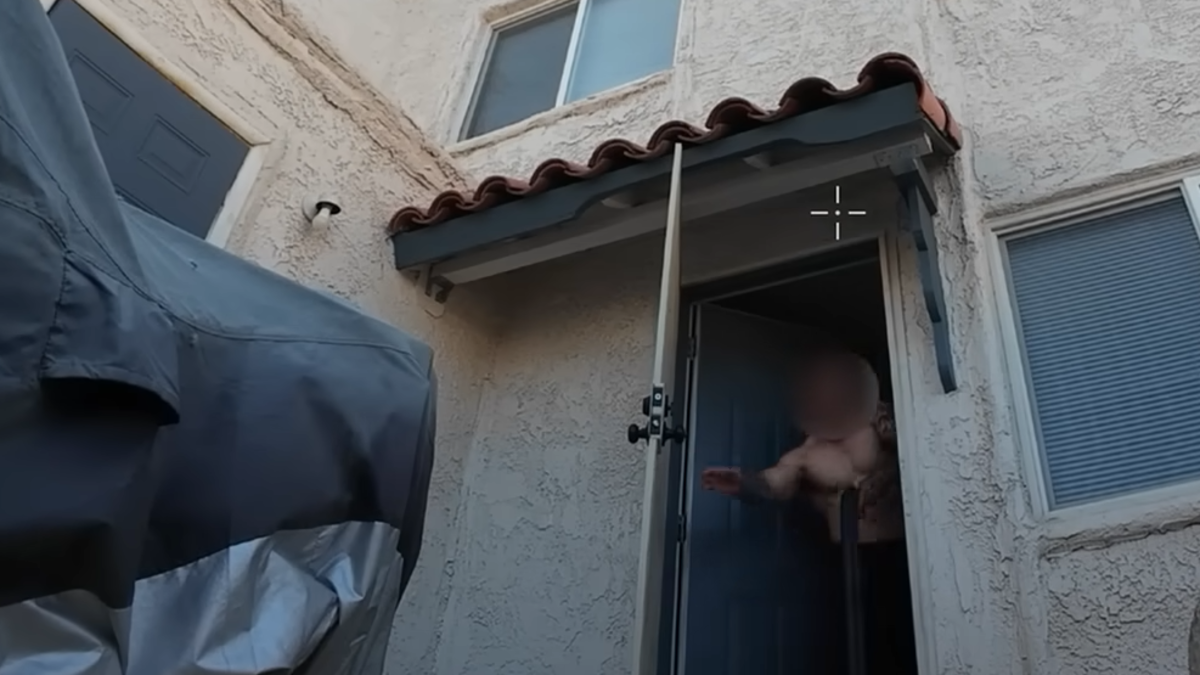
The officers then sent in a small drone, but at 7:43 a.m., a shot rang out. Drone footage provided by the department showed Schmidt opening his door, pointing his gun at the drone, which was sitting on the ground inside the patio, and shooting it.
“He just shot the drone,” one officer said.
A few minutes later, Schmidt reappeared at the door. Another shot rang out, this time aimed at the patio wall. Schmidt went back inside before being spotted a few minutes later peeking out a window, where he fired again.
“Shot out the window!” Patterson said, as a single shot cracks through the air, followed by two more in quick succession.
“Get inside! Everybody inside!” an officer yelled at neighbors who’d come out to watch.
After about a minute, Patterson spoke. “I don’t think I got him with that one,” he said.
“Did you shoot back?” another officer asked.
“Yeah,” Patterson responded.
The aftermath
For nearly 25 minutes, no one moved as they waited for a sign of Schmidt, and for a drone and an extraction team to arrive
About 20 minutes into that period of stillness, an officer asked Patterson if he’d seen the target or if he was suppressing fire.
“Because he was cranking rounds off, I could see the blinds move,” Patterson responded. “There’s different definitions of suppressive…”
“Hold on. On camera. We’ll talk about that later. On camera,” the other officer said, referring to their body cameras and cutting him off.
Ten minutes later, an officer approached Patterson and told him he had to go sit in a patrol vehicle. He’d fired a shot and needed to be isolated. The higher-ups had decided it was safe enough to move him from his position, even though they hadn’t confirmed that Patterson had successfully shot Schmidt.
“They want you to be separated already,” the officer told Patterson. “Just like we would any other protocol.”
According to the critical incident briefing video, the special assignment team arrived and sent two drones in through a window in search of Schmidt. They found him unresponsive upstairs with two long guns next to him.
An excerpt of body camera footage included in the briefing — but not released with the other footage as part of New Times’ public records request — shows the officers entering the top floor of the townhouse, the drones loudly buzzing nearby. They stepped over at least three handguns and some ammunition as they made their way to a bedroom filled with children’s toys and clothing, where Schmidt lay motionless in the corner just feet from a window. On the bed, next to a pile of stuffed animals, were the two long guns.
A 911 recording released in the public records request shows that Schmidt called his family during the stand-off, including just minutes before Patterson shot him. Schmidt’s brother and mother called 911 to ask for a welfare check on him.
“Right now he’s in a situation with officers, pretty much a stand-off,” his brother said. “So we just want to know that he’s OK.”
Schmidt had called his mom to tell her that his girlfriend had called the police on him. (None of the 911 calls released to New Times were made by her.) He was extremely upset and she’d been trying to calm him down, his mom said, insisting that he’d never hit a woman.
“He told me, ‘Goodbye Mom, I’m going to die today,’” she told the dispatcher later in the call, adding that Schmidt had stopped answering her calls.
“Please tell your officers to have some compassion,” Schmidt’s brother told a dispatcher. “He’s just in a bad spot right now.”

Matt Hennie
What’s next
Schmidt was the fifth person killed by Phoenix police officers this year and the third in a spate of three fatal shootings by the department that took place within a few days of each other. The department killed 11 people last year, down from the previous two years and significantly down from a high in 2018, when Phoenix cops killed nearly twice as many people, the most by any department in the country that year. However, 11 shooting deaths is still higher than many similarly-sized departments.
The shooting is being investigated by the Major Incidents Division of the Arizona Department of Public Safety. The Maricopa County Attorney’s Office will ultimately decide whether criminal charges are brought against the officer.
It’s also subject to an internal review by the Phoenix Police Department. Phoenix police’s policy on the use of deadly force says it is justified only when a “suspect is acting or threatening to cause death or serious physical injury to the employee or others,” and has the opportunity and “the means or instrumentalities to do so.” It also requires that de-escalation tactics “have been tried, have failed, or are determined to have not been feasible,” and that suspects be given “a reasonable opportunity to comply voluntarily.”
The department did not originally release Patterson’s name but confirmed him as the shooting officer after New Times identified him from public records. The department then added his name to their media advisory about the shooting.
The department’s online use-of-force databases show that Patterson was investigated for use-of-force 31 times between July 2023 and the end of 2025. He never used lethal force, and the suspect in each of those incidents was unarmed. The department found his actions to be within policy for every incident except for one, which took place on May 20, 2025. This includes an encounter on November 3, 2024, for a traffic stop he conducted with Epps and two other officers. The man, who was acquitted of assaulting the officers, has since filed a $2.5 million notice of claim against them, the department and the city.