
Phoenix Police Department

Audio By Carbonatix
On the evening of June 11, two Phoenix police officers shot and killed 56-year-old James Glenn in his car in north Phoenix. The Phoenix Police Department said the officers killed him after Glenn flashed a gun while police tried to arrest him for an outstanding felony warrant connected to an investigation into sexual conduct with a minor.
On Thursday, the Phoenix Police Department released its “critical incident briefing” on the shooting. The briefing consists of a video and an accompanying write-up, and includes footage from two officers’ body-worn cameras and a police drone. The department releases the briefings approximately two weeks after a critical incident, which includes a fatal shooting by an officer.
Phoenix New Times received the incident report and longer versions of the body-cam and drone footage through a public records request.
The nearly five minutes of drone footage and approximately 16 and a half minutes of accompanying body-cam footage do not provide much insight into the moments leading up to the shooting because Glenn is never visible. But here is what the footage does reveal from the events that evening near 2300 W. Pinnacle Road.
The shooting
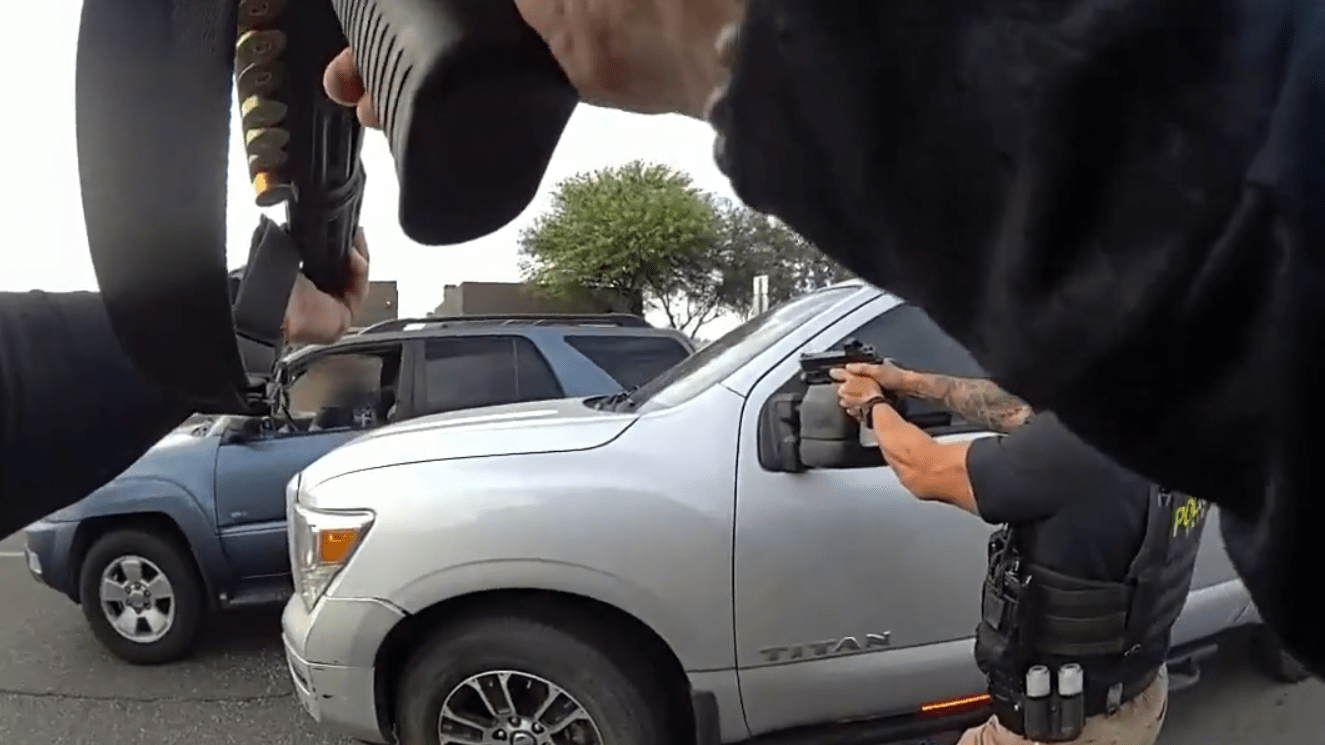
Body camera footage captures the minutes leading up to the shooting. Officer Brian Authement of the department’s K-9 unit was among a group of officers following Glenn in their vehicles. As Authement drove, he sent out updates over the radio, telling listeners that if the opportunity arose, he would use his grappler, a tool that stops fleeing vehicles.
Within a minute of turning on his camera, the moment arrived. Authement grappled Glenn’s SUV, which isn’t visible in the footage, slowing the car to a complete stop. Authement grabbed his shotgun and rushed out of the car as police sirens sounded and a police dog barked. He ran toward another officer’s SUV, which was parked next to Glenn’s car. That officer, Erik Infiesto of the Fugitive Apprehensions and Investigations Detail, can be heard yelling at Glenn that they are Phoenix police.
Footage from Infiesto’s body cam shows him shooting at Glenn with a pistol, though no audio of that moment is available because he had not yet activated his body camera. (The cameras record 90 seconds of silent buffer footage prior to activation.) Glenn is also not visible because Infiesto was behind his vehicle. Authement’s footage showed him stopping next to Infiesto, who still had his weapon trained on Glenn, and firing one round from his shotgun at Glenn, who could be seen in the driver’s seat of his Toyota SUV.
About 30 seconds passed from grapple to shooting. It’s not clear from the footage how long the officers were following Glenn.

Phoenix Police Department
The aftermath
The officers stood still with their guns pointed at Glenn, who was still in the front seat of his blue Toyota SUV.
“Shots fired,” Authement immediately announced over the radio. “Suspect down. Has a gun. Not moving.”
Another officer quickly backed his Tahoe into the front of Glenn’s Toyota SUV, preventing it from being able to move forward. More officers arrived, and the officers debated whether to send in a drone or a dog to find Glenn’s gun and see if he was alive. The department’s report says that an officer fired a non-lethal round from a 37-millimeter launcher, but that is not obvious in the footage released by police.
Officers ultimately settled on using the drone, which arrived about four minutes after Glenn was shot. Drone footage shows about a dozen cars at the scene. Authement told the operator to look for a black handgun. Around the time the drone arrived, Infiesto turned off his body cam.
The drone flew into the Toyota through a shot-out front passenger window and hovered in the passenger seat, its camera scanning for the gun. Glenn sat still and slumped over, wearing jeans and a gray t-shirt. Old drink bottles, travel cups, a t-shirt, a knife and a handle of clear alcohol were scattered on the car floor and passenger seat, covered in glass from the broken window. A plastic bag fluttered around, a victim of the drone’s wings. The drone eventually zeroed in on a black object stuck between the center console and driver’s seat, an object later identified by the department as Glenn’s gun.
Nearly seven minutes after shooting him, the officers moved in, using a shield while they confirmed that he was no longer a threat. Then they took Glenn’s limp body from the car and put him face up on the pavement. Officers stood around looking at him, while one checked his pulse.
“Pupils are fixed and dilated,” Authement said. “No signs of life.”
Clarissa Sosin
What’s next
Glenn was the seventh person shot and killed by Phoenix police this year. Phoenix cops killed three people within a few days of each other in March.
The department killed 11 people last year, down from the previous two years. That’s significantly down from a high in 2018, when Phoenix cops killed nearly twice as many people, the most by any department in the country that year. However, 11 shooting deaths is still higher than many similarly-sized departments.
New Times identified Authement and Infiesto through their body-cam footage. The department confirmed their names and badge numbers. Both officers appear in the department’s use-of-force databases, which track incidents starting in Jan. 2018 and were most recently updated on June 1 of this year. Infiesto, who’s been on the force for 23 years, appears 26 times. He did not use lethal force in any of the incidents and only one involved a person with a gun. All of the incidents were found to be in policy.
Authement, who’s been with the department for 18 years, appears in the database 47 times. None of the people involved in those incidents was armed with a gun. Two had knives. In 14 of those incidents, Authement used his K-9. He never used lethal force. Information on whether his actions were within policy was unavailable for 11 of the incidents because the department did not track that data at the time. All of the other incidents were found to be in policy.
The two cops have also made news before. Authement allegedly roughed up a city councilmember in 2010 while responding to a fire, a matter that ultimately sorted itself out with the help of the Department of Justice. Infiesto was named in a jail wrongful death suit.
The department did not release the names of the other officers on the scene.
The shooting is being investigated by the Major Incidents Division of the Arizona Department of Public Safety. The Maricopa County Attorney’s Office will ultimately decide whether criminal charges are brought against the officers.
It’s also subject to an internal review by the Phoenix Police Department. Phoenix police’s policy on the use of deadly force says it is justified only when a “suspect is acting or threatening to cause death or serious physical injury to the employee or others,” and has the opportunity and “the means or instrumentalities to do so.” It also requires that de-escalation tactics “have been tried, have failed, or are determined to have not been feasible,” and that suspects be given “a reasonable opportunity to comply voluntarily.”
Have information about this story? Reach Clarissa Sosin on Signal at @csosin.27