
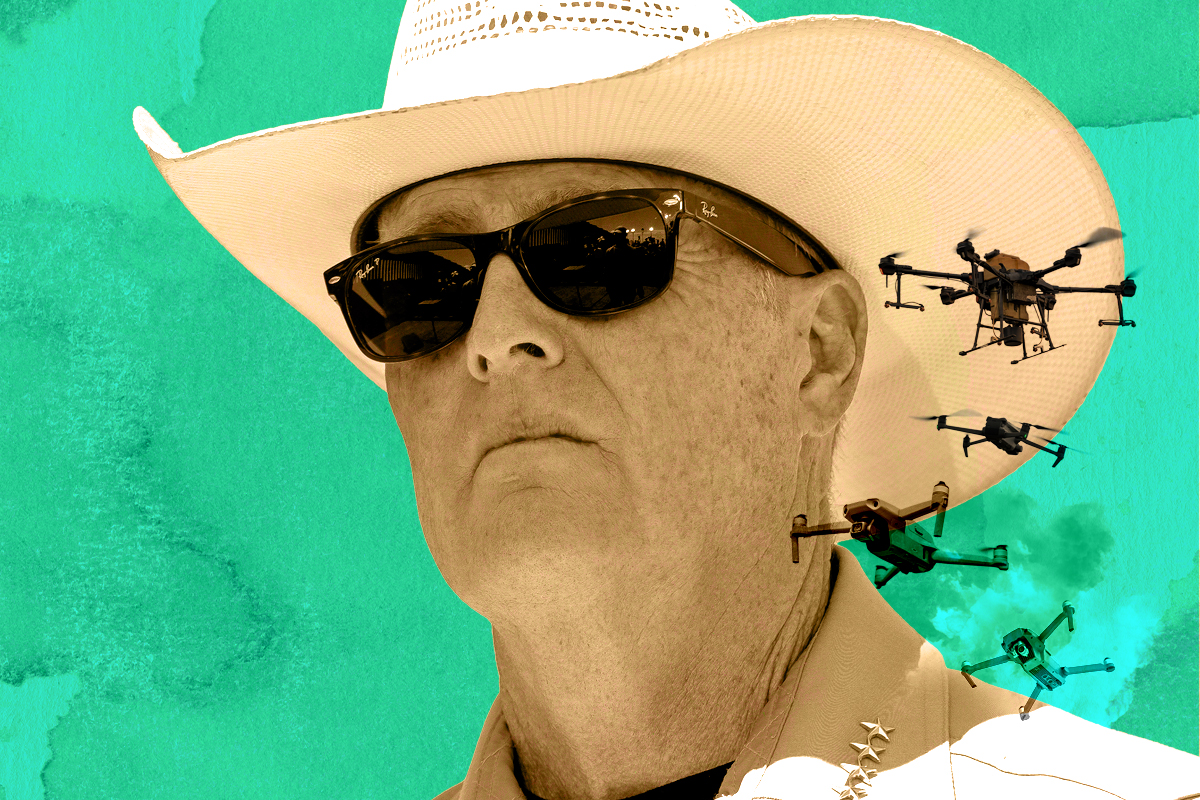
Photos by Envato and Rebecca Noble/Getty Images

Audio By Carbonatix
One bright and sunny day in mid-November, the U.S.-Mexico border in Southern Arizona was a hive of activity.
Metal grandstands filled with spectators while journalists, law enforcement officials and representatives from the federal government and military hobnobbed. Before them were a series of drones — manufactured by publicly traded Canadian defense contractor Draganfly Inc. — and a giant digital screen. In the background was President Donald Trump’s beloved rust-colored border wall, offering glimpses of Mexico between its steel bollards.
Among the crowd was MAGA-aligned Cochise County Sheriff Mark Dannels. Speaking to a local radio reporter, he bragged about the luminaries who had flocked to the county from the northern U.S. border and beyond. He gushed about the drones on display, which were “like taking a recreational drone and putting it on steroids.” He raved about how the drones, which are not yet in production, would help his agency catch border-crossers and aid waylaid hikers.
Dubbed the “Cochise County Border Drone Summit,” the entire event had the feel of an infomercial — one that was, oddly, put on for a private company by a public law enforcement agency. A presentation on the drones was given not by a Draganfly representative — though company CEO Cameron Chell was on hand — but by Cpt. Tim Williams, who leads CCSO’s border security efforts. The guest list was curated, with invitations extended only to potential Draganfly clients and friendly media members — as well as deep-pocketed sheriff’s office booster Howard Buffett.
Phoenix New Times and Cochise Regional News, which have been partnering since last year on accountability reporting, replied to a press release seeking RSVPs for the event. After an initial enthusiastic acceptance, our invitation was rescinded because, according to the PR firm promoting the event, “the reporters guest list has closed.” (The Arizona Center for Investigative Reporting was also shut out.) Few, if any, of the reporters who were invited seemed to have questioned why the sheriff’s office of a sparsely populated Arizona county was essentially doing a commercial for a drone company that’s traded on the NASDAQ.
But emails and other documents obtained by CRN and New Times shed light on the arrangement. They show that CCSO and Draganfly had worked out a quid pro quo. CCSO gets to play with some fancy drone prototypes. In turn, the sheriff’s office — led by Dannels, a rising star in MAGA world and also a member of Trump’s Homeland Security Advisory Council — would boost the profile (and, it follows, the earnings) of a drone company. That effort has helped Draganfly reap the benefits of a Trump-led emphasis on drone deployment and law enforcement militarization.
What’s more, CCSO’s dog-and-pony show may have directly enriched an ex-Trump official on Draganfly’s board: former acting Defense Secretary Christopher Miller. Along with Dannels, Miller was apparently involved in a shadowy Project 2025 effort to craft plans and recommendations for Trump’s second term, specifically to drastically reshape the structure of American policing and place it under the command of Trump himself. CRN and New Times first reported on those plans in May.
While the arrangement between CCSO and Draganfly doesn’t seem to be illegal (and has been reported in company filings with the Securities and Exchange Commission, as required by law), it serves as an example of how influence is peddled among Trump acolytes. Like CCSO’s $1 million grant to cooperate with ICE — which contains a shady $250,000 that seems to benefit Dannels directly, as CRN and New Times reported earlier this month — the Draganfly-CCSO partnership raises more questions than answers.

Rebecca Noble/Getty Images
Shilling for a profit-driven defense contractor
Neither CCSO nor Draganfly responded to questions about their partnership, but records show the relationship between them goes back at least to March 2025.
Public records obtained by CRN and New Times demonstrate that Draganfly reps — including Chell, the founder and CEO — visited Cochise County on March 6, participating in border “ride-alongs” with CCSO personnel and conducting “real-world testing on active illegal border crossings.” Not long after, CCSO started what can only be described as a campaign of actively promoting the company.
This included promotion through various law enforcement associations. An April email shows Williams (the captain who gave the drone presentation in November) “cleared an idea” with Chell to promote Draganfly in a presentation to the International Association of Chiefs of Police. In May, Paul Goldenberg — the head of Draganfly’s newly created Public Safety Advisory Board and a member of the National Sheriffs’ Association Border Committee, which Dannels chairs — emailed Williams to talk about efforts to secure federal funding at an upcoming sheriffs’ association conference. Chell, along with other Draganfly personnel, was copied on the email.
By the time the conference rolled around in June, Dannels and CCSO had shifted their promotion of Draganfly into higher gear.
On June 8, Williams forwarded Dannels and his chief of staff a press release Draganfly had sent him promoting its partnership with CCSO. Written in the voice of the sheriff’s office, while erroneously calling it the “Cochise County Sheriff’s Department,” the release announced a “cutting-edge drone pilot program” with Draganfly. (The release was framed in the context of an executive order issued by Trump on “Unleashing American Drone Dominance” only two days prior. The order emphasized increased reliance on drone technology produced in America.) The draft release heaped praise on Canada-based Draganfly, which has been eager to expand in the U.S. market under Trump, even opening an office in Florida and describing itself in its release as an “industry leader” whose drones are “manufactured in North America.” The draft release seemingly written for CCSO even included Draganfly’s NASDAQ ticker symbol.
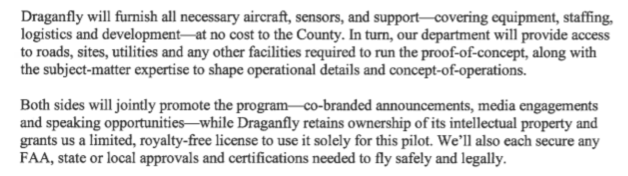
Records indicate that CCSO basically adopted the release’s language verbatim, placing it on CCSO letterhead and inserting the correct name of its agency. What the release didn’t mention was an agreement, communicated on June 9 in a memo from Chell to Williams, that CCSO would promote the pilot program with Draganfly through “co-branded announcements, media engagements, and speaking opportunities.” For its part, Draganfly agreed to “furnish all necessary aircraft, sensors, and support — covering equipment, staffing, logistics and development — at no cost to the County.”
Public records
The memo — which, like the press release, had been written in CCSO’s voice by Draganfly — was signed by Williams on June 9, with only minor adjustments. Williams then forwarded it to both Chell and Dannels. In another email from that day, Chell explained to Williams that “from a regulatory perspective, we need to have something signed.”
The “regulatory perspective” may have been related to SEC requirements that statements issued to investors and shareholders be (reasonably) honest. Draganfly had its press release set to go — and is required to file all such press releases with the SEC upon issuance — but up to the moment Williams signed the “memo” on June 9, there was no actual signed agreement between CCSO and the drone manufacturer. Indeed, the only agreement produced by CCSO in response to our public records request seeking all agreements and contracts between the agency and Draganfly was that memo.
Draganfly issued a press release on the partnership with CCSO a day later, on June 10. Then the media blitz began.
CCSO dated its version of the Draganfly press release to June 17. A review of media coverage from June through August reflects a fair amount of credulous stenography in both the Arizona and national press. Many print and broadcast outlets dutifully (and perhaps unwittingly) bought into the public relations campaign, essentially producing infomercials for Draganfly. Much of this “news” coverage featured slick promotional graphics and videos created by Draganfly, along with interviews and quotes from Williams.
In one email exchange obtained by CRN and New Times, Chicago-based News Nation reporter Jeff Arnold contacted Dannels on July 8 to ask about the drone program. “I wanted to reach out after I received a pitch from a public relations firm about a pilot drone program that you’re doing in Cochise county to help monitor the border,” Arnold wrote. Dannels put him in touch with Williams and Carol Capas, the agency’s public information officer. After interviewing Williams, Arnold asked a follow-up question about the program’s cost. At least in written correspondence, neither Williams nor Capas disclosed that the cost was free advertising conducted by CCSO.
(Perhaps shrewdly and perhaps opportunistically, Williams got into the vendor game himself later that month when he co-founded Spyderweb Technologies, which produces “surveillance solutions” clearly meant for the homeland security and defense marketplace. Despite remaining a CCSO captain, Williams serves as Spyderweb’s chief executive officer and the public face of the company, according to Spyderweb materials.)
The CCSO/Draganfly partnership didn’t end with mutual “co-branded announcements” and “media engagements.” Records show that a Draganfly representative put a commander with the Ontario Provincial Police Intelligence Bureau in touch with Williams in August so that the Canadian cop could learn about CCSO’s use of Draganfly products and potentially even visit Cochise County for a demonstration. The June 9 pilot program agreement also stated that Draganfly and CCSO had “slated a multi-day, in-field demonstration for later 2025” to showcase Draganfly drones’ use on the border.
In October, Draganfly began hyping this event as the grand unveiling of its newest offering, the “Outrider Southern Border Multi-Mission Drone,” which would engage in a “live exercise” right on the border. This took place during the November “Cochise County Border Drone Summit,” at which “select leaders from law enforcement, defense, and security areas” could learn about Outrider’s great utility and seven-hour flight capability. (This was the event CRN and New Times were disinvited from attending.) According to Draganfly’s subsequent press release, the event was a smash success.
Social media posts from Goldenberg, the chair of the company’s Public Safety Board, claimed that nearly 100 members of law enforcement agencies — from both within and outside the United States — were in attendance. National Sheriff’s Association Executive Director Justin Smith was there, as was Howard Buffett, the scion of billionaire investor Warren Buffett who has given tens of millions of dollars to the Cochise County Sheriff’s Office and related entities.
Speaking of free money, as we previously reported, last fall CCSO received a $1 million federal grant, ostensibly to support two officers’ work serving federal immigration warrants in the county jail as part of Immigration and Customs Enforcement’s 287(g) program. According to the grant award letter, a portion of this money may have been spent on CCSO’s “Backyards to Borders” program, through which the agency purports to educate policy leaders and law enforcement officials on border issues by hosting visits to the border.
CRN and New Times asked CCSO whether any portion of the $1 million federal grant was used as part of the drone summit. Capas, the agency spokesperson, did not respond.
Tom Williams-Pool/Getty Images
Media blitz pays off
It appears as if the media blitz and CCSO’s shilling paid off for Draganfly.
A day after announcing its partnership with CCSO in June, Draganfly issued a press release advertising a U.S.-only public offering of 5.5 million units of stock, with a total value of $13.75 million. The offering was set to close the following day. The purpose of the offering was “to accelerate growth, deepen defense market penetration, and expand (Draganfly’s) R&D pipeline,” according to company materials.
On Aug. 11, the company issued its second-quarter performance report, claiming a 37% increase in sales and a 9.3% increase in gross profit year over year. Among key contributing “operational highlights,” the company again touted its partnership with CCSO. And, through the summer and fall, Draganfly announced a number of contracts with the Department of Defense. In November, just before the demonstration in Cochise County, Chell touted the partnership on a shareholder call. He specifically noted that the Outrider prototype drone being used by the sheriff’s office — which is not yet in actual production — was expected to be a big earner for the company in 2026.
“We have some pretty high hopes,” Chell told stockholders. “Certainly, early indications are that this is going to be a leading driver of sales for us even next year. Even though we hadn’t planned on it being a big driver of sales until 2027.”
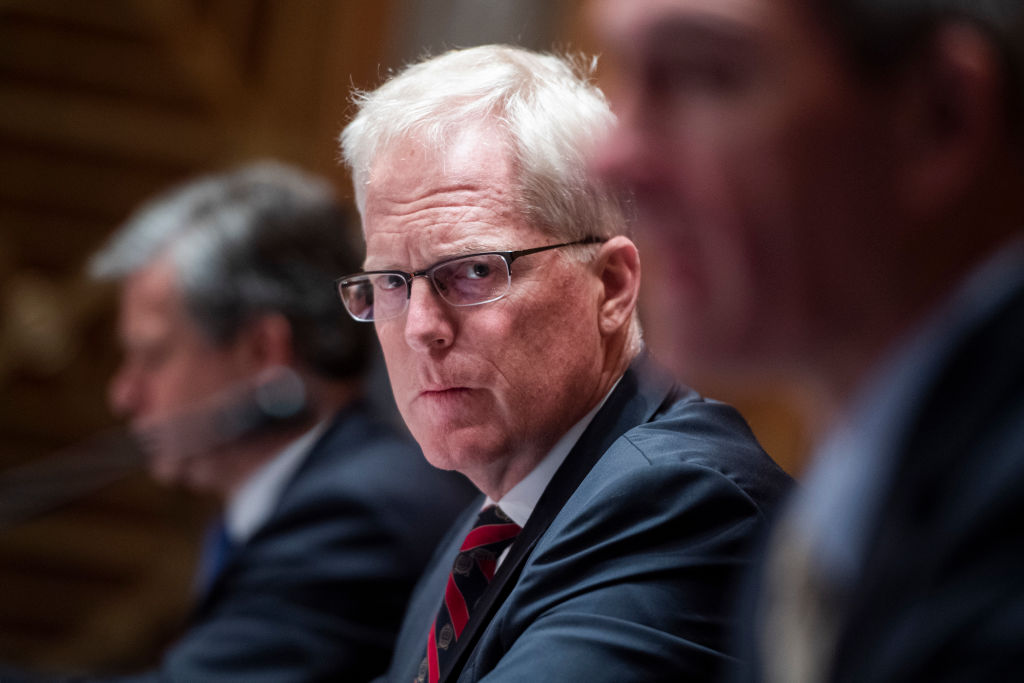
Among those poised to reap the benefits of that anticipated spike is Christopher Miller, the former acting Defense Secretary under Trump in 2020. Miller joined the Draganfly board of directors on March 19. Having a former Trump official on board (literally) certainly couldn’t hurt Draganfly in a second Trump administration. But Miller also swam in some of the same murky waters as Dannels during the lead-up to the 2024 election.
As previously reported by CRN and New Times, Dannels was part of a shadowy collection of law enforcement figures, retired military leaders and former Trump officials who worked through 2024 under the auspices of Project 2025 to craft plans for a second Trump administration. Dubbed the Border Security Workgroup, the group’s plans and recommendations for Trump’s promised mass deportations and other national security objectives — which seemingly have been playing out daily since Trump regained office — amounted to a drastic militarization and reorganization of American law enforcement under Trump’s control. Miller appears to have been involved as well.
Miller served as acting Defense Secretary after Trump’s election loss in 2020 until the inauguration of President Joe Biden in January 2021. Those months were marked by the lunatic fringe in Trump’s circle urging things like martial law — and, of course, by the Jan. 6 insurrection at the U.S. Capitol. Notably, on that day, Miller drew criticism for delaying the deployment of the D.C. National Guard to aid embattled Capitol Police.
When Biden took office, Miller entered the world of private defense contractors, becoming an “executive” with “private autonomous flight company” DZYNE Technologies in 2022, according to records. During this period, Miller also authored the Department of Defense chapter of Project 2025’s “Mandate for Leadership” policy document, published in April 2023. The following year, Miller may have also been advising the Border Security Workgroup, of which Dannels was a member.
According to documentation obtained by CRN and New Times, a “Chris Miller” worked as Project 2025’s overall “DoD lead” throughout 2024. Documentation also indicates that Project 2025’s broader Department of Defense efforts were distributed across a number of subgroups — including the Army Work Group. It was from this Army Work Group that the Border Security Workgroup sprang in late April 2024. Records indicate that the Border Security Workgroup met with and received guidance from a “Chris Miller (Project 2025 DoD lead)” and other Project 2025 personnel.
Records show that Dannels, with his rising MAGA celebrity and leadership status in various sheriffs’ and law enforcement groups like the National Sheriffs’ Association, joined the workgroup in May 2024 at the invitation of Sheriff Roy Boyd of Goliad County, Texas. (Boyd was the primary leader of the Border Security Workgroup team tasked with their “main operational effort,” which was the creation of the new militarized “multi-jurisdictional law enforcement” structure under Trump.) Dannels remained a participant throughout that year. Two other Texas sheriffs with leadership positions with the National Sheriffs’ Association — Urbino “Benny” Martinez of Brooks County and Jim Skinner of Collin County — also participated in the Border Security Workgroup.
Documents indicate that, throughout the course of their work, Border Security Workgroup members took part in Project 2025 functions and met multiple times with Project 2025 “DoD leadership.” According to internal workgroup emails we’ve obtained, this included meetings and/or briefings with someone identified as “Chris Miller (Project 2025 DoD lead),” and “Christopher Miller” was among the recipients of workgroup emails discussing these briefings. During some of these meetings, the group briefed “Project 2025 DoD lead” Miller on their ongoing work and received guidance from Miller, according to documents.

Illustration by Richard Huante
From its beginning, the workgroup was tasked with “providing defense support” to domestic law enforcement and overcoming prohibitions on the military performing domestic law enforcement duties, which is generally barred by the Posse Comitatus Act. Records show that “Chris Miller (Project 2025 DoD lead)” provided guidance to workgroup members, calling for “comprehensive implementing plans” — to include “DoD constabulary roles” and “support to (law enforcement agencies),” ready for execution “upon inauguration.”
Documents detailing plans and policies crafted by the Border Security Workgroup show that the group certainly took this guidance to heart. And, as the administration has attempted to flood city after city with military forces, it would appear as though Trump and friends took these plans to heart as well.
CRN and New Times attempted to contact Miller and submitted written questions pertaining to Project 2025 and other matters relevant to this reporting. We received no response to any of these questions or attempts at contact.
Following Trump’s electoral victory and subsequent inauguration, some members of the Project 2025 Border Security Workgroup continued their work within the Trump administration. One, Earl Matthews, was confirmed as general counsel to the Department of Defense — i.e., Defense Secretary Pete Hegseth’s top legal counsel — in late July. Another, Joseph Humire, was hired on at the Pentagon in June as “deputy assistant secretary of Defense for homeland defense integration and defense support of civil authorities.” He has since been promoted to another role at the Department of Defense.
Miller went another route, choosing to remain in the private sector and joining the Draganfly board. In statements filed with the SEC, Draganfly stated that Miller’s “extensive experience” was “expected to guide Draganfly’s strategic initiatives in government, defense, and aerospace sectors.”
SEC filings indicate that Draganfly board members are compensated through equity compensation, such as stock options. It is not known whether, to date, Miller has been awarded or exercised any such options. However, it is known that Draganfly’s market share and stock value have increased since Miller joined the board — and, more specifically, since the company began its partnership with CCSO. Draganfly’s stock sat at $2.91 per share in mid-March (just before Miller’s appointment to the Draganfly board) but reached its 2025 peak at $13.77 a share by Oct. 13, an increase of 473%.
Neither Chell, Miller nor CCSO responded to questions about the nature of Miller’s relationship with Dannels, or if one exists. Nor did Chell or Miller answer questions about Miller’s compensation as a board member. CRN and New Times also attempted to reach Miller — through various means, including through Draganfly — to confirm whether he is the same “Chris Miller (Project 2025 DoD lead)” who met with and advised the Border Security Workgroup throughout 2024. We received no response.
Whether Miller was a driving force in pursuing the partnership with CCSO is unclear. But any way you look at it, here we have a public law enforcement agency actively working to promote a private for-profit defense contractor. That work has demonstrably boosted the company’s market share and stock value.
And, in the swamp of MAGA world, it’s hardly surprising that both the head of that public agency and a director of that company have deep ties to Trump and Project 2025.
Read an expanded version of this story on CRN. This article is a continuation of the Big Takeover investigative series CRN and New Times began last year. You can subscribe to CRN here. This story is also a part of the Arizona Watchdog Project, a yearlong reporting effort led by New Times and supported by the Trace Foundation, in partnership with Deep South Today.