Danielle Cortez

Audio By Carbonatix
Keep Phoenix New Times Free
We’re aiming to raise $10,000 by April 26. Your support ensures New Times can continue watching out for you and our community. No paywall. Always accessible. Daily online and weekly in print.
As told to Morgan Fischer, a Phoenix New Times staff writer.
The theory of Arizona’s social safety net is that it’s there to catch us when our lives start to plummet. It’s right there in the name: the Arizona Department of Economic Security. “We are committed to supporting Arizona communities, offering a helping hand to individuals and families in need,” it says on the DES website.
Yet when I need it — for my 44-year-old daughter Dana, who has Down syndrome and needs daily care — the only thing I’ve been offered is excuses.
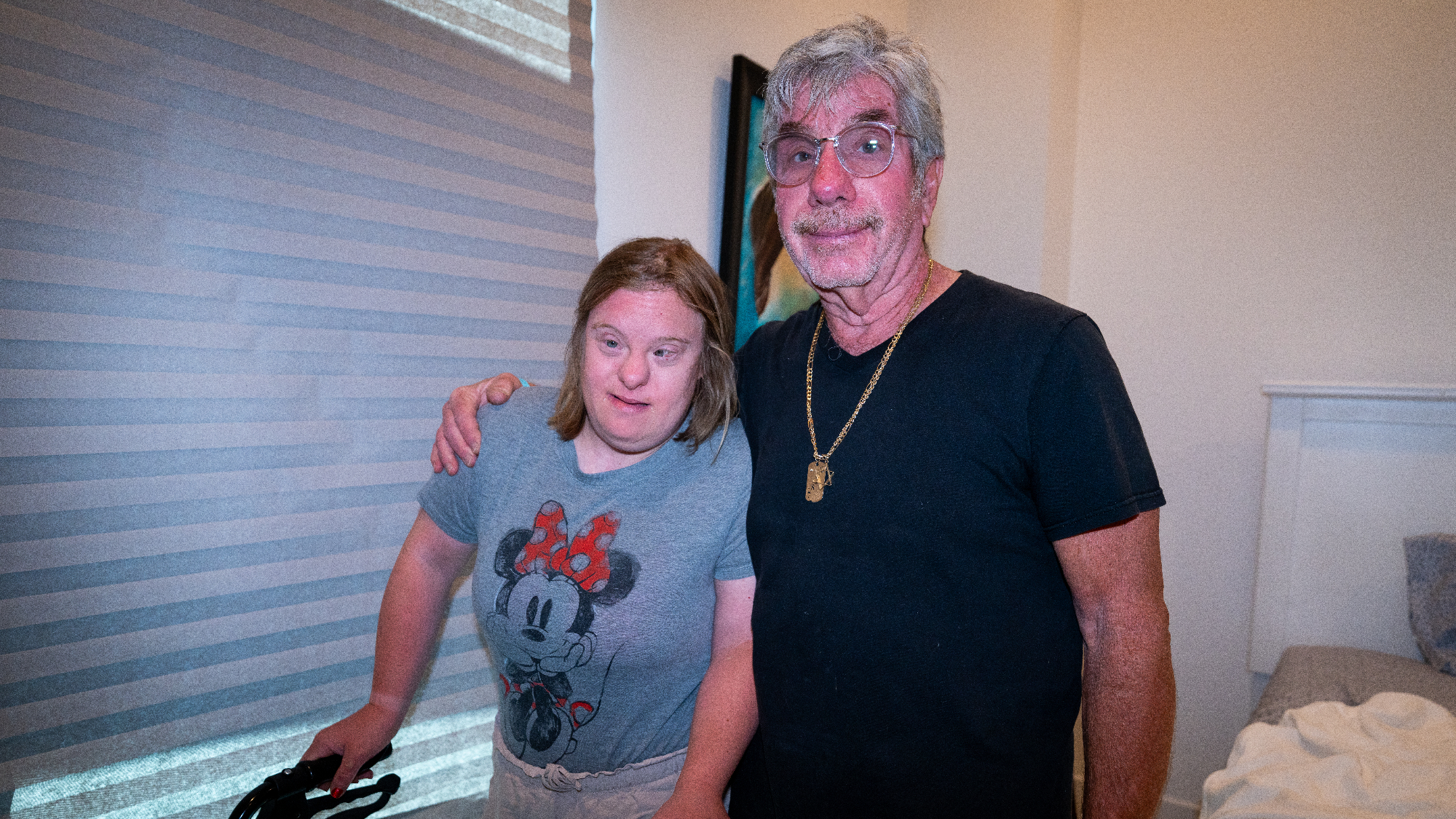
Our situation is getting increasingly dire. My wife and I are both in our 70s, and I’m currently fighting stage-four prostate cancer. We cannot provide the level of care that Dana requires. DES can, but it has left us out to dry, making us jump through hoop after impossible hoop to prove that she even has Down syndrome.
Caring for a child with Down syndrome is a lifelong task. When Dana was born, my ex-wife and I were concerned about her diagnosis. We’d grown up seeing people different than us segregated from classmates in school, excluded from activities and not given the same opportunities as their peers. We worked to ensure that wasn’t Dana’s experience. Growing up in Pennsylvania, Dana had a fairly normal childhood, not unlike her siblings. Our family was tight-knit and very active in our local synagogue and community theater. Dana and I were even in “Pippin” and “Fiddler on the Roof.”
As she grew into adulthood, Dana participated in a Pennsylvania state work program for developmentally disabled adults, packaging cough drops for more than 20 years in a warehouse in a Philadelphia suburb. She was paid only 25 cents an hour, but she worked six or seven hours a day, five days a week. She enjoyed lunch breaks with co-workers, indulged in workplace romances and received a paycheck. It was a level of independence we’d always wanted her to have.
Things got more complicated two decades ago, when Dana’s mother and I split up. I moved to Arizona and remarried, and Dana traveled back and forth between Pennsylvania and Scottsdale to spend time with both of her aging parents. Last summer, Dana’s health began to decline. She’s developed arthritis and has trouble walking. Just trying to move is extremely painful, and she can no longer climb steps. Last month, doctors discovered osteonecrosis in her knee, requiring surgery and then rehabilitation. She can no longer work at her job and requires more intensive care.
That’s care that her mother and I are no longer equipped to provide. My ex-wife is 73 years old and struggling with her own health issues. We looked at finding a group home for Dana in Pennsylvania, but due to high demand, the state was accepting only extreme cases in which neither of the patient’s parents was alive. So we planned for Dana to relocate to live with me. I began researching options in Arizona.
Danielle Cortez
Dana moved to Arizona full-time in December, and we managed to connect with the Jewish Agency to provide a group home in Phoenix. All the state would need to provide was a caretaker. It’s for this exact reason that DES — and, more specifically, its Department of Developmental Disabilities — exists. But my experience dealing with them has been absolutely maddening.
In August, we went down to DES’s offices to enroll Dana in services. I had everything the office needed, but one thing was missing: DES required proof that she has Down syndrome and had been diagnosed before she was 18. This is, in a word, ridiculous.
For one, Down syndrome is pretty noticeable. Most people can look at Dana and tell that she has an extra copy of her 21st chromosome. But more frustrating is that Dana is 44. The records that DES requires — if they still exist at all — are at least 27 years old and on the other side of the country. Through genetic testing, we’ve been able to prove to the state that Dana has Down syndrome. But proving she was diagnosed before the age of 18 has proven to be essentially impossible.
I dug up a nearly three-decade-old report from the Children’s Hospital of Philadelphia related to Dana’s treatment for leukemia, which she fought from ages 15 to 19. The document lists Dana’s Down syndrome in her medical history, but DES denied it because it lacked the required signatures. I reached out to the hospital to request the missing page, but they don’t keep records older than 25 years. I’ve also provided DES with a certification from a psychologist — who is also a family member — confirming Dana’s Down syndrome diagnosis. But the certification was from last fall, well after Dana’s 18th birthday, so the department wouldn’t accept it.
DES staffers recommended I track down school records to “prove” my daughter’s condition, but those are just as old and difficult to find. I have a document from the Individual Education Plan that Dana had to support her studies at school, but it lists only the specifics of that plan. Not Dana’s diagnosis. I’ve even reached out to the state ombudsman’s office for a remedy, with no luck.
I do not understand why this has to be so difficult. That Dana has Down syndrome is not in dispute. My health is failing, as is her mother’s. Our daughter needs help now, based on her current circumstances, not on whatever records remain unshredded from the 1990s. All this running around has made me sicker as I fight cancer, and all the waiting — sometimes months without returned calls or emails — has been a giant waste of my time. The system is failing us, and we’re getting desperate.
In the not-too-distant future, Dana will confront a world without either of her parents. That’s when the state is supposed to step in. At least, that’s how it’s supposed to work. After all we’ve been through, I don’t have much faith that it will.