
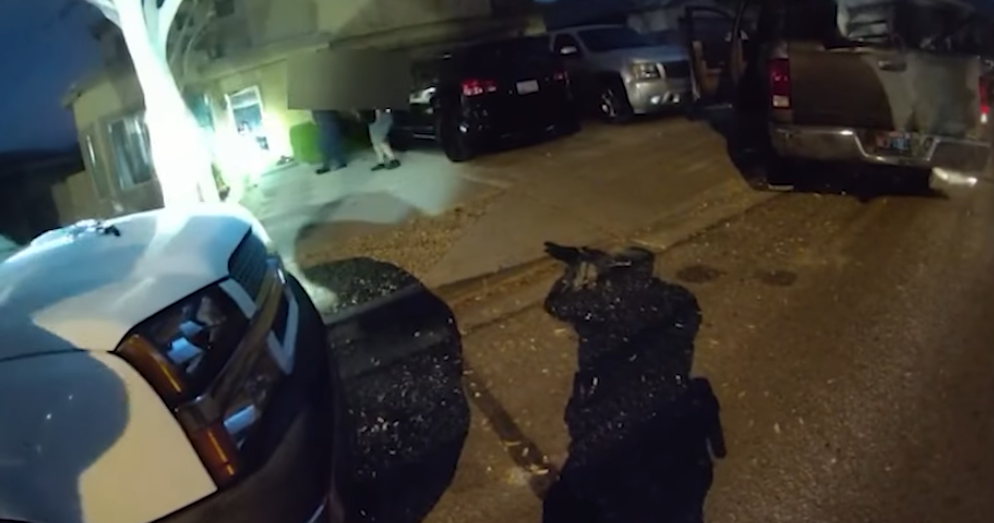
Phoenix Police Department

Audio By Carbonatix
In late January, Edgar Garcia drove to the South Phoenix home of Christian Diaz Rendon and unleashed hell.
On Jan. 26, Garcia, who is the son of Rendon’s landlord and has a history of mental illness, drove to the house to fight someone whom he believed was a part of a plot to murder him, according to court records. Surveillance video captured him firing both a shotgun and a pistol into the home, apparently hitting one of Rendon’s children in the process. As Rendon’s family members huddled upstairs and called 911, Garcia broke into the home from the backyard, ultimately engaging in a struggle with the 36-year-old Rendon near the front door.
Then a Phoenix police officer showed up and hurriedly shot Rendon — not Garcia, who had been subdued and disarmed — in the head, killing him.
The officer, Jason Valenzuela, has not been charged with a crime; an investigation into the shooting by the Arizona Department of Public Safety is ongoing. But the Maricopa County Attorney’s Office is throwing the book at Garcia, charging the 34-year-old with 11 felonies for shooting up and breaking into Rendon’s home. Surveillance footage of Garcia blasting away would seem to make open-and-shut cases of many of those charges — but one of them has struck even Rendon’s bereaved family members as an overreach:
Felony murder.
To be guilty of felony murder in Arizona — and in many other states with such a statute — one doesn’t have to have directly killed anyone. Instead, the law allows prosecutors to seek that charge whenever someone dies as a result of the commission of another felony. Felony murder laws are very controversial in criminal justice, and have been used to lock up people who didn’t actually kill anyone. One such person is currently on death row in Alabama. Felony murder has also been used to prosecute accomplices of people killed by police.
Garcia’s felony murder charge falls into that category. By indicting him on such a charge, county prosecutors are essentially saying he’s responsible for getting Rendon killed, since he started the whole situation. But that’s not a satisfying explanation for Rendon’s family, according to their attorney.
“The felony was over; he was captured,” said David Chami, who is representing Rendon’s wife, Mariana Gonzalez, in a potential lawsuit against the city of Phoenix.
Prosecutors choosing to “pin death” on Garcia by charging him with felony murder doesn’t “soften the blow” of the fact that a cop shot and killed Rendon, Chami said. Rendon’s family blames Valenzuela for his death, not Garcia. Chami said the five-year police veteran “did not pause” and “just picked a guy” in the dark to shoot and kill, adding Valenzuela “had to have known it could have been the homeowner.”
In an interview just days after Rendon’s death, Rendon’s 21-year-old stepson Jarvias Rosas called for Valenzuela to be prosecuted. “Once that person is behind bars, serves his sentence and we get compensation, then we will forgive” the officer who shot his father, Rosas said at the time. “But at the moment, we can’t find it in our hearts.”
Garcia’s attorney, Robert Abernethy, did not respond to a request for comment.
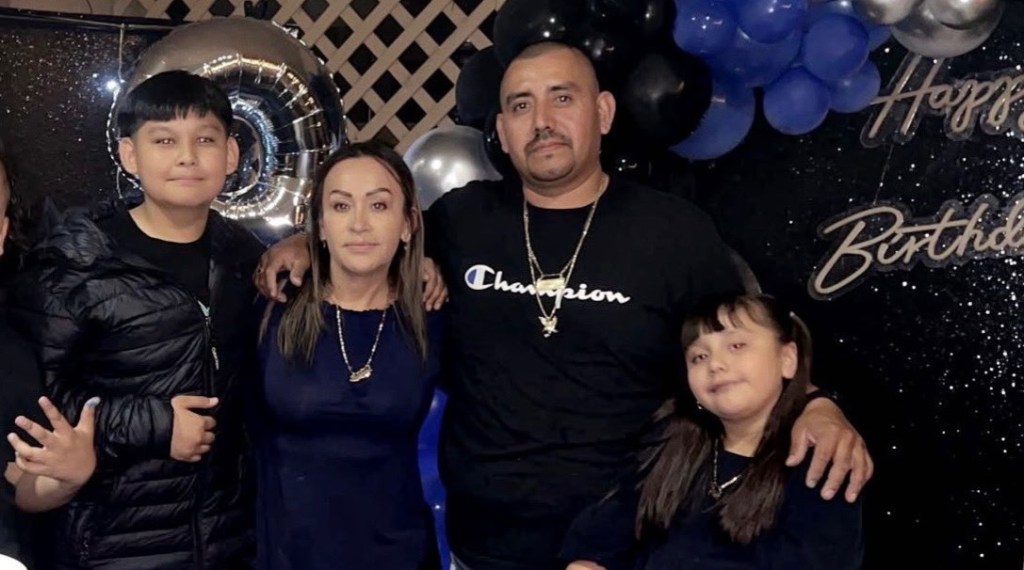
Courtesy of Jarvias Rosas
A $25 million claim
It’s unclear if Valenzuela will face any repercussions for Rendon’s killing. In a statement to New Times, county attorney spokesperson Erin Pellett wrote DPS has yet to submit its findings to prosecutors, “so no charging decision has been made regarding the officer.” But Chami believes Valenzuela is culpable.
Body-worn camera footage and 911 audio from the shooting show that once the officers arrived at Rendon’s home, several people informed them that the danger had passed. “Over here! They’ve got him on the ground!” one of Rendon’s family members could be heard telling the officers. Valenzuela fired anyway.
“NO! NO! YOU SHOT THE WRONG ONE, YOU IDIOT!” one of Rendon’s sons could be heard screaming. “YOU SHOT MY DAD!”
In the minutes after the shooting, Valenzuela could be heard on body-cam footage talking about his fatal mistake. “Dude, I thought he was fucking stabbing him,” Valenzuela said to another officer. “Goddammit.”
On Feb. 12, Gonzalez filed a notice of claim against the city of Phoenix and Valenzuela, demanding $25 million for the killing of her husband. The notice, which is a required precursor to a lawsuit, says that Gonzalez and her family have suffered “an incalculable loss” and are entitled to damages as a result of their “encounter with Phoenix Police.”
Rendon was the “sole provider for a very large family,” Chami said. Rendon cared for three biological children and was also stepfather to seven others, ranging from 11 to 27 years old. Chami said that at the time of Rendon’s death, he was also in the process of adopting two of his wife’s grandchildren, who are two and four years old.
Chami said the dollar figure in the claim was loosely calculated based on the shooting’s “level of egregiousness” as well as the $27 million that George Floyd’s family received from the city of Minneapolis after he was killed by police. He’s doubtful the city of Phoenix will pay up, or even respond, before the 60-day deadline.
Chami believes that Valenzeula’s “utter recklessness” should disqualify him from being a Phoenix police officer, but Valenzeula is still employed by the department, according to police spokesperson Sgt. Lorraine Fernandez. Citing pending litigation, Fernandez declined to comment further on Valenzuela’s employment status, including whether he’s been suspended or placed on leave.
It would seem to be a long shot that Valenzuela faces criminal charges. The Maricopa County Attorney’s Office has not filed charges against a Phoenix police officer as a result of a fatal shooting in several years. In fact, the last time a Phoenix police officer was convicted in an officer-involved shooting was in 2013.
And now that they’ve charged Garcia with felony murder, prosecutors may be even less likely to charge a cop in the same death.
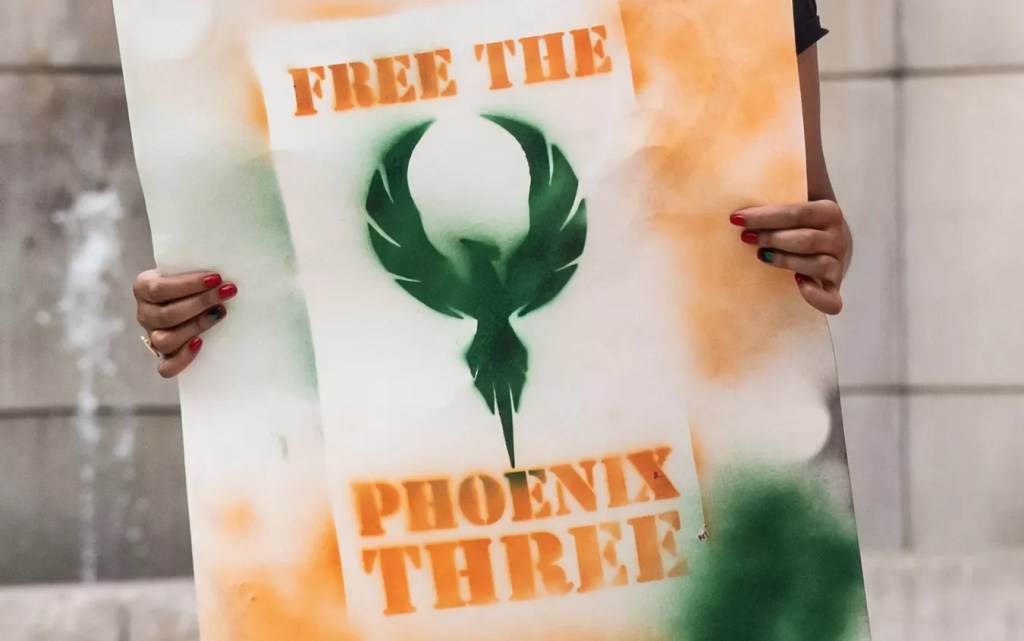
O’Hara Shipe
The controversial history of felony murder
Felony murder has a long and controversial history. There are many examples of people being locked up on felony murder charges for killings to which they had a very thin connection.
In Alabama, 75-year-old Charles Burton is facing the death penalty for a 1991 killing that someone else committed during a robbery. Burton participated in the robbery, but prosecutors acknowledged he was outside waiting in the getaway car at the time of the murder, and Burton has claimed he had no idea a murder was going to take place.
An NBC News story about Burton’s case listed several other notable felony murder cases. In 2019, a 14-year-old Illinois boy was killed by a homeowner after the boy and five friends attempted to break into a house. Prosecutors charged the five accomplices who survived with their friend’s murder.
In 2004, Florida prosecutors dropped a felony murder charge on a man who’d lent his car to someone who drove it to commit a home invasion, where they murdered a woman. Despite being at home and asleep at the time of the crime, the man was sentenced to life in prison, though his sentence was later commuted.
In Arizona in 2019, police shot 19-year-old Jacob Harris as he ran from police following a series of robberies. Prosecutors charged Harris’ three accomplices — known as the Phoenix Three — with felony murder (among many other charges), leveraging the threat of a life sentence into a plea agreement. Two of the defendants in that case are seeking post-conviction relief following a scandal involving one of the detectives involved in the investigation.
Pellet referenced Arizona’s felony murder statute when asked about the decision to charge Garcia. “It applies to anyone who participates in the underlying crime,” she said. “Regardless of who causes the death.” She added that “victim input is one of several factors taken into consideration throughout a case,” though it doesn’t seem to have tipped the scales, given that Rendon’s family blames Valenzuela instead.
Armando Nava, a Phoenix-based criminal defense attorney and a board member with Arizona Attorneys for Criminal Justice, says in the case of police shootings, it can be easier for prosecutors to hit someone with a felony murder charge than to criminally prosecute a cop.
“It’s much harder to prosecute a police officer for their actions — for a whole host of reasons — than it is to charge felony murder on somebody,” said Nava, who is not involved in Garcia’s case. “When prosecutors make these sorts of decisions, there are a whole lot of things that go into that decision, and one of them is they work with police officers all the time.”
Nava believes the felony murder statute, which he characterized as “legal fiction,” has been “warped and twisted from its original intentions” and “shouldn’t exist” in Arizona law. The statute is used by prosecutors when they don’t have enough to argue the suspect’s intent to commit homicide, but they can provide “the underlying offense and argue that that led or caused the death in the course of committing a crime.”
Nava defended a client in a Pinal County trial who was charged with felony murder. The man was fleeing police after an armed robbery when police shot him and his accomplice in the back. His accomplice died, and prosecutors charged and ultimately convicted the man of the murder.
“Felony murder on the books doesn’t deter police officers from shooting other people, and it doesn’t deter people from committing certain crimes,” Nava said. ”It is just something that doesn’t serve a purpose, but it makes people subject to harsher penalties than they would for their conduct.”
Nava said criminal justice reform advocates would likely support the repeal of the felony murder statute. But, he added, due to the current political climate and strong opposition from law enforcement lobbyists, it’s unlikely that a repeal effort would succeed.