
Clarissa Sosin

Audio By Carbonatix
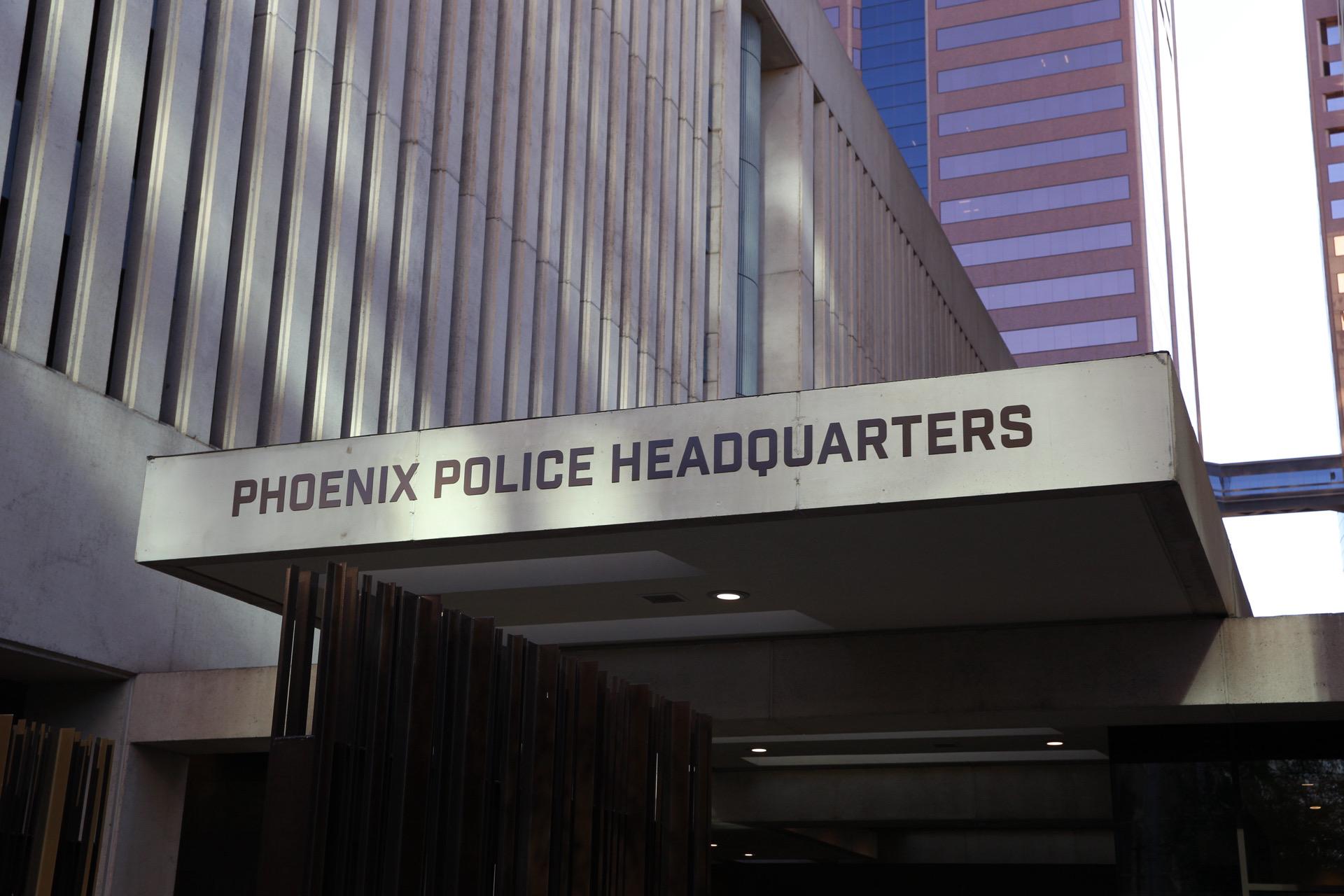
A Phoenix police officer who seemingly reformed after being disciplined and back on patrol is at risk of losing his job. Despite his pleas, the Arizona Peace Officer Standards and Training Board suspended his peace officer certification at its April 15 meeting, after a long and pained debate.
Timothy Clark, the officer, got in trouble twice with the department in 2023, the state’s assistant attorney general told the board. While off-duty, Clark went on a belligerent bender after a Diamondbacks game — harassing people, trying to fight a bar manager, biting a security guard, repeatedly bragging about being a cop. He was arrested for that fiasco. Later he shared privileged, sensitive materials such as unredacted body camera footage with a dispatcher from the Fresno Police Department whom he’d met online.
The Phoenix Police Department suspended him for 240 hours, the maximum its policy allows. When Clark returned to work he was put under a five-year-long Last Chance Agreement. If he were caught breaking any rules, he’d lose his job.
The ultimatum seemed to straighten him up. In 2023, Clark had been going through marital issues. He drank too much. He was struggling with civilian life after a stint in the marines. Today, he’s in therapy. He doesn’t drink. And for the past year and a half, he has been a model officer, patrolling the Desert Horizon Precinct.
“I’ve become a better person, a better husband, and a better officer for it,” Clark said. “I want to prove to everyone here that if given a second chance I will not let any of you down, just as the Phoenix Police Department has given me a second chance and I have not let them down.”
Clark was before the board, known as AZPOST, to fight for his job. AZPOST licenses all law enforcement in Arizona. It’s also among the few agencies with the power to discipline law enforcement officers. The board is made up of 12 people including Arizona Attorney General Kris Mayes, Ryan Thornell — the director of the Arizona Department of Corrections, Rehabilitation and Reentry — and representatives from sheriff’s and police agencies around the state. Last year it punished 42 current and former officers.
Board members spent more than an hour agonizing over Clark’s future. They worried about how their decision would affect him and his recovery, going back and forth trying to balance his turnaround against the need for discipline. They debated how long they should suspend his certification, or whether they should at all. Couldn’t the 240-hour suspension he’d already served suffice? Or would a suspension of 36 months — surely devastating Clark’s career — set a better example?
After nearly giving him time served, the board swung and voted to suspend Clark’s peace officer certification for 18 months. His lawyer Cassidy Bacon and his lieutenant Joshua Calle, who’d testified on Clark’s behalf, told the board that suspension would probably end Clark’s career as a Phoenix police officer.
The Phoenix Police Department will make a decision about Clark’s fate in the coming days, Cmdr. Mercedes Fortune said in an email.
More benders, drug lies and harassment
The board also suspended the certification of Ryan P. Jacquez, a Salt River Tribal Police Department officer. AZPOST compliance specialist William Caldwell said Jacquez crashed his Toyota pickup truck into a pole just after 4 a.m. on October 13 last year while driving to his shift. Queen Creek police officers found him in the truck, wearing part of his Salt River Uniform, with multiple guns and an open can of White Claw Green Apple.
Jacquez, who denied drinking and driving, had a blood alcohol content level of .252%, more than three times the legal limit. He’d knocked back 12 White Claws the night before, Caldwell said. He’d stopped drinking at midnight and woke up around 2:30 a.m. to drive to a 5 a.m. shift. The board voted to suspend his license for 36 months, their maximum suspension. Jacquez also has a pending extreme DUI charge in San Tan Justice Court.
The board voted to deny certification for 18 months to Dylan L. Stone, an aspiring Eloy police officer. Twice he was caught lying about his previous cocaine use on his law enforcement applications. Stone admitted to using cocaine once when he was 17 years old after being caught lying during a polygraph test that he took as part of his application process to the Eloy Police Department. Stone also lied on his application to the Coolidge Police Department in 2024, admitting to the polygrapher before that test that he had lied on his personal history statement. When asked why he lied again on his background questionnaire, “He said he wanted the Coolidge PD form and Eloy PD form to match,” said Mark Brachtl, the assistant attorney general.
The board voted to initiate proceedings against Bryce S. Wantland, a former Yavapai County Sheriff’s Deputy. Wantland put a GPS tracking device in the car of the mother of his child, also a Yavapai deputy. When she confronted him about the tracker, Wantland climbed partially into her vehicle to grab it and refused to get out. He then ran alongside her car as she drove away to meet her boyfriend, another deputy. When he tried to get the GPS tracker again, other deputies intervened and arrested him on charges of domestic violence harassment, assault, and disorderly conduct. Wantland then lied to investigators about having placed a tracking device on her car before. The department fired him. He pleaded guilty to one count of disorderly conduct and was sentenced to two years of probation.
The petty lies that sink police recruits
The board also decided the fates of five aspiring officers at the meeting.
They granted a waiver to Joshua R. Pearson, an aspiring Buckeye Police Department officer. Pearson admitted in his application to the department that in 2014 he sold drugs — two pills — to a friend when he was 18 years old in high school. He is now 30 years old, married and a veteran. The board decided he met their standards and cleared his path towards becoming a certified peace officer.
The board also voted to initiate proceedings to deny certification to four recruits, mainly over their very silly lies.
Tyler Garcia, a former Apache Junction Police Department recruit, lied multiple times to training officers in early March about whether or not he’d shaved his facial hair. He was dismissed from the academy for integrity and fired from the department.
Anthony Canales, a former Gonzalez Police Department recruit, tried to cheat on a retake of an exam he’d already failed previously by writing answers on Post-It notes and putting them inside a book that he was allowed to reference during the test. He replied “Sir, yes sir,” when asked if he planned to cheat.
Edward A.I. Gonzalez, a former Maricopa County Sheriff’s Office recruit, lied to training officers about having submitted a required memo about why he was late and didn’t carpool to the academy. He insisted he submitted two memos: the first by the deadline and the second the day after, as a precaution. He then admitted that he lied about the first memo, which he’d never submitted.
Finally, Jesus A. Gonzalez, a former Phoenix Police Department recruit, was dismissed from the academy after he got arrested by police who found him peeing in the parking lot of a laundromat across the street from a bar where he’d been drinking. He fled when the officers approached him. The officers chased him for two blocks before he allowed himself to be arrested.