

TJ L’Heureux

Audio By Carbonatix
Arizona’s Empowerment Scholarship Account program has been mired in controversy since it opened to the general public in 2022. Reporting has revealed inappropriate purchases of diamond necklaces, iPhones, widescreen TVs and Kenmore appliances.
Still, the program has been strongly supported by Superintendent of Public Instruction Tom Horne and Republicans in the Arizona Legislature, who have balked at any attempts to ensure meaningful oversight. In 2024, Horne instituted a policy of auto-approving expenses under $2,000, saying those purchases would be audited later. Subsequent reporting by 12 News and others has since shown that unallowable purchases routinely sneak through.
On Tuesday, the Arizona Auditor General threw more gasoline on that fire. Auditor General Lindsey Perry released her yearly report auditing the state’s finances. The 342-page document examined the spending and auditing processes of dozens of state agencies, but the Department of Education — specifically its ESA program — was the star of the show. Perry’s report outlined how the rapidly growing ESA program is marred by wasteful spending, inadequate oversight and rampant conflicts of interest. As of April, more than 102,500 students were enrolled in the ESA program for the 2025-2026 school year, according to the report — a 60% increase from just three years ago.
“Program management risks not setting an ethical tone at the top environment for the Program in general,” the report reads.
Horne’s department attempted to cast the audit as a validation of its efforts.
“The Auditor General’s report completely demolishes the myth about misspending in the ESA program,” wrote Department of Education spokesperson Doug Nick in an email to Phoenix New Times. “The potential is miniscule and far less than other government programs,” he added. “With a budget of a billion dollars, the Auditor General found approximately $86,000 — that is 0.0086 percent — of potential ESA dollars at risk. That compares with findings at multiple state agencies involving hundreds of millions of dollars in errors or misspending. The ESA program is being operated appropriately and has been falsely and unfairly attacked by its critics.”
That’s not an accurate representation of the audit’s findings. In many cases, the Auditor General wrote that ESA program processes were inconsistent and incomplete to the point that performing a complete audit would have been difficult. And the $86,000 figure comes from a small-sample audit of transactions selected by the Auditor General’s Office to examine ESA program procedures. It was not a representation of all ESA purchases, as the Auditor General noted in a footnote: “We selected our audit sample(s) to provide sufficient evidence to support our findings, conclusions, and recommendations. Unless otherwise noted, the results of our testing using these samples were not intended to be projected to the entire population.”
Horne’s department rejected each of the auditor’s recommendations, attempting to claim that its internal processes are managing the ESA program just fine. In response, the Auditor General’s Office wrote that the ESA program “has included certain statements in its response that misrepresent our work, mislead the reader, and deflect attention from the message that the Program needs to improve internal controls in various areas.”
The report says auditors faced months of resistance from the Department of Education during their examination of the ESA program. The Department of Education rejected that claim, saying that the Auditor General’s Office delayed signing an agreement with its ESA vendor, ClassWallet, to allow it access to its systems. “For the auditor general to mischaracterize the situation in her report by omitting key information to make it appear that ADE was obstructionist is blatantly deceptive,” the education department wrote in response to the audit. In reply, the Auditor General noted that state law doesn’t require them to jump through the hoops that the Department of Education had required.
The audit is a lot to take in. Here are the five most alarming findings in the Auditor General’s bombshell report.
Nearly 2.3 million transactions totaling more than $653 million were processed automatically.
In December 2024, Horne announced that ESA transactions under $2,000 would automatically be processed — skipping any preliminary review — and later subjected to what the Department of Education called a risk-based audit after parents received the money. It was an attempt to clear the roughly 72-day wait time for ESA families, the report found.
After that change was made, nearly 2.3 million transactions totaling $654.4 million across all spending types were automatically processed. That’s where many unallowable purchases snuck through. The Auditor General found that the ESA program “does not utilize a comprehensive risk-based audit approach” in its post-approval audits of purchases.
Without an effective auditing process, “explicitly unallowable” items are more likely to slip by unnoticed, according to the report. And that’s been happening. The report found that “amusement park tickets, hotels, meals and other travel expenditures” were purchased using state dollars after being automatically approved.
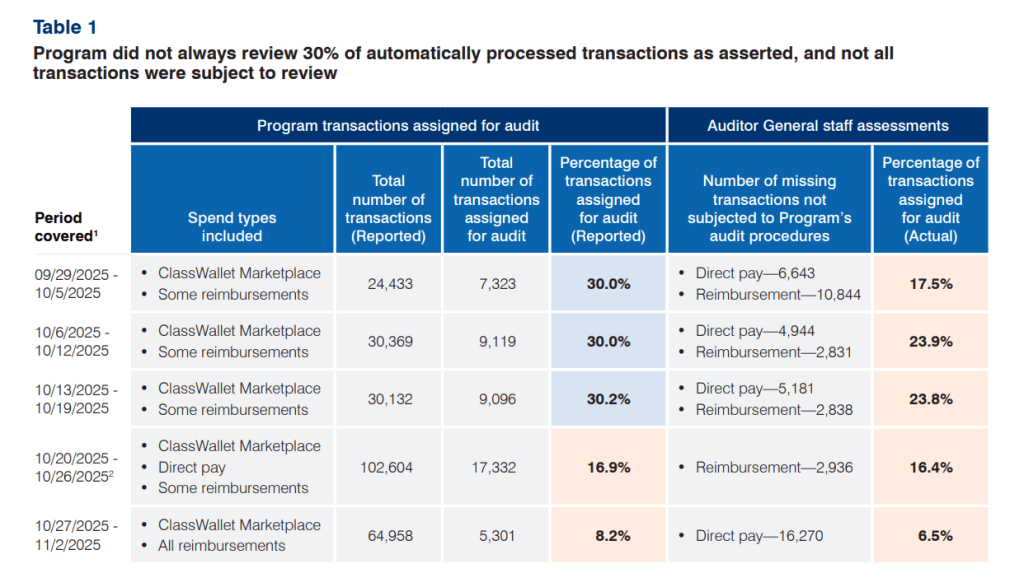
The ESA program claimed it randomly selected 30% of purchases under $2,000 to audit. In reality, as few as 6.5% of purchases were actually audited.
The ESA program’s idea of a “risk-based audit” was using a random number generator in an Excel spreadsheet to review approximately 25% of automatically processed transactions. ESA program officials later told auditors that they selected 30% of purchases to audit in a given week.
However, the Auditor General found that the percentage of these transactions audited was well below the targeted 25-30% range because certain types of transactions were being excluded. Over various two-week periods that auditors analyzed, the highest percentage of audited transactions was only 23.9%. The lowest was only 6.5% of automatically processed transactions.
This meant that unallowable purchases or transactions with missing documentation likely went unnoticed.
Arizona Auditor General’s Office
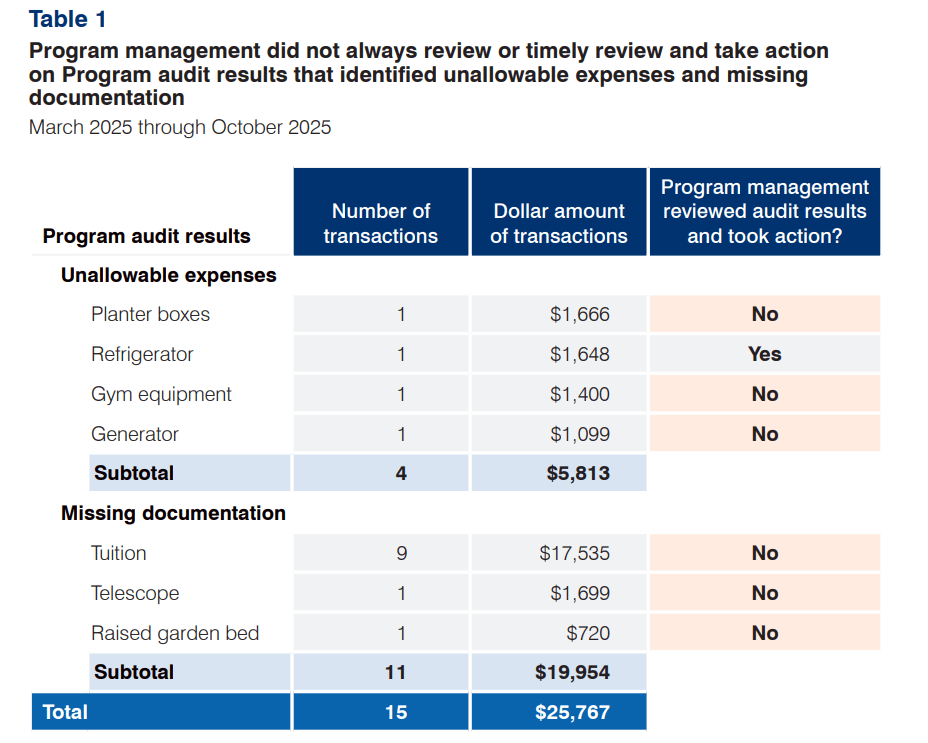
The ESA program often failed to conduct timely reviews of unallowable transactions or those with missing documentation, resulting in the potential misuse of $86,599.
Even when the ESA program identified that state funds were misused, it didn’t always follow up to ensure the funds were recovered.
Between March 2025 and October 2025, the Auditor General’s Office reviewed 15 transactions that ESA management had identified during its weekly audits. Four were unallowable expenses, and 11 of them were missing required documentation. Still, the Auditor General found that ESA program management failed to conduct a timely review of the audit results or take action — such as issuing a termination letter or reporting the account to the Arizona State Board of Education for collection — on 14 of them.
Management failed to take action to recover state funds misappropriated for planter boxes, a refrigerator, gym equipment, a generator, curtain rod brackets, a dashboard camera, a home security camera and bathroom accessories. It also failed to follow up on cases involving missing documentation for purchases of tuition — in one case, the provided “documentation” was a handwritten bank transfer payment receipt for $1,000 — as well as a telescope and a raised garden bed.
Even after these accounts were identified for misspending, they continued to spend the state’s money through the program.
Adding to this problem, the ESA program didn’t have “documented” internal policies to guide employees in manually reviewing and approving transactions, other than what is publicly available in the Empowerment Scholarship Account Parent Handbook. Formal training also wasn’t provided to employees to ensure they understand the documentation requirements when a new handbook is developed.
In its response, the Department of Education cried poor, saying it would document its policies whenever lawmakers deigned to properly fund its operations. On this score, the Auditor General appeared to agree, writing that “although the Program has received appropriations to fund its operations, the resources provided may not have been enough based on Program growth.”
Arizona Auditor General’s Office
Two families were put on a fast-track for expense approvals after meeting with the ESA program’s executive director.
ESA program executive director John Ward directed his former deputy director to add two families to a “high-risk/exclusion list” that allowed their transitions to be “manually reviewed and receive expedited payment and reimbursement processing,” according to the report. Instead, Ward said the former deputy director “erroneously” added these families to the conflict-of-interest logs, the report stated, which is how auditors discovered them.
Between July 2023 and October 2025, these two families submitted 266 transitions. The Auditor General’s Office found “unallowable expenses” totaling $4,031, which included transitions that lacked evidence of a tutor’s credentials and uniforms from a non-qualified school.
In its response, the Department of Education claimed that the two families were added to the list because Ward learned they were experiencing financial hardship. It also wrote that it “has concerns with how poorly this was presented in the auditor general’s report.”
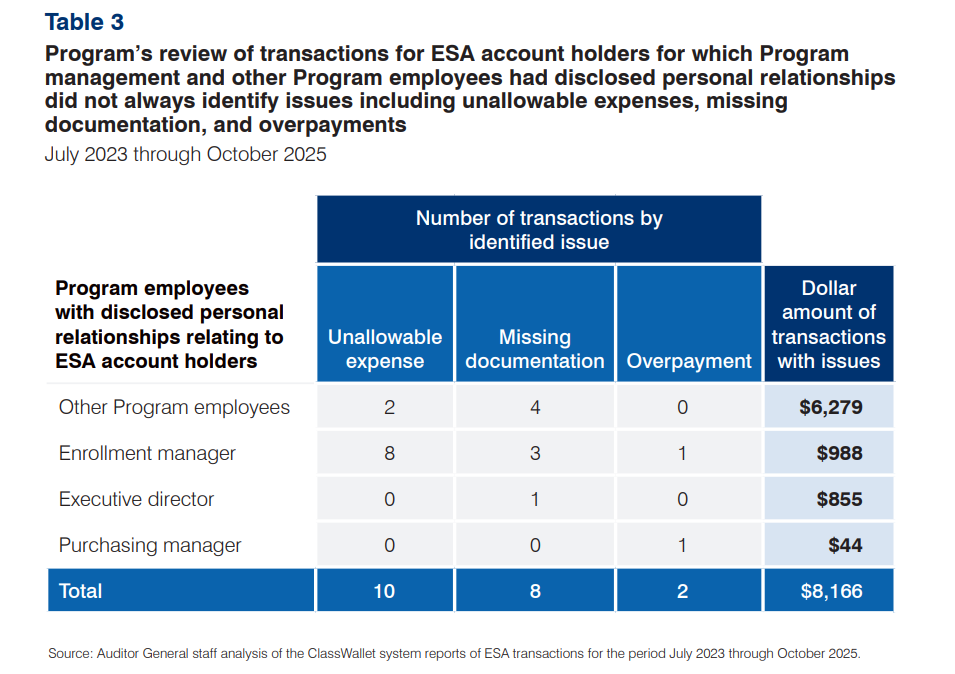
The Auditor General’s Office identified other potential conflict-of-interest issues. “Program management did not ensure $44,120 of transactions for account holders whom Program management and other Program employees had identified as having personal relationships within their employee disclosure statements received an independent review and approval to ensure they were allowable and followed program regulations,” the report reads. That included one instance in which an ESA program employee approved her own child’s tuition reimbursement. Also among those transactions, the auditor’s office found potentially unallowable expenses that included adult romance books, an Amazon Echo Show 5 and Nintendo Switch accessories.
In its response, the Department of Education took particular exception to the claim about allowing purchases of adult romance books, which were revealed to be by author Ana Huang. “To be clear, the ESA manager did not purchase these books,” the education department wrote. “To attempt to impugn her because of purchases by an ESA holder who is related to her in some fashion is very low.” The department also claimed that the Auditor General’s Office had no relevant training to decide what books are and aren’t allowable. “We do not believe there are any ESA families clamoring to have the auditor general decide which books their children should read,” the education department wrote, adding that “auditors are trained in numbers, not in principles of censorship.”
Arizona Auditor General’s Office
5. The ESA program failed to identify problems in 34% of purchases in a sample collected by the Auditor General.
The Auditor General’s Office pulled 63 expenses for a closer look, finding that the ESA program failed to identify issues in 25 of them. Those issues included 11 instances of missing documentation, two indications of possible misuse, seven instances of missing accreditation, three instances of overpayment and two unallowable expenses.
In one of those instances, an ESA employee “initially rejected” a tutoring reimbursement transaction due to “insufficient documentation.” The account holder “resubmitted the transaction with the original documentation,” and a different ESA employee missed the documentation problem and approved it.