

Provided by Ryan Dent

Audio By Carbonatix
Yes, it’s a dry heat. But it’s a deadly one too.
Phoenix keeps breaking heat records right and left. This year we hit 100 degrees in March multiple times and had the earliest triple-digit day in the city’s history. Higher temperatures mean more heat exhaustion and heat stroke—and a greater need to combat them. That’s what co-directors Nita Blum-Reddick and Jonathan Pickett sought to document with their short documentary film “A New Inferno,” recently released by the New York Times Op-Docs. Pickett and Blum-Reddick, who is a professor at Arizona State University’s Sidney Poitier Film School, followed a team of Phoenix firefighters working to save people suffering from heat stroke with a new method — an ice immersion bag. The protocol seems simple: put people who are overheating into a bag with ice to cool them down. Yet, this new technique is only now gaining traction.
I spoke with Blum-Reddick to find out more. Our interview has been edited for brevity and clarity.
Why heat? What drew you to the issue?
It’s an invisible force, right? It’s not something you can see like a hurricane or tornado — the destruction that it can cause. I found it a nice challenge to try to go after this invisible threat and see what it actually does to our community. There’s no dramatic storm front or wildfire coming over a hill.
What also interested both Jonathan and I was this enormous system of care that responds to it. This largely invisible force, which I like to liken to David and Goliath. There’s this huge thing happening, whether you believe in climate change or not. And seeing how we put this Band-Aid on a bullet wound with this collective force of dispatchers and firefighters, EMTs, hospitals, outreach workers, cooling centers — it just lent itself to something that both Jonathan and I were very excited to try to unpack.
Provided by Daniel Reddick
You chose to focus on the Phoenix Fire Department. Why?
We had a couple of ideas. One was to follow HVAC workers in the summer. That’s an emergency. When your air conditioning system goes down and it’s 115 out, your house is going to heat up fairly quickly and create a danger for you, your pets, your plants, your kids. That was one idea.
Jonathan and I both heard an NPR story a couple of years prior. We did not know each other, but we heard the same story, and it stayed in both of our minds. It was about the ice immersion protocol and how it was a game changer for people experiencing heat stroke. So when we connected, we both were like, this could be a story. So we reached out, and they were open arms. They wanted more people to understand that the protocol is really effective and not being utilized. Their goal is to make sure other departments that are dealing with heat can benefit. For instance, the Palm Springs Fire Department. They saw our film and are in talks now about trying to utilize the technique
What was it like getting access?
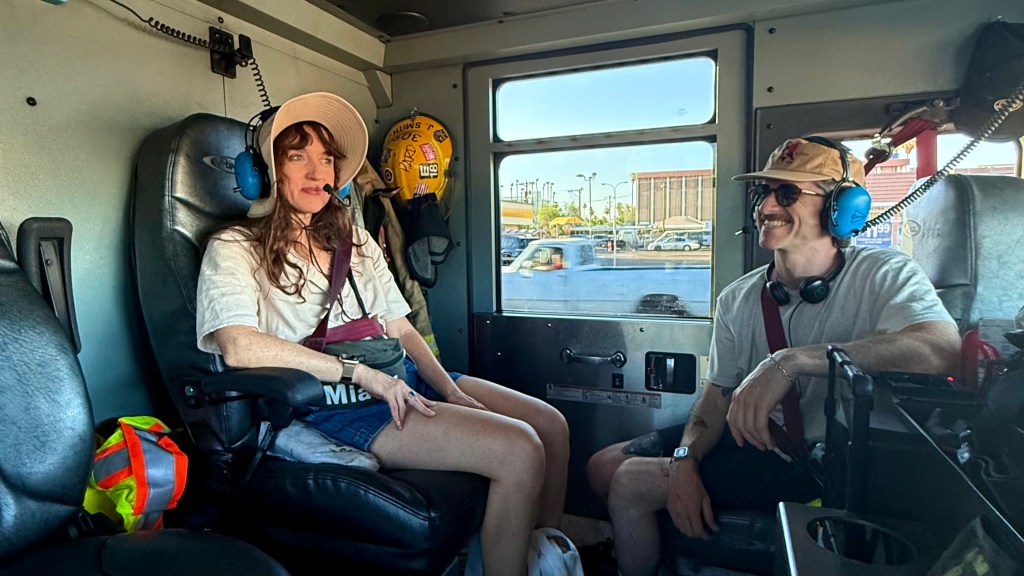
As documentary filmmakers, it’s all about access, right? If you get it, that means you’re going to have a film. If you don’t, then you don’t. It was really humbling for us to come into these people’s worlds, into the fire station. They’re there for three days at a time. They sleep, eat and basically live there. It’s like going into someone’s house. We were given access to Station 18, which is one of the busiest fire stations in Maricopa County. They just get slammed there. They welcomed us with open arms. They explained things to us as they happened. They wanted us to see what they do because they’re really proud of what they do. And they should be. I was in awe with the care that the team we followed gave to anyone. It didn’t matter your economic background, where you came from, the color of your skin. They were very kind. We watched them deal with people who were in really dire straits. Their station gets the area of I-17 and 23rd Avenue. There’s a lot of unhoused folks there and sex workers. There’s a lot going on.
The one part that was a little hairy was with St. Joseph’s Hospital and Medical Center, which is a partner in the ice immersion process. We had to be very careful because of HIPAA compliance. They really wanted to show how the doctors were so excited. They wanted to show how many people are in and out using this technique, to show the urgency and the need. But there are a lot of laws in place to protect people in hospitals and their privacy, and so we weren’t able to film the emergency room. However, they gave us access to their training facility, and that’s the scene you see in the film. That was really fun to shoot because it felt like we were filming The Pit or something.
How long did you work on this?
We were out shooting for the entire summer in 2025, on and off. We started in the beginning of July and we wrapped sometime in September. It was one of our hotter summers. We were shooting one day and it was the hottest day of the year. It was like 118 degrees, and we were riding along in those trucks with them.
What was it like to shoot in the heat? What precautions did you take?
Jonathan would love to answer this question because he’s from San Diego. I live here in Phoenix and so does our crew. We were expecting the heat to be a little rigorous. We’ve all filmed outdoors in the heat in the summer. But my co-director Jonathan, we had to take great care with him because it wasn’t for the faint of heart. He was used to San Diego weather.
I’ve filmed a bunch outdoors in the summer, and it’s dangerous. It will sneak up on you. We came into it knowing that we were going to rotate people in and out. The firefighters, the EMTs, they’re trained for this. But filmmakers, we’re not trained for these circumstances. So we basically decided to do shifts and make sure everybody was hydrated. It was challenging.
Was the heat your biggest challenge?
Anytime a news agency or filmmakers go on a ride-along, they expect this big story, right? We wanted to see an ice immersion happen in the field because that was the story we were telling. Everyone was like, “Oh, you’re gonna have the rider’s curse.” Which means you’re never going to get it. You’re going to sit in the station for hours, and the call is never going to come in. The first day we filmed, we had a bunch of cameras rigged on the fire truck. We were just shooting exteriors of the fire truck riding around. We didn’t even have a sound person there, and so, of course, Murphy’s Law. Our cinematographer was riding along with them monitoring the cameras and the captain just turned and said, “This is going to be an ice immersion, and you better get ready.” And Ryan, to his credit, was very calm and cool about it. He had half a battery left in a little mounted camera that wasn’t his usual setup, and he was like, “Okay, well, this is the reason we’re here to tell the story. So I better get this right.” He grabbed the camera off the rig and he got it to a place where he felt comfortable filming.
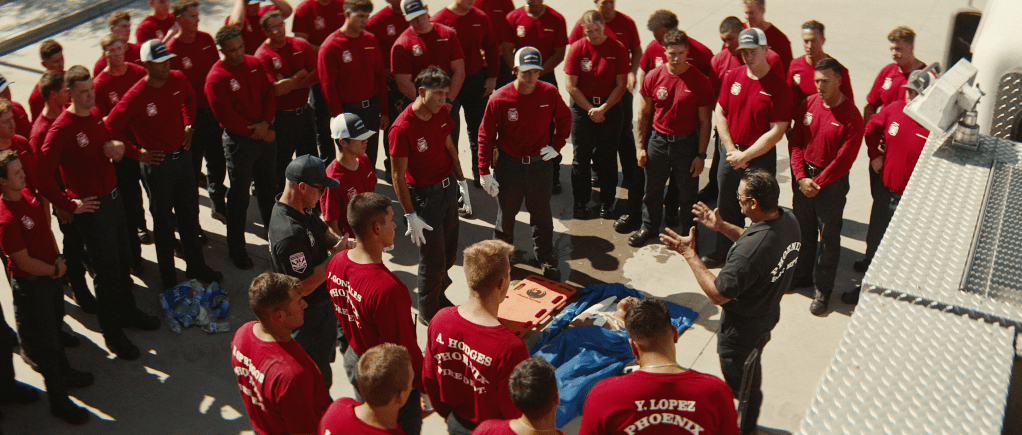
The scene towards the end of the film with the ice immersion is that footage. It was a big surprise that it was in focus and that we were able to use it. That was the only ice immersion we got the entire summer, which was a big deal. A lot of news crews had gone on ride-alongs but they didn’t get an ice immersion. They wanted to buy it. But we decided we would keep it because it was probably going to be the biggest scene in our film and the most meaningful.
I actually did a story the other week where a woman was put in one of those bags. She survived.
That’s something that didn’t used to happen. The department and the EMTs, they told us that before the protocol the big problem was that they had no tool. Like if someone has a gunshot or is overdosing, they have different ways to address it and have a good shot at saving someone’s life. But before this bag — which seems so archaic, right? It’s just a bag with ice — there was no legitimate way of saving someone’s life when they had an internal temp of 107 or 108. There was no way to get them to walk out of the hospital neurologically intact. Morale was low when they got a heat stroke victim call because it was like, “How are we going to save this person’s life? We’re going to put cool rags in their groin or armpits. We’re going to give them an IV.” But it just did not produce the same results that throwing someone in an ice immersion bag does, which rapidly cools their temperature down and gives them a fighting shot at walking out of the hospital alive. The man put in the bag in our film was able to leave the hospital, which is crazy because he was out there for hours baking.
Provided by Ryan Dent
There was one man in the film who you really zeroed in on, Jason. How did that happen?
There were three guys who we honed in on, who were always working the same shift together. Jason happened to be this character, this person who really shined for us. One of the first days that we were out with him, I actually teared up watching him work with a man who was unhoused on the street who refused to get care. Jason was so patient. He just sat there for like 15, 20 minutes in the heat trying to get through to this guy. And I just was like, wow! I watched people drive by on Camelback ignoring these people who lay on the street. But this is Jason’s job: to make sure these people who are forgotten by society are OK. And that just got me in tears.
We didn’t want the film to be deliberately, relentlessly grim because there’s some humor, lightness, downtime and camaraderie. Those moments aren’t there to distract from the seriousness. They reveal that the people doing this work are full-on human beings — Phoenicians. So it was nice to have these moments in the film of them ribbing one another, just like hanging out and driving to an emergency scene after eating jalapeños. That gets me every time. Like, “Oh, it’s really hot out here, but those jalapeños didn’t help.”
Is there anything you think I should have asked you?
I didn’t fully understand how elaborate this response network was just by being a citizen and driving around and pulling over for fire trucks when they drove by with their sirens. Having access to it — seeing the call center, seeing the cadet training, seeing Station 18 and St. Joe’s, and how everyone works together — I’m like, wow, this is happening under our noses. Unless you’re part of it, you wouldn’t even know it exists. And that discovery really became part of the film.
It is a local story, but it’s also this larger story because Phoenix is like a canary in a coal mine. I hope that people take away from the film an understanding of the seriousness of extreme heat, and of the extraordinary network of people that are responding to it. There are still helpers in the world. It’s about much more than climate. It’s about the care that we give one another.