
Sam Eifling

Audio By Carbonatix
Karen Fiorito’s billboard art stands high above the Grand Avenue Arts District in downtown Phoenix.
On one side, the “Swamp King” piece depicts Donald Trump as a dissolute bog monster, swimming in the chaotic filth of his own bluster and graft.
The other side of the billboard is much simpler. It has no words, yet it speaks volumes.
Two photos stand side by side. On the right, robed and masked members of the Ku Klux Klan march menacingly in the night. The date reads 1922. On the left, a small group of people clad in uniforms, helmets and face masks stare awkwardly at the camera. Their uniforms reveal them to be Immigration and Customs Enforcement agents. The date reads 2025.
Ashley Macias
Fiorito, who lives in Southern California, installed that side of the billboard in September, before ICE agents in Minneapolis killed Alex Pretti and Renee Good, before ICE announced it planned to stick detention centers in Surprise and Marana, before thousands marched on the Arizona Capitol to protest the escalation of ICE activity in the Valley.
It was the harbinger of a wave of anti-ICE art that’s been popping up around the Valley for months.
“That’s why I love billboards,” Fiorito says. “People go to certain galleries or certain shows because they want to see certain work, but you don’t always reach everybody that way. You can put a message on a billboard and people hate it or love it.”
Jennifer Goldberg
Not our first rodeo
In 2010, when the people of Arizona were suffering under SB1070, the “show me your papers” law that gave law enforcement officers the power to ask people they stopped for other reasons to show their immigration papers, we made art.
As Phoenix New Times reported in a 2020 retrospective, “the impact (of SB1070) on Arizona’s collective psyche is evident in the culture here. It’s present in the works of artists … who protested 10 years ago, and all those who’ve made works addressing immigration, racism and border politics in the decade hence.” Many of these highly detailed protest signs — such as a cartoon of the judge who presided over the federal case against Maricopa County for unconstitutional policing beating up infamous Sheriff Joe Arpaio — still make common appearances at community meetings and protests.
And now we’re here again, back to innocent people fearing for their freedom and their lives, back to anger and grief and frustration and back to artists expressing what so many Phoenicians are feeling.
ZMoney
In the past year, Phoenix-area rapid response groups have sighted ICE more than 100 times across the Valley. The agency’s true presence in the Valley is likely much larger, and it’s unclear how many Arizonans the agency has picked up in the last year. But in early morning raids, agents have grabbed Phoenix-area painters and construction workers at gas stations, worksites and Home Depots. Agents have teamed up with Pinal County Sheriff Deputies to pull over and detain anyone in a work truck in San Tan Valley. Agents have brought chaos in quiet, suburban neighborhoods from Avondale to North Phoenix as they busted down doors of homes to arrest undocumented immigrants. Agents have stood outside of Phoenix immigration court to arrest undocumented immigrants who’d dutifully shown up to scheduled court hearings. And agents have raided businesses, including Sakura Sushi, taco truck chain El Taco Loko and Zipps Sports Grill locations that netted nearly 40 arrests.
Shellshaker
‘The algorithm won’t save you … but your community might’
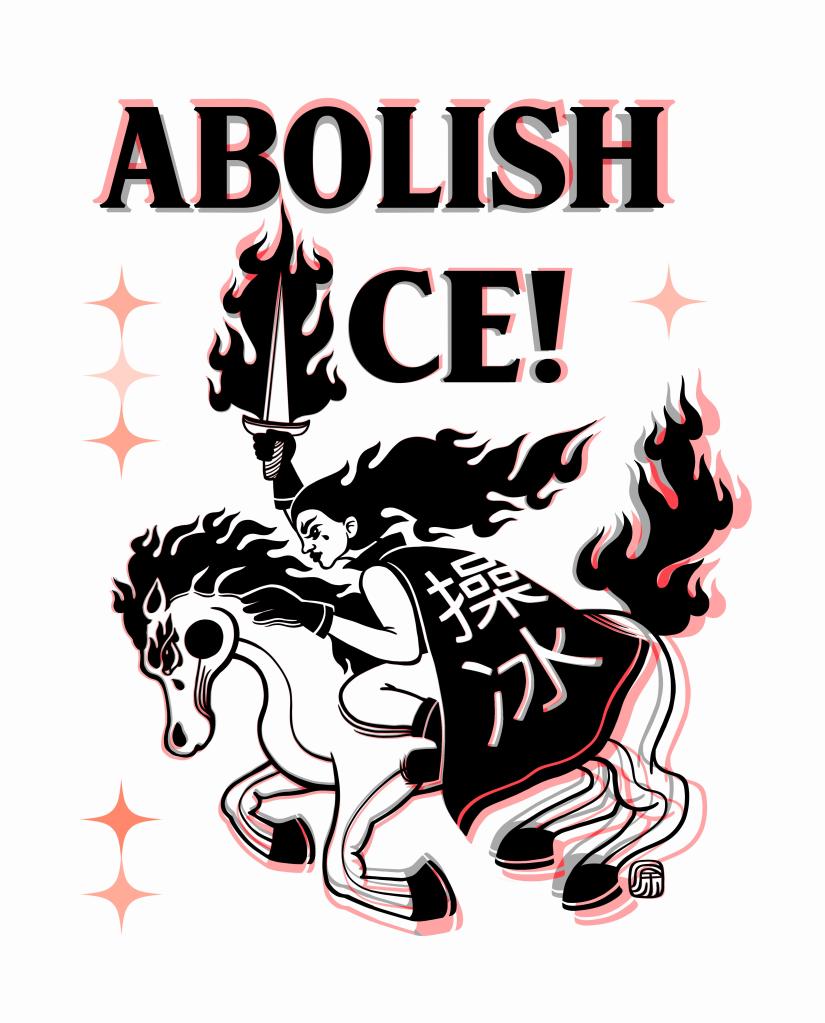
Artist Shela Yu, who works under the name Shellshaker, created a poster in January that represents her feelings about ICE and her Chinese heritage. A woman warrior carrying a flaming sword rides into battle on a charging horse. The bold lines evoke power and rebellion. The poster proclaims “ABOLISH ICE,” with the sword standing in for the I in ICE. (An alternate version reads “FUCK ICE,” as do the Chinese letters on the woman’s cape. Both versions are available for free download on Yu’s Instagram account, @shellshaker.)
“I’ve been thinking a lot about the power of our collective anger and grief,” reads the caption on Yu’s Jan. 26 Instagram post that debuted the poster. “Don’t let it numb you. Don’t let it jackknife you into submission. Don’t let it harden your heart. … Scream if you have to. Cry. Shake. Dance. And try not to isolate. The algorithm won’t save you… but your friends and community just might.”
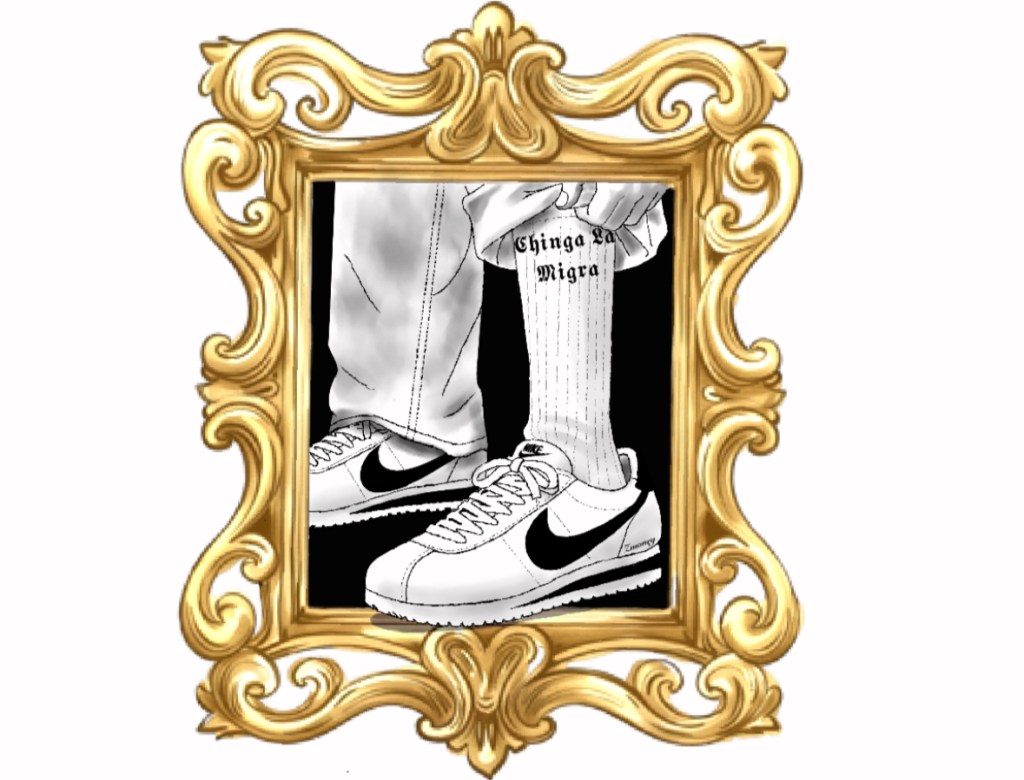
In “Sock Check,” a piece by Zandria Guzman, who works under the name ZMoney, a man lifts up his pant leg to reveal the words “Chinga la Migra” (“Fuck ICE”) on his sock.
“This piece was inspired by the ‘sock check,’ a gesture I grew up seeing/hearing where someone would lift their pant leg to show their socks as a way of expressing style, identity and how ‘down’ they were with their community,” Guzman writes in her artist statement. “By connecting this cultural gesture with a political message, the piece represents how Chicano pride and resistance can show up in everyday expressions. … For me, art is a way to spark conversation and stand in solidarity with my community.”
“I don’t make protest art for authority, but for victims of it,” says Eric Lindquist.
Eric Lindquist
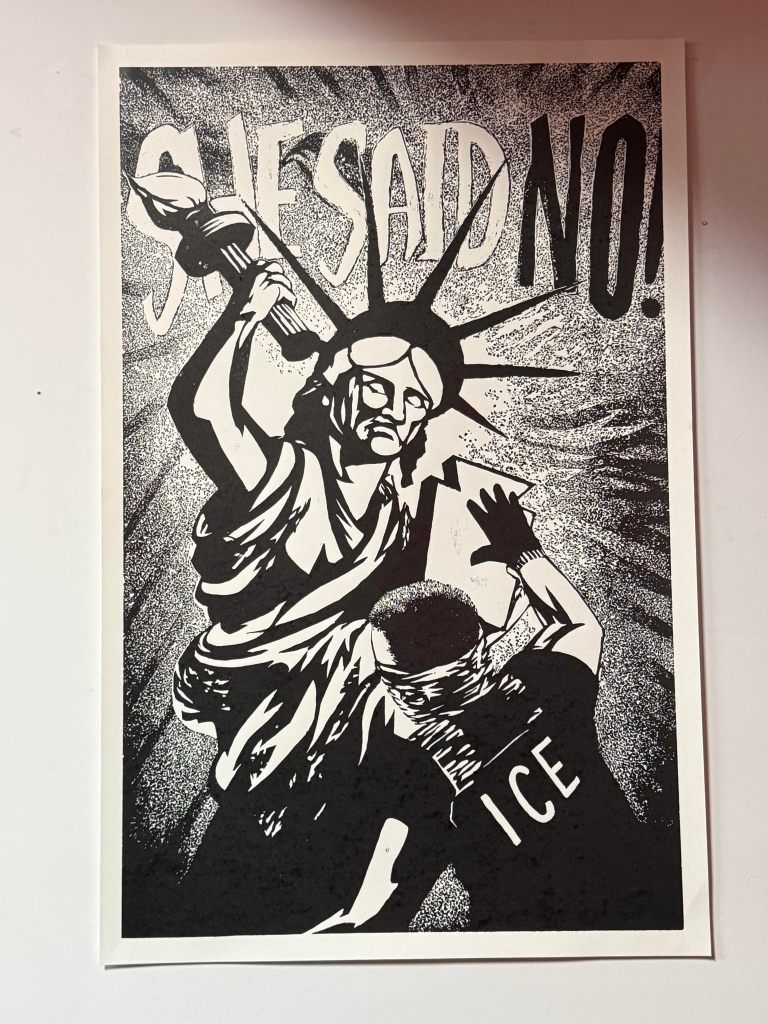
At the intersection of women’s rights and ICE raids is a print by Eric Lindquist based on a woodcut he made. The Statue of Liberty towers over an ICE agent, ready to flatten him with her torch. The print reads: “SHE SAID NO!”
Lindquist makes art to show sympathy and solidarity.
“I hand out prints knowing that each piece of paper will become a story between like-minded people, and each of them will be reassured of their certainty that every aspect of (this) policy is wrong,” he tells New Times. “I don’t make protest art for authority, but for victims of it.”
The artist known as Fancy Dress began dotting downtown Phoenix with a series of ceramic mosaics in 2019.
“I just wanted to express something fun and vibrant. But then, all this madness happened,” he says.
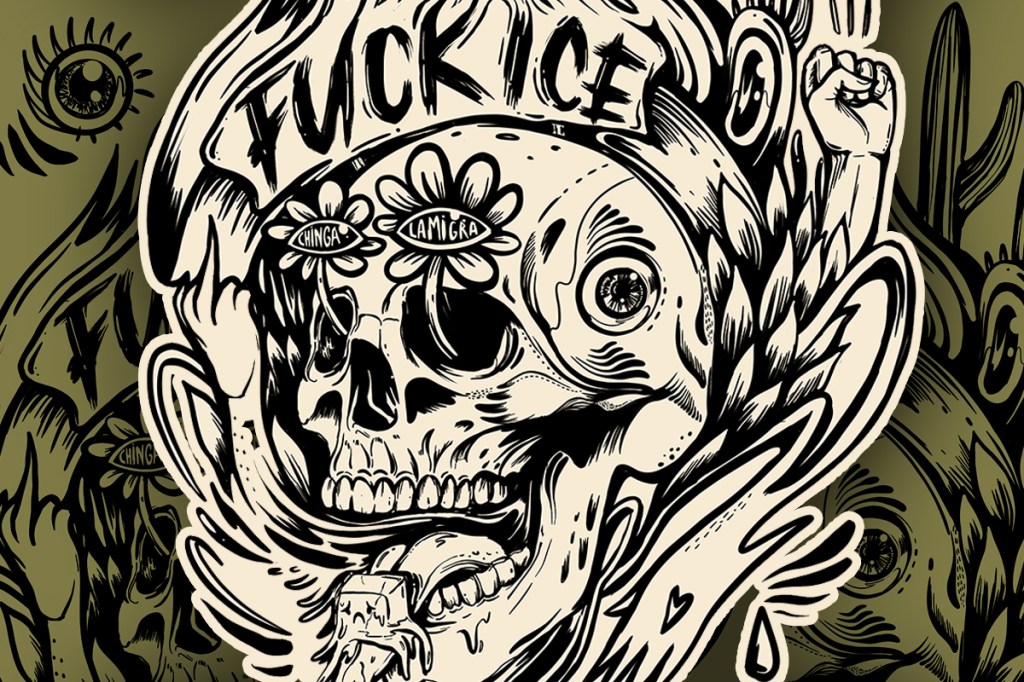
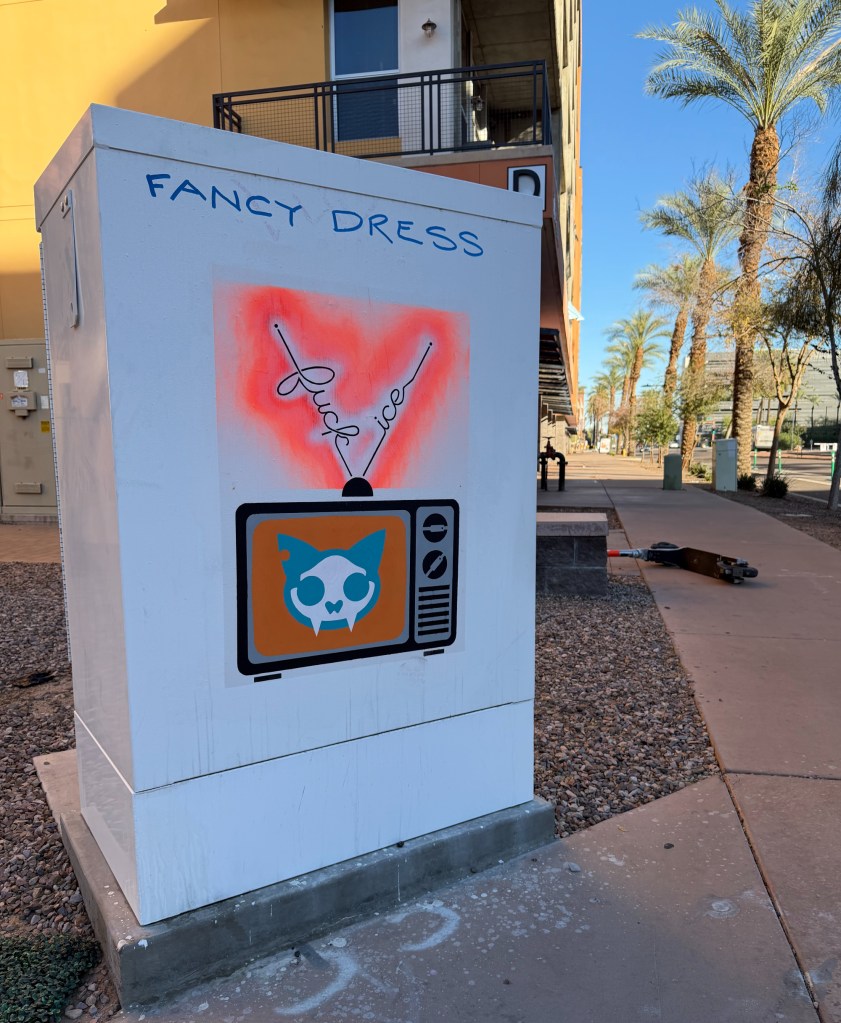
Today, he makes his mark on the city with his signature Cat Sūp cat skull image and the slogan “FUCK ICE,” which he prints and tapes to light poles, paints on walls and sticks on buttons.
“As a public artist, what I can do is highlight the interminable douche-baggery and laughable un-coolness of Trump and his three-ring circus of backwoods connivers,” he tells New Times. “I am so absolutely disgusted by these Tiger King Fascists that you’re gonna see Cat Sūp all over Phoenix saying ‘Fuck Ice,’ ‘Fuck Nazis’ and every variation in between until these degenerates are no longer in power.”
Fancy Dress
Creative power to the people
Last year, filmmaker and artist Ray Kennedy was attending a Know Your Rights workshop hosted by Organize Solidarity when she began to ponder a fundamental question.
“I was thinking, ‘In this situation, what is my place? … Where can I be helpful? How can I be of service in scary times?’ My brain kept coming back to art,” she says.
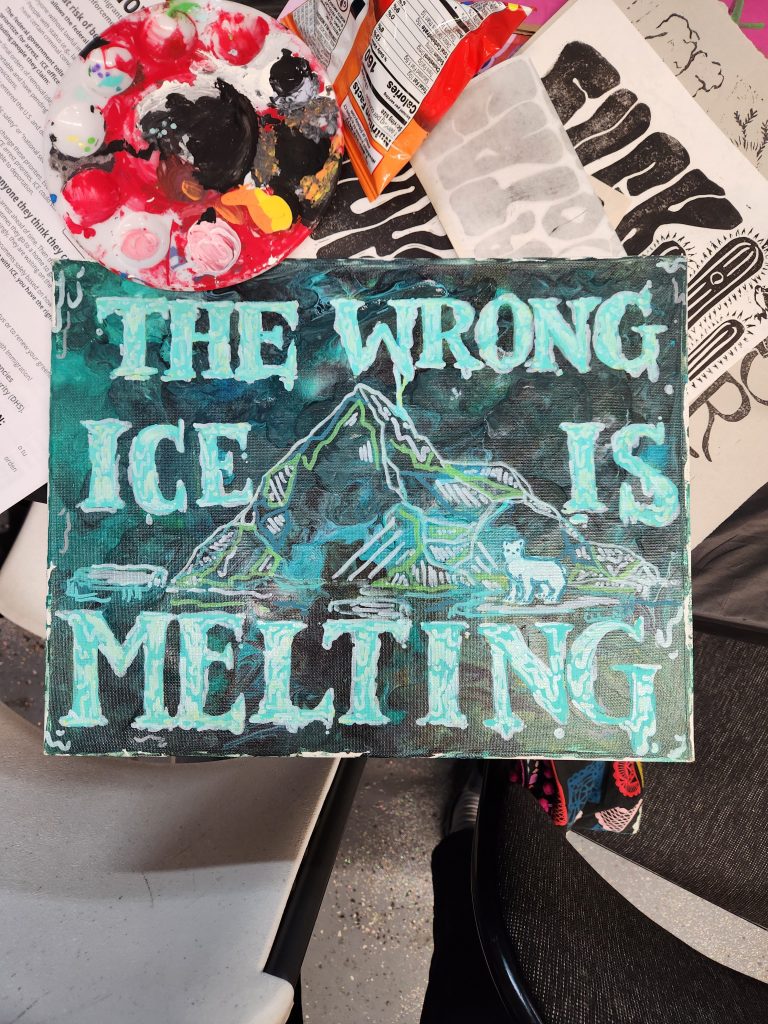
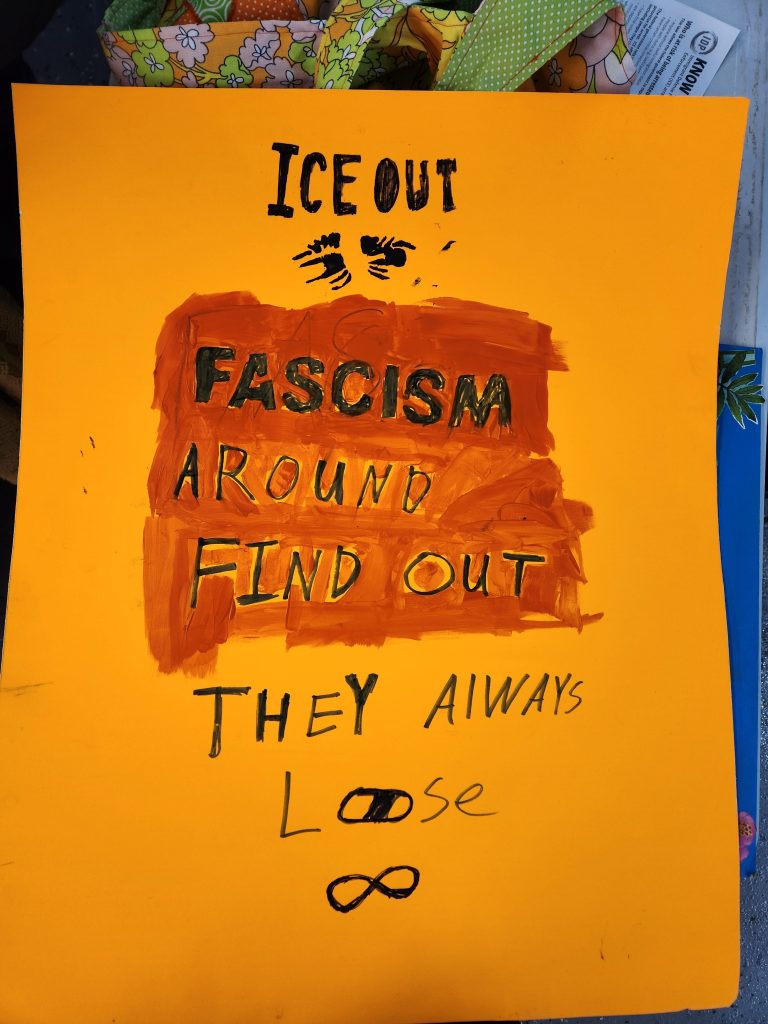
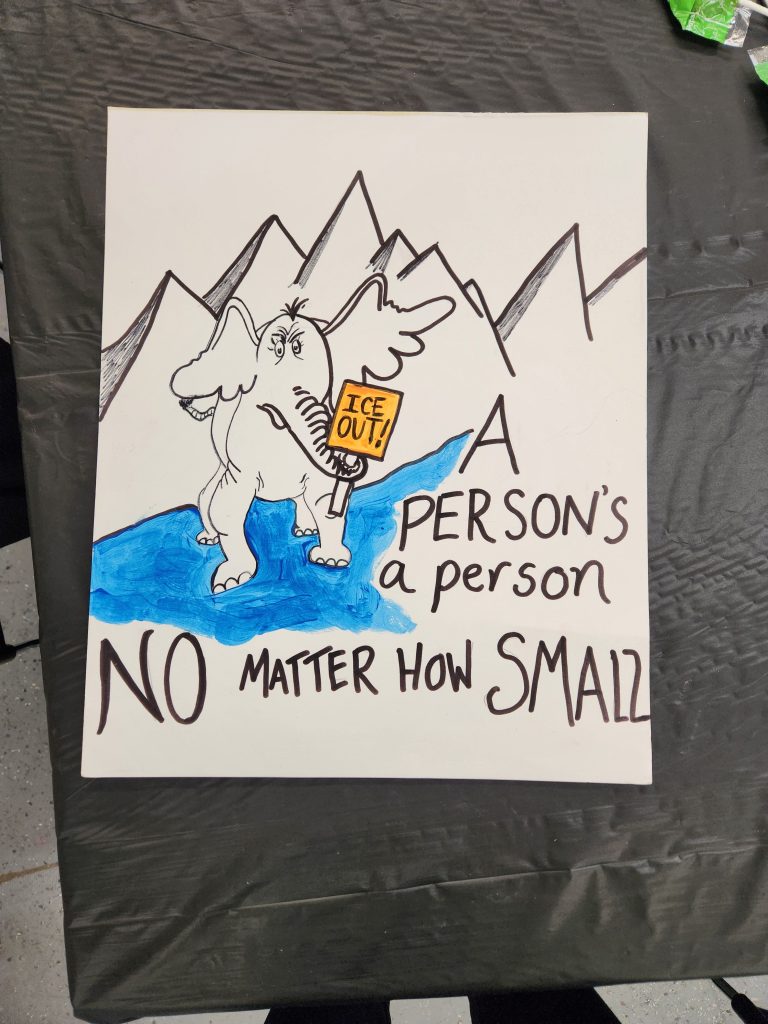
Since July, Kennedy has hosted artistic workshops at Rocket Space Gallery at Danelle Plaza in Tempe as part of Tempe Arts and Music Coalition’s programming. Some of the workshops focus on zines or poetry with no prescribed topic, while others invite the community to come and make protest posters. (The next workshop will be held from 6 to 9 p.m. on April 29 and is free to attend.)
The sessions draw kids and senior citizens, folks of all genders and races.
“The people who do attend the workshops are looking for community or looking for ways to help in the face of fear,” Kennedy says. “I’ve gotten a lot of feedback from people coming into my workshops that that is how they feel. They feel powerless, and so I’m also offering a place for people to feel that they have a little bit of power. So it’s bringing people together to get to know each other more, using art as a way to self-regulate difficult emotions.”
Ray Kennedy
Ray Kennedy
Ray Kennedy
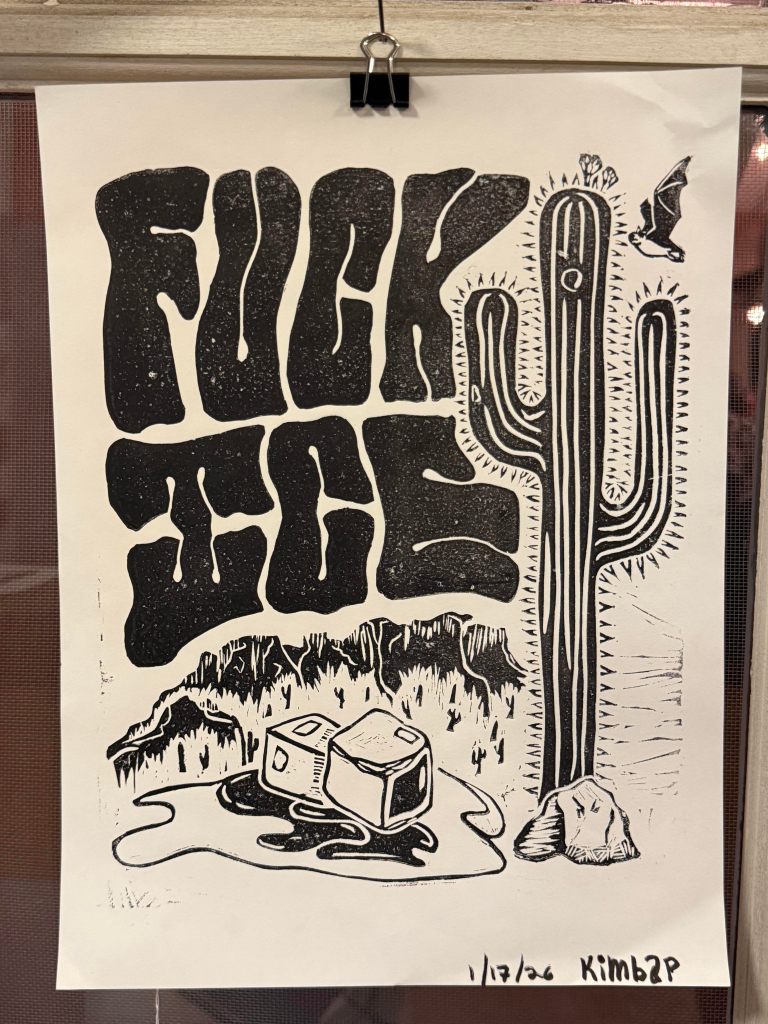
The posters, made by ordinary people in a small community artspace, express hope and rage, strength and humor. “Fascism Around, Find Out,” reads one. “When ICE Melts Hope Blooms,” declares another. “Abolish ICE Forever.” “Immigrants Fed You Today.” “ICE Melts Under Resistance.”
“I witnessed people’s anger coming out in a really wonderful way,” Kennedy says. “The phrases they were putting on their posters, the conversations they were having with each other … Protests can be emotional in a lot of ways and one of the ways that often shows up is anger.”
She speaks of the anger, but also “the grief and heaviness that can sometimes come up in workshops. … I think that’s another really brilliant thing is the way we can grieve through art and hopefully move through the grief to a point where it’s more manageable, to a place where joy and hope seem more accessible.”
And the workshops, and the art that comes out of them, and all art, help to make people feel a part of the community during terrifying and dark times.
“Art is one of the ways we can feel a lot less lonely in the world,” Kennedy says. “Artists often fill this need in the community for the type of bond that’s like, ‘I’m in pain, you’re in pain in a similar way and because we know that, we’re together in it and it maybe feels like we can share the load.’”
Fiorito concurs.
“Fostering a sense of community is really important and I think everyone can do that in their own little circle,” she says. “Everyone has a role to play. It could be very small or very large. Not everyone’s going to have the ability to put up a billboard, but you can make a stenciled poster or you could give to a food bank or take some groceries to your neighbor, and that’s just as important.”