
Mario Tama/Getty Images

Audio By Carbonatix
APS will no longer cut off customers’ electricity when temperatures spike above 95 degrees, no matter the time of year.
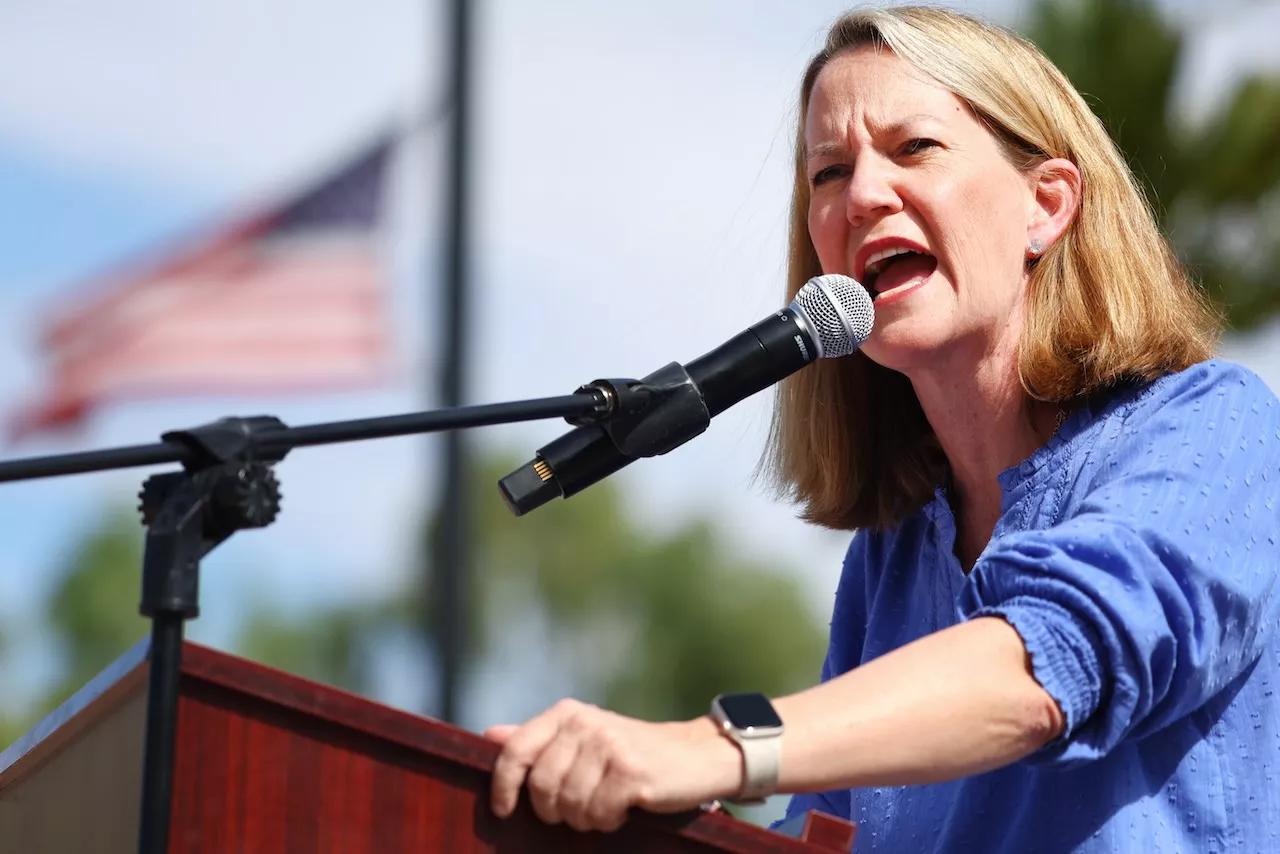
On Wednesday, Arizona Attorney General Kris Mayes announced a $7 million settlement agreement with Arizona Public Service over the utility’s account disconnection policies during periods of high heat.
The utility agreed to stop turning off power to customers for nonpayment on days when the temperature is 95 degrees or higher. (APS already had a disconnection moratorium period, but it covered only part of the calendar.) It will also pay $2.75 million in monetary relief, provide $1 million in credits to eligible consumers with outstanding balances and invest $3.1 million in “consumer protection improvements.”
Mayes’ announcement also noted that APS’s payments “must be funded solely through APS shareholder funds and may not be recovered from ratepayers through future rate cases or surcharges.”
The settlement comes after 82-year-old Kate Korman died in her home in Sun City West on May 19, 2024, after APS disconnected her electricity. Korman owed $500 when the utility disconnected her electricity six days earlier. Temperatures were in the high 90s that week, reaching nearly 100 degrees the day she died.
“No Arizonan should be put at risk because they cannot afford their electric bill,” Mayes said in a statement. “This settlement ensures that APS will no longer disconnect power based on the date on the calendar alone — if temperatures are dangerous, the power stays on.”
APS did not admit liability or fault in the settlement, Mayes said at the press conference on Wednesday morning. However, she still felt the utility was responsible.
APS had a voluntary policy in place not to disconnect service if temperatures were 95 degrees or higher, Mayes said, but discontinued that policy three days before cutting off power to Korman’s home. And while APS said it gave Korman multiple notices that she would lose her electricity if she didn’t pay her bill, whether or not they followed their own protocol for when and how to disconnect service during high heat isn’t the issue to Mayes.
“It was about whether their protocols are adequate to keeping people alive in the summertime,” Mayes said.
Speaking to Phoenix New Times, Korman’s sons — Adam and Jonathan Korman — applauded the settlement.
“The changes in policy that we wanted to see are happening, at least to some degree with APS,” Jonathan said. “There’s more on the table, but today’s a very good day.”
When they realized that their mother’s death was a “part of a pattern rather than a freak accident,” Jonathan said, he and his brother decided to fight for a policy change to prevent similar tragedies. They said they’re grateful to Mayes for doing what was beyond the power of ordinary citizens.
The settlement is the bare minimum, they said. They hope the 95-degree threshold is reevaluated at some point because it is still very hot, and they want to see more money allocated in the future toward helping people pay their bills. They also hope the changes are adopted by other utilities statewide.
“The AG was able to force APS’s hands to do some things,” Adam said, “but it’s more than a problem with one company.”
What the brothers both really want is for APS to take responsibility for their mother’s death.
“APS has still refused to admit any wrongdoing,” Jonathan said. “And they killed my mother.”

JHVEPhoto/Getty Images
Pushback from APS
APS spokesperson Jill Hanks said that the utility has and will continue to find solutions for customers who can’t pay their bills. She pointed New Times to a press release announcing expanded programs for heat relief and emergency contacts. The release also disputed Mayes’ comments.
“Developed as part of a consent judgment with the Arizona Attorney General’s Office, these program enhancements are in line with the company’s commitment to put customers first. APS strongly disagrees with the Attorney General’s characterization of the company’s policies, programs and record, and denies any wrongdoing,” the press release reads.
In her press conference, Mayes also laid blame squarely on the Arizona Corporation Commission, which regulates utilities, and the state legislature for not enacting stricter laws and regulations. Mayes also accused the commission of not conducting an appropriately thorough investigation of its own into APS’s policies after Korman died.
In the aftermath of Korman’s death, a corporation commissioner feuded on social media with one of her sons, saying it was unreasonable to ask utility companies to monitor daily temperature highs. Mayes, a former corporation commissioner herself, had advocated for a temperature-based, and not a calendar-based, system.
“It should not have taken a lawsuit by my office and news reports to get us here today, but that is how that happened,” Mayes said. She noted Arizona is one of the hottest states in the country. “Protecting Arizonans from having their power cut off in life-threatening heat is not a novel or complicated idea. It is a basic obligation of utility regulation,” she said.
In an emailed statement, ACC Executive Director Douglas Clark said that there is nothing in the settlement that contradicts the commission’s investigation.
“It is notable that nothing in the consent agreement contradicts the Commission’s own findings,” the statement read. “We have investigated this matter and found no rule violation. If APS wants to spend additional shareholder funds, it is free to do so. The consent agreement makes it clear that this payment is outside the regulatory framework and will not be passed on to ratepayers.”
Korman is not the first high-profile heat death from an electricity shut-off. Seventy-two-year-old Stephanie Pullman, also of Sun City West, owed just a few dollars to the utility when she died on a 105-degree day in September 2018. Pullman’s death prompted an overhaul of APS’s disconnect policies in 2019 by the corporation commission, which established new rules prohibiting APS and other utilities from disconnecting past-due residential accounts between June 1 and October 15.
However, temperatures in Phoenix often reach the 90s and higher outside those dates. Just this March, Phoenix experienced a heatwave with record high temperatures in the hundreds, around 30 degrees hotter than normal for that time of year.
Maricopa County confirmed the first heat death of 2026 in early April.
There were 430 confirmed heat-related deaths in Maricopa County last year, according to the county’s Heat Surveillance Dashboard. This is down from 608 in 2024 and 645 in 2023.
As part of the settlement, APS must reach out to other utilities across the state and urge them to adopt a temperature-based moratorium on disconnections. While the terms apply only to APS, Mayes said that she hopes the other utilities will follow suit — because someone else will die if they don’t.
“Those utilities that are not following the 95-degree hold policy are on notice,” she said. “They are on notice that anything other than 95 degrees is dangerous and can kill people, and if somebody dies on their watch with a date-based policy, we’re coming after them too.”