
Matt Hennie

Audio By Carbonatix
According to the 2026 Point in Time count of the Valley’s homeless population, more than half of Phoenix’s homeless population is sheltered, meaning in an emergency shelter, transitional housing or a safe haven program and not “on the streets or other place not meant for human habitation.” However, the number of homeless people in the city — and in Maricopa County as a whole — has gone down only slightly.
According to the count, conducted on Jan. 26 and released this week, 4,041 homeless people in Phoenix slept in shelters rather than on the streets, a 15% increase from 2025. In all, the number of homeless people in Phoenix, both sheltered and unsheltered, remained steady, with a 60-person increase to 7,335 in 2026.
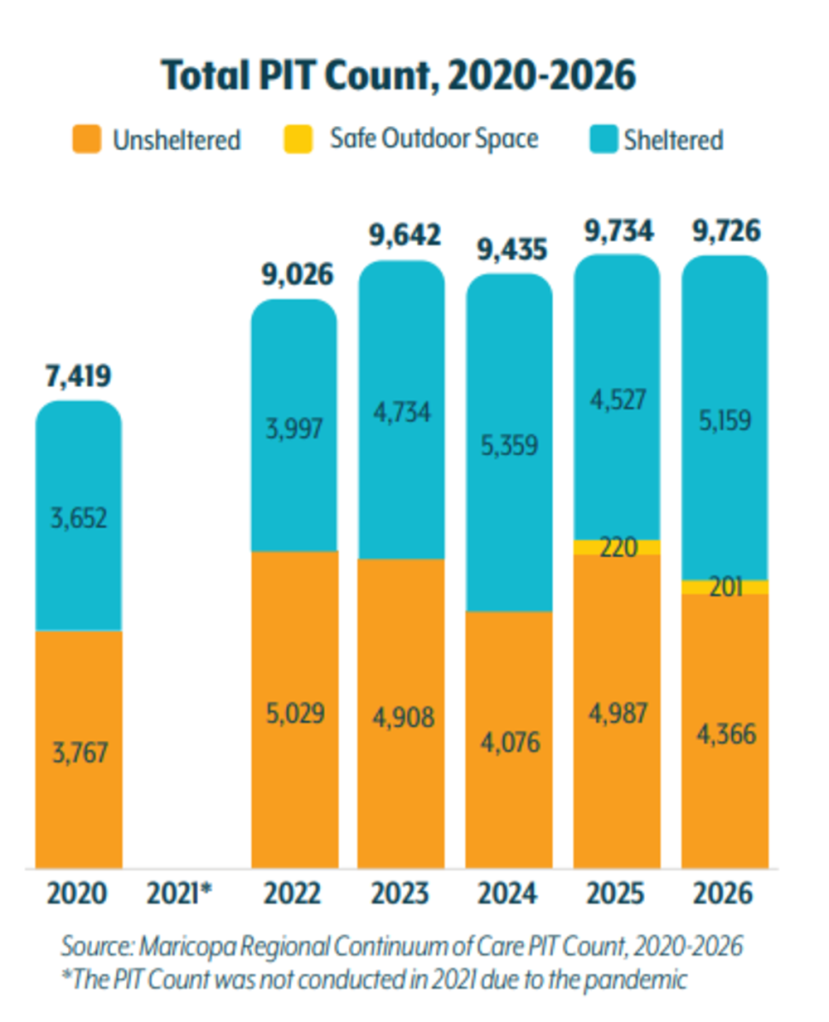
In Maricopa County, the homeless population declined by only eight people, to 9,726. That’s the second-highest number of homeless people tracked by the PIT count since it began, behind only the 2025 total.
Though the homeless population has grown, Phoenix says it’s a sign of progress that a majority of unhoused individuals were sheltered.
“We are pleased that the resources that we have put in place over the last four years have resulted in that increase,” said Rachel Milne, director of Phoenix’s Office of Homeless Solutions.
The PIT count is a federally mandated tally organized and published by the Maricopa Association of Governments as part of a national effort to count homeless people. Volunteer teams around the county and the nation count the number of homeless people on the street and in shelters in a single day. Because it is a snapshot of a single moment in time that is dependent on factors such as weather, self-reported surveys and volunteer training, it is generally considered to be an undercount. However, the data is submitted to Congress to help determine the scope of homelessness in the country and how to allocate funding and other resources.
Notably, the report was published just weeks after the city voted on an ordinance that restricts medical care and food distribution in city parks, a move advocates say will greatly restrict aid to homeless people.
The PIT count data showed that the overall number of homeless in Maricopa County remained nearly the same as last year, with a less than 1% change in population. Similar to Phoenix, though, there was a 14% county-wide increase in homeless people who had shelter during the count. A majority of homeless people in the county were sheltered at the time of the count, which was last the case in 2024.
Maricopa Association of Governments
Not all of the numbers showed improvement or even remained steady. Between 2020 and 2026, there was an 88% increase in the number of people experiencing chronic homelessness, defined as someone who lives somewhere not meant to be lived, has a disability and has been homeless for 12 months, either in one stretch or spread over at least four stints in the past three years.
Families experiencing homelessness in Maricopa County increased by 11% in the same time period. Compared to 2025, the county saw increases in the number of homeless people experiencing mental illness and those experiencing substance abuse. The number of unhoused people 65 years or older also jumped, as did the number of unhoused minors.
Phoenix, which has the largest homeless population in the county, doesn’t receive a breakdown of the data by subpopulation, said Milne.
Milne said there’s been a decrease in family shelter beds in recent years. The city used the American Rescue Plan Act funds to build 1,200 new shelter beds, some of which are for families, but that money ran out. Now, rather than creating new beds of its own, Phoenix is focusing on helping organizations like the Salvation Army open family shelters while maintaining operations in the city shelters. Milne said the city also hopes to reduce the overall number of people who are homeless.
“That’s where we’re really going to see progress,” she said.
Phoenix is also working to get the Safe Outdoor Space reclassified by the Department of Housing and Urban Development as “sheltered.” Opened after the closure of the notorious “The Zone,” the Safe Outdoor Space is a lot near downtown where people can camp and access city services, such as counselors and toilets. The 201 people living there at the time of the PIT count are officially considered unsheltered in the data.
“It is different, it is not unsheltered, it is not the same,” Milne said. “People who stay at the Safe Outdoor Space are in a far better situation than someone who is unsheltered.”
Elizabeth Venable, lead organizer and cofounder of the Fund for Empowerment, disagrees with the city’s push to reclassify the Safe Outdoor Space. The lot is an important resource, but it is not a shelter, which she says is “an indoor environment only.” But Venable applauded the apparent progress in building and supporting the region’s shelters — especially in Phoenix. With federal funds running out, the city decided to keep its shelters open and operational with funds from the general budget, she said. Its attention to shelters has paid off.
“That’s actually great,” Venable said. “They increased the capacity.”
But the work isn’t over. Too many people are still on the streets, she said. The county needs to work towards guaranteed shelter and housing. And it can’t just be Phoenix that does this.
“This is a collective responsibility,” Venable said, “and one city alone can’t defeat homelessness in Maricopa County.”