Clarissa Sosin and Eric Torres

Audio By Carbonatix
It was just after 7 a.m on Tuesday when Circle the City’s Winnebago drove into the soon-to-be-renamed Cesar Chavez Park on Baseline Road. The Phoenix-based homeless service provider was about to make its first stop of the day.
Perla Puebla, a nurse practitioner specializing in wound care and the group leader, sat in the front passenger seat next to Brenda Madril, their medical coordinator. Behind them at the van’s built-in table, surrounded by haphazardly stacked boxes and bags of supplies, was Maritza Arias, a behavioral therapist. The three women have worked together since late 2023, developing the kind of intimate rapport that comes with the challenges of the intensity of their jobs.
The trio had met an hour earlier at Circle the City’s administrative building in midtown Phoenix to begin their shift driving around the city in search of unhoused people in need of medical care. While not the named leader, as the team’s driver, Madril decides where they go. The Winnebago — part pharmacy, part medical office, part mobile coworking space — was filled with everything from HIV and Hepatitis C tests to snacks, water and bandages. As Madril drove, the other two caught up on emails and checked in on the status of previous cases. Puebla balanced her laptop on her knees, bouncing questions and ideas off Madril as they popped up. Arias typed away quietly in the back at the van’s table, which swiveled with every turn.
As they arrived at their destination, the three women kept their eyes peeled for possible patients and a good parking spot.
“This park, they never want to see us,” said Madril, who has worked with Circle the City for nearly nine years, the longest of the group.
Street medicine is unpredictable work. Who they find and where all depends on the time of day, the time of the month and even the time of year. Go to a park too early, and the people who frequent it might not have arrived yet from wherever they spent the night. Go at the beginning or end of the month, when benefits are paid out, and they might be tucked away in a hotel room. Wednesdays and Thursdays are busy. Mondays are slow.
Circle the City’s goal is to have each of its five street medicine teams see an average of eight people per day, five days a week. Some days, they give exams to only one or two people. Other days, it’s 20. They don’t have a set schedule, set route or even set a patient list. They go where they will find people.
The Phoenix City Council is poised to make that work a lot harder. Next week, the council is set to vote on a proposed city ordinance that activists, advocates and organizations like Circle the City say essentially bans them from helping homeless people at all. The ordinance would prohibit providing medical care and distributing food in city parks without a permit, except in the case of a sudden medical emergency. It allows for intranasal naloxone distribution and emergency use — key tools in fighting drug overdoses — but it bans syringe exchanges and any use of needles in medical care completely.
As written, the city will provide two permits per park per month, available for 108 out of the more than 180 parks in the city. A previous draft banned both medical care and syringe exchanges altogether but did not include food distribution. The Phoenix City Council then had the city manager rewrite it. The new draft, advocates say, is worse.
Advocates oppose the ordinance, saying it’s disconnected from the work on the ground. Permitted, preplanned events don’t work for organizations like Circle the City. They can’t plot where they will find people months in advance. And with the ordinance a likely fait accompli, with only one councilmember coming out against it so far, the people actually on the streets delivering the aid say it raises more questions. They wonder not only what will happen to them and their work, but also to the people they serve.
The ordinance, they say, fundamentally misunderstands the nature of what they do. Earlier this week, Phoenix New Times tagged along to get a better look, spending several hours chugging along in the Winnebago and scouring local parks for people in need of help. It made for a hit-or-miss ordeal depending on the park — one that, if the ordinance passes and aid groups are hamstrung, advocates fear will become all-miss.
“Every day is different. Every situation is so different,” said Puebla. “You can’t plan for that.”
Clarissa Sosin
Meeting people where they are
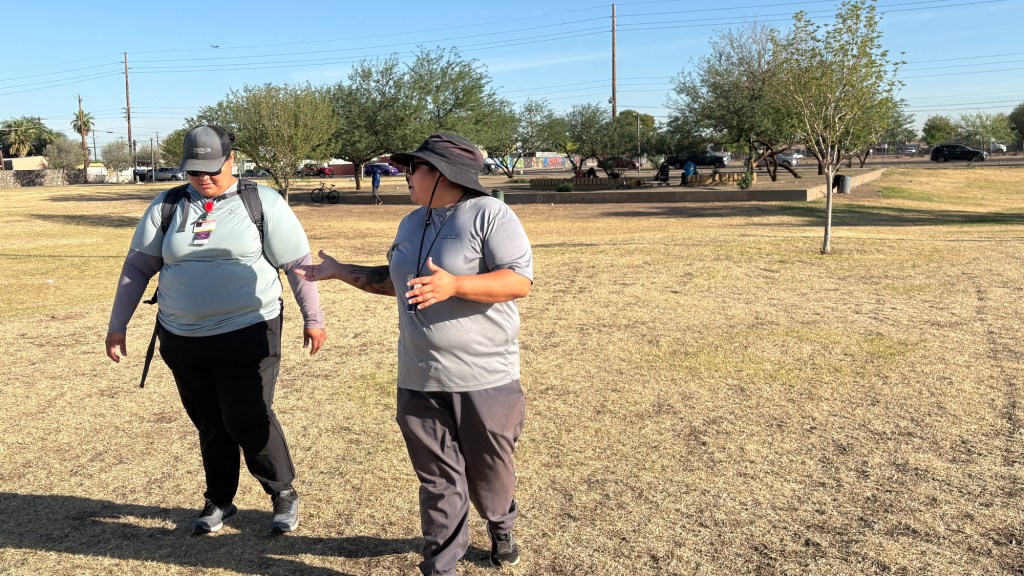
Once parked at Cesar Chavez Park, the Circle the City employees prepared to walk around. The three have learned how to function smoothly as a choreographed unit in spite of their cramped workspace. Madril put on a black backpack cooler filled with bottles of water. Puebla grabbed gloves and a bright red medical bag from in between the driver’s and front passenger seats.
They all grabbed naloxone, sometimes colloquially known by the brand name Narcan.
The emergency kit is a newer addition. A few years ago, after her team found someone who’d died of an overdose in this very park, Puebla rewrote the policy for what street medicine teams bring with them when they leave the van. Now, the teams bring everything they’d need to reverse an active overdose. The person with the emergency kit administers naloxone. The second team member helps while the third calls 911.
Arias and Madril walked up to a group of people seated with blankets and bikes scattered around them. They offered water and medical check-ups. No one wanted to be examined, but they took the water. They also offered Narcan, which the group accepted. Would it be possible to get more? they asked.
Back at the van, Madril rummaged through a plastic baggie filled with the small life-saving packages nestled in the Winnebago’s sink, now serving as storage. “At least maybe two per person…” she said as she grabbed extras for the group. They dropped it off on their way out.
The visit lasted about 10 minutes. The Circle the City team had done no medical exams, but they felt it was a successful visit. Everyone wanted water. The Narcan might save their lives. Each contact is a step towards a new patient. It often takes multiple encounters to convince someone to sit for a check-up, and it might take a few follow-ups to get them to open up and accept additional services.
Afterward, the trio made a pit stop at a QuikTrip gas station. Their days are long, and the city’s gas stations are their breakrooms. In the winter, they leave the administrative building at 8 a.m., timed with the late-rising sun. In the summer, they leave closer to 5 a.m. to beat the heat. During this respite, Madril tried a new Kool-Aid drink that has 22 grams of protein. The three women mused about possibly buying a case for their patients who often suffer from malnutrition. Then they piled back in the Winnebago and moved on.
The next stop was Hayden Park, due northeast at Martin Luther King Jr. Boulevard and Seventh Avenue. It is smaller and drier than Cesar Chavez, but the plan was the same. Offer water, offer medical care, see what happens. They hoped to do a follow-up with a patient they saw last week — if they can find him.
Clarissa Sosin
“Is there anyone back there?” Puebla asked aloud as they pulled into the parking lot.
“There’s a couple,” Madril responded.
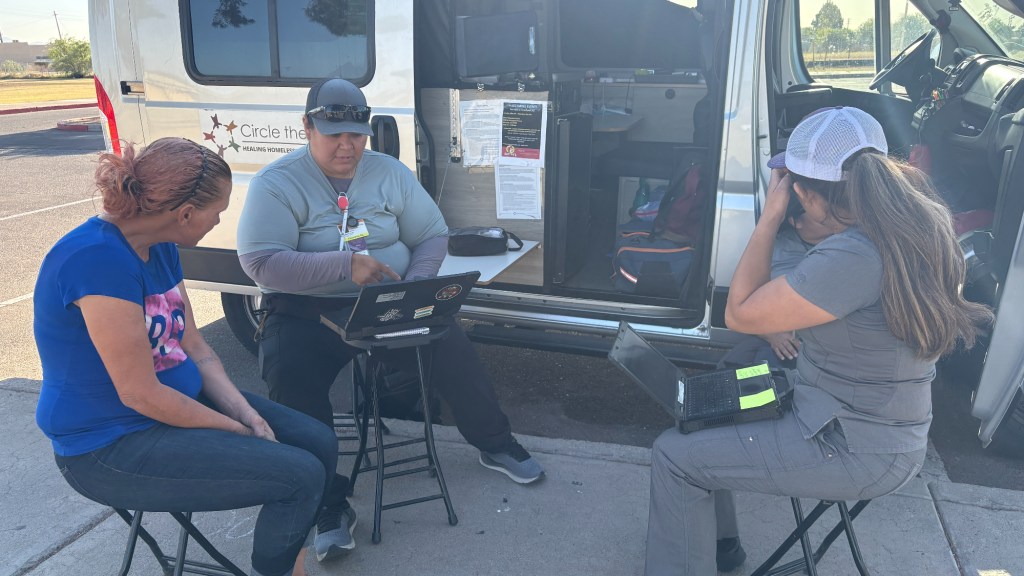
A woman in a blue t-shirt stood outside the bathroom near the parking lot. Madril and Arias offered water. The woman, who identified herself as Andrea, asked for two. They told her they can give her a check-up if she wants when they get back from handing out water, even if all she wants is for them to measure her blood pressure. She agreed.
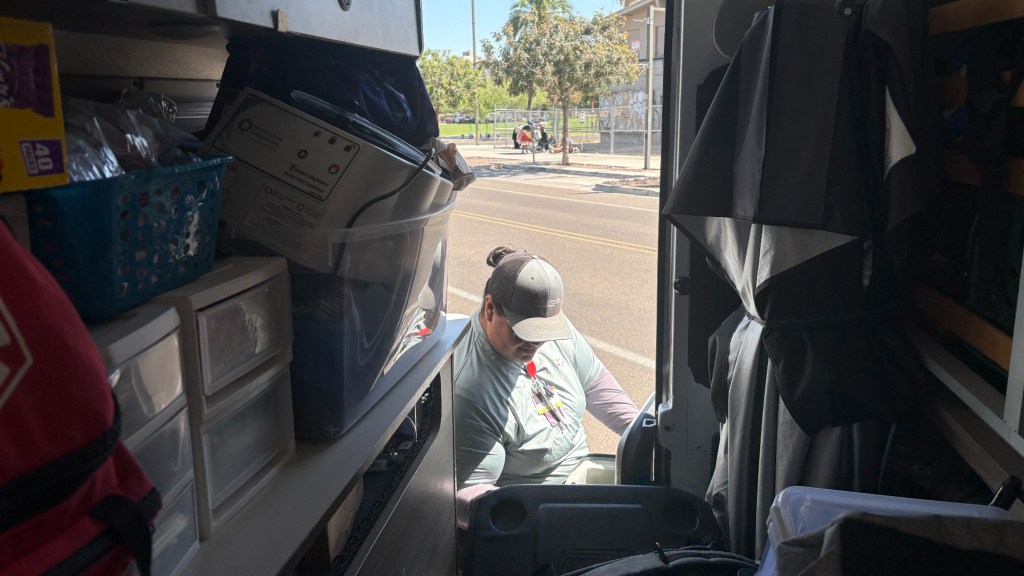
The team pulled plastic folding stools from the van that had been stashed among the bags and boxes of medicine and gear. Madril, Puebla and Andrea sat down on the stools and Madril, who was in charge of doing Andrea’s intake and history, used a stool as a makeshift desk for her laptop and other paperwork. Puebla balanced her laptop on her legs. Arias sat on the side of the van.
They peppered Andrea with questions. Has she been seen by Circle the City before? Does she have a working phone? Does she have any previous diagnoses? When was her last menstrual cycle? They asked about her drug use. Her history with domestic violence. How long she’s spent on the streets. They screened her for depression, asked about her appetite, her bowel movements, her sleep.
Madril pulled out a blood pressure monitor, pulse oximeter and a small black bathroom scale. Andrea’s hands were too cold for the pulse oximeter to get a reading, despite the near-70-degree weather. The Circle the City squad tried multiple fingers before deciding to wait a few minutes to give Andrea a chance to warm up.
They asked her if she’s interested in shelter, but Andrea declined when she learned that shelter would be through Central Arizona Shelter Services. She didn’t say why. She’d found care at a Tempe clinic a few years ago, so the women offered to call it on her behalf. Andrea agreed, but by the time the clinic was open about 30 minutes later, she’d changed her mind. They let her know about a food bank nearby that has showers. It’s open on Tuesdays, they said.
In the end, they sent her off with a clear bag of supplies, including Aquaphor for her dry skin, a Rice Krispies treat, deodorant, water and bandages for the abrasions on her hands.
“Did you want the feminine hygiene?” asked Madril from inside the van. “Which ones did you want?”
“Tampons,” Andrea replied.
This is the only healthcare she has, Andrea said as she rummaged through her bag at a picnic table. If they hadn’t come, she wouldn’t have seen anyone.
Clarissa Sosin
‘I don’t mind being arrested’
So far, it had been a slow morning. Not all of them are.
Last week, the team examined multiple people in Hayden Park. This week, it was just two. The patient they’d hoped to follow up with was nowhere in sight. They might have been too early this week, said Puebla — they’d arrived around 7:30 a.m., roughly an hour and a half earlier than they had a week prior. Fewer unhoused people sleep in parks now because the city began cracking down on them. Now, they sleep somewhere else and spend their days in the parks instead. The patient they were hoping to see might not have made his way over yet.
Consistency in this line of work is hard. The women give out Circle the City’s phone number so those who have access to a phone can reach them if they want. Sometimes people use it. A previous patient recently called. He’d accepted services and was now living in a shelter, and he wanted to say hi.
Next up was Hermoso Park, just 10 minutes to the east. This stop was more like the first — lots of water and no check-ups.
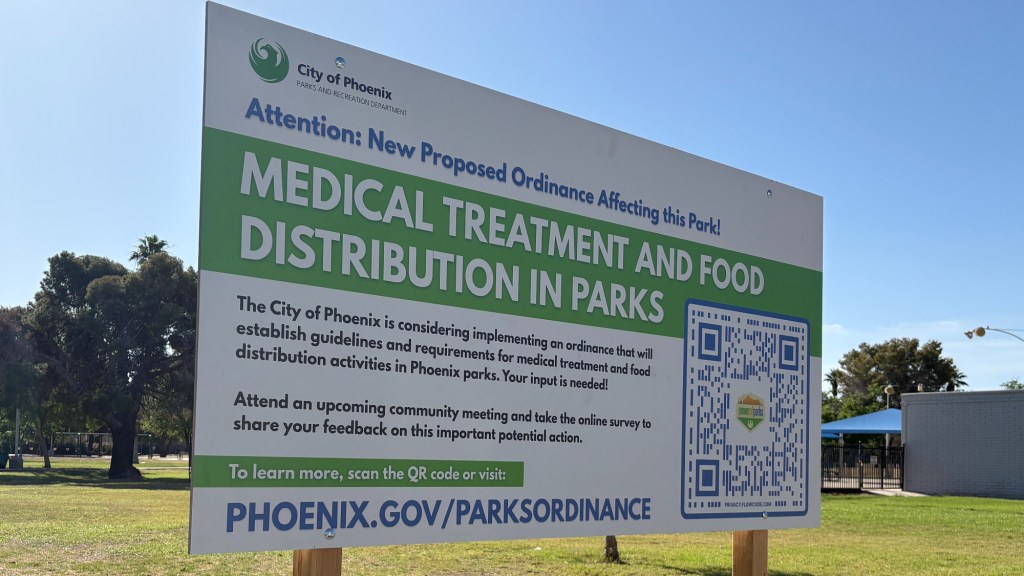
Before getting back in the van, they talked about the ordinance. The city had posted a large sign about it, with a QR code linking to more information near the entrance they’d used when they arrived. It has left them with more questions than answers.
Would they still be allowed to hand out water, or would that be considered food distribution? Water is important for preventing heat deaths. If they don’t have a permit, can they park outside of the park and provide care on the sidewalk? What happens if they come across someone overdosing? Will they be in violation of the ordinance if they administer Narcan? The proposed ordinance would seem to allow that, but the women still felt unsure.
And what happens if they do all of that anyway?
“I don’t mind being arrested for saving someone’s life,” said Arias.
Puebla said she understands some of the city’s concerns. She has kids. She doesn’t want them encountering needles in public spaces. And while they might be well-intentioned, unlicensed people shouldn’t provide medical care. But that is not the majority of the work being done, she said.
Clarissa Sosin
The women question the city’s aim. The new regulations will not make life any easier or safer for the unhoused, nor will they drive them from public spaces. It also won’t help end homelessness, they said. The city needs to fix the root causes and provide more housing.
“The parks ordinance is not going to stop them from coming to the parks,” said Puebla.
They all attended the heated council meeting in December for the first version of the ordinance. It left them feeling disheartened. Their patients have a very particular set of needs and barriers that a medical provider has to consider when providing care.
What works in an emergency room or in a primary care setting often doesn’t work for people on the streets. Many unhoused people can’t access a pharmacy due to a lack of transportation. Even if they can, they have no one to watch their stuff or, if they have one, their pet. Pharmacies sometimes won’t allow them inside, and sometimes they lack the money for a copay. That’s why Circle the City teams travel with a small pharmacy of commonly prescribed medications, ensuring their patients can leave with everything they need. Just that morning, they’d sent the day’s second patient away with an inhaler.
That’s just one complication. Everything from managing side effects to being able to keep track of days to make appointments is more complicated when you’re living on the street. Often when they prescribe antibiotics that have photosensitivity as a side effect, they’ll send the person away with sunscreen, a shirt and a hat so they don’t get sunburnt. At one point, they even handed out simple watches they ordered on Amazon so patients could have a chance at knowing the day and time.
As the morning wore on, the women returned to their van and prepared to drive north on Central Avenue to downtown Phoenix. Their shift ended soon, but they wanted to try to fit in one more stop on the way back to their home base. Maybe they’d find people in Margaret T. Hance Park.
They all agreed on two things before heading out. If the ordinance passes, they hope Circle the City will be able to work with Phoenix to carve out an exception for them. And they invite anyone who might be interested to come out in the field and meet the people who have nowhere to go. To get a look at the problem before trying to solve it.
“You don’t understand it,” said Puebla, “until you see it.”