
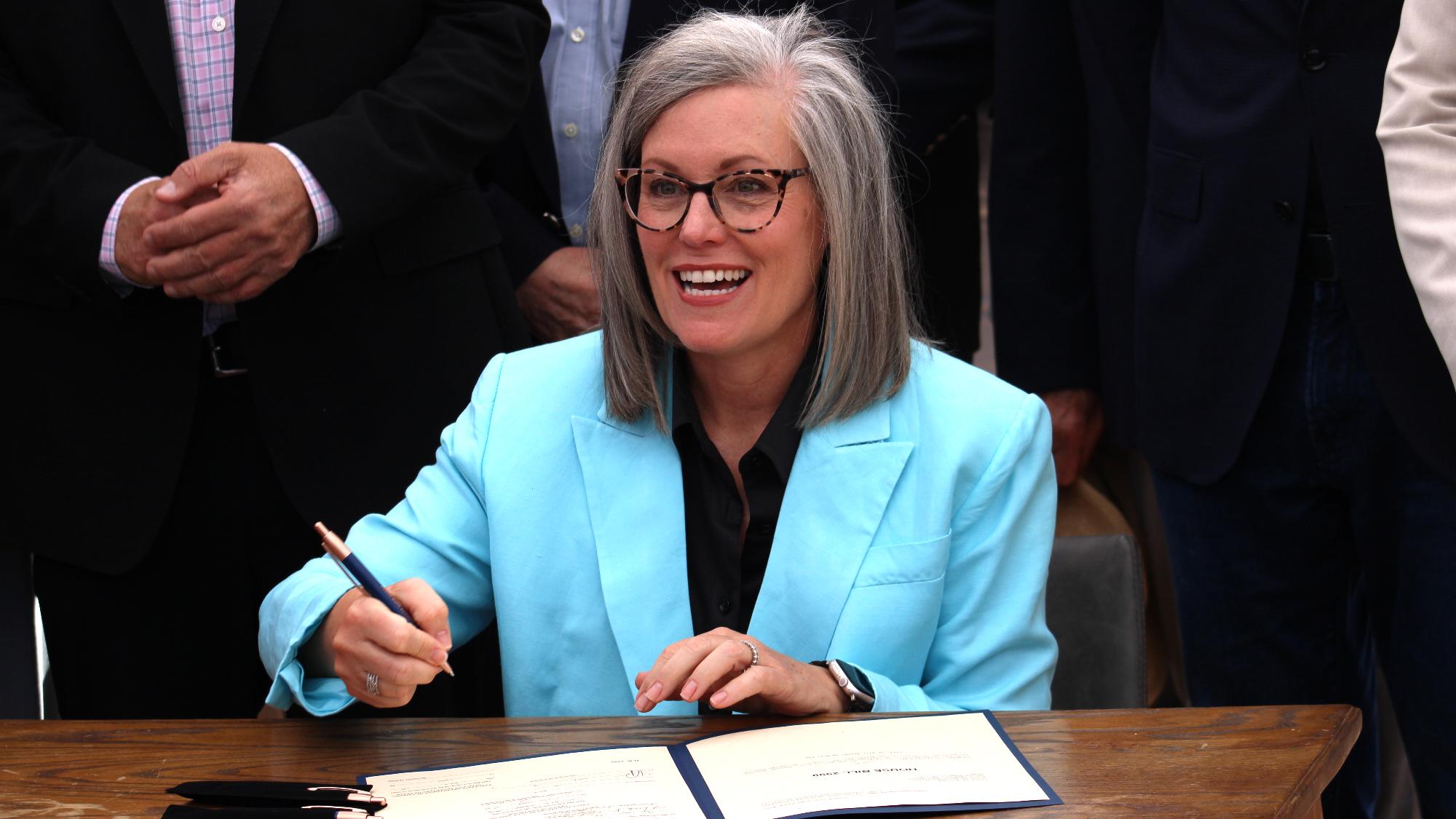
Morgan Fischer

Audio By Carbonatix
It’s an election year. Can Gov. Katie Hobbs make history again?
We’re not talking about the Democrat’s reelection chances, though those prospects will hang over her every action this legislative session. We’re talking about her vetoes.
Two years ago, Hobbs broke the all-time vetoes record by swatting down 216 bills in her first two years in office, topping the career mark previously held by Democratic Gov. Janet Napolitano. Last session, Hobbs ran up the score, vetoing a whopping 174 bills, which is a single-session record. That brings her three-year total to 390 rejected bills, a number that is only swelling in 2026. This legislative session has seen more bills introduced by lawmakers than ever before, and that has already meant more vetoes for Hobbs. In mid-April, she also instituted a bill moratorium, promising to veto most bills that come her way until Republicans publicly release their state budget plan, though she later lifted it when budget talks resumed.
Phoenix New Times has tracked those vetoes for the past three years. This is the 2026 edition. If there’s to be a 2027 version, Hobbs will have to emerge triumphant in November.
January
Senate Bill 1106: Vetoed on Jan. 12. This was the first blow in an ongoing battle between Hobbs and Republican lawmakers. Arizona generally mirrors its state income tax code after its federal counterpart, but President Donald Trump’s beloved “One Big Beautiful Bill” significantly altered how federal taxes are to be paid. That will require a change to Arizona’s code, but Hobbs and Republicans have been unable to agree on what those changes should be. When the session started this year, Republicans jammed through a package that would hew closely to the federal changes, but Hobbs vetoed it because it copied many of the same tax breaks that Trump’s bill gives to high-income companies and individuals. “You have sent me partisan legislation that gives tax breaks to special interests while hiking taxes on working seniors struggling to get by,” Hobbs wrote in her veto letter. “I urge you to rethink your partisan political theater.”
February
House Bill 2785: Vetoed on Feb. 12. This was Round 2 of the big tax fight. Republicans passed another bill that again adjusted the state’s tax code to mirror changes in federal tax law. Hobbs, who has favored adopting only some of the federal changes and excluding breaks for high earners and businesses, vetoed it again. “Again, I urge you to stop the partisan political theater,” Hobbs wrote in her veto letter. Meanwhile, Arizonans are preparing their taxes, knowing that they’ll likely have to file adjustments whenever Hobbs and the GOP finally iron things out.
House Bill 2206: Vetoed on Feb. 20. This was one of several bills that aimed to crack down on the state’s Supplemental Nutrition Assistance Program, or SNAP. The “One Big Beautiful Bill” mandated that state SNAP programs cut their rate of administrative errors — that is, the times they over- or underpay SNAP benefits — to 6%, or else states would have to shoulder more of the program’s costs. Sponsored by GOP Rep. Nick Kupper, HB 2206 went even further: It required the Arizona Department of Economic Security to cut its error rate to 3% by 2030, or face budget cuts. In her veto letter, Hobbs blasted “out of touch politicians in Washington” who passed the federal SNAP cuts before touting the changes DES is already making to comply with the new requirements. She also criticized HB 2206 for creating more work for DES without any additional money behind it. “SNAP is the most robust and effective anti-hunger tool we have in Arizona — I know this firsthand,” Hobbs wrote. “It’s also the most secure, thanks to strong anti-fraud measures and oversight. Instead of creating more needless frustration for Arizona families, I invite you to join me in actually lowering costs for them.”
House Bill 2396: Vetoed on Feb. 20. This bill would have barred SNAP recipients from buying less-healthy items like soda and snack foods with their benefits. Hobbs has vetoed similar bills in past years, as she noted in her veto letter this time around. “I appreciate your intent to improve health outcomes of Arizonans,” she wrote. “Yet, instead of offering Arizonans more options to feed their families, this legislation would deprive them of the dignity and economic freedom enjoyed by other grocery shoppers.”
Senate Bills 1002, 1331 and 1334: Vetoed en masse on Feb. 20. These bills imposed more restrictions on the SNAP program:
- SB 1002 would have imposed additional requirements on DES for verifying SNAP recipients’ eligibility, but without additional funding to do so.
- SB 1331 would have required most SNAP recipients aged 60 or younger to work or participate in job training to receive benefits.
- SB 1334 would have prevented state agencies from issuing waivers for SNAP work requirements unless federal law required it or the Arizona Legislature signed off.
In her veto letter, Hobbs chastised Republicans for sending her “yet more unfunded mandates and not a dollar to help our state agencies implement these changes now, or to modernize our systems for the future.”
House Bill 2796: Vetoed on Feb. 20. This bill would have placed more requirements on the Arizona Health Care Cost Containment System — or AHCCCS, the state’s Medicaid agency — when it comes to verifying participant eligibility. In her veto letter, Hobbs noted that AHCCCS already uses “a wide variety of effective and efficient member eligibility processes” and that the program was already working to adjust to new federal requirements that will go into effect in 2027. Thus, HB 2796 was “redundant,” she wrote.
Senate Bill 1036: Vetoed on Feb. 20. Like the SNAP and AHCCCS bills, this bill would have saddled DES with additional requirements when determining the eligibility of people receiving unemployment benefits, which would likely result in delays or denials for unemployed people. “This legislation creates unnecessary delays for workers, burdens for employers, and costs for the State,” Hobbs wrote in her veto letter.
Senate Bill 1051: Vetoed on Feb. 20. This bill would have required hospitals in Arizona to ask patients about their citizenship status. It would also have required hospitals to report every quarter to the Arizona Department of Health Services data about the number of undocumented patients seeking care, as well as the cost of uncompensated care for undocumented patients. Though the bill specified that hospital intake forms should state that care would not be affected by a patient’s answer to the citizenship question, Democrats said merely asking it would make sick or injured undocumented people less likely to seek necessary medical care. In her veto letter, Hobbs noted that undocumented immigrants aren’t eligible for Medicaid, which the bill ostensibly was created to police. “This legislature continues to show a troubling inability to grasp some of the most basic functions of Medicaid,” Hobbs wrote.
Senate Bill 1056: Vetoed on Feb. 20. This bill would have eliminated any full-time positions at state agencies that have been open and unfilled for at least 150 days. “This bill does not accurately reflect the state’s merit-based hiring processes,” Hobbs wrote in her veto letter, “and would deprive state agencies of their ability to best serve Arizonans.”
March
Senate Bill 1439: Vetoed on March 6. This bill would have resulted in the creation of a special license plate to honor slain Turning Point USA founder Charlie Kirk. Turning Point would have received $17 for every plate purchased through the Arizona Department of Transportation, and the bill was pushed by far-right state Sen. Jake Hoffman, whose consulting company does significant business with Turning Point. In her veto letter, Hobbs decried Kirk’s assassination as “a tragic and horrifying act of violence,” but she wrote that she vetoed the bill because it “insert(s) politics into a function of government that should remain nonpartisan.”
House Bill 2042: Vetoed on March 12. This bill would have prohibited the release of “any material within the borders of this state for solar radiation management,” which it defines as the “modification or attempted modification of atmospheric reflectivity that modifies the amount or intensity of sunlight that reaches the earth.” Basically, this is a chemtrails conspiracy theory bill, which Hobbs nodded at in her veto letter. She called the bill a “so-called solution to a nonexistent problem” that is “without science or data to back up its claims.” “I’m disappointed members of this legislature seem to be more focused on conspiracy theories than working with me to lower costs, secure the border, and grow Arizona’s economy.”
House Bill 2993: Vetoed on March 12. This bill is a nakedly political hit job on Arizona Attorney General Kris Mayes, a Democrat. In January, right-wingers jumped on Mayes for saying (inelegantly) that the mix of masked, armed ICE agents and a state citizenry that is well armed and living in a Stand Your Ground state was a recipe for disaster. Some Republicans inaccurately characterized Mayes’ comments as endorsing violence against federal agents. HB 2993 is the Republicans’ strike back against Mayes — it would have stripped $6.4 million from the Attorney General’s Consumer Protection-Consumer Fraud Revolving Fund to give to the Arizona Department of Public Safety, and would also have exempted DPS from having to use Mayes as its official attorney rather than seeking outside counsel. Even though Hobbs criticized Mayes for her remarks, she vetoed the bill as a “political stunt,” noting that she has suggested an alternate source to boost the DPS budget that doesn’t rob funds that would be used to educate Arizonans about scams and fraud.
House Bill 4115: Vetoed on March 12. This bill continues the long tradition of Republicans trying to make it harder for citizen-led initiatives to succeed. Among other things, it would have required that paid petition circulators — a common and uncontroversial feature of any initiative campaign — verbally identify the state they live in and that they are a paid circulator when approaching anyone with a petition, which critics noted would essentially take up all the brief time circulators have to capture a passerby’s attention. In her veto letter, Hobbs wrote that the bill “undermines” the initiative process “by imposing unrealistic requirements on participants and by opening the door for special interests to silence voters’ voices.”
Senate Bill 1010: Vetoed on March 27. This bill would have renamed Loop 202 as “Charlie Kirk Loop 202,” in honor of the slain right-wing activist and podcaster who called Arizona home. As she did in her veto letter for a bill that would have created a Charlie Kirk license plate, Hobbs called Kirk’s assassination “tragic” and “horrifying,” but said the bill falls short “by inserting politics into a function of government that should remain nonpartisan.” She also criticized the bill for bypassing the Arizona State Board on Geographic and Historic Names, which is tasked with making those kinds of decisions. Republicans, including gubernatorial hopeful Andy Biggs and Arizona Senate President Warren Petersen, have blasted Hobbs’ veto, noting that the state has highways named after Democrats, particularly former Congressman Ed Pastor. However, unlike Kirk, Pastor served in elected office.
Gage Skidmore/Flickr/CC BY-SA 2.0
April
Senate Bill 1787: Vetoed on April 7. This bill would have made it easier for real estate developers to challenge exactions, which are something local zoning authorities require a property owner to give to the community in order to be able to develop the land in question. The bill passed with bipartisan support in the Senate but had more resistance in the House. In her veto letter, Hobbs wrote that the bill “fails to improve zoning processes or accelerate the development of new housing.”
House Bill 2008: Vetoed on April 7. This bill, dubbed the “Library Freedom Act,” would have prevented school libraries from using public money to pay a professional association “that promotes, supports and advocates for libraries, librarians and information services,” per a Senate fact sheet. The bill’s sponsor, GOP state Rep. Nick Kupper, told the Arizona Republic that the bill was needed because library associations have “relatively strong political leanings.” In her veto letter, Hobbs called the bill a “shameful and misguided attack on public school librarians.”
House Bill 2040: Vetoed on April 7. This bill would have required public school employees to provide information about adoption if they discussed or provided contraception or testing for sexually transmitted diseases. It would have also required public and charter schools to include information about adoption in their sex education curriculum. In her veto letter, Hobbs wrote that she “is supportive of efforts to bolster adoption rates,” but not “placing onerous burdens on public education institutions that require adoption information to be provided in inappropriate settings.”
House Bill 2075: Vetoed on April 7. This bill would have required school districts to report the details of administrator contracts to the Arizona Department of Education, and would have required the department to create a searchable online database of that information. Democrats attempted to amend the bill to also require the same information to be reported about charter and private schools that take public money, but Republicans rejected that change. In her veto letter, Hobbs pointed out the discrepancy in reporting requirements for public schools versus private institutions that accept public money in the form of vouchers. “Arizona has a robust school choice environment that requires comparable information between options for parents and families to make meaningful choices,” she wrote. “This bill fails to ensure that all options in the marketplace are held to the same level of transparency.”
House Bill 2289: Vetoed on April 7. This bill would have required information pamphlets for school district budget override and bond elections to include the tax rate and estimated cost for a single-family home valued at $300,000. Currently, those notices must include only that information for homes valued at $80,000 and $100,000, respectively. In her veto letter, Hobbs noted that she’d vetoed the same legislation in previous sessions, adding that “I continue to have confidence that Arizona voters understand what they are doing when they vote in a school district bond election.”
House Bill 2903: Vetoed on April 7. This bill would have prohibited financial institutions from using a person’s social credit score — that is, non-financial information about their trustworthiness — when evaluating them for loan approval. In a one-sentence veto letter, Hobbs wrote that “this bill is unnecessary and marks my third veto for this poorly constructed and unnecessary policy change.”
Senate Bill 1024: Vetoed on April 13. A pet project of GOP state Sen. David Farnsworth, this bill would have required the Arizona Department of Transportation to create a registry of “roadable aircraft,” a speculative technology that envisions a future of Jetsons-like flying cars. Despite some Democratic support, Hobbs wrote that the bill “is an unfunded mandate that lacks the appropriate regulatory framework.”
Senate Bill 1078: Vetoed on April 13. This bill related to challenges made in court when a public records request is denied. Run by state Sen. John Kavanagh, the bill purported to make it easier for people to challenge the denial of public records requests. In her veto letter, Hobbs called the bill “unnecessary” and said that “the courts are capable of addressing these issues.”
Senate Bill 1142: Vetoed on April 13. This bill would have opted Arizona into a new federal program that provides individuals with federal income tax credits for donations to Scholarship Granting Organizations. The program, passed by Republicans in Washington, D.C., amounts to a federal school voucher program for private schools. In her veto letter, Hobbs wrote that it’s “irresponsible to sign this bill before the federal government has released any regulatory guidance,” and noted that “we have seen what happens when these types of programs lack accountability, transparency, and oversight.” If the oblique swipe against Arizona’s Empowerment Scholarship Accounts wasn’t enough, Hobbs went on to mention them directly: “I hope the administration ensures any federal school choice program will have the much-needed guardrails that Arizona’s ESA program lacks.”
Senate Bill 1148: Vetoed on April 13. This bill would have required the Arizona Supreme Court to license all attorneys in the state and barred it from delegating that task to the State Bar of Arizona, which currently licenses attorneys under the court’s authority. Many in the far-right fringe of the Arizona Republican Party distrust the state bar due to discipline handed down to attorneys involved in multiple spurious election challenges. In her veto letter, Hobbs wrote that the bill “erodes the Supreme Court’s authority to execute the functions of the Judicial Branch.”
Senate Bill 1293: Vetoed on April 13. This bill would have barred government property lease excise tax abatements for school districts. Hobbs wrote that the bill “would potentially harm economic development in our state.”
Senate Bill 1586: Vetoed on April 13. This bill would have required state agencies to post on their websites any federal guidance they receive. In her veto letter, Hobbs simply wrote, “This bill is overly broad.”
House Bill 2026: Vetoed on April 13. This bill would have allowed the Arizona Department of Water Resources to consider only a proposed source of water when determining whether to award a certificate of assured water supply that is required for development in Active Management Areas, such as the Valley and the area around Tucson. In her veto letter, Hobbs wrote that the bill “would undermine Arizona’s 100-year Assured Water Supply Program, allowing for ‘creative’ accounting that could lead to more groundwater overpumping.”
House Bill 2031: Vetoed on April 13. This bill would have extended the time people had to apply for grandfathered water rights in the Willcox Active Management Area, the original period for which was about to elapse. In her veto letter, Hobbs wrote that the bill “threatens to create additional confusion” and accused Republicans of attempting “to delay and obstruct real groundwater protections.”
House Bill 2055: Vetoed on April 13. This bill would have established the Brackish Groundwater Recovery Program Fund under the Water Infrastructure Finance Authority, and would have allowed WIFA to use money from its Long-Term Water Augmentation Fund to fund efforts to turn brackish water into potable water. In her veto letter, Hobbs wrote that the bill would divert “important funding intended to develop new water sources for Arizona’s future.”
House Bills 2102 and 2103: Vetoed together on April 13. HB 2102 would have allowed a county improvement district in an Active Management Area formed in a subsequent active to exercise the power of eminent domain to acquire a site for the construction of a single well and standpipe to make water available for delivery through water hauling. HB 2103 would have allowed people to provide financial assistance to qualified owners of
residential property for water hauling, and would have allowed counties to use groundwater transportation fees only for property owners who live within the groundwater transportation basin. In her veto letter, Hobbs wrote that the bills “are nothing more than attempts to create political cover for the legislature’s inaction on rural groundwater protection,” calling them “an insult to rural communities.”
House Bill 2167: Vetoed on April 13. This bill would have subjected the Arizona Attorney General’s Office to financial damages if it brought a public nuisance or consumer fraud action against a party that was dismissed in court, and the office should have known it lacked merit or publicized the filing. Broadly, the bill was part of an effort by Republicans to hamstring Democratic Attorney General Kris Mayes, with whom they’ve feuded over her comments about Immigration and Customs Enforcement. In her veto letter, Hobbs wrote that she “will not curtail a tool that is used to protect Arizonans from bad actors.”
House Bill 2261: Vetoed on April 13. This bill would have reclassified some property as “agricultural real property” and altered the way those properties are valued. In her veto letter, Hobbs noted that the bill is currently the subject of a case before the Arizona Supreme Court and said signing it would be “premature.”
House Bill 2261: Vetoed on April 13. This bill would have transferred the Resource Analysis Division of the Arizona State Land Department to the Arizona Geological Survey. In her veto letter, Hobbs wrote that the bill “risks unnecessary disruption” to statewide systems.
House Bill 2378: Vetoed on April 13. This bill would have prevented engineers and architects who do business in school construction from serving on the School Facilities Oversight Board. In her veto letter, Hobbs pointed out that state conflict-of-interest laws already address the issue the bill purports to solve and said the bill would limit the number of qualified candidates able to serve on the board.
House Bill 2584: Vetoed on April 13. This bill would have prevented public money from being spent on genetic sequencing procedures performed using devices from companies located or controlled by foreign adversaries.” In her veto letter, Hobbs noted that genetic sequencing is vital to diagnosing many diseases and conditions and wrote that providers that use them “invest millions in the devices.”
House Bill 2600: Vetoed on April 13. This bill would have prevented middle schoolers from joining school clubs without parental consent. In her veto letter, Hobbs wrote that “we should be finding ways to encourage schools to provide more enriching opportunities for students rather than creating barriers to participation.”
House Bill 2787: Vetoed on April 13. This bill would have barred the state and its employees from supporting or cooperating with the Mexican Wolf Reintroduction Program under the Endangered Species Act. Some Republicans have advocated for allowing ranchers to kill the endangered wolves. In her veto letter, Hobbs wrote that the Mexican Wolf Reintroduction Program is “an important wildlife management effort.”
House Bill 2811: Vetoed on April 13. This bill would have expanded the definition of “obstructing governmental operations” to include “knowingly obstructing, impairing or hindering the making of a lawful arrest by using or threatening to use violence or physical force.” Hobbs noted there are already state laws governing the issue and wrote that the bill was “an attempt to intimidate and instill fear in those exercising their first amendment rights.”
House Bill 2985: Vetoed on April 13. This bill would have required the Arizona State Land Department to initiate a public stakeholder process to adopt a procedure for allocating Central Arizona Project water currently allocated to the ASLD to parcels of state trust land that may be sold or leased. In her veto letter, Hobbs wrote that the state land department already has a process for that.
House Bill 2033: Vetoed on April 14. This bill would have allowed school district governing boards to approve the administering of statewide assessment tests in written form. Hobbs’ veto letter didn’t address the bill but said she rejected it as part of a bill moratorium she’d implemented because legislative Republicans haven’t publicly released their state budget proposal.
House Bill 2093: Vetoed on April 14. This bill would have removed the requirement that mental health instruction include the multiple dimensions of health. Hobbs vetoed it as part of her bill moratorium.
House Bill 4033: Vetoed on April 14. This bill would have expanded the amount of information required to be included in pamphlets for school district bond elections. It also fell victim to Hobbs’ bill moratorium.
May
House Bills 4138 through 4153: Vetoed en masse on May 5. These 16 bills amounted to the state budget passed by legislative Republicans a few days earlier. While the budget contained some of Hobbs’ priorities, it neglected many others. In her veto letter, Hobbs blasted its $600 million in tax breaks “to billionaires, data centers and special interests” and its especially stringent requirements for the state’s Medicaid and food assistance programs, among other provisions. “I have made it clear that I will engage in good-faith negotiation,” Hobbs wrote. “But I will not sign a budget that brings Washington-style chaos and dysfunction to Arizona’s budget. Let’s get back to the negotiating table and get serious about delivering for Arizonans. I am ready when you are.”
Senate Bill 1058: Vetoed on May 22. This bill would have prevented government entities and “certain private entities” from creating registries to track firearms and firearm retailers using merchant category codes, which are “four-digit numbers used by credit card companies and payment processors to classify businesses based on the goods or services they provide,” according to a legislative summary of the bill. In her veto letter, Hobbs noted that she rejected the same bill a year ago. “Merchant category codes are vital tools that help law enforcement crack down on illegal gun trafficking to transnational criminal organizations,” she wrote. “This recycled proposal would make it harder for law enforcement to catch violent criminals.”
Senate Bill 1237: Vetoed on May 22. This bill would have required the Arizona Secretary of State to consult with all of the state’s county recorders and the ranking members of the election-related committees in the Arizona Legislature on the creation of the Election Procedures Manual, which governs election administration in the state. Currently, the Secretary of State is required to consult only with the boards of supervisors for every county. In her veto letter, Hobbs wrote that there is “no need” for legislative leaders to be consulted on the EPM. “All legislators are welcome to submit comments on the draft manual during the public comment period that I began when I held the office of Secretary of State,” she added.

U.S. Air Force/Matthew Lotz
June
Senate Bills 1011 and 1212: Vetoed on June 19. SB 1011 would have required medical examiners and forensic pathologists to review an infant’s vaccination history in the case of sudden infant deaths, while SB 1212 would have barred health insurers from reimbursing providers at a different rate based on whether a patient refused a vaccine. In her veto letter, Hobbs noted that “vaccines save lives” and gestured at the state’s many measles cases: “It is concerning that diseases that were once eliminated are making a comeback in Arizona’s playgrounds and classrooms because of misinformation.”
Senate Bill 1012: Vetoed on June 19. This bill would have removed restrictions on carrying a concealed handgun into a restaurant, and would have required restaurants to presume that customers with concealed handguns were carrying them legally. In her veto letter, Hobbs wrote that she wouldn’t “take away the decision-making authority from a restaurant over firearms restrictions in their own establishments.”
Senate Bill 1013: Vetoed on June 19. This bill would have prohibited public agencies “from hiring employees based on conditions other than merit,” per a bill summary. In her veto letter, Hobbs noted she’d vetoed a similar measure in a previous session and said that the state already hires based on merit. “This bill attempts to solve a problem that does not exist,” she wrote.
Senate Bills 1015, 1094 and 1095: Vetoed on June 19. SB 1015 would have made medical providers who perform gender transition procedures for minors liable for damages if those patients later choose to detransition. SB 1094 would have created a civil cause of action for physicians who perform “irreversible” gender transition procedures on minors, and SB 1095 would have prohibited gender transition procedures for minors altogether. In her veto letter, Hobbs noted that gender transition procedures for minors are already illegal in Arizona.
Senate Bill 1018: Vetoed on June 19. This bill, which was a brazen Islamophobic dog whistle, would have outlawed Sharia Law in Arizona. In her veto letter, Hobbs noted that Sharia Law and its “abhorrent practices” already “do not and will not exist in Arizona.” She also wrote that “the practical effects of this unconstitutional legislation will be a lawsuit that the State of Arizona will lose, costing taxpayers millions of dollars.”
Senate Bill 1037: Vetoed on June 19. This bill would have barred vote recording equipment and ballot tabulating equipment from being capable of internet connectivity or having a port. In her veto letter, Hobbs wrote that such changes should be made through the Elections Procedures Manual, which is crafted by the Arizona Secretary of State.
Senate Bill 1038: Vetoed on June 19. This bill would have required county elections officials to transmit an election’s “cast vote record” — that is, a record of each voter’s selections, albeit anonymized — to the Arizona Secretary of State within 48 hours after the county board of supervisors submits the election canvass to the secretary’s office. It would also have made the cast vote record a public record. In her veto letter, Hobbs wrote that the bill “would place constitutionally protected voter privacy at risk.”
Senate Bill 1039: Vetoed on June 19. This bill would have allowed attorneys investigated by the State Bar of Arizona to recover lost earnings if they win a disciplinary action case and to sue the bar for reputational harm. In her veto letter, Hobbs noted only that she vetoed the same bill in 2025.
Senate Bill 1040: Vetoed on June 19. This bill would have required county records to make the county’s voter registration list accessible via an internet portal and would have prohibited recorders from charging a fee to access or download that information. In her veto letter, Hobbs wrote that the bill “fails to adequately safeguard voter registration information from being redistributed and posted online.”
Senate Bill 1046: Vetoed on June 19. This bill would have prevented telecommunications utilities from using equipment manufactured by a foreign adversary. In her veto letter, Hobbs wrote that the bill was not a “realistic” way to “protect our critical infrastructure” because it would “create undue difficulty for the business community.”
Senate Bill 1053: Vetoed on June 19. This bill would have changed the concealed weapons permit fee for Arizona residents to be just 10% of the fee for nonresidents. In her veto letter, Hobbs wrote that she’d vetoed a similar bill a year earlier because it would “defund our state police.”
Senate Bill 1055: Vetoed on June 19. This bill would have required police agencies to notify Immigration and Customs Enforcement or Customs and Border Protection if they arrest anyone unlawfully present in the country. In her veto letter, Hobbs wrote that existing state law allows police agencies to contact ICE but gives them discretion not to do so if it would hamper investigations. “We should not tell law enforcement how to do their job,” she wrote.
Senate Bill 1057: Vetoed on June 19. This bill would have required Arizona ballot paper to use a host of complicated anti-fraud features, including special inks and holographic foil. In her veto letter, Hobbs wrote that she’s “confident in the ability of Arizona’s elections officials to administer free and fair elections without added expense and complexity.”
Senate Bill 1060: Vetoed on June 19. This bill would have prevented U.S. citizens who are registered to vote but have never lived in Arizona — such as the children of servicemembers stationed abroad — from being able to vote in federal-only elections in Arizona. Hobbs wrote that she “will not sign a bill that diminishes the right of eligible citizens to register to vote.”
Senate Bill 1061: Vetoed on June 19. This bill would have reduced the amount of fentanyl required to be found to trigger enhanced sentencing requirements, lowering it from 200 grams to just nine grams. In her veto letter, Hobbs touted her record fighting the spread of fentanyl but said the change wouldn’t “effectively target the high-level drug dealers and cartels who are responsible for pushing poison on our streets.”
Senate Bill 1068: Vetoed on June 19. This bill would have barred universities and community colleges from banning people with concealed carry permits from bringing their weapons on campus or storing them in their vehicles on campus. In her veto letter, Hobbs wrote that the bill “threatens student safety.”
Senate Bill 1069: Vetoed on June 19. This bill would have removed suppressors — what are colloquially known as silencers, though they don’t work like they do in the movies — from the definition of “prohibited weapon” in Arizona criminal law. In her veto letter, Hobbs wrote that “gun-silencers make it more difficult for hard-working law enforcement officers to do their job and keep Arizonans safe.”
Senate Bill 1075: Vetoed on June 19. This bill would have created a commission whose approval would be required for the sale of state land to a “hostile foreign entity.” In her veto letter, Hobbs noted that she signed a bill last year that already makes such sales illegal.
Senate Bill 1124 and House Bill 2660: Vetoed together on June 19. SB 1124 would have allowed health profession regulatory boards to require psychological evaluations of health professionals, while HB 2260 would have allowed “unprofessional conduct of a character that is likely to deceive or defraud a patient or the public or that poses a direct threat to the life, health or safety of a patient” to be grounds for disciplinary action. In her veto letter, Hobbs noted the bills were unfunded and “would prevent regulators from taking steps to protect the public.”
Senate Bill 1171: Vetoed on June 19. This bill would have required owners, licensees or applicants of behavioral health facilities to be U.S. citizens or legal permanent residents and would have required them to get a fingerprint clearance card. In her veto letter, Hobbs claimed she’s “done more to crack down on waste, fraud and abuse in Medicaid than any of my predecessors,” but that she would not sign a bill that would do so “at the expense of the good healthcare providers Arizonans rely on.”
Senate Bill 1180: Vetoed on June 19: This bill would have required the Arizona Department of Revenue to assume that the legislature would require tax forms to match changes in federal tax law. The new state budget does just that, and ADOR issued tax forms that were already compliant, so Hobbs wrote that the bill was unnecessary.
Senate Bill 1186: Vetoed on June 19. This bill would have required companies and organizations vying for state contracts or grants to disclose any money given to the governor’s campaign committees or inaugural funds. It was a direct response by Republicans to the Sunshine Residential scandal, in which a state vendor that donated money to Hobbs’ inaugural fund was able to secure a better reimbursement rate. The appearance of pay-for-play has been one of the bigger thorns in Hobbs’ side during her term. In her veto letter, Hobbs called the bill “a political stunt that applies to only one elected official” — her — and encouraged lawmakers to pass her own proposal, which included bans on lobbying gifts.
Sente Bill 1202: Vetoed on June 19. This bill would have required the Arizona Department of Water Resources to provide a specific list of metrics when conducting its five-year water supply and demand assessments for groundwater basins. Hobbs called the metrics “questionable” in her veto letter and noted the bill was an unfunded mandate. She added that the bill was a “deceptive attempt to undermine our world-class water protection laws.”
Senate Bill 1214: Vetoed on June 19. This bill would have laid out a system by which healthcare providers could provide stem cell therapies not currently approved by the Food and Drug Administration. In her veto letter, Hobbs wrote that the bill “would open the door to costly medical treatments that are not permitted federally.”
Senate Bill 1221: Vetoed on June 19. This bill would have required the Arizona Department of Revenue to notify the Arizona Legislature of proposed new interpretations of tax law that would adversely affect taxpayers. Hobbs wrote that the bill would “politicize the administration of our tax code.”
Senate Bill 1233: Vetoed on June 19. This bill would have required the Arizona Department of Health Services, its Medicaid agency and the Arizona Department of Economic Security to allow licensed facilities the opportunity to correct administrative mistakes before discipline is levied. In her veto letter, Hobbs wrote that the bill falls short of the state’s obligation to safeguard against fraud, waste and abuse.
Senate Bill 1280: Vetoed on June 19. This bill would have prevented the Arizona Game and Fish Commission from transporting Mexican gray wolf puppies into the state. The Mexican gray wolf is endangered, and the U.S. population is perilously small. Rehabilitation efforts have involved introducing new puppies so that the pack doesn’t become genetically homogenous. However, ranchers have railed against the wolves as threats to their livelihood. In her veto letter, Hobbs called the reintroduction of the wolves “an important wildlife management effort.”
Senate Bill 1281: Vetoed on June 19. This bill would have required escrow agents engaged in the sale of private property to the federal government to notify the Arizona Legislature. In her veto letter, Hobbs wrote that the bill would chill “voluntary sales that protect public access, open space and working landscapes across the state.”
Senate Bill 1315: Vetoed on June 19. This bill would have required schools that receive public money for interoperable communications with police to establish such capabilities to inform law enforcement immediately of school emergencies. In her veto letter, Hobbs wrote that the bill “lacks a comprehensive approach to school safety.”
Senate Bill 1326: Vetoed on June 19. This bill would have allowed a court to order any party that violates the Arizona Victims’ Bill of Rights to pay reasonable attorney fees and costs incurred enforcing those rights. In her veto letter, Hobbs wrote that the bill “would have unintended consequences for crime victims and could incentivize further victimization.”
Senate Bill 1332: Vetoed on June 19. This bill would have required the Arizona Auditor General to perform a comprehensive feasibility review of light rail expansion in Maricopa County, which legislative Republicans have vehemently opposed. In her veto letter, Hobbs called the bill “costly and unnecessary.”
Senate Bill 1338: Vetoed on June 19. This bill would have prevented undocumented immigrants, asylum seekers and immigrants paroled into the U.S. by the Department of Homeland Security from receiving state or local benefits. In her veto letter, Hobbs noted that state law already requires proof of lawful presence to obtain benefits and pointed out that the bill would deny benefits to recipients of Deferred Action for Childhood Arrivals, or residents who were brought illegally into the country as children who now have protected status.
Senate Bill 1418: Vetoed on June 19. This bill would have allowed utilities to construct small modular nuclear reactors under certain conditions. In her veto letter, Hobbs called the bill “irresponsible,” noting that small nuclear reactor technology is still very new and should be treated with caution.
Senate Bill 1421: Vetoed on June 19. This bill would have prohibited financial institutions from accepting forms of identification from people who are unauthorized immigrants and would have barred foreign remittances — essentially, sending money to relatives out of the country — for undocumented persons. In her veto letter, Hobbs wrote that the bill would “impose substantial operational burdens on Arizona businesses by micromanaging routine business operations.”
Senate Bill 1429: Vetoed on June 19. This bill would have subjected city-, town- and county-based citizen initiatives to stricter scrutiny and would have required out-of-state signature gatherers to disclose that status. In her veto letter, Hobbs said the bill would “further narrow the pathway” for such initiatives.
Senate Bill 1445: Vetoed on June 19. This bill would have allowed small towns that apply for aquifer protection permits to perform their own bacterial tests on discharge. It also would have prohibited the Arizona Department of Environmental Quality from requiring community water systems in counties of at least 400,000 people and fewer than 25 service connections to maintain a storage capacity of more than 1,000 gallons. In her veto letter, Hobbs wrote that the bill “undermines … water quality oversight standards” and “weakens … water supply redundancy standards.”
Senate Bill 1457: Vetoed on June 19. This bill would have expanded the use of the state’s Advanced Air Mobility Fund to allow the purchase of advanced air mobility vehicles to be used for border security. In her veto letter, Hobbs wrote that the bill “appears to cater to a particular California-based vendor.”
Senate Bill 1475: Vetoed on June 19. This bill would have barred school districts from allowing students who have been convicted, admitted to in court, pleaded no contest to, or struck a plea agreement admitting to a number of criminal offenses from participating in interscholastic activities. It would also have required districts to keep students charged with those crimes out of such activities until the charges were dismissed or the student is found to be not guilty. In her veto letter, Hobbs noted that athletic programs and after-school clubs are “important tool(s) in the rehabilitation process.”
Senate Bill 1476: Vetoed on June 19. This bill would have established child neglect as a class 6 felony and would have defined it as causing the harm of a child when the child was exposed prenatally to drugs or shows signs of fetal alcohol syndrome. In her veto letter, Hobbs wrote that “further criminalization will not yield safer pregnancies and births.”
Senate Bill 1511: Vetoed on June 19. This bill would have required people operating commercial vehicles in Arizona with nondomiciled commercial licenses to show proof of legal authorization to be in the country. Hobbs called the measure “unnecessary and redundant.”
Senate Bill 1520: Vetoed on June 19. This bill would have required the state and its agencies to share data on immigrants who are undocumented or who have overstayed a visa. In her veto letter, Hobbs called the bill “unconstitutional.”
Senate Bill 1549: Vetoed on June 19. This bill would have included “ultralight vehicles” in the definition of “advanced air mobility.” Hobbs wrote that the bill falls short of “federal safety standards.”
Senate Bill 1572: Vetoed on June 19. This bill would have required schools to observe “Celebrate Freedom Week,” with mandated instruction on the Declaration of Independence and the Constitution. In her veto letter, Hobbs wrote that the suggested curriculum is already covered in schools and that “changes to civics education should go through experts, not the legislature.”
Senate Bill 1573: Vetoed on June 19. This bill would have barred courts from relying on “religious sectarian law” in making rulings — essentially, barring Sharia Law without saying as much. Hobbs wrote that Arizona law already features such a prohibition and called the bill “a solution in search of a problem.”
Senate Bill 1624: Vetoed on June 19. This bill would have capped photo-enforcement traffic penalties at $75 and prevented them from being used to determine car insurance rates and driver’s license qualifications. In her veto letter, Hobbs wrote that the bill “undermines cities’ ability to keep communities safe.”
Senate Bill 1670: Vetoed on June 19. This bill would have prevented counties and municipalities from setting requirements for the licensing of contractors, leaving on the state’s Registrar of Contractors to do so. In her veto letter, Hobbs wrote that the bill “limits local control” and was “written without engaging relevant stakeholders and experts.”
Senate Bill 1741: Vetoed on June 19. This bill would have required that public and charter schools release students for off-campus religious instruction during school hours. In her veto letter, Hobbs wrote that “if parents with for their child to receive a religious education, they have every right and opportunity to do so” through the state’s school choice program.
House Bill 2003: Vetoed on June 19. This bill would have changed the criteria to obtain a driving permit and the amount of experience permittees must accumulate to obtain a license. In her veto letter, Hobbs wrote that lowering the permit age “will not enhance roadway safety among teen drivers.”
House Bill 2010: Vetoed on June 19. This would have barred entities like Amazon that “sell” internet goods (such as movies and songs) from using the words “buy” or “purchase” if that good is merely a license that could be revoked. In her veto letter, Hobbs welcomed the idea but criticized the bill’s “ambiguous” provisions regarding how sellers should refund customers who lose access to a purchased item.
House Bill 2013: Vetoed on June 19. This bill would have required the Arizona Department of Environmental Quality to seek an “exceptional event” waiver from the Environmental Protection Agency when a wildfire occurs on federally managed land. The waiver would exclude the event from being included in air quality data. In her veto letter, Hobbs wrote that the bill is “duplicative.”
House Bill 2015: Vetoed on June 19. This bill would have imposed penalties on state agencies that failed to submit accurate and complete financial data to the Arizona Department of Administration to meet federal audit deadlines. Hobbs wrote that the reporting delay began under Republican Gov. Doug Ducey and that “adding a fee will only further slow things down.”
House Bill 2028: Vetoed on June 19. This bill would allow courts to order homeless people to perform community service instead of paying a $20 court fee. In her veto letter, Hobbs noted that the fee is already waivable for all defendants based on circumstances and called the bill “poorly drafted.”
House Bill 2047: Vetoed on June 19. This bill would have made it third-degree criminal trespassing to reenter or remain in a property after being issued a writ of restitution for forcible entry. In her veto letter, Hobbs wrote that she’d already signed legislation that addresses the issue.
House Bills 2086 and 2248: Vetoed on June 19. HB 2086 would have barred government entities from imposing mask mandates, while HB 2248 would have essentially outlawed vaccine requirements implemented by businesses, school districts and government entities. In her veto letter, Hobbs wrote that “vaccines save lives.”
House Bill 2100: Vetoed on June 19. This bill would have allowed county boards of supervisors to allow small land developments under certain guidelines. In her veto letter, Hobbs wrote that “Arizonans are being harmed by wildcat development and rural groundwater depletion,” and that the bill would weaken consumer protections.
House Bill 2113: Vetoed on June 19. This bill would have required the state Residential Utility Consumer Office to intervene in utility rate cases if rates are set to increase by 100% or more. In her veto letter, Hobbs wrote that the bill did not provide funding.
House Bill 2118: Vetoed on June 19. This bill would have barred local governments from requiring that mobile food vendors obtain a license. In her veto letter, Hobbs wrote that cities and towns “should retain local control” about how they license such businesses.
House Bill 2133: Vetoed on June 19. This bill would have required entities that publish sexual material to the internet to require that uploaders consent to the publication of the material and to verify that the person depicted is at least 18. In her veto letter, Hobbs noted that the bill’s sponsor, GOP state Rep. Nick Kupper, brought the bill after “South Park” used deepfake technology to depict a naked Donald Trump. Kupper later admitted that, under his bill, the show would have been required to seek Trump’s permission to do so. Hobbs wrote that the bill “has a chilling effect on free speech and would violate First Amendment rights to engage in satirical discourse about elected officials.”
House Bill 2134: Vetoed on June 19. This bill would have prohibited “critical infrastructure software and critical communications infrastructure equipment” from being produced by a Chinese company. In her veto letter, Hobbs wrote that the bill “imposes costly burdens on critical infrastructure providers.”
House Bill 2140: Vetoed on June 19. This bill would have permitted the Arizona Treasurer to invest in gold or silver bullion stored in a U.S. precious metals depository. In her veto letter, Hobbs wrote that she’s confident that the state’s portfolio is “sufficiently diversified.”
House Bill 2170: Vetoed on June 19. This bill would have prevented Chinese-based and -owned companies from contracting with the state for electronic or information technology. In her veto letter, Hobbs called the bill “overbroad.”
House Bill 2249: Vetoed on June 19. This bill would have created a Parents’ Bill of Rights, which would have included the right to be informed if school staff assist with a student’s gender transition by using their preferred pronouns or names. In her veto letter, Hobbs wrote that she will “not support a bill that threatens schools and educators with exorbitant financial penalties.”
House Bill 2305: Vetoed on June 19. This bill would have preempted local regulations on towing companies and commissioned a study on towing. In her veto letter, Hobbs wrote that she’s previously signed legislation that established a study and that the state should wait for that study to be completed before weighing back in on the subject.
House Bill 2311: Vetoed on June 19. This bill would have established regulations for when AI chatbots interact with minors, with violations of $1,000 per occurrence — maxing out at $500,000 per operator — when regulations are not followed. In her veto letter, Hobbs wrote that the bill “limits damages to families to what amounts to a drop in the bucket for large corporations” and “prohibits families from bringing their own lawsuits.”
House Bill 2322: Vetoed on June 19. This bill would require the Arizona Department of Child Safety to record interviews conducted with children if federal funding for doing so is enacted. In her veto letter, Hobbs wrote that she would direct the department to apply for such funding regardless of the bill.
House Bill 2379: Vetoed on June 19. This bill would have required school governing board members to complete school finance training and would have barred any who failed to do so from standing for election. In her veto letter, Hobbs said the bill “goes too far” and also provides no funding for training resources.
House Bill 2380: Vetoed on June 19. This bill would have required school governing boards in districts with at least 250 students to provide live feeds of their meetings. In her veto letter, Hobbs noted that the bill originally set that limit at districts with at least 5,000 students, writing that the lower threshold “could add costs to rural districts.”
House Bill 2460: Vetoed on June 19. This bill would have barred a county or municipality from assessing a penalty on a business for “the theft of its movable property.” The bill is essentially a measure to crack down on ordinances in cities, including Phoenix, that require grocery stores to track down and retrieve their shopping carts. In her veto letter, Hobbs wrote that the grocery cart problem “is a truly local issue that is best resolved between businesses and their local elected leaders.”
House Bill 2481: Vetoed on June 19. This bill would have required training for school district leaders who fail to correct deficiencies in the Uniform System of Financial Records in a specific timeframe. It would also bar districts with deficiencies from calling bond and budget override elections, which are used to fund school improvements. In her veto letter, Hobbs noted that the election prohibition “will only negatively impact students.”
House Bill 2482: Vetoed on June 19. This bill would have limited individual jobs in job-order-contracting for school improvements that come from the state Building Renewal Grant Fund at $1 million. In her veto letter, Hobbs wrote that the measure “could further delay projects that have waited to be funded.”
House Bill 2592: Vetoed on June 19. This bill would have required state agencies to develop regulations for instituting AI. In her veto letter, Hobbs wrote that the bill is redundant because state agencies are already weighing AI adoption.
House Bill 2611: Vetoed on June 19. This bill would have codified a number of regulations for group homes contracted by the Arizona Department of Child Safety, including mandatory drug tests for employees. In her veto letter, Hobbs said she appreciated the intent but felt parts of the bill “go too far and would deprive youth in group homes of the normalcy they deserve in their living arrangements.”
House Bill 2662: Vetoed on June 19. This bill would have allowed courts to take testimony from expert witnesses in parenting time cases when one parent is alleged to have committed domestic violence. In her veto bill, Hobbs wrote that the bill too narrowly defined who can serve as an expert witness.
House Bill 2745: Vetoed on June 19. This bill would have allowed individual legislators to hold people in contempt for not responding to a legislative subpoena. In her veto letter, Hobbs wrote that contempt charges should be left to the whole legislative body.
House Bill 2755: Vetoed on June 19. This bill would have allowed mineral lessees of underperforming state land to trigger a sale at auction by the Arizona State Land Department. In her veto letter, Hobbs wrote that allowing lessees to compel a sale “overrides the Land Commissioner’s independent fiduciary judgment.”
House Bill 2771: Vetoed on June 19. This bill would have allowed the Arizona Department of Corrections, Rehabilitation and Reentry to require prisoners with community supervision to pay “reasonable costs” associated with the rehabilitation program. Hobbs wrote that the measure would create more barriers to such programs.
House Bill 2830: Vetoed on June 19. This bill would have required the State Board of Education to create a curriculum on fetal and prenatal development for use in public schools. In her veto letter, Hobbs wrote that “instructional requirements should be left to experts.”
House Bill 2873: Vetoed on June 19. This bill would have allowed someone who filed a citizen ballot initiative to withdraw it before it qualified for the ballot. Hobbs wrote in her veto letter that the issue is currently the subject of litigation and the bill would introduce more uncertainty in that situation.
House Bill 2957: Vetoed on June 19. This bill would have barred cities from requiring digital identification for any government purpose, and would have barred the state from requiring that residents obtain a REAL ID-compliant license from the state. In her veto letter, Hobbs wrote that the bill fails to strengthen federal safeguards “that keep our state safe.”
House Bill 2970: Vetoed on June 19. This bill would allow for the prosecution of fraudulent schemes and artifices without establishing that all of the unlawful acts occurred within Arizona or a particular political subdivision of the state. In her veto letter, Hobbs wrote that the bill is unnecessary.
House Bill 4005: Vetoed on June 19. This bill would have required school districts to offer instruction on the uses of AI. In her veto letter, Hobbs wrote that the bill creates different instruction requirements for public and charter schools and said instructional decisions should be left to experts.
House Bill 4049: Vetoed on June 19. This bill would have allowed the Arizona Department of Child Safety to obtain its own legal counsel and would have required the Arizona Attorney General to represent the state and not DCS in legal disputes involving alleged DCS misconduct. In her veto letter, Hobbs wrote that the bill would “lead to unnecessary conflict and delays in juvenile court.”
House Bill 4056: Vetoed on June 19. This bill would have prohibited legislators from being charged fees for public records requests and would have mandated that records requested by legislators be provided in any format requested. This bill arose after the Tolleson Union High School District charged GOP state Rep. Matt Gress a large fee for the printing of records after Gress began investigating the district and its staff. In her veto letter, Hobbs wrote that the bill “weaponizes the public records process when a legislator has a grievance.”