

csreed/Getty Images

Audio By Carbonatix
Today is Local News Day
A national day of action to support and celebrate the trusted local journalism that strengthens communities. If you believe local news matters — this is the day to show your support. Make a contribution today to help keep our reporting free and accessible to all.
For eight and a half months, Kelly Yu sat in an immigration detention center in Eloy. An undocumented immigrant from China, she was far from her husband and daughter — both U.S. citizens — and far from the chain of West Valley sushi restaurants they ran together.
Yu’s detention became national news. Rep. Greg Stanton and Sen. Mark Kelly visited her in Immigration and Customs Enforcement lockup, and Sen. Ruben Gallego met with her family at one of their restaurants. Local political activists from both sides of the aisle even teamed up to ask the White House for her release. Yes, they noted, Yu had entered the country illegally two decades ago and had a removal order. But she’d also built a family and a business and had become a staple of the community. She should be spared deportation.
Despite that advocacy, it seemed the only way she was getting out would be on a plane back to China. But earlier this year, something changed.
In late February, Yu was released — not through the advocacy of local representatives or public outcry, but thanks to a simple court filing. An attorney for Yu filed a habeas corpus petition challenging the legality of her detention. And it worked.
In Arizona and across the country, habeas petitions are the court filing du jour in immigration law. Habeas corpus petitions require the government to justify detaining or imprisoning a person, calling upon the Fifth Amendment’s requirement that no one be “deprived of life, liberty, or property, without due process of law.” Despite that, habeas petitions are not all that common in modern-day courts. Last March, only two habeas petitions were filed in the United States District Court for the District of Arizona. But a lot can change in a year.
Last month, nearly 350 habeas petitions were filed in Arizona district court, according to a tracking service. That’s more than were filed in the District of Arizona all of last year. The uptick began in September — nearly 82% of 2025 habeas filings occurred in the last four months of the year — and has continued into 2026. This year, more than 900 of these same petitions were filed in the first three months alone.
Yu’s attorney, Bianca Villalpando, filed her first habeas petition in December. She’s since filed between 15 and 20 on behalf of detained clients. So far, only one of them has been denied.
“This is never something we’ve ever had to do,” Villalpando said. “This was a big learning curve for a lot of attorneys, because it really came down to like, this was the last resort.”

Morgan Fischer
No other options
Why have habeas petitions gone through the roof? Because the federal government has left detainees few other recourses.
As the Trump administration has pursued a mass deportation agenda, immigration authorities have been detaining anyone and everyone they can. ICE also has resisted paroling people entering the country without authorization — that is, releasing them as their immigration cases progress. This has drastically increased the country’s detention population, and the administration is buying up warehouses nationwide to expand its detention capacity.
“There’s definitely a policy move toward increasing the number of people in detention,” said Brian Green, a Denver-based immigration attorney who has filed habeas petitions in Arizona. “Increasing the detention space around the country and to make people in the U.S. who are detained uncomfortable and to disincentivize people coming to the United States.”
In July, as a part of this effort, ICE reinterpreted a federal law to deny bail to anyone who entered the country without legal authorization, which Green called “an extreme position both legally and historically.” Previously, immigrants entering the country would be briefly detained before generally being granted bail and paroled into the country with the condition that they make required court dates and check-ins with immigration authorities. But in September, the Board of Immigration Appeals affirmed the new no-bail policy, which effectively eliminated bond hearings for millions of people, including longtime residents with deep community ties.
That includes Yu. At 18 years old, she fled from China while pregnant and sought asylum in the U.S. Her asylum claim was denied in 2004 and she was given a removal order in 2005, and her final appeal was dismissed in 2016. But as her case worked through the immigration system, Yu opened two restaurants and planned to open a third.
Then in October 2024 — while Joe Biden was still president — ICE arrested and detained Yu, despite her having no criminal record. She was sent to Eloy, then sent to a detention center in Texas and then released with an ankle monitor after 90 days. In May 2025, with Trump back in office, ICE redetained her at an immigration check-in and sent her back to Eloy, where she languished for months.
“They’re trying to keep people detained so they can give up,” Villalpando said. “Who wants to be in jail? Especially if you haven’t necessarily committed a crime.”
Countless detainees have been in the same position, especially since the procedural change in September. So, as a last resort, immigration attorneys began filing habeas petitions to compel ICE to either grant their clients a bond hearing or release them from detention. Detainees have also been filing these petitions en masse on their own, often with the help of the Florence Immigrant & Refugee Rights Project, which provides free legal services to Arizona immigrants in detention. The group provides detainees with habeas petition templates, pays the $5 filing fee and delivers the filing to the court.
And, like in Yu’s case, they started winning.
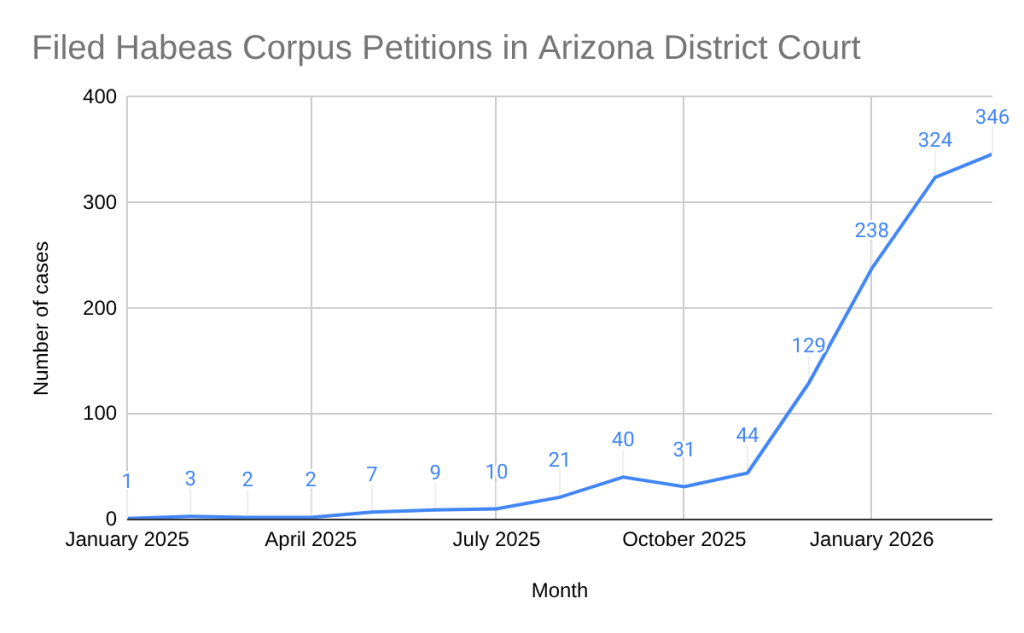
Data: HabeasDockets.org
More filings, more wins
Generally, habeas petitions are filed for detainees in two situations: Those who have removal orders, and those who have what’s called a withholding of removal orders.
If a detainee has a removal order, the government has 180 days after detaining them to remove them from the country before it’s considered “unreasonable” to keep them in detention, Green said. If the detention spans past that time, a habeas petition may result in a federal judge ordering a detainee’s release if “the government can’t show that you’re going to be deported within a reasonably foreseeable time,” Green said.
The government is often unable to “effectuate” a detainee’s removal in that timeframe if the U.S. doesn’t have strong diplomatic relationships with that country, said Philip Rody, the managing attorney for the Florence Project. Before ICE can deport a detainee, it must coordinate with the individual’s country of origin and have certain travel documents, such as a temporary passport. That’s largely what was holding up Yu’s deportation to China.
“U.S. judges don’t let you stay an unlimited time in detention,” Green said.
Habeas petitions for those with withholding of removal orders are more complicated.
Under Biden-era immigration rules, if migrants passed through another country on their way to the U.S., they had to apply for asylum in that pass-through country; otherwise, they were not eligible for asylum in the U.S. However, if an immigration judge found that such an asylum seeker has a “credible fear or persecution in your home country,” Rody said, the judge can order the migrant to be removed but bar the government from acting on it unless they can prove that conditions in the migrant’s home country have significantly changed.
That’s the situation that Nicaraguan immigrant Jose Suarez Chavez is facing right now. He entered the U.S. in November 2022 and was denied asylum and ordered to be deported. But in July, according to court documents, an immigration judge granted him a withholding of removal. Less than a month later, ICE deported him to Mexico, where he was “kidnapped, raped and subjected to sex trafficking” before he returned to the U.S. “out of fear for his life,” according to a filing in his federal habeas corpus petition. Since then, he’s been detained in ICE’s Central Arizona Florence Correctional Complex.
Chavez’s habeas petition, filed on April 1, is still pending. His immigration attorney did not immediately respond to inquiries from Phoenix New Times.
Prior to the Trump administration, people like Chavez typically would have been paroled into the U.S. until something changed in their case. But now, they’re spending months and months in ICE lockup as the government tries to “remove them to a third country, a country that they have no connection to,” Rody said.
So far, the results of habeas petitions have been generally effective. In 2025, federal judges ruled in favor of detained immigrants in roughly 97% of decided habeas cases, according to recent federal court tracking data. Petition filings have skyrocketed since then.
For example, 10 habeas cases were filed in Arizona district court on March 4 alone. A judge ruled in favor of the detained person 60% of those cases, either granting the detainee full release or ordering a bond hearing, which the government must provide within seven days. Of the other habeas petitions filed that day, three remain active and one was dismissed.
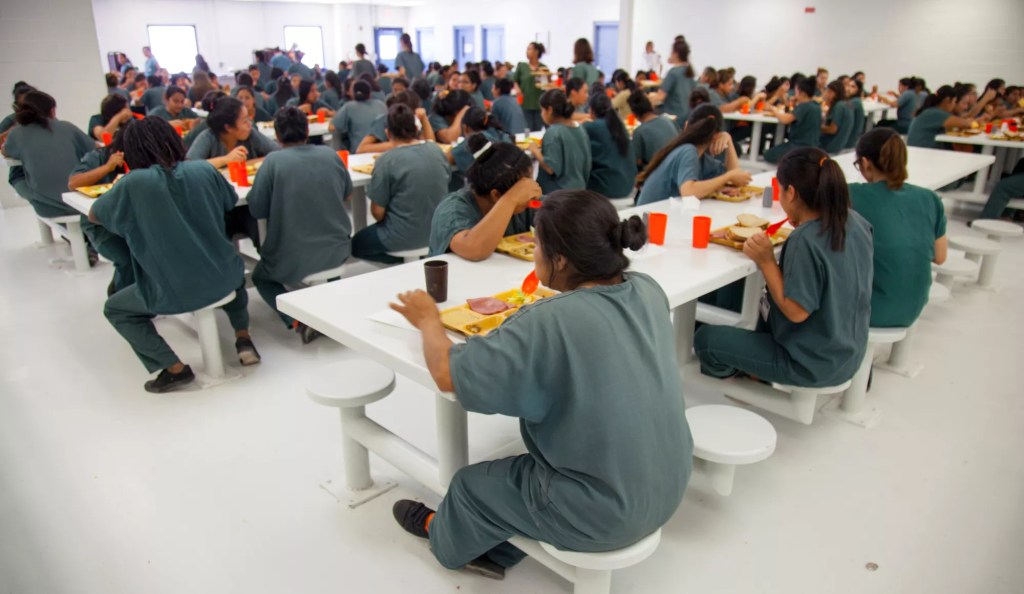
Charles Reed/Immigration and Customs Enforcement
Not a magic bullet
Habeas petitions may be successfully springing more ICE detainees, but they’re not a cure-all.
Things have slowed down more recently due to the high number of habeas petitions. In March, magistrate judges began to be assigned to habeas cases to meet that demand. Some cases are resolved in weeks, while others take months.
How quickly decisions are made in these cases depends on the judge, Rody said. Some judges “feel the need to act very quickly on these petitions” and only give the government a few days to respond, Rody said, while other judges are giving the government as many as 20 days.
“It’s kind of the luck of the draw,” he said. “Are you going to get a judge that moves things along? Or is this going to be a more lengthy process?”
Even if a federal judge rules in favor of a detainee, that doesn’t mean that person is out of the woods — or even out of detention. A federal judge may order a bond hearing, but those are heard by immigration judges, who are not part of the judiciary branch but work instead for the Department of Justice. Thus, it’s less likely that immigration judges will grant a reasonable bond amount, several immigration attorneys said.
After going through the “hoops and hurdles of forcing this bond hearing,” immigration attorneys are seeing bond set at “crazy high prices” or seeing it being denied entirely, Villalpando said.
“The justification is usually (that a detainee is a) flight risk,” she added. “No amount of bond will satisfy that risk.”
If a detainee isn’t able to be released via bond, it’s basically back to the drawing board for immigration attorneys and their clients. And if a detainee is released, like Yu was, that may not be the end of it. A habeas petition doesn’t protect a released detainee from being detained again — or deported.
“If the government tried to make the argument like, ‘OK, we think we can remove her now,’ they can be detained at any time,” Villalpando said. “And again, just to like sit for a couple of months (in detention). And then, if nothing happens, do another habeas to try to get them out.”