
Wing-Chi Poon/Wikimedia Commons/CC BY-SA 2.5

Audio By Carbonatix
Arizona was once an affordable paradise, attracting new residents from out of state thanks to its low housing costs and overall low cost of living.
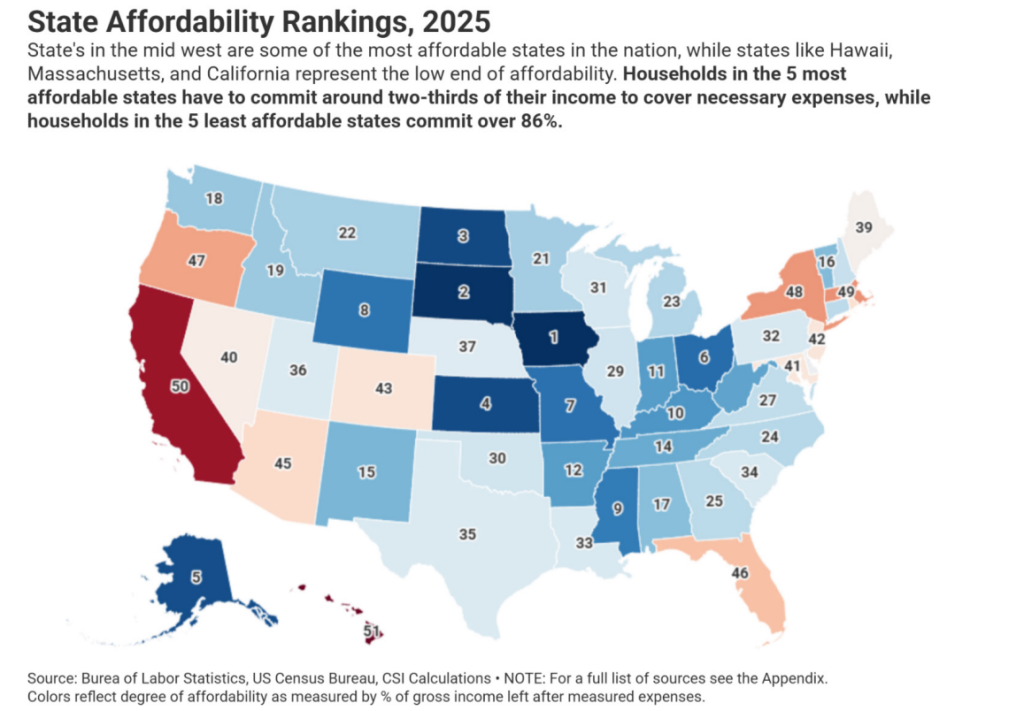
A new study by the Common Sense Institute, a center-right think tank with ties to former GOP Arizona Gov. Doug Ducey, now finds that Arizona is one of the least affordable states in the country. Out of all 50 states plus Washington, D.C., the state ranks 45th in affordability — or, in other words, seventh-worst.
“Arizona was a fast-growing, affordable state to live in,” said Zachary Milne, a senior economist for CSI and the study’s author. “That’s changed now.”
To determine its affordability rankings, CSI created a metric it called a “modeled household” — a four-person household consisting of two adults, both working full-time at the state’s prevailing median hourly wage,” according to the study. It then compared that household’s income to the cost of “essential expenses,” which includes costs of housing, groceries, car insurance, gas, childcare and estimated income tax. “Modeled households” in the most affordable states had the most money left over after accounting for those expenses.
In Arizona in 2025, modeled households had only 19.6% of their income left after those expenses, below the national average of 24.7%. The Grand Canyon State ranked poorly in several metrics that contribute to that ratio, including the price of groceries (45th), car insurance (43rd) and gas (42nd). But the main driver of unaffordability in Arizona has been the cost of housing and utilities, for which the state ranked 47th.
Anyone who lived here during and just after the COVID-19 pandemic can tell you how crazy the housing market became. The state didn’t build enough housing before the pandemic, leading to a crunch from about 2020 to 2022. At the same time, mortgage rates were absurdly low thanks to federal fiscal policy, leading home prices to skyrocket and pricing many regular families out of the market. If you owned a home, you saw its value go up, up, up. But if you were trying to buy a home, you were either paying way above asking or unable to compete at all.
“There was a lot of stimulus money,” Milne said. “A lot of people were working from home and they wanted a home office, they wanted a bigger house, all of those things. All of those factors collided in the U.S. more broadly, but especially more acutely in places like Arizona and especially in Phoenix, to lead to these super-high housing prices, a big jump up in rent prices.”
Perhaps unsurprisingly given that trend, CSI’s study shows that affordability in Arizona has gotten worse since 2019, before the pandemic. That year, the state ranked 33rd in affordability — not great, but not among the worst states in the nation. The exploding housing market changed that picture, with shelter and utility costs increasing by $9,000 since 2019. But CSI also found that Arizonans are paying far more for child care ($3,950 more since 2019) and groceries ($3,375).
Common Sense Institute
The inflation hangover
There’s no divorcing the spike in affordability from the COVID-19 pandemic, which shut down large swathes of society, led to more than a million deaths in the U.S. and sent a shock through the American economy. To keep people and the economy afloat, the federal government passed huge stimulus bills that both put money directly in the pockets of American citizens and dramatically increased federal spending to help spur economic activity. As a result of those factors, inflation jumped to nearly 9% in the years immediately following the pandemic, though it has calmed significantly in recent years. (That doesn’t mean prices fell, just that they didn’t grow as rapidly.) For that reason, CSI dubbed its study “The Inflation Hangover.”
To an extent, some of this was beyond Arizona’s control — and arguably beyond anybody’s. Milne, who previously served as an economist and budget analyst under Ducey, thinks many levels of government were too draconian in their responses to the pandemic, shutting things down too firmly and keeping them shut for too long after the availability of vaccines reduced the risk of contracting the virus. If shutdowns hadn’t ground the economy to a halt — or at least not to the same extent — the federal government wouldn’t have needed to flood the economy with so much money, thereby causing so much inflation.
“The simple answer would have been to go much lighter on some of these restrictions, and I think that would have removed some of the necessity that led to a lot of the inflation in the first place,” Milne said.
Of course, that was an equation with life-and-death implications at the time, as the country was responding to a novel threat for which it was medically unprepared. Milne nodded at that, noting that “hindsight is 20/20” and that “I think we were likely to see economic turmoil regardless of government shutdowns.”
And it’s not as if Arizona was among the most locked down. The state remained largely open during the deepest throes of the pandemic, with minimal restrictions on indoor dining and gathering. And Milne notes that Arizona’s affordability issues, at least as it relates to the post-pandemic inflation shock, are largely out of its control. “We’re sort of slaves to whatever’s happening at the national level,” he said. But he said Arizona leaders — both locally and at the state level — could improve the state’s affordability picture by tackling an issue over which they have a lot of influence: housing costs.
The state doesn’t have enough housing, particularly affordable housing. Milne said Arizona lawmakers should prioritize that problem if they want to improve the state’s ranking.
“Zoning laws are almost exclusively a local issue, a city and town issue,” he said. “I think lawmakers and policymakers have the ability to influence how easy and how cost-effective it is to build new affordable housing.”
The state is making some headway on that issue. The state legislature has passed bills that cut back on local zoning restrictions to allow more kinds of housing to be built in residential neighborhoods, and additional housing bills are making their way through the legislature this year. At the same time — though probably too early to attribute to new laws — home prices and rents have started to fall from their post-pandemic peaks. That suggests the housing market is softening.
That doesn’t make Arizona affordable, at least not yet. But maybe, by the time CSI does its calculations in another seven years, Arizona will no longer be bringing up the rear.