

Stephen Lemons

Audio By Carbonatix
This “AI lobbyist” thing doesn’t seem to be working out for former Sen. Kyrsten Sinema.
For the better part of a year, Sinema schmoozed and charmed city staffers and the seven members of the Chandler City Council. Now a senior advisor with the powerhouse Washington, D.C., lobbying firm Hogan Lovells, she traded numerous emails and arranged one-on-one meetings. The firm’s client, Active Infrastructure, wanted to build a massive new AI data center on Price and Dobson roads, and Sinema said Chandler should join the “AI revolution” by approving it.
In public appearances before the council and the city’s planning and zoning commission, she added an ominous threat: If Chandler didn’t get with the program, the Trump administration would compel the city to accept the 422,877-square-foot, energy-guzzling data center anyway. Sinema’s condescending tone in her public appearances galvanized opposition to the project, setting off a wave of anti-data center and anti-Sinema emails to the city council. This month, reporting by Phoenix New Times revealed the extent of Sinema’s hard sell and the “unknown” water costs of the proposed six-building development.
The final nail came Thursday night, as residents packed a city council meeting to watch the data center go down in flames in a 7-0 vote. Sinema was nowhere to be found.
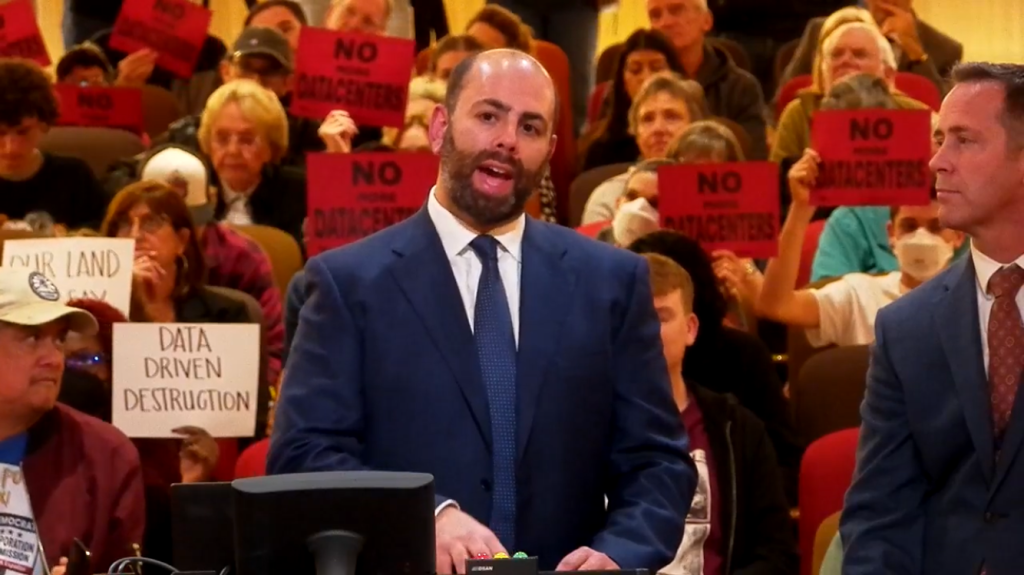
Without her, Active Infrastructure CEO Jeff Zygler and the firm’s local zoning attorney, Adam Baugh, were left to make the case for their project themselves.
They assured councilmembers that it would not use excessive water, due to a high-tech “closed-loop” cooling system, with Baugh repeating the risible claim that the data center would actually save the city 12 million gallons of water per year. Baugh told the council that “focusing only on the data center is myopic” and touted the “attraction of the AI data center” to other businesses, which supposedly would flock to the area once the project was up and running.
But when several councilmembers turned up the heat — even those who had previously been friendly to the project, as revealed in emails obtained by New Times via public records request — the pair fumbled.
City of Chandler
Tough questioning
When Chandler Mayor Kevin Hartke asked how many jobs the data center alone would employ, Zygler admitted that it would be only about “50-80 jobs for the data center itself.” The city’s voter-approved general plan says the Price Road corridor, where the data center would be located, should be reserved for high-value companies that create more jobs.
Councilmember Matt Orlando, who is running for mayor in 2026, explained that he had just come back from a trip to Wall Street, where various analysts were telling him that the AI industry was “over-leveraged” and that they were “concerned about the bubble because of the investment dollars” put into the industry. He asked Zygler, whose company purchased the site in 2024 for $20 million, how long it would take for the data center to be fully operational. Zygler told him that the $2.5 billion project could take as long as six years.
“Tell me what customer’s going to wait around for six years and not potentially go somewhere else?” Orlando asked. “And how are you going to capture that customer base?”
Zygler assured him that there was a demand for the data center’s computing power and that after six years, income would start rolling in “to pay back the debt.” Orlando, who in emails had been eager to meet with Sinema about the project, was now a doubter. He was astonished that Zygler’s creditors would wait that long to be reimbursed, saying they must have “deep pockets.”
“I’m sorry, I don’t buy it,” he said, later adding, “I don’t care about the water. We’ll fix that. I don’t care about the noise. You can fix that. I do care about it, but we can mitigate those things. You can’t give me a viable business case and that’s my concern.”
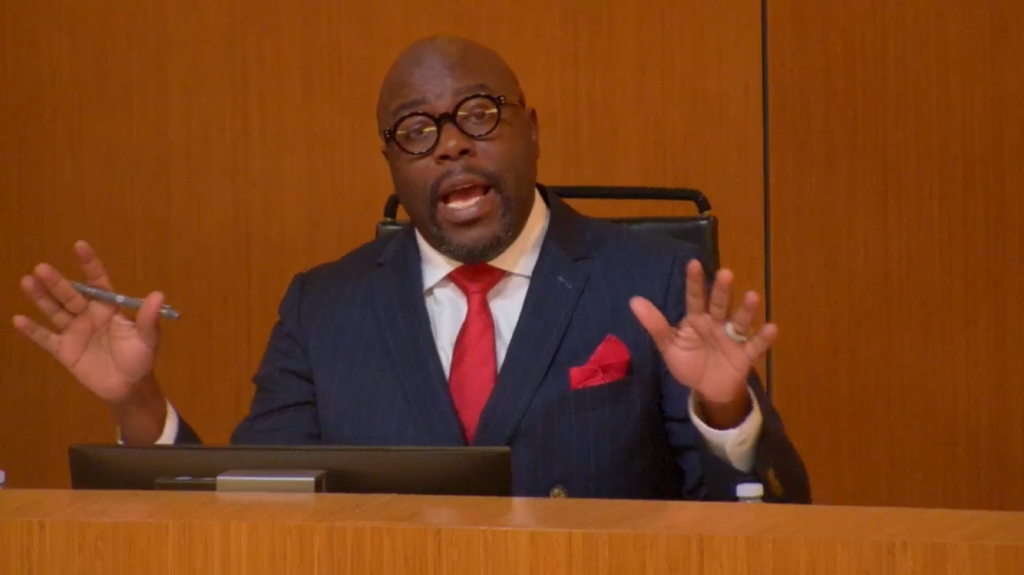
Councilmember OD Harris also put the pair on the spot. Very few residents attended the three public meetings that Active Infrastructure hosted, he observed, but now the council chamber was overflowing with people, almost all of them in opposition. He wondered what the “disconnect” was, and suggested that they should spend more time in the community doing outreach before coming to the council for approval.
“You’re asking us to do something that our voters are saying no to,” he said, telling them that their pitch as “a big miss” that he couldn’t ignore. “I mean, they follow me in the grocery store and told me, ‘Make sure you vote no.’ That’s the intense level that we have.”
Zygler urged Harris to make his decision “based on facts, not necessarily emotion.” Instead, Harris made a motion for the council to kill the deal, saying Zygler’s implication that “my votes are emotional” was “insulting.”
“The Price quarter is supposed to be a place of innovation, research and high-quality jobs,” he added, “not a row of concrete boxes, humming day and night with almost no long-term employment. That’s not smart growth to me. That’s a step backwards.”
Hartke, Vice Mayor Christine Ellis and Councilmember Jane Postonall indicated that they would be voting no, sealing the project’s fate. When the final 7-0 vote flashed on the TV monitors in the council chamber, a cheer went up, with a group of activists chanting, “Power to the people.”
By that point, Zygler and Baugh had left the building.
City of Chandler
The Sinema effect
Until recently, the data center had seemed destined for approval. The city planning commission had approved sending it to the city council, despite a recommendation from city staffers against doing so. But then Sinema’s bigfooting appearance in front of the commission went viral.
When Sinema spoke to the commission and later to the council in October, the chamber was filled with empty seats. Thursday, however, people filled Chandler’s city hall to capacity, with many holding signs reading “Data Center Destruction” and “No More Data Centers.” One sign featured an illustration of Sinema, styled as a rubber-gloved proctologist, stating that she was working “‘hand in glove’ with the Trump administration to F*ck Chandler.” Hartke noted that as of 4 p.m., the city had received 256 emails and web forms opposed to the data center and just 10 in favor.
More than three dozen members of the public spoke forcefully against giving New York-based Active Infrastructure the green light, with just two speakers in support of the project. Several speakers either name-checked Sinema or made reference to her support of the development. One Chandler resident identified himself as a tech worker and mentioned a litany of issues surrounding data centers — the lack of jobs they produce, the massive amounts of energy and water they consume and the speculative nature of the industry.
“Will you follow Kyrsten Sinema, who sold herself to push for this plan, or will you do the right thing and choose us – the people in this room?” he asked. “You only have two options, big business and the billionaires, or the working class.”
Another resident noted the unsettled issue of how much water the project would utilize and the “dangers of an AI bubble” bursting, leaving Chandler to hold the bag. “I know you have weathered lobbying from AI industries and senators looking for a second act,” he said, “but I ask you to not look at them today, but to turn to us and see the popular mandate behind you.”
After the vote, as attendees eased out into the chilly night, several told New Times that they had been unaware of the proposed data center until they saw footage of Sinema’s appearance before the council in October. A mustachioed gentleman declined to give his name but told New Times that Sinema’s involvement had “created more outrage” and “drew more people in opposition” to the data center.
“Basically,” he said, “I think it had the opposite effect that she had intended.”
Alexandria Jones echoed that sentiment. She thought she would have eventually heard about the Chandler data center, but Sinema basically drew a bright red circle around the project.
“The benefit of Kyrsten Sinema coming is that people who are not plugged into these things were able to see what’s going on and see why it’s not a good thing,” Jones said. “She came in and was basically threatening us.
“So yeah,” she added, “thank you, I guess, to Kyrsten Sinema.”
This story is part of the Arizona Watchdog Project, a yearlong reporting effort led by New Times and supported by the Trace Foundation, in partnership with Deep South Today.