

Illustration by Eric Torres, photo by Gage Skidmore/Flickr/CC BY-SA 4.0

Audio By Carbonatix
It felt like a visit from your friendly neighborhood cartel kingpin. Or in this case, an ex-senator.
It was Oct. 16 and Kyrsten Sinema — the reviled former Democrat and former lawmaker — was standing at a podium in a much less august chamber than the one she used to haunt. Speaking to the Chandler City Council about a data center project awaiting the body’s approval, she adopted a friendly yet menacing tone.
Sinema told the council that she was representing something called the “AI Infrastructure Coalition,” a fuzzily defined group that includes giants like Meta, Google and ExxonMobil as members. In a three-minute spiel, the ex-senator touted the coming “AI revolution” and talked of working in concert with the Trump administration, which has made AI and the data centers that power the technology a matter of national security.
She added a warning: If the councilmembers didn’t get with the program and vote yes on a proposed 422,877-square-foot data center to be located at Dobson and Price roads, President Trump would cram the data center down Chandler’s collective neck.
“Federal preemption is coming,” she told the councilmembers, “and it is coming soon.”
Viewed charitably, Sinema was piping up about the data center project because she and her AI coalition — of which she is the founder and chair — desperately want to “ensure that American AI is globally dominant.” Chandler could play its part in beating back the red devils in China and win the defining tech war of the 21st century. Stars and stripes forever, and all that.
But emails obtained by Phoenix New Times cast Sinema’s threatening speech in a different light. She wasn’t there out of deep concern for Arizona’s place in the AI race or to push through Donald Trump’s agenda. Or, at least not only for those reasons. Though she didn’t mention it in her comments before the council, Sinema has been directly lobbying Chandler City Council members on behalf of Active Infrastructure, a New York-based firm that is developing the data center.
Sinema was there, channeling Maleficent and throwing her senatorial weight around, because she was getting paid to be.
When Sinema left office, scared out of running for reelection by now-Sen. Ruben Gallego, she quickly completed her heel turn and joined the powerful lobbying firm Hogan Lovells. The website law.com reports that Hogan Lovells is ranked the seventh-largest law firm in the U.S., with more than $2.9 billion in gross revenue in 2024. The firm also hired her chief of staff, Daniel Winkler, as a “policy advisor.”
Sinema is not officially a lobbyist for the firm — she’s technically a member of the company’s “global regulatory and IP practice group” — though she’s sure been acting like one. In February, Sinema appeared before the Arizona Legislature, supposedly in a personal capacity, to advocate for research into the hallucinatory drug ibogaine. KJZZ later discovered ties between Hogan Lovells and a company that once sought to manufacture ibogaine. Sinema insisted her pro-ibogaine work was pro bono and “took place before any discussions regarding joining Hogan Lovells.”
Emails between Chandler City Council members and Sinema plainly show she was doing Hogan Lovells’ bidding regarding the data center, though. Sinema may have begun lobbying city council members as early as June from her Hogan Lovells email account.
One June email from a city staffer to Councilmember Angel Encinas reminds him that his schedule included a 1 p.m. meeting with Sinema, Active Infrastructure CEO Jeff Zygler and the firm’s zoning attorney, Adam Baugh. Sinema also emailed each of the city councilmembers separately in July, thanking them for “devoting time and due diligence to our” — notice the possessive pronoun — “AI data center project.”
There’s also an email string that same month between Sinema and City Councilmember Matt Orlando, who is running for Chandler mayor in 2026 and who has made modest donations to Sinema’s past political campaigns. Seemingly starstruck, Orlando said he was “excited to hear” from Sinema. “I think we’ve made great strides over the past few months in understanding the business model of the complex,” he wrote, telling her that he would be “delighted” to sit down with her and discuss the proposed AI data center. Sinema wrote back to set up a day for an in-person meeting.
There are also emails to and from Winkler, now Sinema’s assistant at Hogan Lovells, including one in which Winkler sends Orlando links to an article about a data center in Louisiana being built by Meta, as well as information on a system used to keep the equipment in data centers cool. Zygler was included in the exchange, leaving no daylight between Sinema’s and Hogan Lovells’ priorities and his. In another email, Zygler emails Orlando directly, cc-ing Sinema and Baugh.
Baugh declined to answer questions about any coordination between himself, Zygler and Sinema in lobbying Chandler, and Sinema did not respond to a request for comment on her activities.
What Sinema is doing is clearly lobbying, though she is not registered anywhere as a lobbyist. And thanks to a legal loophole, she doesn’t have to be.
Federal law prohibits former senators from lobbying for two years after leaving office, but the prohibition doesn’t apply to states and cities. Arizona law requires anyone lobbying the legislature or a state agency to register with the Secretary of State’s Office, but that law does not apply to municipalities. While many in the Valley have similar ordinances on their books — including Phoenix, Tempe, Surprise and Peoria, according to the Arizona League of Cities and Towns — Chandler spokesperson Matt Burdick told New Times that the East Valley city is not one of them.
That’s what allows Sinema to stand before the city council in a public meeting and adopt the air of a concerned patriot and former senator.
And not, you know, a paid shill.
Google Maps
A water-guzzling storage facility
But what if the data center is actually good for Chandler? Can’t Sinema believe in a cause and get paid for it, too? Sure, but there are plenty of reasons to question why Chandler needs another warehouse full of computers.
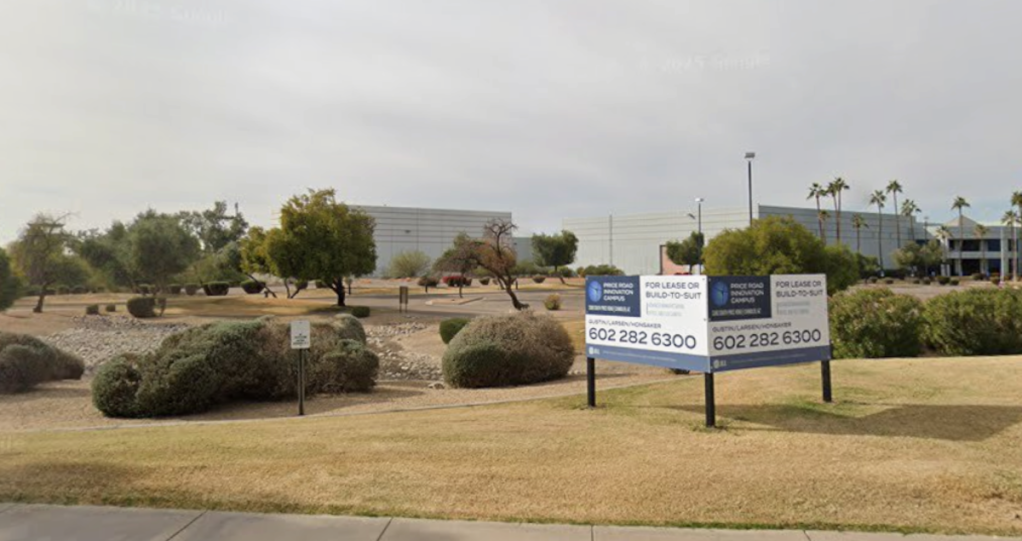
The data center, dubbed the “Price Road Innovation Campus,” would be built in the city’s South Price Road business corridor, tearing down the existing building that has sat vacant for years. The 40-acre plot sold in 2024 for $20 million to “BA Price Owner LLC,” which is registered with the Arizona Corporation Commission as a foreign entity with an address in care of Connecticut-based company “Bear Development.” A phone number on Bear Development’s bare-bones website eventually yielded contact with a public relations representative for Active Infrastructure. New Times submitted a list of questions to the spokesperson, but has yet to receive a reply.
Baugh, Active Infrastructure’s zoning attorney, confirmed to New Times that the company will own and operate the data center, but he claimed he wasn’t aware if Active Infrastructure had purchased the land that would sit underneath it.
Regardless, the data center plan will have to overcome two obstacles: a 2022 city ordinance that limits the proliferation of data centers, and the plan’s supposed violation of the city’s General Plan, passed overwhelmingly by voters in 2016. The General Plan reserves the South Price Road Corridor, a six-mile swath that runs north to south through the city, for “high-value employers” such as Intel, Northrop Grumman, Microchip Technology and Wells Fargo. Basically, places where Chandler residents might find jobs.
A report from city planners, who recommended denying the data center, suggested that few humans will find employment there. In a presentation at a planning commission meeting, city staff stated that a data center is “more akin to a storage facility for active computer servers” and employs “significantly lower numbers of jobs after construction is complete” than many other industries. So while Active Infrastructure has promised its $2.5 billion project will create 1,332 jobs during the construction phase, many of those seem likely to go away once it’s complete.
Then there’s energy and water. In a podcast appearance, Zygler revealed that the Salt River Project utility had approved his data center approval to receive 150 megawatts of electricity, when his company had been hoping for just 50. An SRP spokesperson could not confirm that figure but did say that 1 megawatt of electricity was “enough power to serve 225 average sized homes at once.” Baugh, the company’s zoning attorney, told the city that Active Infrastructure “and no one else” would pay SRP $242 million to produce the energy that the data center needs, but there are knock-on effects.
SRP’s rates already rose in November, mirroring a nationwide spike in energy costs. Much of that has been widely attributed to the AI data center boom. Given that 72% of SRP’s current energy mix is made up of nonrenewables — that is, coal, gas and nuclear — the environmental costs go well beyond whatever dollar figure Active Infrastructure will pay for the juice. As Sandy Bahr, the Arizona director of the Sierra Club, put it: “What kind of power are they creating with that $242 million?”
Another concern is water, which is increasingly scarce in Arizona. Baugh told the city that the data center will use no more water than a normal office building, conserving water with a “closed-loop” liquid cooling system. But AI ethicist and attorney Masheika Allgood told New Times that while closed-loop systems are better than the alternative, “you can still go through millions of gallons a year with a closed-loop system.”
“I would hope that you would have some understanding of how much water you intend to pump on a regular basis,” Allgood said, though a city spokesperson told New Times that Active Infrastructure has not provided the city with a diagram of how the cooling system would work.
Perhaps dealing with all that — the water demands, the impact on the climate, the lack of clear benefits for actual humans — is worth it to beat China to the proverbial AI moon. But that value proposition rests on a possibly faulty assumption: that AI works.
The market is starting to wonder if that’s really true. Fears over an AI investment bubble, similar to the dot-com bubble of the late 1990s, are rampant, with The Wall Street Journal churning out stories on the subject on a near-daily basis. As one WSJ columnist recently quipped, “the only absolute proof of a bubble comes when it bursts.”
If you’re in the AI business, like Sinema, best to make bank while there’s still time.

Gage Skidmore/Flickr/CC BY-SA 2.0
‘The people are not happy’
The Chandler City Council’s vote on the Active Infrastructure data center is set for Dec. 11, and if it goes down in flames, Sinema will ironically be to blame.
There’s little reason to doubt Sinema’s ability to schmooze behind closed doors, but her comments in front of the council in October seem to have had the opposite of its intended effect. Sinema’s hard sell earned the project a buttload of media attention and, apparently for the first time, alerted many residents of Chandler to its existence. To many, Sinema’s remarks to the city council went over like a hot lead enema.
Earlier this year, before Sinema weighed in, Active Infrastructure held three sparsely attended neighborhood meetings about the data center. By mid-October, the city had received a total of 12 emails about the project — three in support, seven in opposition and two general inquiries.
Following Sinema’s scene-chewing performance, however, the city was deluged with emails opposing the project. Of those obtained by New Times, 36 were opposed versus just four in support. Many of them shared common complaints about data centers in general, but several took specific umbrage at Sinema’s presumptuousness.
One “long-time resident of Chandler” wrote that she had “no interest in being threatened by the former senator on behalf of the Trump administration,” adding that Sinema’s “disgusting rhetoric is not welcome.” Another, who identified himself as a former Intel employee, said he was “completely OPPOSED to politicians lobbying for for-profit corporations.” A third urged the council to reject any future data center proposals, “even if Arizona’s failed Senator Sinema tries to extort this council.”
After the onslaught of emails, the council pushed back the vote on the project from November to Dec. 11.
Some within Chandler’s government oppose it, too. Rick Heumann, the chair of Chandler’s Planning and Zoning Commission — before whom Sinema did cop to speaking “on behalf of Active Infrastructure” — called Sinema’s federal preemption threat “a bunch of garbage.” He believes the data center would create around 75 full-time jobs and is skeptical of the “smoke and mirrors” presented by Sinema and others. The data center would take up “prime land” and would not generate much tax revenue, given Arizona’s generous tax breaks for data centers.
“There were just too many ‘what ifs’ about this thing,” Heumann said. “Too many promises that I, on the whole, had concerns about.” Sinema turned him off, too. “I’ve been doing this probably 26, 27 years,” Heumann continued. “And I don’t like people coming into our city and threatening anything.”
Ultimately, Heumann voted against sending the modified data center plan to the city council. His was the lone “no” vote.
Chandler councilmember OD Harris is another Sinema is unlikely to win over. He has opposed the data center on his Facebook page, calling data centers “pathological noise makers” that create few jobs and “harm the quality of life for Chandler residents.” Sinema’s city council presentation was “very ineffective,” Harris told New Times, and since Sinema spoke, he’s received “nonstop emails, nonstop social media posts, nonstop calls” in opposition to the data center.
“She activated a whole group of people who may not have known what was going on,” he said. “They have awakened the people and the people are not happy.”
Other councilmembers have not returned calls for comment from New Times, though Orlando — the onetime Sinema donor — defended Sinema and the project to the Chandler Independent.
As she usually does, the former senator has shrugged off any criticism. In an Oct. 22 panel discussion hosted by Hogan Lovells, Sinema blamed data center resistance on a national plague of NIMBYism. “I’ve got to say, even shockingly in places like Arizona,” she added, which has a “really, really strong pro-business community.” The plebes in Chandler and other places may simply need help learning how to think.
“How do we help local communities combat NIMBYism and understand the value of AI data centers?” she said, blaming “a lack of understanding around the national security issues.”
That sounds like a job for a good lobbyist. Unfortunately for Active Infrastructure, they have Sinema instead.
This story is part of the Arizona Watchdog Project, a yearlong reporting effort led by New Times and supported by the Trace Foundation, in partnership with Deep South Today.